Stability. Clarity. Strength.

Daily Practice Changes Everything

There’s a feeling we all have that the more triggered we are, the greater the remedy we need.  Therefore, we often overlook very basic and fundamental tools that help us regain and maintain emotional balance and mental clarity.

Being triggered affects our stability because the experience compels us to react. Often reactions happen too quickly for us to be mindful. We are, in essence, lashing out blindly, not unlike flailing about in a canoe.  But just as we might regain balance in a canoe, we can reset ourselves in life.

Before we do anything or believe anything, we can come back to the present and reset our ground.  Stability is key.


Stability

It is the basis for mindful (read: effective) actin. Once we have stability, the mind can settle, feeling more comfortable in the space our body inhabits. From settling comes clarity. And clarity, grounded by the stability of being fully in our body, affords the strength to navigate difficulty with balance and poise.

When we feel threatened or overwhelmed, the best first step is to recognize what is happening before we try and fix anything. What is happening right now? Is this fear? Doubt? Confusion? Anger? Frustration? Inadequacy? The answer is not nearly as important as asking the question. This is because when we’re triggered, it is a younger, sometimes ancient part of our system that becomes engaged. That part of our being may not have access to the language, training, and understanding that our higher mind enjoys. By simply recognizing that we’re triggered we begin to calm the nervous system. The effect may be temporary, but it opens the door to further engagement through self-compassion and awareness.

It is essential that once we recognize we are triggered—experiencing fear, doubt, confusion, perhaps all of these at once—we accept what is happening. Acceptance is not resignation. It is simply acknowledging the reality of this moment without immediately projecting into the future or revisiting the past. Future and past are always speculation that leads to unhelpful narratives. Instead, our meditation training, enables us to look directly at what we are experiencing now. This begins to loosen the bondage of suffering.

Looking at our experience allows us to feel into what is actually happening within us – what we are unwittingly doing to ourselves.  We do not need to come to firm conclusions. We do not have to explain anything away. We simply notice, feel, and accept.

By allowing ourselves to feel and accept the present experience, we begin to find the inner space to settle. With daily meditation practice, specifically shamatha practice, we train the mind away from clinging to reactive states and return ourselves to the balance we can only have in the present.

Coming back to the present when we are triggered is an ongoing process. Just as in shamatha practice, we go away, notice, remember, and return. We may notice tension in the body—tightness in the belly, constriction in the jaw, heaviness in the shoulders and neck. This awareness develops through mindfulness of body cultivated in meditation practice.

Recognition followed by acceptance has a neurological calming effect. It may only last a moment, but we don’t need to chase outcomes. Instead, we work with – by returning to –  the direct experience of suffering in the present moment. We feel the elevated heartbeat, the confusion, the tightening, without immediately extending it into narrative.

This can be very simple. But, one of the ways we miss the mark is by believing the stories in our mind, especially catastrophic projections. We become so frightened that we assume there must be a dramatic and immediate response. Yet often the most effective response is simply recognizing that we are being pulled away.  The world is ending – just return to the moment. My life is heading for disaster – simply return to the moment.  None of this is how I imagined it would be – return. Return. And by returning, we release ourselves from the panicked grip in our body and mind and regain our balance.

When we are triggered, frightened, or thrown off balance, we are no longer reliable witnesses. The mind begins feeding us fake news. So rather than following every conclusion and projection, we return to what is actually happening now. We address what is real and immediate: the tension in the body, the racing heart, the fear, the confusion. By boycotting the complications we construct, we gradually find stability. Then, like water held still long enough for sediment to sink, the mind becomes clear.


Clarity

At some point we become reliable witnesses once again. This is trusting our wisdom mind. But to do this we may have to gently acknowledge and let go of the panicked mind. The wisdom mind is quieter, subtler, and less reactive, which is why it can be difficult to access when we feel threatened.

Our first impulse is rarely to calm down and relax. Yet by turning away from mental complication and returning to breathing, recognition, and acceptance, we stabilize. Stability is the necessary prerequisite for right action. Before the mind can be clear, the nervous system must become relatively calm.

When you are overwhelmed, do not fight with the mind or attempt to think your way through panic. The mind that creates the complication cannot solve the complication. Letting go of the panicked mind and returning to the body allows the mind to settle and clarify on its own.


Strength

Once we are stable and the mind is clarified, we become reliable again—not only as witnesses, but as supports for others and as compassionate human beings. We develop the strength of someone who is not shaken and who knows when to respond and when not to respond.

This is great strength.

This strength allows us to navigate the world and respond in ways that are actually helpful. My teacher mapped out the logic of shamatha practice very simply: stability leads to clarity, and clarity leads to strength.

Shamatha is simple and subtle. In many ways it can seem inadequate compared to the intensity of our emotions. But that is precisely why it matters. We are boycotting the dictates of panic, ego, and self-will, and opening ourselves instead to our basic goodness and the inner strength that can actually carry us through.

We notice the impulse to escape, fix, or react. We recognize it, accept it, release it, and return once again to the breathing. The breathing relaxes the nervous system, and as the nervous system settles, the urgency to fill the space begins to dissolve.


The Importance of Daily Mind Training

Looking at a depiction of the Buddha, you can sense their stability clarity and strength. This is, of course, due to the fact that we are seeing a picture or statue. But, we are people, flawed and insecure but able to train ourselves toward this process by noticing, accepting and returning with no hope of an outcome.

At some point, the mind of Buddha nature will dawn within us.

This is where we come back to. This is what we are training to recognize.

WALKING THE WARRIOR PATH

Good and evil.

What cosmic narcissism to be the center of everything in the moral universe.  The classic trope of the good angel on one shoulder and the bad angel on the other with us caught in a struggle between ultimate good and ultimate evil. Many of us continue to live under the weight of these outsized beliefs.

I suppose this makes us feel important.

While the universe contains extreme temperatures and vast distances, there are no definable poles. Each point in the universe is equal to any other. Anything we measure is dependent on position. Good and evil, like all else in our universe, are relative to situation and circumstance. Nonetheless, relational binaries abound in our consciousness. They are ingrained in us as good versus evil, left versus right, wonderful versus horrible. We live squeezed between exaggerations, limited by beliefs with scant logic. I suppose binary extremes offer us a comforting sense of place. But they also imprison us in that place.

The problem arises when we turn these guideposts into solid truths. When we make our point of view solid, we end up judging everything by that imaginary metric. That point – which we come to believe is right – becomes a center by which the rest of the universe must confirm to. But just as cosmology grew from the belief that earth was the center of the solar system to an understanding of the inter-dynamics a complex universe, so our Buddhist path leads us from the limited view of our ego, with its opinions and prejudice, to understanding how we are a part of everything.

Buddha taught that truth lies between extremes. Or you might say everywhere between extremes. Calling it the “middle way,” the Buddha was turning us toward the idea of being present in life and trusting ourselves to do what is needed in the moment. The Twelve Step traditions refer to “doing the next right thing.” According to the Buddha, the next right thing is specific to the moment and its circumstances. Of course, this is predicated on clarifying our view. The role of meditation and the Eightfold Path is to train the mind to rest in the present, allowing clarity to dawn. That clear seeing disabuses our self-centeredness and allows us to see what is best for all.

The middle way is based on what is actually happening. We can point to the middle way each time we recognize an extreme belief. “This is not right,” we might say. But is that true? Are there opposing points of view? Is there nuance? What is actually happening if we strip away judgment? Then the next right step becomes clear. Buddhist thought suggests that our largest view — the view with the most room for ourselves and everyone else — is to be compassionate, open, and helpful to the world. That’s not dogma. It’s not absolute. It is a recommended direction. Then our provisional binary might become: “Is this next step leading me toward that view, or away from it?” This is a more practical binary because it relates to what we are doing in the moment, not to what everyone else should be doing.

In order to do this, we would do best to loosen our grip on needing to be right. The need to be right is a trap. My music, my movies, my politics, my religion, my point of view — these all feel like truths to me, but they are opinions. My opinions. You may feel differently, but sharing our differences openly, without coercion, is a great way to learn and grow. I don’t have to give up my feeling that the Beatles were the best band in order to remain open to understanding how much you love electronic dance music.

Once we let go of exaggerated extremes, loosen our judgments, and release the need to be right, we can begin to see clearly. But where are we heading? As with everything on the Buddhist path, we come back to the present moment. The next right step is one step. Frequently, this is all we need to do in order to reset. We catch ourselves rushing toward a conclusion, stumble, notice, and come back. Here are my feet on the ground. Here is the next step.

But where are we going?

Each step may lead toward or away from our destination. This is our provisional binary. But each step is not the destination, and the destination may not resemble the next step. We are remarkable beings. We can chew gum and walk at the same time. We can know where we are heading while still paying attention to the steps needed to get there. We can hold the larger view and let go of it enough to be here now. There is no contradiction in that.

However, it is important to remember that the steps are actually happening, while the destination is still unfolding. Or not. We make plans, and the universe laughs. So the destination is not holy. As Peter O’Toole says in Lawrence of Arabia: “Nothing is written.”

That means the path is open. And the warrior is brave enough to face it. In Tibet they say “Pawo,” which means brave. Brave enough not to be right, but wise enough to be accurate. The universe is a vast place. We can map out provisional, imaginary points to guide us, but we do not need the limitation of making them solid. We can stay open, keep our eyes ahead, and feel our feet on the ground.

This is walking the warrior’s path: open, available, holding on as needed to steady ourselves, then letting go, taking the next brave step and being present to support the life that calls us.

HONORING THE MOTHER LINEAGE

By Nurturing Our Natural Kindness


I wanted to reach out in the spirit of my mother, who passed a few years ago and for whom I will always carry a quiet torch. In many ways, she was the great love of my life—a spiritual guide, a dear friend, and a near perfect mom. Trudi, as everyone knew her, was a relentless acceptor of everything in life, including me—her damaged, broken boy soldier, ever faithful, yet rarely grateful.

Like many children, I accepted her for the blessing she was, but never realized how rare that was, or how lucky I was. If there is any part of me that is loving, kind, and accepting, it is my mother still alive in me.

We grew up around a tight-knit Pentecostal church. She was the preacher’s kid, and the only boy who could reach her was a rough, arrogant Spaniard with a world to conquer. Everyone loved “Boy,” as he was called—charming in the way of men for whom the world is opening. Years later, I found a new familial community rooted in an American form of Tibetan Buddhism. My mother cried as she drove away, leaving me at a mountain retreat center blanketed in snow.

In Tibetan Buddhism, we speak of mother and father lineages. While equally important, they are understood differently—not as men and women, but as essential energies within each of us.

The father lineage is seen as creator and protector. The mother lineage as nurturer, holder, and the great agent of understanding that speaks from heart to heart. In many traditional cultures, men traveled and taught, while women held together the fabric of family and community.

My family, unknowingly, echoed this. My father traveled—first as a soldier, then as a businessman—while my mother, who also worked, carried the responsibility of raising us. It was not an easy life for either of them.

I lived in Baltimore during the riots, and as dangerous as those streets could be, the violence often softened when grandmothers stepped out of their homes. I still remember the image of a grandmother scolding a cowering grandson. The mother lineage need not be overshadowed by the father. Ideally, they work in tandem.

During times of difficulty, returning to the sense of protection associated with the father, and the nurturing and connection associated with the mother, can be deeply supportive. This is something we can carry within us.

The image of my father as protector, while potent, also evokes a sense of competition within me. This may be natural for boys and fathers of my generation. But I never worked well with competition. I tried to best others and spent a lot of time in aggressive disconnection. That was not necessary.

I saw my parents as separate and never appreciated how they might be conjoined. As a result, those energies have not been fully integrated within me. I feel deeply and care deeply, but I also fight and compete where it isn’t needed. Perhaps learning to unify these is my life’s task.

It is my view—and the view of the practice I’ve been given—that we begin to resolve the masculine and feminine within our own minds. We do this by recognizing the generosity of these energies, and how fortunate we are to have known them through others.

When times are difficult, we do not have to forget the softness, kindness, and compassion of the mother. When times are generous and forgiving, we do not have to forget the discipline and uprightness of the father.

I want to offer the idea that we can find calm in the storms of our lives and in the storms around us—that this calm and openness is itself an expression of strength. We can rely on our strength without losing our heart, and open our heart without losing our strength. The union of mother and father is strength.

The openness of the mother, protected by the strength of the father, allows us to find stillness in the midst of turmoil.

In remembering my mother, I feel again the presence of that balance—already here, already alive within me. I feel held, reminded that I do not have to do this alone. Something softens, and something becomes steady.


IN THE EYE OF THE STORM

Choosing Peace in Times of War

These days many of us describe our world as crazy, cruel and chaotic. It seems socio political dysfunction is a common experience.  This lack of stability in our outer reality understandably influences our inner health and wellbeing.

When our mental health is attacked, even the pressures we normally face seem might amplify to catastrophic proportions. Our emotional tolerance becomes compromised and we fall prey to any number of adventitious afflictions such as depression, anxiety, compulsive thinking and extreme beliefs. Our kneejerk solutions may be to arm our hearts with corresponding violence or check out in retreat. But these kneejerk reactions are not intentional. They are not mindfulness.  They only add to the confusion.

However, there is a place within experience that is not at war with what is happening. This experience of space allows, what Tara Brach calls, “radical acceptance.” Radical acceptance is not acquiescence. It is not supporting, nor is it ignoring. It is the simple and powerful act of facing what we face. Before we can take the right action to help ourselves or our world we need the emotional balance to see clearly.

This is not a poetic idea. It is not something we manufacture through strength or rigidity. It is something we discover—often accidentally at first—in the middle of chaos. A space within where, despite all the  movement around us, something is not moving. Despite the noise, something is not making noise.

We might talk about basic goodness or Buddha nature—not as something elevated or distant, but as something so immediate we often overlook it. It’s not reactive, it’s an open space that births an inner kindness that is so powerful, yet hard to grasp. When we are punched in the gut, our first reaction is not to relax, be kind to ourselves and open to our natural stillness.  Our kneejerk is to grip and harden, not open.

It is so important that we train the mind away from its tendency for gripping reactivity toward the open space of mindfulness. That may seem crazy, if we believe the craziness around us.  But in the midst of chaos is a space that offers the capacity to be aware. And within that space, knowing each experience as it arises.

This knowing is not disturbed by what it knows.

Thoughts race. Emotions surge. The body tightens and releases. The world presents itself in all its complexity—joy, sorrow, fear, beauty. And yet, the awareness of these things remains open, ungrasping, and fundamentally undamaged. The problem is not the storm.

The problem is that we believe we are the storm.

We identify with the movement—“my thoughts,” “my fear,” “my situation”—and in doing so, we lose access to the space in which all of this is occurring. The eye of the storm is not something we create. It is what remains when we stop trying to follow everything that moves.

So how do we find this eye?

Not by stopping the storm.  This is where the path becomes both simple and confronting. We are so conditioned to improve, adjust, and control our experience that the idea of not doing that feels almost irresponsible. But the practice here is not passivity—it is precision.

We begin by taking a seat.

Literally, in meditation, we sit down. We place attention on something simple—often the breath—not as a solution, but as a reference point. Something stable enough to return to as the mind moves. The instruction is deceptively basic: notice when you’ve wandered and just come back.

But what we are actually doing is far more radical. We are learning to see movement without becoming it. A thought arises—we notice it. An emotion surges—we feel it. A memory, a plan, a judgment—we see it pass through. We don’t need to suppress it. We don’t need to follow it. We simply return.

Again and again.

At some point, something shifts—not because we forced it, but because we stopped interfering. We begin to notice that there is always a gap. A moment of simple presence before the next thought takes hold. A space in which experience is vivid, but not solid.

This is the beginning of discovering the eye.

Off the cushion, the practice deepens. In conversation, in conflict, in the rush of daily life—we notice when we are pulled into the storm. The tightening, the urgency, the need to assert or defend. And then, if we can, we pause. Even briefly. We feel the body. We hear the sounds around us. We recognize the movement of mind as movement, not identity.

So how does this help anything?

This is not about withdrawing from life. It is about finding the balance to face life without losing our seat. When we are no longer trying to control or escape our experience, we begin to meet it more directly. The sharpness of pain, the warmth of connection, the unpredictability of life—it all becomes more vivid, not less.

But there is space around it. This space allows for compassion.

If we are no longer overwhelmed by our own storms, we can begin to sense the storms in others—not as threats, but as shared human experience. The anger, the confusion, the grasping—it is no longer foreign. It is recognizable. And from that recognition, something softens.

This recognition is not disturbed by what it sees because it is resting in basic goodness.

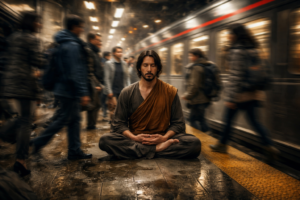
This is what it might mean to “live in peace while witnessing war.” The eye of the storm is not an escape from the world. It is a way of being in the world that does not amplify its chaos. And perhaps most importantly, with mindfulness, it is always available. Not later. Not when things calm down. Not when we finally get our lives together. Right here—in the middle of whatever is happening.

Stop trying to outrun the storm. Take your seat. Don’t follow anything. Until you do, then just come back. Let it settle. Stability allows an opening to clarity. And clarity opens to the possibility of right action.

Right action is the first step to compassion where we thought none was possible.