
I Have Tried in My Way …
I have a pet bird. Or perhaps the bird has a pet human, as it seems to have adopted me. We haven’t actually met face to beak, but it sits on a wire outside my window while I’m meditating. It may perch there at other times, and it might not even be the same bird each time. But I hate those possibilities. I want so very badly to believe the connection I have with my meditation based spirit bird. I don’t need logic. Because she seems to be out on the wire each time I meditate, my mind has connected the dots.
The game of connecting dots is a brilliant function of mind. Three pencil marks might suggest a face looking back at me; shift them slightly, and the face frowns or smiles. The dots themselves are neutral, but belief spins intention into them.
The bird I call Suzanne (after Leonard Cohen’s muse) may or may not feel any connection to me. I’ve had similar dissonance in relationships before. But as a lonely, insecure person, I hold on to beliefs that make me feel stronger. I love to believe I am being held by the universe. I love to believe I am important enough for a bird to gravitate toward me.
I think I create ideas, dramas, and scenarios just to keep me believing in the belief of me. Yet it occurs to me that I spend more energy scripting beliefs than I do simply being. Being and seeing. Maybe that’s all there is when I’m not up on a soap box going on about something.
As humans evolved, we lost fangs, claws, and scales in favor of a higher processing system. The mind now fires millions of signals each moment, most of them unseen or unknown to us. Hence the old adage that we use only 10% of our brain — something I believed as a child, though we now know it isn’t true. The truth is, most of the brain is active, but we’re only aware of a fraction of its work. Still, with limited awareness, we connect the dots — turning fragments into a world we believe in.
We do this to centralize our experience, to feel some sense of control in this vast universe of self. Some say we could be anything. Some say we are everything. Yet we spend much of our energy convincing ourselves that we are this limited self — compensating for its fragility by clinging to importance.
To navigate this inner vastness and the outer world, the mind developed an aspect that believes itself to be independent, permanent, and in control. This subset of mind is a fiction created by mind itself. Whether we believe we are glorious manifestations of the universe or abject failures in need of salvation, this aspect clings to beliefs in a fierce attempt to control. It seeks to manage life, the self, and reality itself, shrinking it all to manageable parcels.
We can see this dynamic echoed in the popularity of fascism. Its potential for evil is clear from the violent examples of the 1930s and 40s. But functionally, fascism is simply a way of protecting a populace by reducing complexity to the simplest components. A rainbow is inspirational but fleeting; a black-and-white world is easier to navigate, especially when survival feels threatened. Fascism thrives on people convinced they are fighting for survival. The truth of the danger matters less than the self-bolstering power of belief.
In the same way, this subculture of the mind becomes self-important and self-protective. We believe in our “rightness” and fall into the mistaken conviction that we must believe in something — and that the stronger the belief, the stronger we are. But this leaves little room for possibility. Even noble beliefs — in kindness, compassion, clarity, strength — can become limiting if clung to too tightly. Anything can be blinding if we believe in it hard enough.
The purpose of the Buddhist path is liberation. If we take this defensive subset of mind — a natural development of evolution — and redirect it toward freedom, we may discover that we ourselves are the source of suffering and also the key to its end. The Buddhist method employs conscious attention, best applied with kindness and clarity. With kindness, clarity, and awareness, we can deconstruct our defensive habits and welcome a richer, more complete way of being.
The bird is gone now. Does it think of me? Does it return because it feels the energy of my meditation? Or is this all just coincidence — a story I create in order to believe? Does it matter if it’s true, if the belief itself serves?
The subset of mind that tries to control reality is often called ego. Usually the word carries a negative connotation — egotistical, egocentric — as though ego were an inflammation of personality. And in some sense it is: a reaction to danger. But what happens when this protective system becomes parasitic, draining us of energy and potential? What happens when ego reduces our world to only what it believes?
Is it wrong to believe? I don’t think so. Belief can be a provisional tool — a way to orient ourselves, much like prayer doesn’t require certainty in a god. The problem arises when we believe the belief, when we defend ego and mistake its narratives for reality. Thus the Buddhist path invites us to investigate our beliefs, to see through them, and to use them when they serve, letting them go when they limit.
So yes, I believe Suzanne sits on the wire when I meditate because she feels the energy I’m cultivating. I believe she is drawn to it. I believe this is evidence that I’m on the right track. Do I believe any of this is objectively true? Probably not. But if it gets me onto the cushion, does it really matter? Only if I cling so tightly to the belief that I miss the deeper reality: my resistance to practice and my grasping for something, anything, to believe in.

 This post is an exploration of a traditional Buddhist teaching called “The Four Foundations of Mindfulness”. These are the cornerstones of clear seeing on which the powers of mindfulness rest. Interestingly, the trad texts translate mindfulness as “remembering”, or “recollection.” The point seems to be remembering to remember that we are here. Right now. Problems come when we believe we’re in some internally created reality that doesn’t include very much actual reality. While this is a big problem when we don’t recognize it, in reality, it’s not a problem at all when we see happening. Mind’s wander. They make up stories. They start trouble when they’re bored. Just like kids, the unawakened mind believes make believe. The mind grips so tightly to here that it fails to see see what is happening now.
 Ever wish you could just run and hide? Ever play hide and seek with your life because it all becomes too heavy? Do you ever reach for the panic-button in reaction to difficulty? Ever slump in discouragement because it’s all on you, but you just can’t figure it out?
 the wrong straws. We create more confusion out of a confused world when we blindly reach for what we think will save us. This might be as grand as a lifelong commitment to a nation or spiritual community—or as quick and impulsive as a harsh word, or hitting “send.”
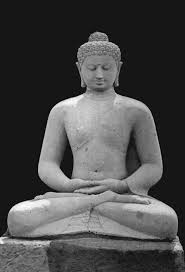 The Buddha was not a god. He was a human being—who lived, died, failed, and succeeded. He had no supernatural powers. He was a teacher and student of the Dharma (the path to liberation) who worked diligently to free himself from his own suffering. Because he did the work, he understood how others suffer—and offered teachings to guide people to their own liberation.
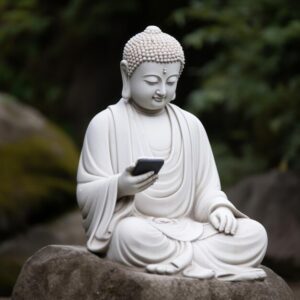 When Lord Buddha became enlightened, he was asked how he knew he was enlightened and he touched the earth and said “the earth is my witness.” This act of humility was simple and profound. Enlightenment to the Buddha was not some grand state of all-knowing; it was a state of acquiescence, acceptance, and presence. It was not rising above our circumstance, but simply being here. We can reconnect to that state of presence, everytime we touch the earth by making contact with the present. Feeling our feet on the ground as we walk, feeling our hands touching the knife as we prepare our meal, taking any and every opportunity to interrupt the grand narratives we script with ourselves at the center and allow ourselves to be present with whatever we’re doing. And today I would like to introduce how we might do that in a tactile and definite way. This simple engagement will transform your life.
 Anxiety is a
 Jokes are good when they make us laugh—but even bad jokes are good when we’re thinking that way. A good joke is an expression of technique. But it’s the timing and delivery that make it special. And when that timing and delivery aim at social injustice or psychological limitation, there’s real depth. Humor punches through the walls of limited thinking and lets a bit of air and space into the equation. Sometimes it hurls itself headlong into the wall. But if it’s spot on, it will enliven us, release us, and bring us into community.