TRANSFORMING AGGRESSION INTO WISDOM
Just he released the book Cutting Through Spiritual Materialism in 1971, Trungpa Rinpoche realized his burgeoning meditation community reach an audience beyond the familial hippie trappings. This would mean different kinds of peo0ple, with varying degrees of processing, would be enter his community and it would elevate him to the iconic status as one of the key founders Tibetan Buddhism in the West.
Throughout history, iconic figures and spiritual leaders have become reference points for hope and fear, leading to adulation and, sometimes, violent consequences. Contemporaneously, the Manson family and the assassinations of John and Robert Kennedy, and Dr Martin Luther King Jr were on everyone’s minds. Whether driven by personal projections or deeper political motives, such figures faced the double-edged sword of renown.
Trungpa Rinpoche discussed with his senior students the  importance of creating safety for not only himself but also the Dharma and for his students. The need for protection grew alongside his rapidly expanding community. In Tibet, monasteries were safeguarded by monks trained in awareness and nonviolent crowd control. Trungpa’s close attendant, John Perks, a British armed forces veteran, played a pivotal role in this initiative. Perks, who passed away on January 31st, was an outrageous and endlessly creative figure whose book The Mahasiddha and His Idiot Servant captures the spirit of the time.
At his inspiration, Trungpa founded a group he referred to as “Kasung,” from the Tibetan meaning “protectors of the word, or command.” These protectors used danger and potential aggression as tools to cultivate awareness—and applied compassion. Traditionally, meditation communities have leaned towards peaceful manifestations. However, with Trungpa’s new community, this nonviolent approach incorporated the realities of danger and aggression to foster greater awareness. This marked a shift from the ideal, toward engaging with the world as it is.
The motto of the Kasung was “Victory Over War.” Perks designed a system based on his military background, complete with uniforms, drills, and calisthenics. Training included self-defense, defensive driving, and crowd control, but emphasized mindfulness and awareness. In Tibetan monasteries, guards maintained stillness while being acutely aware of their surroundings. This awareness is the ultimate defense against aggression. The best response to aggression is non-aggression and non-violence, aiming to diffuse tensions before harm occurs. Achieving this requires training, self-awareness, and the discipline to transcend personal biases and resentments. Tibetan monastic guards were trained not just to monitor external environments but also to guard against their own reactivity—skills profoundly relevant to staying awake and present in the real world.
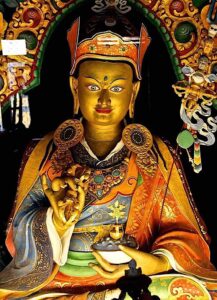 These principles trace back to the 9th century when the Indian Mahasiddha Padmasambhava introduced Buddhism to Tibet at the invitation of King Trisong Detsen. Padmasambhava encountered numerous obstacles, as Tibet’s rich mystical traditions were diverse and often aggressive. While some practices were positive, others were rooted in fear and superstition. The Tibetan king sought to unify his people through a central spiritual framework, seeing Buddhism’s ideals of nonviolence and compassion as tools for governance. Inspired by India’s spiritual renaissance, Padmasambhava aimed to refine Tibet’s spiritual landscape.
Skilled at transforming obstacles into assets, Padmasambhava turned the aggressive elements of Tibetan spirituality into protectors of the Dharma. Instead of escalating conflicts, he synthesized various traditions, using negativity, violence, hatred, and fear as signals to awaken and deepen awareness. This approach prevented endless cycles of violence, much like the wars we witness today.
We can apply this in our daily lives. By facing rather than rejecting our negativity, we become more aware of our motivations and develop the discipline to refrain from acting on base impulses. This perspective yields two key outcomes: we stop demonizing the world’s difficulties, and we cultivate personal strength to master challenges and enhance awareness.
As Trungpa Rinpoche addressed larger audiences, strategically placed Kasung provided not only security but also heightened awareness. Trungpa’s self-awareness of his potential shortcomings led him to counterbalance them—for instance, teaching from an uncomfortable chair to stay alert. The Kasung served not just to guard against external threats but also to foster an environment that kept Trungpa attentive and present. Thus, the protectors embodied an outer defense, inner self-awareness, and the overarching principle of protection—all opportunities for wakefulness. This environmental awareness was as integral to the teachings as the words and gestures themselves.
Awareness is our most powerful defense. Ignorance, especially when fueled by aggression, is our greatest threat. When driven by hatred, we lose the ability to perceive the damage we cause. By softening our hearts against our own aggression, we train our minds to stay present. There is no better time to cultivate this presence than the approach of the new year.
The Tibetan calendar is based on solar cycle which feels to me like a much more organic way of calculating our spiritual being. Each month being the cycle of a moon. Many indigenous cultures marked time this way. The Tibetans believe that the end of the lunar new year was preceded by a period of the accumulation of karma so that everything became heightened and increased in its volatility and consequence. Therefore mindfulness – the specific knowing of an object in the present and awareness the present sense of knowing in the environment – becomes more important during this time. Rather than seeing it negatively as a dangerous time, we can understand the danger to be an opportunity to hone the craft of our aware being.
We could become protectors of our own heart and protectors of the heart of our communities.
In honor of the great Lion of Dharma, John Perks.
 The ideal meditative state—clarity and acceptance—rests on the openness and settledness of the body, heart, and mind. However, life rarely offers us perfect conditions. For me, morning practice often begins with a scattered or resistant mind. The first step, then, is acceptance—meeting the mind as it is and not as I wish it to be.
 Once again, meditation isn’t about fixing; it’s about seeing. The mind of meditation arises in awareness like a point in space. And as the space of awareness is relieved of the pressure to fix itself or chose a side, it remains loving and supportive. It is a state of grace. By stepping into the grace of awareness, we don’t need to force change—we simply allow what we notice to be with us, remembering none of it is as real, solid or urgent as our fear suggests. Trungpa Rinpoche famously wrote, “good, bad, happy, sad – all thoughts vanish like an imprint of a bird in the sky.” Once we release ourselves from the grip of control, we see everything as ephemeral, diaphanous and in dynamic transition. Sakyong Mipham calls this the displaysive activity of mind. All of our worries are the mind revealing itself. Many of our worries are kid fears. And like kids, they need to be loved and accepted, but not always believed.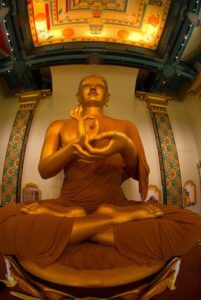
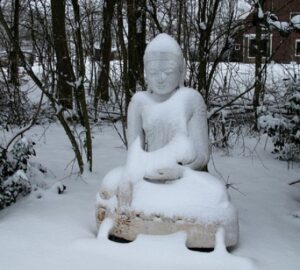 As well, we also remember the passing of David lynch the great auteur who was deeply dedicated to meditation. His children recommended that a perfect way to commemorate their father would be for the world to meditate today. So today we bring it back home to remembering those who have come before, our meditation practice, who we are, why we are here and what we can do to help bring love and sanity to our world.
 Ego which can be seen as the very limited defensive nature of the mind, serves to reduce our world to a controllable space. Its logical extension is the propagation of surety, dogma and doctrine. The opposite of ignorance(ma-Rigpa) is knowing (Rigpa), and therefore, egoless being is sees and knows what is happening. And it always has. This is Buddha Nature – our natural state. Because it is accepting reality as it is, it is not at war. Thus, Buddha Nature is said to be indestructible. It has never changed. It is the life of the universe and the very life around us. And though our lives will pass into other configurations, our essential nature is said to be part of all of nature. Ego clings to temporal things in order for us to believe that temporary things give us solace and sustenance. We can squint our eyes and believe what we are happy but, inside us, we know that happiness is immaterial. Material things are “like a banquet before the executioner leads us to our death.” Revenge, retribution, and displays of grandiosity masquerading as leadership are fleeting and meaningless. They are basically good, because they are there. But they are expressions of ego and ultimately fleeting.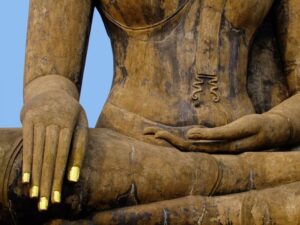
 Physical pain awakens us to the possibility of danger or a need to heal. While few of us like pain, it serves a vital function. Some p
 There is nothing wrong with fantasies until they take the place of actual engagement in life. Fantasies allow us to journey into edgy realms with no real investment. By imagining pleasures of the flesh, we have no actual skin in the game. (Yes, bad pun intended.) We can live out fantasies at will in apparent safety. However, as they serve an important creative function, it may be that fantasizing only supports the solitude that allows wounds to fester. Sometimes we analogously recreate the actual wounding we are otherwise unable to look at directly. People may act out abuse sexually by entering a “play space” that is an active dissociation of their primary personality. The “play-space” is a safe space people can act out being unsafe. And whether this is working through their deep wounds or reinforcing them is unclear.
 The present moment rests between the past and the future. Specifically, how we could protect ourselves from this situation or how we can enact laws to protect our community in the future. Or, going deeply into the causes and conditions of what happened to us might lie in the past. Either of these examples might be helpful, but they are more the province of therapy. Meditation looks at what is happening now. That is what we mean by the light. Many of us were wounded so deeply in the past that there is little possibility of contacting the source of that suffering. But we can feel their effect right now if we remain conscious. And as we become more and more conscious of that which lies within us, we become more and more whole.
 adjacent worries, recrimination and judgment. For instance, there is drilling happening not far from my apartment. It’s annoying and incessant. I’m here having to work on a post about creating peace with this going on in the background. It becomes especially painful when the background becomes the foreground, as is happening now as I’m referring to it. However in the course of writing, I’ll refocus on my work and forget the noise. This cessation of suffering comes and goes and yet the drilling is continuing unabated. Sometimes I’m aware and sometimes not. Each time I’m aware of the drill I forget all about the periods of relative peace. It seems this drilling has been going on my entire life and will continue forever. I cannot help but take this personally.
 to create a gap between input and impulse, which serves as a mote or buffer of aware space. Whether we are triggered by someone else, or drilling outside the window, all instigating impulses happen in our mind. When the mind builds it cocoon it compounds itself into a hall of mirrors. Turning the attention from this brain constipation toward the aerobic movement of breathing interrupts the process and allows the claustrophobia to abate. When we turn our attention from the overwhelmed brain to the body breathing, we go return to something grounding. And while simple awareness of the breath may seem inadequate to address how impacted we feel, it actually creates a gap that allows the mind more clarity to see clearly.
 In a world filled with endless information and impulses, the idea of simplifying life to a single breath may seem overly reductive, especially in contrast to the overwhelming chaos of our triggered states. And while chaos is part of life these days, perhaps there is a way to navigate this chaos. Instead of trying to control the flood of thoughts and data, we can shift our focus from the mind into action. And we can take that action one step at a time. The question becomes: What is the next right step?
 While it is important to be in the moment, each moment is leading to the next. To make this next authentic action practical, it helps to determine where we are going. If we have a commitment to work for the benefit of all beings then it becomes clear. By “all,” beings we are including ourselves. Helping others at the cost of our own wellness is not truly helpful. So, what is the next step that leads toward helpful engagement with our world? Once we know this, the next step we take is a natural action. By natural we mean not rooted in confusion or external expectation, but what needs to be done for the benefit of everyone, including ourselves. Taking that step will clarify the next step and in so doing reveal the journey ahead. We move toward helpfulness and harmony, and away from reactive patterns that keep us entangled in life’s struggles.
 holidays are often described as loving and warm, but it can also feel cold and threatening.