
Maybe It Is All About Me
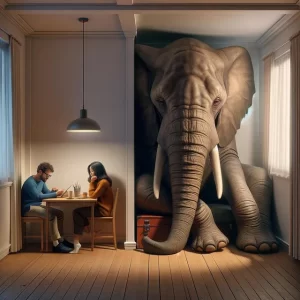
Let’s discuss the elephant in the room. Specifically, that big elephant standing in the middle of everything. This ungainly creature influences and interprets all we perceive, feel taste and touch, yet remains nonetheless unregarded and unseen.
The elephant is standing guard over our precious sense of self. Its primary purpose is to protect us by surreptitiously inserting itself into nearly every situation in an attempt to control nearly everything. As one of its tools is stealth, this unseen elephant is an agent of ignorance. We don’t see it, and it sees only what it’s trained to see, which includes itself. And unless we’re retraining the mind to see clearly, we never see beyond the firewall to ourselves. Buddhist thought delineates a path of developing awareness of the elephant and all the other wildlife in our being so that we might see beyond that which controls us to our life as it is beyond unconscious interpretation. This path develops awareness, which is a sense of panoramic knowing that allows us to navigate life with ease and dignity. The more we see, the better we can care for ourselves and others. Awareness is the essence of compassion. Once we see, we are able to understand. And caring is a natural response to understanding. A life with awareness, dignity and care is a better place to live. So what is keeping us from leading that life?
In the larger picture of things, awareness sees all possibilities. However, our untrained mind does not have the ability to process all of this information. On the practical level, we need to focus our intention within that sea of information to get anything done. Our perception is localized and administered in an aspect of mind Tibetans call “sems”. Sems acts as a mental switchboard that organizes input from our 6 gates of awareness. These gates are our five sense perceptions and the mental interpretation of each. It is important that in Buddhist thinking our mental interpretation is considered a discrete sense. Most importantly, there is a difference between our raw perception and our mental interpretation and sometimes these are not in alignment. It is the purpose of meditation practice to clarify the dissonance between perception and interpretation. This is referred to as developing valid cognition. In time, with consistent meditation practice, we become aware of our mental input and learn to look beyond the elephant to see where life is leading us.
 So, let’s break down the components of this elephant. The elephant stands on the notion of a “self“. At some point in human evolution we became conscious. That localized sense of perceiving began to organize itself into an entity that is aware of itself. This allowed us a vantage from which to navigate an otherwise unmanageable sea of possibility. Yet, that navigation comes at the cost of limiting those possibilities. This notion of self is a necessary limitation in order for consciousness to have a reference point. Ego is a further limitation of those possibilities. Ego happens as self-awareness becomes a self-consciousness that assumes itself to be self-existing. This assumption of “me” can become a self-referential closed loop that reduces awareness to specifically localized points of view. The ego works as a set of patterned functions that reduce what we see of the world. We conflate reality down to serviceable quanta which, in turn, are seen as a means to serve our perceived compensatory needs. These perceived needs are generated to compensate for feelings of lack or vulnerability. In other words, we see what we are conditioned to see and generate feelings that prompt reactions. We generally do this all without much investigation.
It is the role of mindfulness meditation to create gaps in this automatic process, so that we may be able to track reality. Ego solidifies the idea of itself with uninvestigated and unintentional habitual reactions and Mindfulness Meditation allows us to see through this process and unpack the mechanics of our ignorance. Therefore, by insinuating space and awareness into our life, mindfulness meditation creates an existential challenge to ego. This is why we sometimes have resistance to meditation. The gaps created by developing awareness are like cracks in the wall of ego’s fortress.
Ego is created as a protective process, however like all protective processes it is also charged with its own survival. The defensive system has become more powerful than the host it’s enlisted to protect as it serves to also protect itself. For many of us, most of the time, the elephant is running the show. And direct challenges to the elephant are met with further resistance. The way to work with the elephant is to acknowledge its value, and to encourage it to relax. Like everything on the Buddhist path we are encouraged away from antipathy and toward care and understanding. In other words, learn to love the elephant. And again we do this by knowing the elephant. What makes it tick? When is it likely to be inflamed? How can we remember it’s there? How can we learn to treat this creature with love and respect?
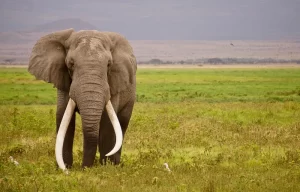
Unlike the majestic elephants of the wild, our egos are furiously overworked conductors trying to control streams of information. Sometimes they resort to bullying tactics. The more they are threatened, the larger – and more invisible – they become. Frightened people tend to see only themselves. And this inflammation of self into blind egotism obscures everything – and everyone – else. Narcissists seem overbearing but that inflation of self and their inability to relate to social cues are compensatory defenses for those who feel inadequate and vulnerable. That self-centeredness creates expectations that are hard to live up to. When we feel larger than life, we have so much to carry. After times that ego has arisen in our defense, we become deflated and depressed. We lay there wondering how we can actually manage getting this elephant off our chest. I call this the “Unbearable Weight of Being … Me.”
We wake up in the morning to my alarm clock, take my shower, drink my coffee just as I like it, take my car, to my job. No wonder that when I come home to my house I’m sick of myself. Buddhist teachers will say that the problem is not ego. The problem is cherishing the self. We are clinging to the idea of me and creating this weight that becomes exhausting to carry around. Sakyong Mipham says “what about me” is the incessant mantra we say first thing in the morning and the last thing at night. He went on to suggest that after all this, we should be full of joy. But, we are not. Lastly, ego is an addictive state that cries out to be fed. And the more we feed Seymore, the more it needs to feed.
 The antidote is to stop. Allow a gap. Breathe out. Drop into ourselves and feel ourselves in our body. That is much closer to reality than circular, ego world building. Just drop it. Come home, and be here. This act of self love will allow the elephant to rest. When the elephant rests we can look around and see the world as it is.
WIth the room to see the world, we might find it is quite workable. In the 12-step tradition they say, becoming right-sized we see life on life’s terms. We don’t have to conflate our life, or inflate ourselves just to be here.
_________

 After years of study, training and ascetic discipline, the Buddha began a 49-day yogic meditation fast. During this time, he gained mastery over his body and attained relative mental clarity. But, as he was at the point of death, he did not have the strength to fully cross over into awakenment. Perhaps knowing that his work was not about his own accomplishment, but that his quest would be to reach a state that would allow him to help others, he broke his vow and accepted a bowl of rice from a young woman. It wasn’t until he accepted this sustenance that he had the strength to attain full realization.
 Therefore, as the Buddha’s teachings developed, the methods changed. Zen Buddhism is different from Vajrayana Buddhism, which is different from Theravada. Buddhism in the west is its own expression. The commonality to all of these expressions is that they are rooted in the belief that we are born as we should be and our lives can be led by a path positioned toward greater awareness of ourselves and our world. Each expression of Buddhism has its own methods. It is considered a rookie mistake to be an unwavering adherent to any method. Renunciation is not abstinence. Renunciation stepping back from an attachment in order to see more clearly. Sometimes this happens all at once, and sometimes incrementally. Renunciation may require abstinence in some cases. or for some period for those who cannot work safely with the person, place, or thing. There is no shame in that. But abstinence is not the point. The point is liberation. And liberation is not another jail we place ourselves in. Liberation is the vast space beyond our imprisonment that we can grow into.



 The key is developing surety in our commitment to remain present whenever we can and to return as quickly as we can when we are not. The gentle insistence is how we combat the aggression of our world. Does that sound impractically pollyannaish? Confucius would remind us that the gentle persistence of the river will cut through a mountain over time.
 A worldly path to perfection is quantifiable in comparison to our world. As vicious as it may be, it is comforting to judge our progress with standard quantifiable metrics. Are we becoming richer, thinner, or more popular? Do our peers turn their heads in admiration, or avert their glances in disdain? Whenever we have the wherewithal to stop and look, are we able to see our world? Or do we only see how far up the ladder we are?

 A slow uncovering of the wounds that bind us, is an apt description of the path of compassion. Understanding and transforming our pain is a common motivator for the path. Many of us came to the path because we were in pain. There is nothing like a broken heart to introduce us to meditation. But once that heart has mended, or once we get tired of that broken song, what is it that prompts us to continue on the path?
 So how can we help anyone, when we ourselves are wounded? We talk about “opening the heart”. But what does that mean? Usually, this statement evokes feelings of empathy, communication, and kindness. But doesn’t opening the heart also release the pain that we have been protecting and the suffering we are protecting ourselves against? When we began the path our wounds were the source of antagonism and aggression. In an attempt to protect ourselves from a future projection of past violence we struck out against actual or imagined danger. However, it may be that these wounds are also the source of empathy, communication, and kindness. The “Lion’s Roar” may be that the wounds we guard in embarrassed secrecy may be our gateway to compassion. When we have worked the path of self-discovery, we get what it is to be human. And because of this, we understand what humans need. Opening the heart is simply relaxing the protective tension with which we gird ourselves. As this cocoon is protecting us from real, imagined or remembered pain, we must respect it. Opening the heart is not about aggression at all. Opening the heart is acceptance and release.
 Pema Chodron speaks of suffering as having created a wound in our heart. All of us have those wounds. Pema suggests that we cover the wound to protect it, as we would a physical wound. However, with a physical wound we remove the bandaid for it to heal under the sun. But emotional wounds often remain covered, and so healing is compromised. We become embarrassed of the wounds, somehow believing we are the only ones. Because they don’t heal in the shadows, the wound becomes sensitive to touch. We are constantly bumping into the wound, and flincing through life trying to protect ourselves from the pain. This creates more suffering. Yet, the saddest part of this is how we are denying the very thing that makes us unique. No one notices perfect trees in the forest. We notice the trees that are gnarled and curled from lightning, bent by wind or darkened by fire. These trees have character. And our pain gives us character. Lightning struck trees don’t feel embarrassed about themselves. Nor do three legged dogs. Nor do blues musicians, or poets as they express their pain. Is there a form of life on earth that judges itself as much as humans do? There is a song by The Big Moon that goes “trouble doesn’t last forever. The trouble is that memories do.”

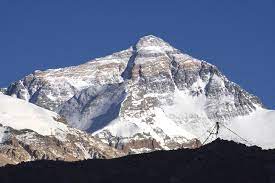 deadly conditions and extreme energy, yet the mountain is seemingly still. It serves to inspire and guide us. It is not hurrying or competing. And should we be drawn to climb the mountain; haste would not be in our favor.
 A kinder, and vastly more productive, approach would be to employ mindful awareness to relax into a flow state that optimizes our experience and honors our existence. We are able to stand up and hold ourselves with dignity and grace. I had a teacher that suggested I slow down enough to move quickly. This is pausing just enough to synchronize with our mindfulness and awareness. Then when we are interrupted, we can respond intelligently with consideration. We say considerate because we are considering a fuller situation before we react. When our mind is racing, we don’t have time for that we’re rushing down the street late for work and pushing people out of the way or cutting off cars on the road, without any regard for the basic human relationships that make us feel confident and strong. The more we push our life out of the way so we can force our agenda the more we are robbing ourselves from the fundamental sustenance of our life. That sustenance can only come from being grounded. It’s as if we’re pulling the nutrients up from the earth. But we can only do that if we’re synchronized with the earth. When we are synchronized, we are present, and the game slows down. We see that we have more options than the panicked reactions that come from speed would reveal. When we are grounded, we are able to consider more helpful approaches.
 One thing that blocks the flow state for us is this feeling that we are pressured and have to make an immediate decision. We have to act immediately without pause, without thought, without consideration. When we’re running late, miss the train and we’re delayed another 8 minutes we stand on the platform looking up at the clock, tapping our feet. The speed and constriction that we become addicted to slams us into survival mode. Our options are reduced to fight flight or freeze. When something stops our momentum, we either lash out, run away, or freeze in a PTSD trance. The remedy is to boycott reaction, pause and breathe. Feel your feet on the ground. Come back. Then we can respond.
  actually have a considered response. It might be offering some counterpoint, it might be walking away, or it might be simply waiting in space until the next right action becomes clear. Once we make an offering of our anxiety our fight flight freeze reactions are transformed. We’re using the same mechanism of reactive mind but because we’ve paused and synchronized, we’re able to use these impulses with executive reasoning. Fight turns into expressing our point of view, flight may be that we can walk away. Retreat is not surrender. Retreat is simply stepping back to regroup. And freeze might simply be resting here. This is not a PTSD trance state where we can’t move but a loving pause where we have the option to do nothing but remain present. Not to react, but just simply to wait. And that waiting is the essence of patience. If we learn to pause when we’re triggered, we might find that we’re more patient at stop signs, more patient in the subway and more patient with our life.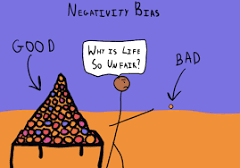
 If Trungpa recommended we accept our thoughts without judgement, there is one category of thinking he deemed unacceptable. “Negative negativity” are the judgements we have about ourselves, including those we have toward our own negativity. Negativity is naturally inherited behaviour. Blaming our negativity is counterproductive. It’s essentially blaming ourselves. Whenever we feel the tightness associated with self-affliction, we can come to see that we are punishing ourselves, which is self-flagellation. We can just let any self-judgement go.WE don’t have to pretend we are a buddha, or Mother Theresa or Kendrick Lamar. We can be ourselves and accept negativity as small minded and self-defeating but entirely common and natural. We can allow ourselves to feel our negativity without judgement – but also without action. We can become aware of our underlying behaviors without acting on them. We have every right to feel however we feel, but no right to inflict those feelings upon ourselves or anyone else. If we act out our negativity we are training the mind to continue negativity. On the other hand, as we are socialized not to act out, “acting in” builds internal pressure until we explode, or fall into depression. Both of these actions build the propensity for us to see the world negatively making it easier to act out/in.