Our Life’s Work

When I developed my meditation instruction into a practical life path I chose the name LIFEWORK for my new business. This felt apt because, in a very practical sense, our work is to live our life. Our jobs and any financial security we’ve earned would, ideally, support our life. While many of us have pressing financial and professional issues, I believe Right Livelihood is the creative development of our essential being. Simply said, living is our life’s work. And perhaps that work can be a work of art. A truism in the field of motivational development is that money is not an effective motivator. While a few may be genuinely motivated by acquiring wealth, the majority of us fear not having wealth. Or, perhaps we fear wealth itself 

My work is to remind people that life is the point. Our jobs are only one of life’s pillars. Some others are health, play and spiritual wellness. A “Life” Coach would help illuminate all of the aspects of life, not just help with employment.  If our job supports our life we are fortunate. And if our job is eroding our health and spiritual wellness, we are also fortunate. We have been gifted an opportunity to rediscover ourselves and reorient our path. All roads led us here, and so here we are.

Now, where would we like to go?

The healthiest life orientation is one in accord with our true nature and placing this in alignment with, and service to, the world around us. Some traditions talk about turning their path and our life decisions over to God. Some talk about working with the universe. THe important point is that we don’t have to muscle through on our own if we orient ourselves toward a greater purpose. Yet, we cannot lose ourselves in the process. My belief is that we have to honor what Martha Beck calls our “Essential Being,” which she posits as distinct from our “Social Being”.  Our Essential Being is informed by other’s needs but is not defined by anyone’s expectations. It is self-existing and yet open to communication and change. Our essential nature seems to understand verbs over nouns. What is our action? If our action is fearful, then this action programs us to believe that that life is to be feared. When our action is confident we are guiding ourselves toward openness. In terms of our livelihood, many of us have a complicated relationship with money. We fixate on money, we discuss money, we may even study money, but we are actually quite frightened of money. Hence, money doesn’t excite us and wealth feels unattainable. And so, our lives become obligatory rather than creative. Lennon suggested that we break our backs to earn our day of leisure. And yet, Lennon was wildly successful in life because he “broke his back” for his passions. Whether it was perfecting the three-minute song, affecting progressive politics, falling in great love, or finally caring his family, he was an example of dedicating life to the things that matter.

And what matters will change as we develop. When we have this co-creative relationship  we are living life imperfectly, as a work of art. Art is never perfect. Or maybe its imperfections make it perfect.

In 1989 Marsha Sinetar released “Do What You Love and the Money Will Follow” which was something of a manual on what the Buddha called “Right Livelihood.”  Rather than motivate our life journey by our fear, if we identify the essential element of our being, we will access a wellspring of energy that will effectively drive our life. I think of it as a crystal river that runs through the essence of our life. Everything becomes clear when we remember to return to that flow. This is what we are training toward in our daily meditation. Shambhala Buddhism refers to “Basic Goodness.” This is not good versus bad, but a description of our human essence. It is the basis of human being. We are good. We have every right to be here. If we can learn to believe in ourselves, we will believe we are worth whatever goodness life can offer. So “Right Livelihood” is dependent on connection to our spirit.

Do gold rings and bling really satisfy us? Maybe. If we can access our essential goodness then the accoutrements of the world will be, as Chogyam Trungpa said, “ornaments which are pleasant to wear.” But when we forget to remember our basic goodness, acquiring any goodness of the world is,  Sakyong Mipham says, “like putting elegant clothes over an unwashed body.”  If we don’t recognize our own goodness and believe we are worthy, the goodness of the world will not be sustainable. Many of the things in life that we so desperately seek will only lead us from ourselves if we think these things will complete us. This actually erodes our wellbeing. On the other hand, there are things in life that directly feed our soul. When we are in tune with ourselves, we can feel this in our body. So, there are things we do that close us down and things in life that genuinely light us up. If these are the things that money can help acquire it might do better to focus on that which genuinely excites us and then allow the accumulation of wealth to be a practical means to that end.

In my coaching, I have my clients envision what they want from life. This is a maddening exercise at first. We are  trained to regard our own wishes as selfish. But how do we have the ability to help anyone if we’re depleted and unhappy?  And I tell them “lets just toss some ideas and see what the universe sends back.” Nothing is written in stone. Stones are for laws. Laws are an important support, but only to guide the creative. Creativity is an imperfect process. We let go and relax into the flow of life and allow the universe to co-create that life with us. This means we allow God, our teachers, or our higher power into the equation. The way we access the goodness of life is to dedicate that life to enriching all life. Nothing engenders confidence like caring for others. When we do this, we are accessing our higher spirit. We are in line with spirit, source, God, or Basic Goodness.  That spiritual alignment is an amazing feeling. When we have the capacity to extend to others, we are aligned with goodness and the goodness we need from life will come. This is Ruling Our world with dignity and grace. Conversely, when out of fear we live life only for ourselves, we live scurrying and frightened. Thinking about our livelihood, our health, or our life at all seems overwhelming.  Perhaps this is because these thoughts are manifestations of fear and not expressions of confidence.

 

For some, the money that drives our social economy is a cruel master that causes us to barter our passion for societal progress. Societal progress is not evil, but it doesn’t light us up. And motivating toward financial security is an obligation at best. But what is important is that we remember the essential cause of our motivation. We are humans, not machines. Caring for humanity is a way of transferring our anxiety into meaningful action. This makes us feel better about ourselves which allows us the confidence to recognize and accept goodness from the world. This reconnection to our basic goodness has to be maintained with the daily effort of coming back. We get lost and we come back. Over and over. There is no other way to progress. We train daily by simply coming back to the breath in our practice. Eventually, we gain the confidence to remember to recognize and return to the present in daily life. Then we can turn our life over to our higher power, which is always at the service of helping others. We can go from anxious self-centeredness, which is self-limiting, to the confidence to allow our life to unfold as it should. When we are selfish, we are walling ourselves away from goodness and so will struggle in fear. When we see this, our daily work, our good work, is to return.

It is the biological imperative to protect life on our planet. When we are in alignment with that, we are part of the goodness of creation. With this view, all the goodness in life is dedicated to giving us the means to protect life.

 

NOW

NOW is a long story.  I didn’t know exactly where to begin. Or when. So, I thought I might begin at the beginning, which makes sense. But then I thought, given the subject, I might start with the present and reflect back. However, I’m also fascinated with the future. Thriller novelist, the late Robert Ludlum, began writing his books with the last chapter. This way he had a bead on where the story might go. From the Vajrayana Buddhist point of view, the past, present and future are happening at once, around us, in each moment. Perhaps being here now is knowing what came before, where we are and where we are heading. “Now” is not sedentary. Trungpa Rinpoche called this larger space of time, nowness. Nowness is not a solid thing. Nowness is an ever evolving experience.

One of the best things I have ever done was to look up at the sky. This simple act brings a keen perspective to our ground eye view whenever it happens. However, looking up in a place without light pollution, such as the mountains or the desert, can be quite profound. Millions of billions of stars exploding across the sky in an orgasmic display of complex, creative consciousness.  And the deeper we look, the more we see. Stars behind stars behind stars. Though we are not always aware of what we are seeing, the course of all history is mapped out above us. We are peering into the secrets of time from our little ledge of now. The closest natural light we see is the reflective light of the moon which happened just over a second ago. The light of the sun happened 8 minutes ago.  Beyond that many of the stars we’ll see tonight are so very far away that the light we’ll be seeing happened a long time ago. As we look up in wonder, we are seeing the past, stars as they were before we were born, and in most cases, before humanity was born. And if we look deep deep within the recesses of universal time, we’ll see stars that predate all life on this planet. The James Webb telescope is beginning to uncover galaxies that may have existed right after the birth of time and space. So the very beginning of our story is actually happening now.  In fact, the entire history of our universe is happening right now in the sky above us.

How worlds were created, exist, and die – Brahma, Krishna and Vishnu, from the Indian mythology – are scripted in the patterns of time and space in the universe. The Vajrayana Buddhist Tradition of Tibet suggests that concepts of past, present and future are simply linear conceptual constructs. And while no one has been able to see evidence of future occurrences it seems the seeds of what’s to come are planted in each moment.  There are those who are able to feel past the linear and understand the future, by understanding the patterns of the past and the present. The I Ching states that those who know the patterns of time and space will rule their work with dignity and grace. Seeing into the future seems to be one of the firewalls that is existent in the universe. Travel into the future, the absolute limit of speed locked in at the speed of light are some of the currently held laws of the universe. Yet, maybe these laws simply delineate the limits of our understanding.  As our mind evolves, so does our understanding. When we climb a mountain the view changes as we ascend. Yet, humans are fond of identifying with what we’ve already seen. We embrace our limitations. I suppose shackles offer comfort. 

Our conceptual mind can organize and explain the creative non-conceptual experience of the universe. But it is only a map. The map is not the destination. The finger pointing to the moon is not the moon. Nowness is happening now, but it is comprised of all time. Nowness is as ever-evolving as is the universe of time and space. Even if we could define the universe right now our understanding would change as time leads into space.  The nature of the universe is expansive. The nature of concepts are reductive. Concepts are limitations that express how far our understanding has come. But the universe is more vast than we can understand.  The universe is not linear and it doesn’t exist in a way that our conceptual mind understands.  So, throughout time humans have used mathematics, physics, and all kinds of theoretical principles to begin to understand what is actually there.  Mystics and shamans approach it from an intuitive point of view. Ancient humans created stories of what they saw in the sky.  Those stories described the pre-history of their culture.  Judaism, Greek, Roman, Indian and many other cultures believed in a time that astral beings existed physically on earth.  As two legged bipedal humans came to prominence these beings, be they mythical or historical, were placed in the sky. When the ancient Greeks looked to the sky they were able to see a map of their past, as well as a navigational tool for the present. 

The stars were describing the birth of these cultures from the very beginning time and space and offering a script of how they saw themselves.  If the gods and goddesses depicted in the sky were not corporeal then perhaps they represented energies common to all beings.  Debating the existence of gods and goddesses is missing the point. Humans were trying to describe something from their ancient history in the designated patterns in the sky.  Orion the hunter, Taurus the bull, the Little Dipper and the Big Dipper were ways to explain what and who they were. And maybe these pictures also explain who we are now. And perhaps what we are to become. It’s possible that the climate difficulties we’re facing on Earth will force us to find other alternatives. Perhaps we are being urged by the spirit of the universe to move psychologically, conceptually, socially and technologically toward the sky.
It’s possible that the climate difficulties we’re facing on Earth will force us to find alternatives in distant parts of the cosmos. Perhaps we are being urged by the spirit of the universe to move psychologically, conceptually, socially and technologically toward the sky. Perhaps our suffering blue planet is humanity’s incubator. Maybe our cocoon is readying us to ascend. Perhaps we will sprout wings and become like the sky beings of space.  Maybe this is our legacy. However, a more pessimistic reading would be that we’re quickly approaching our own doom because we simply – and despite copious warnings – simply cannot break the habits to which we are addicted. Yet, looking to the sky, we see that death and birth are symbiotic and necessary.  And if the great spirit of the universe is heeding us at all, why are we more important than the bugs we kill walking on the street? Are we more important than the trees we cut for our lawns, or the deer we poison to spare our roses, or the cows or chickens or all life we deem expendable so that our life is more comfortable?

Some people look to the grandness of the sky and see themselves as a god. Some people look to the sky and in comparison feel they are nothing at all. The Buddha taught that from the latter perspective we can offer great love, kindness and healing to the world. From the vantage of serving the universe without centering on our-selves, we are open to understanding the greater patterns of things.
Thus with that panoramic awareness we become “a Chakravartin” a holder of the wheel of time. When we offer up our petty struggles of existence, which are killing each other and strangling our planet, we can instead open up to connection with all life.


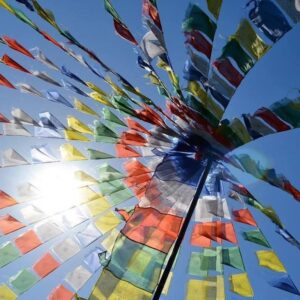
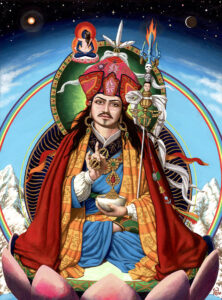
(The pictures above are of Tibetan Prayer Flags marking the center of a spiritual mandala, a rendering of the earliest galaxies taken from the James Webb telescope, and a thangka of Guru Rinpoche Lord Padmasambhava considered the chakravartin of their age.) 


THE WARRIOR

True strength is not measured by physical prowess, but by the ability to control one’s own mind, cultivate inner fortitude and resilience through the practice of self-mastery. Self-mastery is not about suppressing or denying your desires and emotions, it is about understanding them, acknowledging them and making conscious choices that align with your higher principles.

       – Marcus Aurelius


MEETING THE WARRIOR 

In many traditions the ideal of compassion is one of boundless kindness and caring. In the Shambhala Buddhist tradition, and generally in the Tibetan traditions on which it is based, kindness and caring are seen as dependent on confidence. The willingness to face our world with dignity and strength is known as the warrior principle.

The foundation of caring for our world lies in the strength in the warrior’s authentic being. In this sense, a warrior is not based on aggression in any way. When we are aggressive, we are being competitive. When we are in competition or struggle with another, we are defining ourselves by that metric. That is not what we mean by authentic. Authentic means we are acting from our own higher power.  Authentic Being on which warriorship is based is not the ego-self that is fighting with their world, or scrambling to please anyone. It is the sense of being based on our feeling of self-worth. When we rest in this basic goodness we naturally connect to our higher principles.

With meditation practice we begin to train the mind to recognize how authentic being feels and how that feeling differs from the way ego defenses feel. Our body is actually different when we are posturing. We begin to feel the difference between our ego gripping and when we relax and let go. It is recognition of this difference that allows us to step back from our defenses and meet our authentic being. Letting go into authentic being takes confidence. So, with our meditation practice we are training to recognize and embody the warrior within. By sitting in the warrior’s posture we are developing the confidence and bravery to let go of our defensive posture and claim our warror’s seat. By letting go we release the tension in the body and our mental grip on our struggle. This is not surrender. It is getting past our blockages so we can access the ability to see clearly.  Then we can respond appropriately.

By letting go we are expressing our authentic nature, our essential being. By contrast, when we adopt a defensive ego posture we are expressing a conditioned nature. Our conditioned nature often manifests as an habitual reaction to life. This defensive nature might masquerade as strength but, in reality, deep within ourselves, we are acting on fear.  Fear is the cause and condition of egos structure. We are simultaneously reacting to fear and creating fear. When we are caught in this cycle of anxiety-based lashing out or lashing in, we are acting unconsciously and are not able to understand how we are adding aggression to our being. Instead of maintaining the awareness to allow our emotions to serve us, we are allowing our awareness to be consumed by them. We react blindly becoming our anger, our fear, our lust, our denial. In this way, we lose the connection to authentic being. However, the good news is, we can easily reconnect to the warrior within by simply remembering. When we talk about meeting the warrior, we are talking about remembering how our authentic nature feels.

Don’t think about this. Just BE the warrior in body, spirit and mind.

We express our essential nature in meditation practice by adopting the posture of the warrior. In this way, we embody warrorship. We remind ourselves how it feels to be open to the present. While this takes confidence it also builds confidence. However, meeting the warrior takes time and is a constant process of unlearning our conditioning and remembering our truth. When we find the balance and majesty of sitting, we are training to remember the warrior on the battlefields of life.

Training in warrorship is learning to express our authentic being. In time, we learn to trust the warrior within us. As we become less fascinated with our reactive nature, we turn to the openness of our true nature, our Buddha nature. We are not adopting anything new here. We are releasing what has always been there. This is like the story of Michelangelo saying he didn’t sculpt David. He released him from the confines of the rock. When we release our true nature by releasing ourselves from the grip of our defenses, we are exhibiting and building the confidence to be open. Openness is the requisite for kindness. When we are open we are not weak or defenseless at all. In fact, we are more able to see clearly how to respond. Compassion takes many forms. The statues of Quan Yin or Avalokiteshvara are often depicted as having many arms to represent the many ways that compassion can manifest when we are open enough to see them. Confidence allows compassion to manifest as anger, love, caring or kindness as needed.

It takes bravery to be open enough to see what best serves the situation. The warrior rests in their authentic being with the confidence to respond creatively rather than react habitually. This is the warror’s posture. This is what we are training for when we sit.

This is meeting the warrior.


SPIRITUAL FITNESS

In his book Turning the Mind into an Ally Sakyong Mipham identifies “stability, clarity and strength” as the basic logic of the path of Shamatha meditation. Shamatha is the practice of calm abiding, or cultivating peace in the body, spirit and mind. Beginning with the body, with the ability to remain on our seat, we naturally begin to settle. As we settle, a calm abiding occurs that brings a sense of contentment. This allows the body to accept itself, as it naturally relaxes.

Relaxation is opening somatically. We are releasing ourselves from the panic induced gripping to ourselves that keeps the body tight and poorly aligned. Contentment brings a sense of well-being and openness to the world around us. That openness occurs as we release the grip we have on ourselves.

As with weight training, periods of intensity need to be alternated with relaxation and recovery. The point of exercising is how we feel as we relax into the confidence of a strong body. But many of us walk around mistaking bodily tension for strength. We grip to ourselves as a base mind protective reflex. But the gripping – or in psychological terms, self-clinging – closes us down. We are hiding behind our physical and mental frame. Hiding is a way of removing ourselves from immediate danger, but it also closes us off from alternatives and healthy responses to fear. In this sense, it’s a very limited defense. Gripping also impedes our ability to navigate life with ease and relaxation. Most egregiously, being imprisoned in our pain body makes us ill prepared and vulnerable to attack.

Consistent meditation practice brings the stability we need to feel comfortable enough to release ourselves from the bondage of physical tension. It takes courage to step past this bobdage, but doing so increases our confidence. So, it’s a positive feedback loop. Opening brings confidence, and confidence allows us to open. There is a subtle, but nonetheless powerful, shift in our allegiance. Rather than tense up and make ourselves emotional sitting ducks, we relax into challenges, and are able to navigate past our fear. Openness in the face of fear is very strong.  This strength will change your life.

Spiritual strength comes as we develop a firm body, an open heart and a clear mind. Firm body means we have the ability to remain in place, on the spot, and relax into our seat. We are connected to the earth and have the confidence to remain at our post. Open heart happens naturally as we relax into our seat. Once we feel less threatened, we are naturally able to look past our protective frame and contact the world. We are not freezing ourselves in emotional isolation. We are opening. Once we open we are able to make contact. This practical – and manual – contact with life brings a confidence that allows the mind to see clearly. We are able to accept our life, as it is.

Spiritual wellness is a sense of our body, spirit and mind being synchronized. It takes daily manual practice as well as a willingness to remember the practice in impacted moments. Spiritual wellness becomes apparent when we are willing to eschew the panic reactions of threatened behavior for the calm reasoning of an integrated mind. We are in our body, in our heart, in our mind and fully able to respond to life as it happens.  This strength is born of consistent meditation practice on the cushion and mindful awareness in our daily life.

GRACE

Many spiritual traditions refer to GRACE as a state where we are aligned to a higher purpose and connected to the inherent power of the universe. We might feel guided by the light of God, in accord with the blessings of a teacher and their lineage, or a personal connection to our higher being. This brings a sense of blessings whereby we are freed of personal concerns and aligned to a greater purpose. Many feel a sense of ease because we are not struggling to live a life dictated by greed, defensiveness and doubt. We are instead entrusted with the care and concern for all beings. And, as we are one of those beings, we can be likewise be held by the firm and gentle hands of compassion. 

Although the state of grace connects us to the timeless, our personal experience is nonetheless temporary. As profound as it is, grace comes and goes. Sometimes we feel blessed in our everyday life. Unfortunately more often, we feel we are fighting uphill just to get through our day. Becoming mindful allows us to see these oscillating patterns more clearly so we can learn to enhance our connection to grace. We see that when we are open and in a place of acceptance, we feel more aligned to the universe and held in its loving hands. When we close down and become insular, we may find our connection to grace wanes. It is important to know that we have not done anything wrong. Humans are relatively new life on earth. We have learned a lot about using materials to our benefit, but we are still learning how to navigate our spirituality. With mindfulness practice and the awareness of the ramifications of our actions we can begin to steer away from self aggrandizement and the limitations that it imposes. We can move toward the open space of kindness and caring. This opens us to grace.

The fallacy is that we feel grace happens to us regardless of our actions. Or, on the other extreme, that we have to make it happen of our own will. The truth is in the middle. It takes some intention on our part, but also a lot of letting go and acceptance so we can receive. In this way, it is as though we are partnering with the universe. We can’t make grace happen as though it were an act of ego, but we can prepare the ground for the experience. One important tool is to soften our heart and begin to learn how to accept ourselves.

In the Shambhala teachings, there is the directive to be “kind to ourselves and merciful to others.” This is actually a spiritual equation. Having the emotional space to be merciful, depends on kindness to ourselves. If the golden rule is to treat others as we would be treated ourselves, the diamond rule might be to treat yourself as you hope to be treated by others, so you can treat others with kindness and grace.  This allows others to trust us and increases the probability that life will treat us well. It is a complete circuit. Love in and love out. We generate that circuit by creating the love in our own heart first. Our heart and its self compassion is the battery that powers the love in and love out circuit.

I have a dear friend I love very much. We were talking about this prospect of kindness to oneself and they listed all the places they wish they were more kind in their life. At the end they threw in “and learn to be kind to myself, as well.” And I thought maybe they have it backwards. Being kind to yourself is the first step to repairing our disconnect to others. Our connection to others is a way of connecting to the loving power of the universe. Learning to be kind to ourselves is the first step toward living in grace. And when we fall out of grace, the remedy is to increase the love for ourselves. We boycott the self recrimination. Beating ourselves up feels like we are guiding ourselves back into alignment, but is only bad self-parenting. It is actually closing ourselves off to our own loving heart, which is the generative power of creation. The remedy is to rekindle the fire of kindness.



With our meditation practice, we develop the discipline to act with love regardless of our perceived mistakes. People want to feel our love, not listen to our apologies. When we generate the feeling of loving kindness for ourselves, we are preparing the ground to receive the loving hands of the universe.


BALANCE

There are many expressions of a spiritual path. Some of us open to a higher experience. Some connect to the earth below. Some find an expression of divine spirit within themselves. Others recognize a universal goodness in all beings. And some find divinity in everything around them. Although, the majority look to no spiritual truth at all but attend, the best they can, to their everyday lives.

The Buddhist tradition accepts any and all of these possibilities. It also offers a very practical interpretation of its own: being in alignment with spirituality is to be in balance with ourselves. The practice of Shamatha meditation cultivates a calmness of body and mind, which allows us to access the essential spirit of life around us. The cultivation of peace is an acceptance of life as it is in the present moment. The obstacle to developing that peace is the itchy and scratchy mind that constantly fidgets and dreams and lunges after provocation.

The traditional texts reference and experience that Sakyong Mipham identifies as “laxity and elation.” This is the nascent bipolar experience of an untrained mind. These tendencies are subtle on the cushion but if unchecked, may develop into real imbalances as we continually lurch toward reward and away from discouragement. We try to be submissive in some situations and dominant in others. We gorge and purge and tend to find comfort in imbalance. This is the neurosis that generates samsara. We are constantly wanting and grabbing only to find that to which we cling to be devoid of spiritual nutrition. These spiritual empty calories leave us exhausted and depressed …  until we want something else. That wanting increases our dopamine and so this excitement feels so very right and lifts us up again … until it doesn’t. And so we are depressed again until we find the next mirage.

The idea of becoming a Buddha is profound but also very ordinary. It is an altogether human endeavour. In meditation we are training ourselves to find the stability to be here and the strength to accept whatever comes. Laxity and elation are the subtle urges that, if not checked, will lead to major swings in our mood, our life and our society. When we progress in meditation practice we catch these tendencies before they’ve had a chance to hijack us into the torrents of samsara.

In the practice of Shamatha, we are cultivating a peaceful mind by gently and diligently returning to the breath until we have synchronized body and mind. This synchronicity allows the mind to settle and clarify. Thus the point of Shamatha is not just a peaceful mind, but a stable mind that sees clearly. This stability and clarity manifests as strength in our life. We have trained our mind to recognize and accept the present moment. This becomes a baseline to which we return again and again. Balance is not maintained by rigidity. It is the spiritual experience of being in alignment with ourselves. This is an experience of great acceptance. Resting in the present is an act of self-love and self confidence. Running from the present is usually an act of self-doubt. But when we relax into a good posture and find stillness in our homebase, we become comfortable with ourselves and, in time, develop the confidence to be present with great acceptance and peace.

Like a Buddha.

And while Buddha refers to the divine within us, it is more importantly, the human within us. Buddha means awake. And this principle of enlightenment is not only available to all beings, it is an integral part to every one of us. Our samsaric upbringing has led us from the spiritual nature which is our birthright.  But that spiritual nature is not so far from us. In fact, it is right here when we are brave enough to return to our seat. It is right now the moment we remember to come back into balance and align ourselves to our heart.


REBIRTH

George Harrison released All Things Must Pass just following the breakup of his previous band, which happened to be one of the world’s most beloved institutions. Many of that generation were left shattered and unsure in the wake of their parting, not the least of whom were members of the band itself. Yet despite his fear,  “All Things Must Pass” was George Harrison’s masterwork, with songs as good as any he had penned when he still had the day job. This is the idea of rebirth. All things must pass and all things are the product of birth. And every birth, no matter how much it may be a new beginning, is the product of what came before. Thus, many spiritual traditions speak of the cyclical nature of life. And Buddhism, in particular, speaks of the interconnectedness of everything.

The movement and flow of reality can be a beautiful thing when we are able to step back and see creation happening all around us. But when it is OUR life it feels like suicide to step back. Our life is so very important to us. But, clinging to our life makes the fluid dynamic of reality appear solid and frozen in time. We believe what we are holding onto is REAL. And the tighter we hold, the more real it feels. Therefore, the more real we feel.  The more real we feel, as comforting as it sometimes appears, the more stuck we become. Holding on in white knuckled stubbornness gets us nowhere but stuck. But, as the song goes, ALL things must pass. This means everything. Yet, there are many things still here. Life, it seems, is happening all around us.

And death is everywhere. Like a thief in the night, it comes without warning. Dying is the alpha and omega. It is the beginning and the end of everything on our cosmological and temporal plane.  It is the existential point of contact with reality. Nothing that exists will last forever, and everything that exists will end. But is the end? And is the end really the end?

Many spiritual traditions speak of an experience beyond the death of our corporeal forms. In the Buddhist tradition, we deny the reality of that temporal form in the first place. Even while alive, our bodies are not solid. They are always changing. If I get a knee replacement, am I the same fellow? I still have my neurosis. What if I got a heart transplant? Or a new face? At what point am I no longer me? Well, the Buddhists suggest that there was never a me because that me was also ever changing. What are the values that define my ego? And were those values the same as they were a decade ago?

Perhaps, our sense of self is as mutable and dynamic as any other aspect of reality. Similarly, maybe our mind is different from moment to moment, and mental pain and emotional discouragement come not from our changing nature, but from trying to hold on. The tighter we cling, the worse it feels to let go. This clinging is the cause of our suffering. And if that’s the case, then letting go is the cause of the cessation of suffering. Letting go does not mean ‘getting rid of’ or pushing anything away. In fact, letting go is the best way to appreciate something you love. Letting go means you step back and see the whole picture. Letting go is key to appreciation.

Letting go is how we move forward.  Moment to moment we release ourselves from the grip of our past actions and allow the natural flow of life to happen. This is easy to imagine, moment to moment. It becomes more challenging when we face the end of our moments. The darkness, the utter night, the dire finality of death. But, if we were to step back at some point in our process, we’d see that every deal is the fertile ground for a new beginning. The problem for us is that we are there at the end, but maybe not at the beginning. Aye, there’s the rub. Some essential part of me will reconfigure and continue, but the inessential parts will fall away in that reconfiguration. And because we are processed by a material experience and society, it may be the very things we think comprise “me” that will fall away. And, that which remains, will likely be someone else altogether.

Buddhists believe that living in virtue and kindness will allow whatever rebirth there is to be beneficial to all beings. The Buddha taught that everything in reality is interconnected and interdependent and therefore, the good we do in this life creates goodness for all. Just as every moment of neurosis creates a little more confusion for everyone.  Perhaps human beings are singular parts of a greater whole that none of us can see, but all of us can feel. Perhaps our every breath affects the whole. Maybe the point of our journey through life is to help create less myopic aggression and foster more awareness and goodness.

Just as a lily that blooms from the dirt, we can rise from our darkness and open our hearts to the radiance of life. And then that radiance ends, and we return to darkness, perhaps we can let go of the things we cling to, and open our hearts to the goodness that will lead wherever it must.

This post is dedicated to my mother, Trudy.  It is her birthday today.  The part of me that can’t let go still suffers for my loss. It is MY loss. and I suffer. But the part of me that opens to basic goodness rejoices in all she left for everyone who knew her. It’s not about me. It’s about everything else.

And that’s the part that is most like her.

SILENCE, WITHIN

Silence, within.

This is an idea beyond ideas that seems to indicate finding the quiet in the storm of life. This silence is a place of intimate connection to ourselves and the universe.  It may mean finding the quiet between thoughts or the space in life that we are not bombarded by the cacophony of mind.


Our minds are very strong. And many of us are brought up to rely on the prosaic, literal, material part of our consciousness. Its assertion at the service of personal will power is often egoic and self-referential. This Newtonian consciousness sharpens itself at the expense of the less literal Neptunian quantum subconscious. But is sub-conscious an accurate descriptor of the majority of mind, which lies within like the base of the iceberg? And does this deeper consciousness lie within at all, or is it our connection to the universe itself?


These thoughts are overwhelming, of course. As they should be. They lie beyond the scope of our conditioned consciousness and seem irrelevant to everyday experience.  However, the truth of our spiritual being is the core of our everyday life. Suffice to say, there is much, so much, more going on than meets our eyes.  There is more going on than can be contained in the perimeters of our conditioned, conventional mind. Conditioned mind knows what it has learned. But what it has learned has come from many sources, not all of them reliable. Conditioned mind has been conditioned, sculpted, or some might say warped, by the interpretation of personal experience as codified by concepts common to society. For instance, our trauma has shaped us and our environment has framed our understanding of that. From this we deduce beliefs which, in turn, create identities. I am a victim of this, or a champion of that.  Many of us chafe against these delineators even as we cultivate their limitations. Like birds that once freed from their cages fly around for a moment only to land back on the cage. We are more comfortable in limitation than we are in freedom, especially when freedom is an expansive unknown.


The idea of what’s “in here” may be as infinite as what’s “out there”. Yet we seem attached to doing what we have done, again and again, limited to knowing what we have been told. Is it possible that we might contact the greater space of creation which seems to lie both within and without us (Thanks, George) for inspiration and guidance?The problem is trusting our unknowing. Religious people refer to faith as a way of trust. But many religions create solid narratives that try to conceptualize non-concept. But, if we don’t rely on narratives then can we just rest in the emptiness of unanswered questions?  This is not just academic rhetoric.  So much of life lies outside the grasp of conceptual understanding and yet it is happening all around us. And why can’t understand?  Perhaps because we are too busy thinking and speaking instead of listening.  My mother, who was a practicing Christian, used to remark that people were always yelling at God, or talking at God. They were demanding, pleading, cajoling, and bargaining.  But were they ever listening?  From some point of view, listening requires silence.


In the path of meditation, we learn to settle the prosaic mind, quiet the concepts, and let the questions remain unanswered. Unanswered questions remain open. As soon as we know the answer – or think we do – we close the book. Questions are essential, but answers are limited. Meditation affords us the stability to wander into unknowing and settle there in silence, so we might access the vastness of the spiritual universe.  And here in the midst of this expanse, we might find a place that lies silent and unperturbed by the waves of mental consciousness. When we learn to rest in this silence, we are able to perk up and listen to the space.  If we guard that space carefully, leaving it undisturbed (thanks, Sarah), unmanipulated and unexplained, we can connect to the dynamic open space of the universe. In this way, touch the silence in our being, and reclaim our seat as children of the universe, connected to the mind of all.


We are so much more than we know.


GRATITUDE

GRATITUDE is not only a nice thing to feel, it is a powerful spiritual practice. It is a way of opening to the world with positivity and love. Yet, gratitude is all too often lost in the pressures of our materialistic world. This kind thought doesn’t hold much value to the self-mesmerized ego-mind. Ego whispers that the world has taken so much from us we need to grab some back.  Its dangerous, these whispers opine, to acknowledge the kindness the world has offered us. Perhaps we might jinx it, or maybe we’ll weaken our position.


Frequently objects of gratitude lie hiding among the negative circumstances of our lives. We’d never want to acknowledge how much an adversary might have helped us. And while bias against seeing the value of painful places seems understandable, withholding our gratitude for the things we learned or the places we benefited, robs us of enacting its healing power. While being grateful to someone might help them, it always helps us. Gratitude is an opening of the heart that allows energy to flow from our spirit to the spirit of the universe within another. We are communicating on the heart level by feeling grateful to those who have cared for us. And while undoubtedly, many have cared with pure intention, gratitude also works for those who have helped imperfectly, or who have aided our journey in the course of causing us harm. The well-known Mahayana Buddhist slogan “Be Grateful To Everyone” suggests that even those who have harmed us have given us cause to develop compassion. And, while it may seem a tall order to feel grateful to those who have hurt us – and it may be impossible in some cases – when we are able to offer this kindness, it feels as if a great burden was lifted. We no longer have to be weighted down in the mire of our resentment. We can offer an adversary whatever kindness and forgiveness our heart can offer and release ourselves for the constant tit-for-tat legering of ego. Let it go.


Let it go if not for the other’s sake, then for our own.  When we are able to look through the eyes of gratitude, we notice more of the world, and we begin to see how much of that world has been part of a cradle of loving kindness that has sustained us. Many of us have built self-limiting stories about how we were short changed by our families, abandoned by friends, or hurt by society. And while there may be truth to all of this, where in those scenarios might we recognize kindnesses that were bestowed. These kindnesses do not negate cruelties or indifference, but they can certainly be added to the equation adding more light, hope and possibility to our self-story. 


When things go well, we feel blessed. But sometimes that creates an assumption of awesomeness on our part. It’s very healthy to feel awesome when things go well for us, but do we need to have each victory build our ego beyond reasonable dimensions?  LIke resentments, egoic awards are weighty and unwieldy to carry.  One way to cut the advance of ego appropriation is to acknowledge the goodness of those who contributed to our victory. One way to set ourselves up for failure and disappointment is to assume it was all our doing. In the 12-step traditions, they mention the power of self-will as being a self-centered way of making our relationship to the world all about ourselves. This might feel powerful to ego, but this impenetrable castle is a sad and lonely place to be.


The truth of karma is that nothing is ever only about us. Life is a confluence of causes and conditions that come together every present moment. Many of these moments may have been negative and due to our ingrained negativity bias we sometimes allow this to overshadow the preponderance of goodness that has sustained us. But there has ever been goodness that has sustained us. Tibetans refer to “Tashi Tendril”, which means interconnected good fortune, or auspicious coincidence. It is the idea that we are recipients of a network of goodness that has created and sustains us.  It is fundamentally good that we are here and very good that we are connected to the goodness of others.


The practice of meditation in the Shambhala Buddhist tradition is a process by which we are beginning to open our eyes to the goodness in the world, and the goodness in ourselves. When I acknowledge gratitude in a given instance, I am opening my heart to see more of the goodness in the world.