
Many beliefs we hold are taken for granted without investigation. They remain hidden motivators that  influence our life journey. Yet, as these belief systems stem from reactions to difficulties in life, they are defensive and don’t offer access to a larger world with more options and deeper understanding of each other’s beliefs. We just assume that we are right and write off those who disagree as misguided.
Like fish that don’t recognize the water they swim in, we remain protectively out of touch with the larger context of life. There is some justification for this as much of the life on our planet goes along with unconscious programming that insures its best chance at survival. It may not be helpful, or even necessary, for a lion to have awareness of the suffering of its prey. They are acting out a program for their survival and the survival of their clan. Humans might be different, at least in potential, if not always in action.
We have the possibility to access a larger picture and operate on a greater plane of awareness if we are willing to look beyond our self interest. This leaves us torn between acting out programmed survival instincts and being able to see the larger context of how our actions affect our world. The ability to access the larger context is the result of our evolutionary or spiritual development. Whenever we do this, we are waking up, from the womb of unknowing into the full understanding of our inter-connectedness with all life.
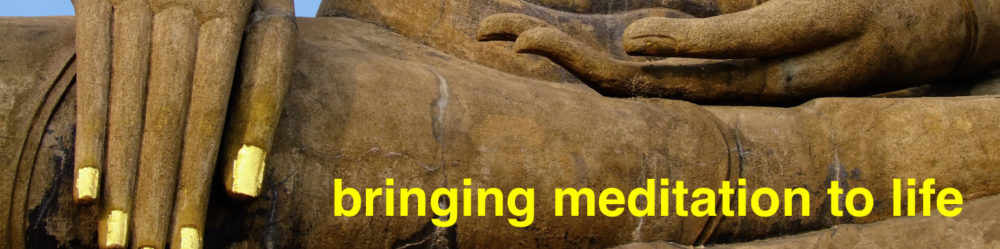
Buddha was a student of life who woke up and became a guide for the beings caught cycles of suffering. Buddha was able to bridge awareness of our sense of self and the interconnectedness of the life around us. Buddha means “awake” and so THE Buddha means the awakened one, although I’m not sure Buddha would have made that designation. One day the prince woke up to the understanding that their life was interconnected to all life around them. They renounced station and status and simplified their journey to the elemental, existential aspects of being. They sat beneath a tree in exhaustion and surrendered the inner wars waging within. Then Buddha simply awakened. When asked what brought about their deep serenity, they simply said, “I am awake.” I am Buddha. And from that vantage, Buddha was able to understand the complexity of human suffering. He despaired of being able to convey that. Buddha’s loneliness became aloneness, as their confidence grew. Buddha was willing to be alone in the company of humans in order to connect to them. This aloneness and deep understanding was shared by great profits. Jesus and St. Francis were guides who lead humans from shadows in a cave to a life of service in the world.
In the Buddhist tradition, we speak of “enlightened beings” or “Bodhisattvas” who dedicated their lives to leading others from the suffering of ignorance to the great understanding of awakenment. And the greater their understanding, the more alone they were. It is interesting that connecting to all life puts us on a plane that we are less accessible to the programmed lives of those around us. If we surrendered our personal greed, we may wake up and see that we are part of everything else. It seems a fair trade off. Yet, that awakening might be another trap if we don’t surrender our personal space and dedicate our understanding to others. This evokes a conundrum. Caring for others is dependent on caring for ourselves. Kindness to others is dependent on kindness to ourselves. So, it becomes integral to our path that we begin to see when we are making ourselves strong in order to care for others, and when we are self centralizing and agranding ourselves. I think of the Buddha eating rice and milk before awakening, or Christ searching his spirit and confronting the antagonist in the desert, as a necessary precursor to helping the world. The great Bodhisattvas of our human age at some point were ready to dedicate themselves to leading others away from the conditioned dungeons of our projected lives into the wakeful sanity that is our potential.
By understanding that much of what we believe -and take for granted us truth- has been programmed by nature and nurture. The basic survival instincts of maintaining our life in a dangerous world, might be seen as a tool that when we become conscious and conscientious we can see as a language we might employ to communicate with others. If we speak Russian, we are more able to understand a Russian person,we might better fall in love with them and feel their pain, but we don’t become Russian and lose ourselves. A guide has one foot on the shore and the other with those being guided to safety.
 Helping ourselves we are more able to develop the clarity and strength to help others. Should we fall into self aggrandizing self importance we lose balance and fall into the river. THen if we surrender we can allow someone else to help us along. This seems to be the process. When we awaken into compassionate interconnection to life, we naturally care for the life around us. And that connection supports us as well. Of course we falter and sometimes fall. But we can learn that our ego is the part of ourselves that needs more and compares itself to everything else. We can recognize that ego is a defensive state that has been programmed to hide in the darkness. Try to make ourselves strong in order to best someone else feels good for a moment, but it is never enough and will never last. When we manifest strength by caring for others we gain a confidence that nurtures a part of us that lies deeper than our programming. With kindness to ourselves and others we nurture our basic goodness that has been there always. We have always had everything.
When we give up placing ourselves at the center of life, we are, in turn, gifted with all of that life. When we let go of our self-importance we are part of everything else. But that is a lonely road different from the ways netflix and our society encourages us. Being a Bodhisattva does not exempt us from suffering. Chris Bell was a sad and misunderstood soul who before his death wrote a song with the heartbreaking line “every night I sell myself I am the cosmos, I am the wind. But that don’t get you back again.” The bodhisattva never outruns suffering. They simply learn to not cause more suffering. The Bodhisattva helps others to learn the importance of not causing harm.
Not causing harm is a powerful action. The earth is incredibly regenerative. If we can stop waging war, life will regrow. And if we cannot, we may not survive. But I believe life will still be there. Some other form may arise to take the mantle. So we should be kind to all beings. They are supporting us whether they know it or not.
 Of all the distractions in my life, my mind is the most seductive. I am perpetually engrossed in my thinking to the extent that if I was not a meditator, I likely would reside full-time in my head. While our minds are amazing tools, being lost there keeps us from accessing its power and potential. When I am lost anywhere, I am sucked into a part of my mind that cannot see beyond itself. This is to say I lose awareness. When I am unaware I am missing the beauty of my mind and my life. By cultivating UNawareness, I am putting my head in the sand, making myself vulnerable to danger. When I am not aware, a deep inner part of me becomes frightened. My reveries take on a paranoid hue as I succumb to anxiety about the future and regrets of the past.
 This was the worst attack upon the Jewish people since the 2nd world war. It will precipitate an intense retaliation which will rock the foundations of world security. All this is happening in the shadow of the invasion of Ukraine that had shaken the world. AIt is also a time when technology has created more awareness and nuance than ever before. The world is either waking up or falling fast asleep. Or perhaps both. We have the setting sun approach turning toward darkness counterposed with the rising sun view of opening to possibility. We can take either position. We can take the easy approach of blaming a group and wishing for their eradication or we step back and try to see more clearly with eyes of healing and compassion. And just like any of us waking up on a spiritual journey, we will see harsh realities along with positive development. It is important not to latch onto solid propositions. As we develop spiritually, one of the things we are waking up to is the horror we are capable of inflicting.
 As we journey up the mountain our view changes. We begin to value possibility. Instead of defensive protectives, we start to see the commonality in all humanity. We see that we are part of a greater whole. We are part of an experiment by the cosmos to develop wisdom and begin to see itself. But in order to do this we have to understand a very simplistic binary: acknowledge the mind that keeps us locked in suffering, but follow the higher mind that leads to clarity and strength. While the shadows of our past are still an influence, we can develop the power to look ahead toward a bigger view. No one looks out from the top of the mountain and says, “this sucks”. Sure, we may see all the refineries and junkyards but the view from above is nonetheless beautiful. In time, we will see more of the war and hatred people still rage upon themselves. But we will also see trees growing and life blooming. All of life needs to defend itself, and all life yearns to grow. This higher mind cares naturally for the world. And even as it hurts deeply for its suffering it rejoices in its liberation. We are evolving.
 In the 90’s I lived in a meditation center in the Rocky Mountains. What was then known as The Rocky Mountain Dharma Center, was based on the Shambhala Buddhist Tradition and catered to a variety of communities. Each year a group of college students from Chapman University in California came for a 10 day immersion in the healing arts we called “Ancient Wisdom, Modern Madness.”Or program introduced a variety of ancient traditions from Buddhist teachings of Trungpa Rinpoche and Sakyong Mipham to the African tradition of Malidoma Some’. The director of the program was Michele Killoran, who was to become a major influence on my life. She had been leading the “Chapman Program” for a decade, when she picked me to be her successor. I was very new to teaching but my youth gave me entry into the students’ trust and heart. I immediately felt a kinship with them. And this was the first principle in the healing circle: trust born of heart connection.
 MIchelle showed me the notion of the self-healing, self balancing community. Buddhists call this a mandala. Many indigenous traditions employ this principle, or their version of it. The mandala denotes a community or an environment that organizes around a primary principle. That principle may be a fire, a mountain, a lineage, a teaching, or an idea. In the Chapman program we used Wisdom as our organizing principle. Whatever tradition we introduced, we were looking to use it to develop wisdom. Wisdom is not knowledge. Knowledge is the map. Maps are important but they are the not the and they represent. The Buddhists talk about fingers pointing to the moon. The finger is not the Moon. Truly seeing the moon, as we would at the RMDC on high alpine nights, is an experience. It is contact with something we can never own. Wisdom is knowledge married to experience. It is knowledge that happens within us. Wisdom changes us. In the Tibetan Buddhist tradition we refer to transmission as an instantaneous download of wisdom that affects our body, spirit and mind. A given student might experience transformation in a moment or over time. The ones who were open might experience a transmission from launching a bow in Kudo – a ceremonial Japanese archery, or from a rebirthing ceremony with Meledoma, in the sweat lodge or a fire ceremony. The transmission might occur in meditation, when we come back to the breath. If we are open enough transmission may happen as we notice a falling leaf or hear a bird sing.
 Years later, in New York City I met a woman named Jaime. She seemed a younger version of Michelle, with flowing gold-woven hair and piercing bright eyes. She was a student of mine, who quickly became a colleague and finally my teacher. She was a shooting star that illuminated my life and then touched down in darkness, leaving waves of her benign effect on the world. She was our original co-teacher in Dharmajunkies, a group we founded on the idea of the sacred community circle. Jaimie and I taught together weekly on Monday nights and her heart touched everyone who came into that circle. Jaimie instructed us on how to speak with each other in ways that opened hearts and fostered heartfelt communication. Like Michelle, Jaimie was gentle and tough. She ushered our group away from competition and comparison. She taught us to support each other by maintaining an awake, loving space. She taught us deep listening. She gave us the strength to be a community based on individuals who, like her, were entirely, completely, unapologetically themselves.
 Jaimie was on vacation in Hawaii when she slipped on rocks overlooking the ocean, fell to her death, and was swept to her grave by Namaka, goddess of the sea. The hole she left in my heart will never be filled. Perhaps another key to the healing circle is that wounds need not be healed. That space need not be filled. That all is blessed just as it is. I suppose it is our work to remember that. Who are we bending ourselves to be? Who are we apologizing to? To whom are we explaining ourselves? And why?