TALKING TO MYSELF

Making Sure I’m still here

I was riding in the car with a friend. After a time we had fallen into silence. I found myself having an imaginary conversation with a brother who lived on the other side of the continent. I’m an Italian American, so I talk to myself with my hands. My friend glanced over and asked, “Are you winning the argument?”

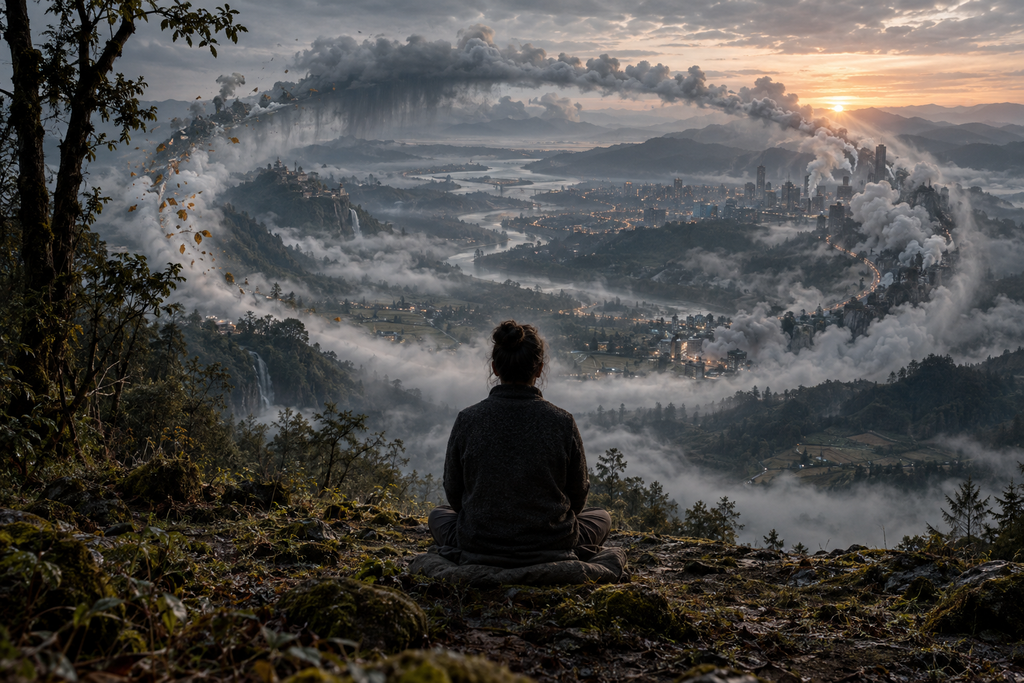
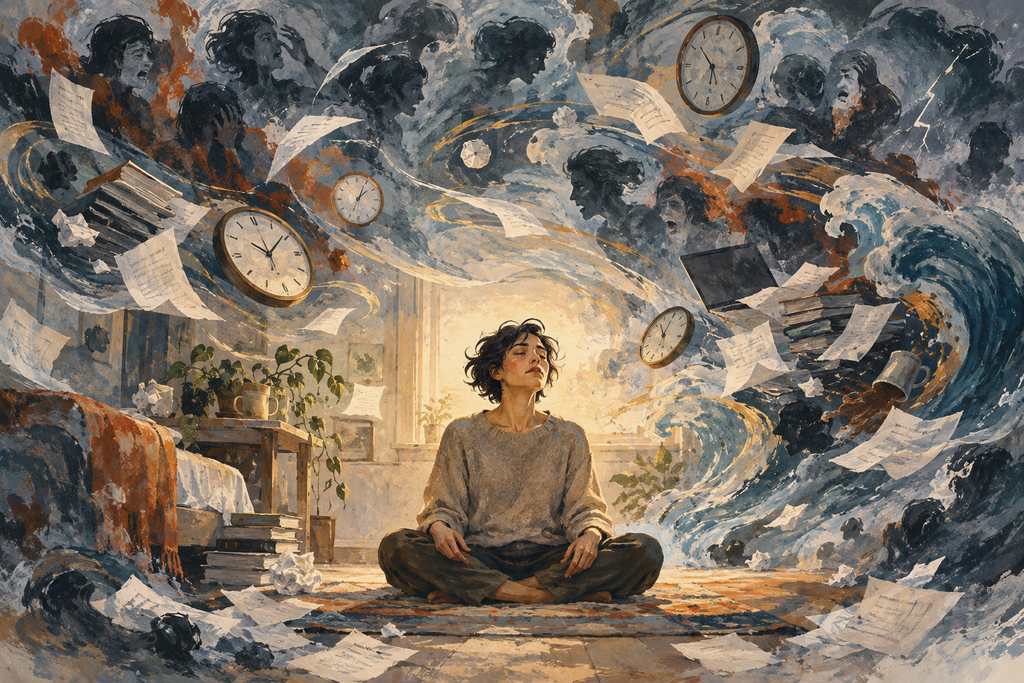
Having done a number of lengthy meditation retreats, I’ve had the opportunity to see my mind in different contexts. When we spend enough time sitting quietly, something interesting happens. We begin to see our thoughts without automatically becoming part of them. Something like looking out the window of a high rise at pedestrians scrambling below. The activity continues, but we are no longer caught in the chaos.

What surprised me from this perspective, was how damned crowded my mind seemed. Although I came to understand that the very act of seeing my mind from an objective perspective meant that I was accessing the open space of my mind. That was the vantage that allowed me to see the overcrowded streets below. And I saw that the preponderance of the crowding wasn’t brilliant ideas or profound insights. It was rote, repetitive narration. Endless thought streams in which I was explaining, defending, proving, correcting, and justifying… something. To someone. For some reason. The loudest conversations were defensive. I was making points to people who were not present, defending myself against accusations that weren’t being made, and winning arguments that never actually happened.

Then again, none of it was really happening.

I began to notice how much psychic real estate I had been giving to these internal debates. Within the enormous landscape of my mind I had selected the same arguments – or the same kind of arguments – repeatedly. Each discourse consumed me so thoroughly that there was little room left to experience life as it was actually unfolding.

Without space for fresh experience, all we really see are reflections of our own ideas. And most of the time those ideas had me at the center. “This is what happened to me” “This is how I was offended.” “This is who I am.”

“This is me.”

Perhaps what we are doing when we talk to ourselves is trying to prove that we exist. Descartes famously said, “I think, therefore I am.” He meant that the very fact of consciousness proved existence. But somewhere along the way, many of us began to believe: I think, therefore this is all I am.

We become identified with the commentary.

The strange thing is that our thoughts mostly tell us what we already know. They recycle familiar experiences, familiar fears, familiar hopes, familiar resentments. We return to them again and again, as though familiarity itself were a kind of refuge. Even when the stories are painful, they are comfortable because they are the devil we know.

Meditation practice offers us the mental space to notice this process. One of the most important moments in meditation is not achieving tranquility or reaching some exalted state. It is simply noticing that we have become lost in thought.

That moment is huge.

And then, of course, in time we might develop the willingness to return to the present. In time, consistent practice will build the neural pathways that will change our allegiance from escaping into interwoven narratives of habitual thinking to actually living in the present.

For years I believed my thoughts completely. If I was anxious, I became the anxiety. If I was angry, I became the anger. If I was defending myself in some imaginary courtroom, I became the defense attorney, the prosecutor, the judge, and the jury. I would stay up in bed cycling through what I should have said or what I might have done. This is our mind as a defensive tool trying to save us from imaginary evil.

Now, when I catch myself caught in one of those internal arguments, the first step is very simple. “This is just a thought.” Not a revelation. Not reality. Just a thought. I don’t layer a better thought over a limiting idea. Thoughts are thoughts are thoughts. A radio prattling in another room.

And simply noticing them is the result of the neural pathway development from meditation practice. We will begin to see when we are escaping into thoughts, arguments, complaints. And we begin to see that we have a choice to turn from that.

Thinking is not the totality of our mind. To say that thought is the whole of mind is like saying that the foam floating on top of a lake is the entirety of the lake.

There are depths beneath the surface.

There is a vast open sky above.

Yet many of us become frightened when we begin to glimpse those depths. We hear teachings about ego or no-self and immediately interpret them as attacks on our existence. We defend ourselves because our sense of self feels precious and necessary.

And in many ways it is.

But perhaps there is a difference between having a self and constantly proving that we have have a self. Maybe there is nothing to prove.

Meditation practice offers glimpses of possibilities beyond our usual patterned thinking. When the body settles into the present moment and the mind settles into the body, windows begin to open. We start to observe not only the content of our thoughts but the process itself. We see thoughts forming, dissolving, and reforming. We see the machinery rather than just the product.

And occasionally we encounter something we might find unsettling. Openness. Not the certainty, not the answers or schemes or solutions that our habit-mind presents. But openness. People often rush to fill that openness with new stories. We think we’ve seen God, glimpsed a past life, discovered a hidden destiny, or uncovered some cosmic secret. Maybe sometimes those things happen. But more often, I think we are simply rushing to replace one story with another.

The truly challenging aspect of meditation is not that it reveals something extraordinary. But that is reveals what we do not know. It brings us to the edge of fresh experience rather than recycled experience.

I’m reminded of a Monty Python sketch. The son is standing at a window looking outside. His father stands behind him and says, “Son, someday all this will be yours.”

The son replies, “What, the curtains?”

The father sighs. “No. Look beyond the curtains.”

“Oh,” says the son. “The window?”

That is often how we live. We spend our lives staring at the curtains of our own thoughts while an entire world waits beyond them. Meditation does not ask us to destroy the curtains. It does not ask us to silence every thought or win every internal argument. It simply invites us to look beyond them.

To stop seeking constant reassurance from the familiar stories of who we are. To rest, if only for a moment, in direct contact with ourselves and our world.

Stability. Clarity. Strength.

Daily Practice Changes Everything

There’s a feeling we all have that the more triggered we are, the greater the remedy we need.  Therefore, we often overlook very basic and fundamental tools that help us regain and maintain emotional balance and mental clarity.

Being triggered affects our stability because the experience compels us to react. Often reactions happen too quickly for us to be mindful. We are, in essence, lashing out blindly, not unlike flailing about in a canoe.  But just as we might regain balance in a canoe, we can reset ourselves in life.

Before we do anything or believe anything, we can come back to the present and reset our ground.  Stability is key.


Stability

It is the basis for mindful (read: effective) actin. Once we have stability, the mind can settle, feeling more comfortable in the space our body inhabits. From settling comes clarity. And clarity, grounded by the stability of being fully in our body, affords the strength to navigate difficulty with balance and poise.

When we feel threatened or overwhelmed, the best first step is to recognize what is happening before we try and fix anything. What is happening right now? Is this fear? Doubt? Confusion? Anger? Frustration? Inadequacy? The answer is not nearly as important as asking the question. This is because when we’re triggered, it is a younger, sometimes ancient part of our system that becomes engaged. That part of our being may not have access to the language, training, and understanding that our higher mind enjoys. By simply recognizing that we’re triggered we begin to calm the nervous system. The effect may be temporary, but it opens the door to further engagement through self-compassion and awareness.

It is essential that once we recognize we are triggered—experiencing fear, doubt, confusion, perhaps all of these at once—we accept what is happening. Acceptance is not resignation. It is simply acknowledging the reality of this moment without immediately projecting into the future or revisiting the past. Future and past are always speculation that leads to unhelpful narratives. Instead, our meditation training, enables us to look directly at what we are experiencing now. This begins to loosen the bondage of suffering.

Looking at our experience allows us to feel into what is actually happening within us – what we are unwittingly doing to ourselves.  We do not need to come to firm conclusions. We do not have to explain anything away. We simply notice, feel, and accept.

By allowing ourselves to feel and accept the present experience, we begin to find the inner space to settle. With daily meditation practice, specifically shamatha practice, we train the mind away from clinging to reactive states and return ourselves to the balance we can only have in the present.

Coming back to the present when we are triggered is an ongoing process. Just as in shamatha practice, we go away, notice, remember, and return. We may notice tension in the body—tightness in the belly, constriction in the jaw, heaviness in the shoulders and neck. This awareness develops through mindfulness of body cultivated in meditation practice.

Recognition followed by acceptance has a neurological calming effect. It may only last a moment, but we don’t need to chase outcomes. Instead, we work with – by returning to –  the direct experience of suffering in the present moment. We feel the elevated heartbeat, the confusion, the tightening, without immediately extending it into narrative.

This can be very simple. But, one of the ways we miss the mark is by believing the stories in our mind, especially catastrophic projections. We become so frightened that we assume there must be a dramatic and immediate response. Yet often the most effective response is simply recognizing that we are being pulled away.  The world is ending – just return to the moment. My life is heading for disaster – simply return to the moment.  None of this is how I imagined it would be – return. Return. And by returning, we release ourselves from the panicked grip in our body and mind and regain our balance.

When we are triggered, frightened, or thrown off balance, we are no longer reliable witnesses. The mind begins feeding us fake news. So rather than following every conclusion and projection, we return to what is actually happening now. We address what is real and immediate: the tension in the body, the racing heart, the fear, the confusion. By boycotting the complications we construct, we gradually find stability. Then, like water held still long enough for sediment to sink, the mind becomes clear.


Clarity

At some point we become reliable witnesses once again. This is trusting our wisdom mind. But to do this we may have to gently acknowledge and let go of the panicked mind. The wisdom mind is quieter, subtler, and less reactive, which is why it can be difficult to access when we feel threatened.

Our first impulse is rarely to calm down and relax. Yet by turning away from mental complication and returning to breathing, recognition, and acceptance, we stabilize. Stability is the necessary prerequisite for right action. Before the mind can be clear, the nervous system must become relatively calm.

When you are overwhelmed, do not fight with the mind or attempt to think your way through panic. The mind that creates the complication cannot solve the complication. Letting go of the panicked mind and returning to the body allows the mind to settle and clarify on its own.


Strength

Once we are stable and the mind is clarified, we become reliable again—not only as witnesses, but as supports for others and as compassionate human beings. We develop the strength of someone who is not shaken and who knows when to respond and when not to respond.

This is great strength.

This strength allows us to navigate the world and respond in ways that are actually helpful. My teacher mapped out the logic of shamatha practice very simply: stability leads to clarity, and clarity leads to strength.

Shamatha is simple and subtle. In many ways it can seem inadequate compared to the intensity of our emotions. But that is precisely why it matters. We are boycotting the dictates of panic, ego, and self-will, and opening ourselves instead to our basic goodness and the inner strength that can actually carry us through.

We notice the impulse to escape, fix, or react. We recognize it, accept it, release it, and return once again to the breathing. The breathing relaxes the nervous system, and as the nervous system settles, the urgency to fill the space begins to dissolve.


The Importance of Daily Mind Training

Looking at a depiction of the Buddha, you can sense their stability clarity and strength. This is, of course, due to the fact that we are seeing a picture or statue. But, we are people, flawed and insecure but able to train ourselves toward this process by noticing, accepting and returning with no hope of an outcome.

At some point, the mind of Buddha nature will dawn within us.

This is where we come back to. This is what we are training to recognize.

WALKING THE WARRIOR PATH

Good and evil.

What cosmic narcissism to be the center of everything in the moral universe.  The classic trope of the good angel on one shoulder and the bad angel on the other with us caught in a struggle between ultimate good and ultimate evil. Many of us continue to live under the weight of these outsized beliefs.

I suppose this makes us feel important.

While the universe contains extreme temperatures and vast distances, there are no definable poles. Each point in the universe is equal to any other. Anything we measure is dependent on position. Good and evil, like all else in our universe, are relative to situation and circumstance. Nonetheless, relational binaries abound in our consciousness. They are ingrained in us as good versus evil, left versus right, wonderful versus horrible. We live squeezed between exaggerations, limited by beliefs with scant logic. I suppose binary extremes offer us a comforting sense of place. But they also imprison us in that place.

The problem arises when we turn these guideposts into solid truths. When we make our point of view solid, we end up judging everything by that imaginary metric. That point – which we come to believe is right – becomes a center by which the rest of the universe must confirm to. But just as cosmology grew from the belief that earth was the center of the solar system to an understanding of the inter-dynamics a complex universe, so our Buddhist path leads us from the limited view of our ego, with its opinions and prejudice, to understanding how we are a part of everything.

Buddha taught that truth lies between extremes. Or you might say everywhere between extremes. Calling it the “middle way,” the Buddha was turning us toward the idea of being present in life and trusting ourselves to do what is needed in the moment. The Twelve Step traditions refer to “doing the next right thing.” According to the Buddha, the next right thing is specific to the moment and its circumstances. Of course, this is predicated on clarifying our view. The role of meditation and the Eightfold Path is to train the mind to rest in the present, allowing clarity to dawn. That clear seeing disabuses our self-centeredness and allows us to see what is best for all.

The middle way is based on what is actually happening. We can point to the middle way each time we recognize an extreme belief. “This is not right,” we might say. But is that true? Are there opposing points of view? Is there nuance? What is actually happening if we strip away judgment? Then the next right step becomes clear. Buddhist thought suggests that our largest view — the view with the most room for ourselves and everyone else — is to be compassionate, open, and helpful to the world. That’s not dogma. It’s not absolute. It is a recommended direction. Then our provisional binary might become: “Is this next step leading me toward that view, or away from it?” This is a more practical binary because it relates to what we are doing in the moment, not to what everyone else should be doing.

In order to do this, we would do best to loosen our grip on needing to be right. The need to be right is a trap. My music, my movies, my politics, my religion, my point of view — these all feel like truths to me, but they are opinions. My opinions. You may feel differently, but sharing our differences openly, without coercion, is a great way to learn and grow. I don’t have to give up my feeling that the Beatles were the best band in order to remain open to understanding how much you love electronic dance music.

Once we let go of exaggerated extremes, loosen our judgments, and release the need to be right, we can begin to see clearly. But where are we heading? As with everything on the Buddhist path, we come back to the present moment. The next right step is one step. Frequently, this is all we need to do in order to reset. We catch ourselves rushing toward a conclusion, stumble, notice, and come back. Here are my feet on the ground. Here is the next step.

But where are we going?

Each step may lead toward or away from our destination. This is our provisional binary. But each step is not the destination, and the destination may not resemble the next step. We are remarkable beings. We can chew gum and walk at the same time. We can know where we are heading while still paying attention to the steps needed to get there. We can hold the larger view and let go of it enough to be here now. There is no contradiction in that.

However, it is important to remember that the steps are actually happening, while the destination is still unfolding. Or not. We make plans, and the universe laughs. So the destination is not holy. As Peter O’Toole says in Lawrence of Arabia: “Nothing is written.”

That means the path is open. And the warrior is brave enough to face it. In Tibet they say “Pawo,” which means brave. Brave enough not to be right, but wise enough to be accurate. The universe is a vast place. We can map out provisional, imaginary points to guide us, but we do not need the limitation of making them solid. We can stay open, keep our eyes ahead, and feel our feet on the ground.

This is walking the warrior’s path: open, available, holding on as needed to steady ourselves, then letting go, taking the next brave step and being present to support the life that calls us.

HONORING THE MOTHER LINEAGE

By Nurturing Our Natural Kindness


I wanted to reach out in the spirit of my mother, who passed a few years ago and for whom I will always carry a quiet torch. In many ways, she was the great love of my life—a spiritual guide, a dear friend, and a near perfect mom. Trudi, as everyone knew her, was a relentless acceptor of everything in life, including me—her damaged, broken boy soldier, ever faithful, yet rarely grateful.

Like many children, I accepted her for the blessing she was, but never realized how rare that was, or how lucky I was. If there is any part of me that is loving, kind, and accepting, it is my mother still alive in me.

We grew up around a tight-knit Pentecostal church. She was the preacher’s kid, and the only boy who could reach her was a rough, arrogant Spaniard with a world to conquer. Everyone loved “Boy,” as he was called—charming in the way of men for whom the world is opening. Years later, I found a new familial community rooted in an American form of Tibetan Buddhism. My mother cried as she drove away, leaving me at a mountain retreat center blanketed in snow.

In Tibetan Buddhism, we speak of mother and father lineages. While equally important, they are understood differently—not as men and women, but as essential energies within each of us.

The father lineage is seen as creator and protector. The mother lineage as nurturer, holder, and the great agent of understanding that speaks from heart to heart. In many traditional cultures, men traveled and taught, while women held together the fabric of family and community.

My family, unknowingly, echoed this. My father traveled—first as a soldier, then as a businessman—while my mother, who also worked, carried the responsibility of raising us. It was not an easy life for either of them.

I lived in Baltimore during the riots, and as dangerous as those streets could be, the violence often softened when grandmothers stepped out of their homes. I still remember the image of a grandmother scolding a cowering grandson. The mother lineage need not be overshadowed by the father. Ideally, they work in tandem.

During times of difficulty, returning to the sense of protection associated with the father, and the nurturing and connection associated with the mother, can be deeply supportive. This is something we can carry within us.

The image of my father as protector, while potent, also evokes a sense of competition within me. This may be natural for boys and fathers of my generation. But I never worked well with competition. I tried to best others and spent a lot of time in aggressive disconnection. That was not necessary.

I saw my parents as separate and never appreciated how they might be conjoined. As a result, those energies have not been fully integrated within me. I feel deeply and care deeply, but I also fight and compete where it isn’t needed. Perhaps learning to unify these is my life’s task.

It is my view—and the view of the practice I’ve been given—that we begin to resolve the masculine and feminine within our own minds. We do this by recognizing the generosity of these energies, and how fortunate we are to have known them through others.

When times are difficult, we do not have to forget the softness, kindness, and compassion of the mother. When times are generous and forgiving, we do not have to forget the discipline and uprightness of the father.

I want to offer the idea that we can find calm in the storms of our lives and in the storms around us—that this calm and openness is itself an expression of strength. We can rely on our strength without losing our heart, and open our heart without losing our strength. The union of mother and father is strength.

The openness of the mother, protected by the strength of the father, allows us to find stillness in the midst of turmoil.

In remembering my mother, I feel again the presence of that balance—already here, already alive within me. I feel held, reminded that I do not have to do this alone. Something softens, and something becomes steady.


IN THE EYE OF THE STORM

Choosing Peace in Times of War

These days many of us describe our world as crazy, cruel and chaotic. It seems socio political dysfunction is a common experience.  This lack of stability in our outer reality understandably influences our inner health and wellbeing.

When our mental health is attacked, even the pressures we normally face seem might amplify to catastrophic proportions. Our emotional tolerance becomes compromised and we fall prey to any number of adventitious afflictions such as depression, anxiety, compulsive thinking and extreme beliefs. Our kneejerk solutions may be to arm our hearts with corresponding violence or check out in retreat. But these kneejerk reactions are not intentional. They are not mindfulness.  They only add to the confusion.

However, there is a place within experience that is not at war with what is happening. This experience of space allows, what Tara Brach calls, “radical acceptance.” Radical acceptance is not acquiescence. It is not supporting, nor is it ignoring. It is the simple and powerful act of facing what we face. Before we can take the right action to help ourselves or our world we need the emotional balance to see clearly.

This is not a poetic idea. It is not something we manufacture through strength or rigidity. It is something we discover—often accidentally at first—in the middle of chaos. A space within where, despite all the  movement around us, something is not moving. Despite the noise, something is not making noise.

We might talk about basic goodness or Buddha nature—not as something elevated or distant, but as something so immediate we often overlook it. It’s not reactive, it’s an open space that births an inner kindness that is so powerful, yet hard to grasp. When we are punched in the gut, our first reaction is not to relax, be kind to ourselves and open to our natural stillness.  Our kneejerk is to grip and harden, not open.

It is so important that we train the mind away from its tendency for gripping reactivity toward the open space of mindfulness. That may seem crazy, if we believe the craziness around us.  But in the midst of chaos is a space that offers the capacity to be aware. And within that space, knowing each experience as it arises.

This knowing is not disturbed by what it knows.

Thoughts race. Emotions surge. The body tightens and releases. The world presents itself in all its complexity—joy, sorrow, fear, beauty. And yet, the awareness of these things remains open, ungrasping, and fundamentally undamaged. The problem is not the storm.

The problem is that we believe we are the storm.

We identify with the movement—“my thoughts,” “my fear,” “my situation”—and in doing so, we lose access to the space in which all of this is occurring. The eye of the storm is not something we create. It is what remains when we stop trying to follow everything that moves.

So how do we find this eye?

Not by stopping the storm.  This is where the path becomes both simple and confronting. We are so conditioned to improve, adjust, and control our experience that the idea of not doing that feels almost irresponsible. But the practice here is not passivity—it is precision.

We begin by taking a seat.

Literally, in meditation, we sit down. We place attention on something simple—often the breath—not as a solution, but as a reference point. Something stable enough to return to as the mind moves. The instruction is deceptively basic: notice when you’ve wandered and just come back.

But what we are actually doing is far more radical. We are learning to see movement without becoming it. A thought arises—we notice it. An emotion surges—we feel it. A memory, a plan, a judgment—we see it pass through. We don’t need to suppress it. We don’t need to follow it. We simply return.

Again and again.

At some point, something shifts—not because we forced it, but because we stopped interfering. We begin to notice that there is always a gap. A moment of simple presence before the next thought takes hold. A space in which experience is vivid, but not solid.

This is the beginning of discovering the eye.

Off the cushion, the practice deepens. In conversation, in conflict, in the rush of daily life—we notice when we are pulled into the storm. The tightening, the urgency, the need to assert or defend. And then, if we can, we pause. Even briefly. We feel the body. We hear the sounds around us. We recognize the movement of mind as movement, not identity.

So how does this help anything?

This is not about withdrawing from life. It is about finding the balance to face life without losing our seat. When we are no longer trying to control or escape our experience, we begin to meet it more directly. The sharpness of pain, the warmth of connection, the unpredictability of life—it all becomes more vivid, not less.

But there is space around it. This space allows for compassion.

If we are no longer overwhelmed by our own storms, we can begin to sense the storms in others—not as threats, but as shared human experience. The anger, the confusion, the grasping—it is no longer foreign. It is recognizable. And from that recognition, something softens.

This recognition is not disturbed by what it sees because it is resting in basic goodness.

This is what it might mean to “live in peace while witnessing war.” The eye of the storm is not an escape from the world. It is a way of being in the world that does not amplify its chaos. And perhaps most importantly, with mindfulness, it is always available. Not later. Not when things calm down. Not when we finally get our lives together. Right here—in the middle of whatever is happening.

Stop trying to outrun the storm. Take your seat. Don’t follow anything. Until you do, then just come back. Let it settle. Stability allows an opening to clarity. And clarity opens to the possibility of right action.

Right action is the first step to compassion where we thought none was possible.

PLEASE RELEASE ME

The Joy of Letting Go

Learning to let go is important to our health and happiness. Letting go is releasing into openness, rather than creating tensions that to shut us down. But letting go is not getting rid of anything. It is not pushing anything away. It is simply releasing our stranglehold on the things to which we’re clinging. Sometimes we cling out of routine habit and sometimes we lunge in an existential panic to prove we’re here. I obsess, therefore I am.

Our near constant gripping and appropriation causes pain, not only for ourselves, but also the objects of our gripping. We keep the things we love strangled and imprisoned within our projections. We don’t see these captures; we see our idea of them. So even when we get what we think we want, it’s not what we have.

We cling to things we want. But we also cling to things we disdain. Whether we want or want to not want, the result is the same. We have forged an attachment with something we’re holding too tightly to see.

Attachments are often the boogeyman in Buddhist thought, but not because what we attach to is necessarily problematic. It’s because attachment creates a stickiness that keeps us from moving through situations with ease. We get stuck, as Pema Chödrön would say.

The primary binary—like/don’t like—reduces life to a two-dimensional experience. But in truth, the things we hold can trap our mind in cycles we never grow beyond.

Letting go is dropping the struggle. It doesn’t mean getting rid of anything. It’s not self-denial, nor a denial of that which we hold. Letting go is simply releasing our relentless effort to keep things in place. When we are able to release our tension, its as if we are able to open into a space of clarity. We love more truly when we allow the things we love to be themselves. We are able to protect ourselves more readily when we see what is actually there.

That sticky quality of mind—our attempt to appropriate what we see and hold it in place—keeps us emotionally tethered. The things we cling to keep us from seeing alternatives. If we have the openness and bravery to experience life as it is, rather than clinging to what we like and pushing away what we don’t, our world becomes three-dimensional.

To live a life of openness, we need to develop the bravery to open. This is more natural than clinging, so when we open, it feels like a release—a return. We can’t create openness; we can only open to it. On the other hand, we do create the blockages that keep openness at bay.

The practice is to notice the impulse to grasp, recognize it, accept it as the habit of the mind, and then release it.


Who are we without the things we cling to? Who would we be without the tethers we create?

Life is leading us down the river of time. There are challenges and dangers along the way, but also a great joy when we let go. Regardless, we are heading toward a waterfall we will not navigate. We are all final girls in this horror show. But along the way, if we are too frightened to open up, we will be trapped without ever appreciating the joy of our journey.

If we let go into the beauty and the tragedy of our life, we may find peace along the way. And when the time comes, perhaps we will choose to be present for our final letting go.

Letting go is not getting rid of anything. It is, in fact, accepting everything—allowing things to be as they are.

We are greedy. We want, and we want, and we want. That’s okay. The question is: can we stop grabbing? Can we stop harming? Can we stop appropriating?

Learning to accept what is here as enough—and experiencing the joy in that.

CRYING TO THE SKY

The Role of Prayer in a Non-Theistic Tradition


Buddhism has largely been divorced from the idea of an overseeing creator—someone to whom we can supplicate, someone managing our experience, someone to yell at us when we’ve gone astray. This is called Theism. Turning an object into a thing that, in turn, becomes a solid reference.

Refuting the existence of God, as we know, is called atheism. Sometimes atheists can be more dogmatic than theists, turning a non-thing into a very solid proposition.

Then there is a story of the Buddha, when asked by Indian scholars why he did not refer to a god. Buddha reportedly answered, “Because that’s not important. This was not a denial of gods. It was a repositioning. By placing the question of a deity into the realm of theology, he freed himself to be a teacher, not a priest. This was his great reformation. And this is what we call non-theism.

As Buddha removed the idea of a spiritual hierarchy he placed responsibility back into the hands of human beings. The gods were not the issue. The issue was how we wake up in this life right now.

But what if I simply want to pray? 

When I am faced with confusion, reaching out to something feels important. When I have failed myself—as I have, repeatedly in my life—it would make sense to look beyond myself for solace.

Before I came to Buddhism, I would fall into treating God like my butler. Someone to do my bidding when difficulty arises. I’d ask for this, ask for that—often with more demand than humility. And when I didn’t get what I wanted, I’d recoil in a huff, turning the name I once called in reverence, into a curse.

It would seem I was invoking a codependent, rather than empowering, relationship.

The point of Buddha’s teaching was not to establish a system of divine dependence, but to guide people toward leading themselves on the path of awakening. Nonetheless, I have secretly envied the certainty of deeply religious people. I am moved when I walk down a busy street and see someone kneeling in prayer, facing Mecca. I am struck by the conviction of those who feel aligned with a power they trust completely.

Non-theism is not a denial of god. It is a refusal to rely on a deity as a solid, external savior. Instead, it suggests that when we call upon something beyond ourselves, we are co-creating an experience between our mind and the wisdom beyond the conceptual limitations that mind. So, praying to the sky, indeed crying to the sky in sadness and frustration, with the hope that we can go beyond ourselves is actually a very practical method.

When I am in states of confusion or despair, praying to Padmasambhava gives me relief. It gives me orientation outside of my habitual patterns. Over time, this has developed into a kind of faith.

But it is a practical faith.

I don’t assume this process would work for everyone. I don’t believe it is better or truer than any other object of prayer. It is personal. A gateway. A way of stepping beyond myself and receiving.

The non-theistic view suggests that we can use the idea of a deity—or prayer itself—as a gateway to access something larger. If someone believes wholeheartedly in a deity and finds strength in that, then that’s great. Buddhism has not rejected these forms. And although in its fundamental form Buddha’s teachings turned away from reliance on a deity as the teachings spread, it adapted and changed. In Tibet, for example, figures like Guru Rinpoche (Padmasambhava) were said to transform local spirits—forces of fear and chaos—into protectors of the Dharma.

Whether taken literally or symbolically, the message is clear: what is frightening, chaotic, and unknown can be transformed into something that supports, even protects, our path.

That is deeply compelling to me.

So yes—I pray to Padmasambhava. Not because I believe in a solid being somewhere granting favors, but because I have faith in the transformation of darkness into awakening.

When I am lost in confusion, doubt, or fear, I remember my teachers. I remember the Buddha. And sometimes I call out—to Padmasambhava, to the sky, to something beyond myself. My work is to find passion in a belief that opens to possibility rather than narrows down on expectation.

Whether I visualize a deity, a teacher, or simply cry to the very sky amounts to the same thing. Rather than limiting my prayer to a fixed, external god I am asking for guidance to step beyond myself.

Buddhism tells us to rely on ourselves, why do I still feel the need to pray?

Because I have run afoul relying solely on myself. So I ask for help. And the simple act of asking opens the gateway to a greater possibility. And rather than limit those possibilities to my own usual thinking I’m simply opening with the question.

Not expecting reward. Not demanding results. But praying to the open sky – and the loving spirit of the universe – removes the burden of having to do anything my way. All I have to do is open and trust that I will understand.

OPENING TO LIFE . . .


And Living the Life We’ve Been Gifted

In some readings of Buddhist thought, there is the interpretation that desire is problematic—that people on a path to awareness shouldn’t be desirous. We shouldn’t want anything, and we most certainly shouldn’t hold onto it if we did.

I can’t think of a better way to forestall someone’s development on the Buddhist path than to turn them away from their basic human instinct.

The purpose of meditation is to wake up, or you might say, learn to pay attention to our life. If we are awake in our meditation, then we may wake up in our life. If we are awake in the world, then our senses would likewise be awake. In Buddhist practice, these senses are sometimes referred to as gates as these sense gates are our connection to the world.

I suppose, for the sake of developing calmness we could keep these gates locked. We could shutter our ears, wrap out mind in a cocoon, look to the ground, and live out life dutifully waiting for it to pass. We might move to a cave and lock ourselves away from everything. But even then there may be interesting stalagmites, stalactites, rock formations, and dark secrets that exist in this subterranean world.

As long as we have a mind, we will have no shortage of things that grab our attention. But shutting down the mind would be to shut out life. I think it’s a much braver to be willing to open our senses to the world. But how can we do this and keep our equilibrium?  With consistent meditation practice we can train our mind not to grasp at everything it sees, thus getting thrown out of balance.

Perception and desire are not the cause of suffering. Suffering happens when we grasp at things, often with a gripping panic as if holding on for dear life. This becomes problematic with our unbridled appetite to devour all the things we see, feel, taste, touch and think. Likewise when we lash out attacking all the things we disdain. And likewise ignore everything we deem beneath our attention.

Passion, aggression, and ignorance are the three seeds that are the cause and condition of the clinging and grasping that throws us off balance and causes suffering when we land on the ground.

Suffering comes from the friction between our solidification of things we desire, disdain, or deem unworthy, against a reality that is always moving and changing in continual dynamic flux.

The world is moving. It’s singing. It’s dancing. And we’re invited to join the party.

But if we see something we want, our attention will narrow and focus on the desired object. That’s problematic. When we objectify anything we turn it into something solid and fail to see it clearly. This is not reality. Believing in things that are not reality causes harm.

As much as anyone loves to be desired, it’s a rare circumstance when people want to be owned and objectified. Life wants to be seen. Life wants to be understood. Life wants us to dance, not growl at the wedding table because our partner is dancing with someone else.

By the same token, there are certain attachments that are entirely natural—for instance, parent and child, any of us and the pet that loves us, our favorite music, poetry, or favorite places on the beach or in the woods.  This is natural.

It becomes unnatural when we are grasping and clinging at objects  driven by a need to control. Our need to control comes from insecurity, from a disbelief within ourselves.

And hence we hold on to things that we deem valuable, things that we believe will increase our status if we cling to them, or manipulate them into clinging to us in some codependent dance. This is the dance of insecurity, not the open and flowing dance of life. Neurotic clinging and control is a stumbling, drunken reeling across the floor, bumping into tables and chairs, knocking things over. It is out of step with the natural flow of life. And it is precisely this dissonance—being out of step with the flow of life—that causes suffering, pain, and anxiety within us.

The more anxiety we feel, the tighter we cling. The tighter we cling, the less in the flow of life we are, and the more pain we are likely causing.

If we grip hard enough, we might believe for limited periods of time that we have gotten what we want, that we have wrestled that which we desire into our grasp and placed it in an immovable straitjacket. But it will never really please us, and it certainly won’t please the objects that we cling to and refuse to truly see.

We fall in love, and then we go into this state of blind gripping that keeps us from actually knowing and understanding the very thing we covet. We would rather keep a bird caged than experience birds in their natural beauty and majesty.

So how do we allow ourselves to feel natural attachment without falling into clinging and grasping?

Like everything, it takes training.  We sit in daily meditation practice and finbd the stability to see and release all that we perceive.  If we are willing to open our mind in meditation, and release ourselves from the grip of compounded thinking  then we are learning to open our eyes in life.

We start the process of releasing our grip when we see something that attracts us. Rather than grabbing and narrowing down on it, we could open up to it.  That opening can lead us to further perceptions.

We could see one thing we love and rather than narrowing down on it like a predator we can open top it in appreciation.  The same is true of things we hate, disdain, or fear. When we grab onto hatred, or really want something feared to leave us, we are still clinging. And we are imbuing it with much more power. By struggling with them, we are making ourselves smaller than the things we struggle against.  When we are smaller than an adversary, we are prone to lash out and grapple. But in the martial arts, for instance, students are trained to remain relaxed, open and balanced.

So the work here is to open up to that which we fear. Opening up simply means allowing ourselves to see the object clearly. We are not increasing the fear so much as opening to it and seeing what is actually there. And opening our eyes is the best defense.

Releasing our grip, lifting our gaze, and opening our senses to the world is not only brave, it’s an effective way to live.

It doesn’t mean we have to agree with anything. It doesn’t mean we have to like what we see. It simply means we are joining the party and becoming part of life.

So to me the two steps are simple:

open my eyes and remain open to what I see.

And when I inevitable collapse into grasping panic, I forgive that as basically human and seeing it as a departure from reality return to something present, such as out breath or our body.

There is nothing wrong with perceiving our world. There is nothing wrong with appreciating our world. There is nothing wrong with healthy attachments.

But there is nothing wrong with going wrong and clinging for dear life, as long as we realize it’s not reality and are willing to let go of the fantasy, and return to reality.  It’s okay to make mistakes. Notice them. Release your grip and come back to the flow of life in the present.

The art of being human is based on the practice of making mistakes and having the bravery to return to openness.

SPRING AWAKENING!

Good morning.

Chögyam Trungpa often began his talks with that salutation. Regardless of the hour, he would hold his golden fan open and proclaim “Good Morning.” Even though he sometimes began his talks very late at night, there was no irony intended. He was inviting everyone to wake up.

Good morning.

Any moment can be a fresh start when we’re awake to greet it. This very moment, right in this moment, can be an invitation to open to life.

So much of our lives are lived sleepwalking. We move through our days inside protective cocoons of habit, belief, and repetition, until we stub a toe against reality. In recovery parlance we talk about “islands of clarity” – moments of awake when we see beyond ourselves with more perspective. Unfortunately, for most pre-enlightened beings, we fall back into our brown out almost instantly. The pull of our sleep is so very strong.

People say “wake up and smell the coffee”.  But I can smell the coffee just fine from bed.

Dilgo Khyentse, Rinpoche said that the difference between the dreams we have at night and the dreams we walk through in life is duration. Dreams at night last mere seconds, despite the fact that they feel much longer. In the same way, our lives feel long and solid. In truth, our lives are startlingly brief. In fact, we are dying the moment we are born. Each moment of life ends and gives birth to the next. Yet, though we know life is short, we live as though we are permanent. We believe our pain is permanent. Our fear is permanent. Our identities are permanent.

We believe in the bubble.

We often live inside bubbles made of belief—sealed worlds of fixed assumptions about who we are, what is possible, and how long our suffering will last. Once we expand as far as we can within that enclosure, we begin to dull and atrophy.

Then something merciful happens. The bubble bursts. Fresh air rushes in. And for a moment, life feels miraculous. And what is a miracle if not the sudden rebirth from what seemed lifeless?

Yet so often we try to preserve that miracle, clutching it this is like someone opening a window for fresh air and then quickly shutting it so the freshness cannot escape. But rebirth is not a possession. It is a cycle.

Nature teaches this relentlessly: winter gives way to spring, death to life, ending to beginning. They are not opposites so much as two expressions of the same movement. I once heard a Tibetan teacher ask a room full of students, “How many of you have accepted the reality of death?” It being a Buddhist gathering a few hands went up.

Then he asked, “How many of you understand that you are dying right now?”

That question remains with me.

The death of winter is already the birth of spring. The end is already the beginning. And just as surely as every beginning comes from death, every life leads to this same destination.

In birth we leave behind of the dark and protected enclosure that first held us. In our life, living to our fullest is leaving the soft enclosure of our cocoon and learning not to squint so much at the sun. But looking ahead, we always miss what’s behind. It pulls us. What we’ve experienced feels so much more real than what we’ve yet to experience. Beginning is always a barter with something we lose.

I think of my niece on her wedding day, radiant in the doorway beside her father, suspended in that extraordinary moment before stepping forward. The future seemed so luminous that I had to go and offer my blessing.

As I drew closer, she was l cursing in that abrupt jersey way that the damned dress was cutting into her ribs.

There it was all at once: the transcendent and the corporeal, the sacred and the profane, the perfect image and the very human discomfort beneath it.

Every human birth is beautiful and painful and horrible. Because awakening is not abstract. It happens precisely here, in the tender recognition that life is moving, changing, dissolving, and renewing in every moment.

Many years ago, I found myself in a mountain community of practitioners who had been deeply shaken by the death of their teacher. There was grief everywhere, yet also an extraordinary honesty and warmth.

In that open mountain space, my own heart began to soften. Something in me that had been encased began to thaw. What I discovered was that there are two kinds of containers. One is the bubble of self-protection, which suffocates possibility. The other is the cradle of love and kindness, which allows something truer to be born.

The first imprisons. The second incubates.

Perhaps this is the real invitation of spring: not merely to admire rebirth in nature, but to allow it in ourselves. To understand that every awakening asks for a small death.

Every fresh morning is also the ending of the night. So whether the weather is good or gloomy, if we’re sad or glad, any movement of mind is precious and everything we encounter is an invitation to wake up.

Good morning.


IN THIS TOGETHER

The Power of a Self-Healing Community


A basic premise of recovery and healing is that isolation incubates pain, expanding it into suffering. On the other hand, communication, community, and connection allow space for healing.

It is true that when we are triggered, wounded, or overwhelmed, crawling into our protective space is often needed in the initial stages of healing. There is a wisdom to retreat. Sometimes the first act of sanity is to step back, become quiet, and allow the nervous system to settle.

But more quickly than we might find comfortable, isolation begins to have diminishing returns. At some point, if healing is to continue, we need to open up and connect with others, or the wound begins to fester.

Part of the reason is that the isolated mind reflects only itself. In that closed loop, it begins to feel different, separate, unique. We suffer in a way that seems as though no one else could ever understand. When we try to communicate we may feel as though no one gets us. And while this is true to some extent—no one knows the exact particulars of our experience—we are, as Maya Angelou reminds us, “more alike than we are different, my friend.”

By sharing our private pain with a trusted community, we allow ourselves to see it from a different perspective. We also give others the opportunity to empathize, often because they have lived their own version of something remarkably similar. We may begin in isolation until we are strong enough to reach out. And this makes us stronger. The stronger we become the wider our community is likely to become. At some point, our community may include those with differing opinions and points of reference. But, as the Buddha instructed the soldier, take the arrow out first. This is akin to the “putting your gas mask on first” trope.


HEALING.

When we are wounded—frightened, defeated, antagonized, or simply exhausted—it feels personal, as though we are being attacked by the world itself. It is reasonable that our immediate reaction is to strike back, assign blame, or clench our fists against the forces that seem to be victimizing us. But our reactions are not really the point. Blame blocks healing. Healing comes from feeling. Or, as is said, “feeling is healing.” Blame is something that happens in the head while feeling happens in the heart.

And it is our heart that has been wounded. The heart doesn’t have the same logic or language as does the mighty brain. The heart paints in abstract colors. We can only listen in and hold space for ourselves with loving patience until the infection abates.

The point is that we have been hurt and we need to acknowledge this. It’s not about who did what. It’s about what is. And what is, is pain.

The first step in working with hurt is to acknowledge it. Not what caused it. Not what it says about our personality or our place in the world. Not the story. Simply the hurt itself.

Can we face it directly?

Once we face the hurt, acceptance becomes the next important step. In time, we can train the mind to experience pain without immediate elaboration—psychological, social, or philosophical. We begin to see what is there without rushing to explain it.

Then acceptance opens into inquisitiveness. We become interested. Where is this pain happening? How do I feel it in the body? Is this pain being amplified into suffering or finding the space to heal?


COMMUNITY.

At some point, we may be to turn outward and speak it aloud to others. This is a brave step in the healing process. To let go our healing and begin to feel with others. This creates more space for the wound to continue to heal. There are many ways to do this: therapy, spiritual friendship, meditation communities, recovery groups, or simply trusted friends.

Sometimes just allowing someone to speak their pain exactly as it is—without fixing, changing, or judging—gives them the opportunity to hear themselves more clearly. In that simple act of being heard, something often softens. And when others respond not by solving but by speaking their own truth in a way that resonates, the person may feel less lonely, less cut off, less singled out by life.

Of course, each modality has both strengths and shadows.

Therapy can be profound, though there is always the risk of dependency on the relationship itself. Community spaces that discourage crosstalk can offer a neutral and nonjudgmental container, though at times they may feel emotionally distant. Informal conversations with loving friends can provide warmth and support, though sometimes those closest to us may only echo what we already want to hear.

To me, an ideal healing community contains something of all of these elements. Warmth. Heart connection. Support. Space. Camaraderie. A sense of being understood and a willingness to understand. One of my mentors, Michelle Killoran, introduced this to me as “the self-healing community.” We are seeking a community, built on empathy and understanding, that allows the next stage of our healing journey.

We are more alike, my friends, than we are different.

How can we help one another without adding further confusion—either through subtle judgment or through over-support of each other’s neuroses? How can we help one another see our own minds and our own path toward healing? And just as importantly, how can each of us become clear enough within ourselves to communicate what we truly need from the group, ourselves, and each other?

Sometimes we need simply to be held, physically or metaphorically. Sometimes we need clear advice and instruction. Sometimes we need silence. Sometimes we need witness. My hope is that this community can become a place where all of that is possible.

We are more alike, my friend, than we are unalike.