TALKING TO MYSELF

Making Sure I’m still here

I was riding in the car with a friend. After a time we had fallen into silence. I found myself having an imaginary conversation with a brother who lived on the other side of the continent. I’m an Italian American, so I talk to myself with my hands. My friend glanced over and asked, “Are you winning the argument?”

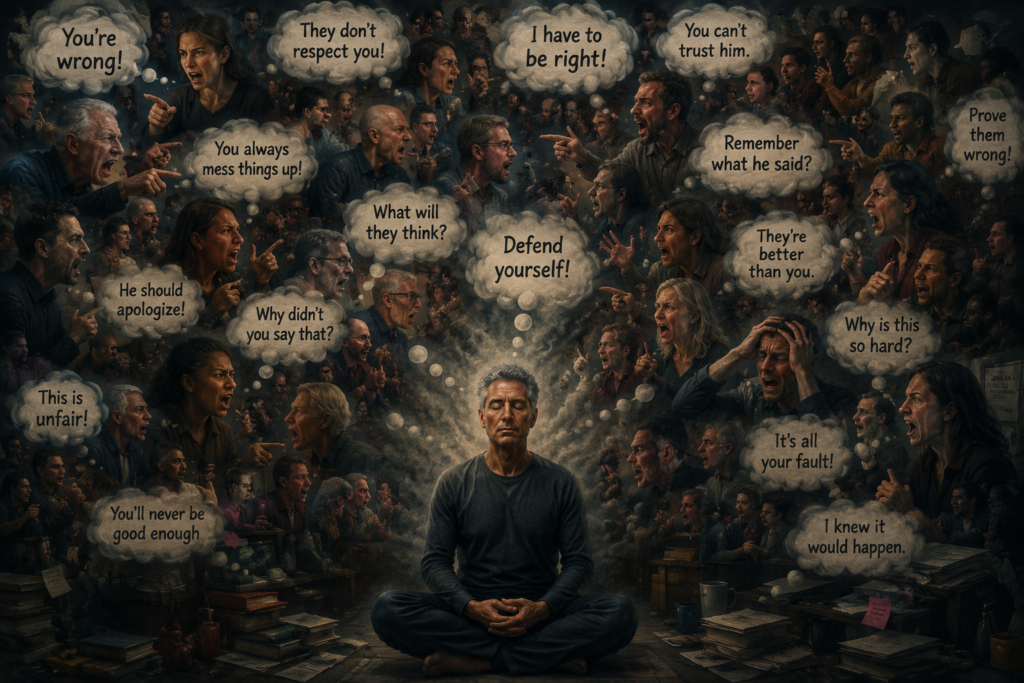
Having done a number of lengthy meditation retreats, I’ve had the opportunity to see my mind in different contexts. When we spend enough time sitting quietly, something interesting happens. We begin to see our thoughts without automatically becoming part of them. Something like looking out the window of a high rise at pedestrians scrambling below. The activity continues, but we are no longer caught in the chaos.

What surprised me from this perspective, was how damned crowded my mind seemed. Although I came to understand that the very act of seeing my mind from an objective perspective meant that I was accessing the open space of my mind. That was the vantage that allowed me to see the overcrowded streets below. And I saw that the preponderance of the crowding wasn’t brilliant ideas or profound insights. It was rote, repetitive narration. Endless thought streams in which I was explaining, defending, proving, correcting, and justifying… something. To someone. For some reason. The loudest conversations were defensive. I was making points to people who were not present, defending myself against accusations that weren’t being made, and winning arguments that never actually happened.

Then again, none of it was really happening.

I began to notice how much psychic real estate I had been giving to these internal debates. Within the enormous landscape of my mind I had selected the same arguments – or the same kind of arguments – repeatedly. Each discourse consumed me so thoroughly that there was little room left to experience life as it was actually unfolding.

Without space for fresh experience, all we really see are reflections of our own ideas. And most of the time those ideas had me at the center. “This is what happened to me” “This is how I was offended.” “This is who I am.”

“This is me.”

Perhaps what we are doing when we talk to ourselves is trying to prove that we exist. Descartes famously said, “I think, therefore I am.” He meant that the very fact of consciousness proved existence. But somewhere along the way, many of us began to believe: I think, therefore this is all I am.

We become identified with the commentary.

The strange thing is that our thoughts mostly tell us what we already know. They recycle familiar experiences, familiar fears, familiar hopes, familiar resentments. We return to them again and again, as though familiarity itself were a kind of refuge. Even when the stories are painful, they are comfortable because they are the devil we know.

Meditation practice offers us the mental space to notice this process. One of the most important moments in meditation is not achieving tranquility or reaching some exalted state. It is simply noticing that we have become lost in thought.

That moment is huge.

And then, of course, in time we might develop the willingness to return to the present. In time, consistent practice will build the neural pathways that will change our allegiance from escaping into interwoven narratives of habitual thinking to actually living in the present.

For years I believed my thoughts completely. If I was anxious, I became the anxiety. If I was angry, I became the anger. If I was defending myself in some imaginary courtroom, I became the defense attorney, the prosecutor, the judge, and the jury. I would stay up in bed cycling through what I should have said or what I might have done. This is our mind as a defensive tool trying to save us from imaginary evil.

Now, when I catch myself caught in one of those internal arguments, the first step is very simple. “This is just a thought.” Not a revelation. Not reality. Just a thought. I don’t layer a better thought over a limiting idea. Thoughts are thoughts are thoughts. A radio prattling in another room.

And simply noticing them is the result of the neural pathway development from meditation practice. We will begin to see when we are escaping into thoughts, arguments, complaints. And we begin to see that we have a choice to turn from that.

Thinking is not the totality of our mind. To say that thought is the whole of mind is like saying that the foam floating on top of a lake is the entirety of the lake.

There are depths beneath the surface.

There is a vast open sky above.

Yet many of us become frightened when we begin to glimpse those depths. We hear teachings about ego or no-self and immediately interpret them as attacks on our existence. We defend ourselves because our sense of self feels precious and necessary.

And in many ways it is.

But perhaps there is a difference between having a self and constantly proving that we have have a self. Maybe there is nothing to prove.

Meditation practice offers glimpses of possibilities beyond our usual patterned thinking. When the body settles into the present moment and the mind settles into the body, windows begin to open. We start to observe not only the content of our thoughts but the process itself. We see thoughts forming, dissolving, and reforming. We see the machinery rather than just the product.

And occasionally we encounter something we might find unsettling. Openness. Not the certainty, not the answers or schemes or solutions that our habit-mind presents. But openness. People often rush to fill that openness with new stories. We think we’ve seen God, glimpsed a past life, discovered a hidden destiny, or uncovered some cosmic secret. Maybe sometimes those things happen. But more often, I think we are simply rushing to replace one story with another.

The truly challenging aspect of meditation is not that it reveals something extraordinary. But that is reveals what we do not know. It brings us to the edge of fresh experience rather than recycled experience.

I’m reminded of a Monty Python sketch. The son is standing at a window looking outside. His father stands behind him and says, “Son, someday all this will be yours.”

The son replies, “What, the curtains?”

The father sighs. “No. Look beyond the curtains.”

“Oh,” says the son. “The window?”

That is often how we live. We spend our lives staring at the curtains of our own thoughts while an entire world waits beyond them. Meditation does not ask us to destroy the curtains. It does not ask us to silence every thought or win every internal argument. It simply invites us to look beyond them.

To stop seeking constant reassurance from the familiar stories of who we are. To rest, if only for a moment, in direct contact with ourselves and our world.

Stability. Clarity. Strength.

Daily Practice Changes Everything

There’s a feeling we all have that the more triggered we are, the greater the remedy we need.  Therefore, we often overlook very basic and fundamental tools that help us regain and maintain emotional balance and mental clarity.

Being triggered affects our stability because the experience compels us to react. Often reactions happen too quickly for us to be mindful. We are, in essence, lashing out blindly, not unlike flailing about in a canoe.  But just as we might regain balance in a canoe, we can reset ourselves in life.

Before we do anything or believe anything, we can come back to the present and reset our ground.  Stability is key.


Stability

It is the basis for mindful (read: effective) actin. Once we have stability, the mind can settle, feeling more comfortable in the space our body inhabits. From settling comes clarity. And clarity, grounded by the stability of being fully in our body, affords the strength to navigate difficulty with balance and poise.

When we feel threatened or overwhelmed, the best first step is to recognize what is happening before we try and fix anything. What is happening right now? Is this fear? Doubt? Confusion? Anger? Frustration? Inadequacy? The answer is not nearly as important as asking the question. This is because when we’re triggered, it is a younger, sometimes ancient part of our system that becomes engaged. That part of our being may not have access to the language, training, and understanding that our higher mind enjoys. By simply recognizing that we’re triggered we begin to calm the nervous system. The effect may be temporary, but it opens the door to further engagement through self-compassion and awareness.

It is essential that once we recognize we are triggered—experiencing fear, doubt, confusion, perhaps all of these at once—we accept what is happening. Acceptance is not resignation. It is simply acknowledging the reality of this moment without immediately projecting into the future or revisiting the past. Future and past are always speculation that leads to unhelpful narratives. Instead, our meditation training, enables us to look directly at what we are experiencing now. This begins to loosen the bondage of suffering.

Looking at our experience allows us to feel into what is actually happening within us – what we are unwittingly doing to ourselves.  We do not need to come to firm conclusions. We do not have to explain anything away. We simply notice, feel, and accept.

By allowing ourselves to feel and accept the present experience, we begin to find the inner space to settle. With daily meditation practice, specifically shamatha practice, we train the mind away from clinging to reactive states and return ourselves to the balance we can only have in the present.

Coming back to the present when we are triggered is an ongoing process. Just as in shamatha practice, we go away, notice, remember, and return. We may notice tension in the body—tightness in the belly, constriction in the jaw, heaviness in the shoulders and neck. This awareness develops through mindfulness of body cultivated in meditation practice.

Recognition followed by acceptance has a neurological calming effect. It may only last a moment, but we don’t need to chase outcomes. Instead, we work with – by returning to –  the direct experience of suffering in the present moment. We feel the elevated heartbeat, the confusion, the tightening, without immediately extending it into narrative.

This can be very simple. But, one of the ways we miss the mark is by believing the stories in our mind, especially catastrophic projections. We become so frightened that we assume there must be a dramatic and immediate response. Yet often the most effective response is simply recognizing that we are being pulled away.  The world is ending – just return to the moment. My life is heading for disaster – simply return to the moment.  None of this is how I imagined it would be – return. Return. And by returning, we release ourselves from the panicked grip in our body and mind and regain our balance.

When we are triggered, frightened, or thrown off balance, we are no longer reliable witnesses. The mind begins feeding us fake news. So rather than following every conclusion and projection, we return to what is actually happening now. We address what is real and immediate: the tension in the body, the racing heart, the fear, the confusion. By boycotting the complications we construct, we gradually find stability. Then, like water held still long enough for sediment to sink, the mind becomes clear.


Clarity

At some point we become reliable witnesses once again. This is trusting our wisdom mind. But to do this we may have to gently acknowledge and let go of the panicked mind. The wisdom mind is quieter, subtler, and less reactive, which is why it can be difficult to access when we feel threatened.

Our first impulse is rarely to calm down and relax. Yet by turning away from mental complication and returning to breathing, recognition, and acceptance, we stabilize. Stability is the necessary prerequisite for right action. Before the mind can be clear, the nervous system must become relatively calm.

When you are overwhelmed, do not fight with the mind or attempt to think your way through panic. The mind that creates the complication cannot solve the complication. Letting go of the panicked mind and returning to the body allows the mind to settle and clarify on its own.


Strength

Once we are stable and the mind is clarified, we become reliable again—not only as witnesses, but as supports for others and as compassionate human beings. We develop the strength of someone who is not shaken and who knows when to respond and when not to respond.

This is great strength.

This strength allows us to navigate the world and respond in ways that are actually helpful. My teacher mapped out the logic of shamatha practice very simply: stability leads to clarity, and clarity leads to strength.

Shamatha is simple and subtle. In many ways it can seem inadequate compared to the intensity of our emotions. But that is precisely why it matters. We are boycotting the dictates of panic, ego, and self-will, and opening ourselves instead to our basic goodness and the inner strength that can actually carry us through.

We notice the impulse to escape, fix, or react. We recognize it, accept it, release it, and return once again to the breathing. The breathing relaxes the nervous system, and as the nervous system settles, the urgency to fill the space begins to dissolve.


The Importance of Daily Mind Training

Looking at a depiction of the Buddha, you can sense their stability clarity and strength. This is, of course, due to the fact that we are seeing a picture or statue. But, we are people, flawed and insecure but able to train ourselves toward this process by noticing, accepting and returning with no hope of an outcome.

At some point, the mind of Buddha nature will dawn within us.

This is where we come back to. This is what we are training to recognize.

HONORING THE MOTHER LINEAGE

By Nurturing Our Natural Kindness


I wanted to reach out in the spirit of my mother, who passed a few years ago and for whom I will always carry a quiet torch. In many ways, she was the great love of my life—a spiritual guide, a dear friend, and a near perfect mom. Trudi, as everyone knew her, was a relentless acceptor of everything in life, including me—her damaged, broken boy soldier, ever faithful, yet rarely grateful.

Like many children, I accepted her for the blessing she was, but never realized how rare that was, or how lucky I was. If there is any part of me that is loving, kind, and accepting, it is my mother still alive in me.

We grew up around a tight-knit Pentecostal church. She was the preacher’s kid, and the only boy who could reach her was a rough, arrogant Spaniard with a world to conquer. Everyone loved “Boy,” as he was called—charming in the way of men for whom the world is opening. Years later, I found a new familial community rooted in an American form of Tibetan Buddhism. My mother cried as she drove away, leaving me at a mountain retreat center blanketed in snow.

In Tibetan Buddhism, we speak of mother and father lineages. While equally important, they are understood differently—not as men and women, but as essential energies within each of us.

The father lineage is seen as creator and protector. The mother lineage as nurturer, holder, and the great agent of understanding that speaks from heart to heart. In many traditional cultures, men traveled and taught, while women held together the fabric of family and community.

My family, unknowingly, echoed this. My father traveled—first as a soldier, then as a businessman—while my mother, who also worked, carried the responsibility of raising us. It was not an easy life for either of them.

I lived in Baltimore during the riots, and as dangerous as those streets could be, the violence often softened when grandmothers stepped out of their homes. I still remember the image of a grandmother scolding a cowering grandson. The mother lineage need not be overshadowed by the father. Ideally, they work in tandem.

During times of difficulty, returning to the sense of protection associated with the father, and the nurturing and connection associated with the mother, can be deeply supportive. This is something we can carry within us.

The image of my father as protector, while potent, also evokes a sense of competition within me. This may be natural for boys and fathers of my generation. But I never worked well with competition. I tried to best others and spent a lot of time in aggressive disconnection. That was not necessary.

I saw my parents as separate and never appreciated how they might be conjoined. As a result, those energies have not been fully integrated within me. I feel deeply and care deeply, but I also fight and compete where it isn’t needed. Perhaps learning to unify these is my life’s task.

It is my view—and the view of the practice I’ve been given—that we begin to resolve the masculine and feminine within our own minds. We do this by recognizing the generosity of these energies, and how fortunate we are to have known them through others.

When times are difficult, we do not have to forget the softness, kindness, and compassion of the mother. When times are generous and forgiving, we do not have to forget the discipline and uprightness of the father.

I want to offer the idea that we can find calm in the storms of our lives and in the storms around us—that this calm and openness is itself an expression of strength. We can rely on our strength without losing our heart, and open our heart without losing our strength. The union of mother and father is strength.

The openness of the mother, protected by the strength of the father, allows us to find stillness in the midst of turmoil.

In remembering my mother, I feel again the presence of that balance—already here, already alive within me. I feel held, reminded that I do not have to do this alone. Something softens, and something becomes steady.


The Coming of the Light

BUDDHA’S LUMINOUS PROMISE


The holiday season is marked by lights that shimmer and glisten in the cold darkness of long nights. This tradition of surrounding ourselves energetically with radiant color harkens back to the earliest experiences of the human race. In ancient times, humans had fewer distractions and were more attuned to the world around them and the sky above them. They felt the sun rising and felt it falling and diminishing. Like all life on our planet, they learned to live in conjunction with these rhythms.

As human consciousness grew more acute, we developed ideas about concepts that began to separate us from direct perception of our life. Feeling the sky move around us, we imputed meaning to those movements. As our life was dependent on things that lay beyond our control. So we created stories. In time those stories became beliefs. This was the blessing and curse of our developing awareness. We ended up believing our beliefs.

While animals move naturally toward warmth or rest, humans began to think about these cycles. Imbued with conceptual meaning, we tried to understand what was happening. We saw the sun sink lower in the sky. and experienced nights growing longer until they reached their nadir. The longest night of the year became, for many cultures, the coldest and darkest moment of our survival.

To lift their spirits through the dark, humans lit fires, created rituals, and celebrated to urge the light’s return. After two or three days, they noticed the subtle shift—the light was coming back. Many traditions arose around this moment, celebrating the return of the sun. Certain dates were singled out as markers such as December 25th. These times were—and still are—marked with celebrations of light. As fires became torches, and torches became electric lights, the fundamental energy of the sun continued to transmit hope, stability, and wellness. From lights we string grandly across our homes to candles glowing quietly in our room, an energetic message of possibility is transmitted deeply within us. We feel the light because we are light. Every atom, molecule, and element that composes life on this planet came from our sun. When we experience light, it is said to a child recognizing its mother.


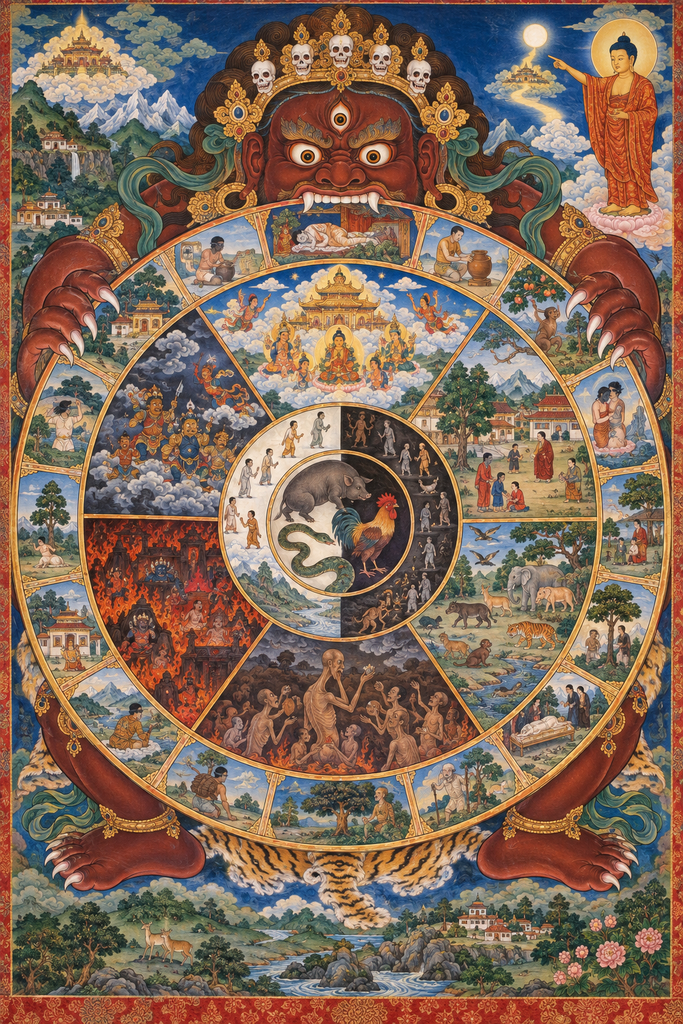
The notion of a sacred world as an orientation of mind is essential to what is known as the Third Turning of the Buddha’s teachings. In the Vajrayāna schools of Tibet, we recognize three essential epochs of Buddhist transmission. The first centers on the Buddha’s teachings of the Four Noble Truths and the Three Marks of Existence. These teachings form the foundation for everything that follows. Schools emphasizing this turning are commonly referred to as Theravāda, meaning the ancient or early schools. The First Turning occurred at Deer Park, where the Buddha gave his first sermon articulating the possibility of seeing ourselves and the world as we are.

The Second Turning of the Wheel of Dharma took place at Rājagṛha, on Vulture Peak Mountain, and emphasized the teachings of emptiness (śūnyatā) and compassion. There is a deep symbiosis between these two. In everyday life, emptiness can be understood quite practically: our ideas, constraints, and prejudices are simply thoughts. Until we act on them, they are just energy—something we can see through and choose not to solidify. A teacher once told me, as I was suffering a period of angry depression, “Nothing is happening. There is nothing here but your mind.” At the time I felt insulted and diminished. But years later I don’t recall what had me so upset. I recall her advice to me.

Nothing is happening.

Veterans of the Vajrayāna tradition of Buddhism often say that life is like a dream. This is not meant to diminish life’s importance, but to help us take things less personally. Taking things personally points to the solidification of the self—the ego that feels compelled to defend, prove, or promote itself. Imagine moving through life without that constant burden. Imagine how freely we could benefit the world, and how naturally we might benefit ourselves.

At the same time, caring for family, concern for the climate, or awareness of political consequences are all valid responses to life as it unfolds around us. The practice is to engage without personal fixation—without the need to defend or proclaim our beliefs. Reality has real consequences, and yet it is not solid except insofar as we react to it. Therefore reality is both real and not real. Science echoes this insight: what appears solid is composed of atoms that are mostly space and energy, and those components dissolve further upon investigation. As the Buddha taught, all things arise dependently; nothing exists as a separate, permanent, immutable entity.

This paradox—that things function and yet lack inherent substance—is known as the inseparability of form and emptiness. Because experience is ephemeral, we are free to manifest loving-kindness and compassion. Nothing truly obstructs this except our own limiting beliefs. The Buddha taught that compassion is natural to sentient beings, that all beings possess bodhicitta—the awakened heart-mind. This union of heart and mind reflects the truth that emotions and needs is real in experience yet empty of fixed essence. When resistance is seen as empty, compassion radiates freely.


So what in our lives is both seemingly solid and empty? Light. Light can be focused to cut through the toughest metals, yet when diffused we can walk through it and be nourished by it. Life is born of light.

The Buddha gave his third and most esoteric teachings at Vulture Peak and in refined settings such as royal courts and celestial realms—teachings later known as the Third Turning of the Wheel of Dharma. This turning emphasized Buddha-nature, the innate luminosity of mind, and the sacredness of lived experience. It returned us to the understanding that life is profoundly beautiful and that goodness is not only possible, but fundamental.

A traditional way of pointing to this truth is the contemplation of ourselves and all beings as beings of light. Life is alive. It is not a thing. It is a dynamic interactive experience. At our deepest level, there need be no doubt, no confusion, no self-limitation—only the responsibility to work compassionately with the circumstances of our lives in order to benefit our world.

Because life appears and functions while remaining empty of inherent solidity, we can come to see all existence as the expression of Buddha-nature. Goodness, in this sense, refers to awake, clear, crystalline knowing—pure awareness itself. When perception is not clouded by fear or prejudice, life is revealed as workable, even benevolent. Life does not need to be battled, owned, or subdued. Ultimately, it need not be feared, because there is nothing to lose.

Buddha-nature provides the ground from which we see all life as sacred, just as it is. While this view does not prevent death, it transforms death from an ending into a continuation. We are the universe waking up. We are the vanguard of Buddha-nature, vast as all creation, expressed here in our little corner of the cosmos.

When Vajrayāna speaks of being one with everything, it means both the vastness of the outer universe and the equally vast inner expanse of awareness. Life is energy—appearing as form yet vastly exceeding any fixed notion of being. And this is true of everything, including awareness itself. Awareness and compassion are not things we possess; they are experiences we are.

So enjoy the holiday lights. They connect us to our truest nature. Whether good, bad, happy, sad, rich, poor, sad or glad the light is always there. Whether we feel it or forget our nature it’s always art of our nature with us, because it is our nature. Our Buddha Nature.


WAKING UP IS HARD TO DO


Struggling Through the Hangover of Delusion

There was a song by Neil Sedaka in the 60’s called “Breaking Up is Hard to Do”. Many of us have been there. It is hard to let go of someone to whom we’ve grown attached.  First we try to let them go, only to find the part of us who identified as their partner also had to be let go. It’s not easy to see beyond the love bubble. It’s not easy seeing beyond me.

Waking up in life can be similarly difficult. Arising after a long, wild night we are cloudy and unsure as we try and reconstruct the events of the night before. It seemed like so much fun, I think. Maybe. But why am I suffering now? And why do the few things I remember make me cringe?

In the same way, after years, even lifetimes, of believing the delusional states we sleepwalk through, waking up can be disconcerting, embarrassing and painful.

“Waking up”refers to the glimpses or stabilization of realization that is a consequence of regular meditation practice. It might begin with flashes of insight that permeates our practice, but in time fuses into a sense of panoramic knowing. We begin to see ourselves in context to the world around us rather than being lost in ideas to which we’re conditioned. This seems like a good thing, and yet a part of us resists this. We would rather cling to sleep finding excuses to stay in a routine of non-awareness. Perhaps we can set the phone to “snooze”, but that doesn’t really work. Once we’ve seen the sunshine our slumber is ruined. We toss and turn but at some point rolling out of bed becomes choiceless.

Waking up in the spiritual sense can be disorienting because there’s seeming comfort in delusion, as we hide within layers of protective self-deception. (My autocorrect had written “stealth deception,” which is serendipitous because much of the way we fool ourselves lies deep in our psychology and goes uninvestigated.) We take “me” for granted, assuming everything we do is the same me doing it. We fail to notice how that me shifts from circumstance to circumstance. We may be one me with our mother, another me at work, another me in a bar and several others with each drink as each releases another layer of me.  I can’t tell you how many times I’ve excused myself with, “I’m sorry, I wasn’t wasn’t myself last night.”

“Stealth deception,” indeed.

So much of our ego — the part charged with defending us and keeping us socially acceptable — lies unseen. Buddhism describes ignorance as the primary manifestation of ego.  Various ego states (plural because despite seeming solid they constantly change) shape who we think we are, yet lie uninvestigated, beyond reach. We accept the brother me, the son me, the teacher me or the pupil me without question. Hence, when we’re angry, we assume it’s justified, fixating our ire on some person or object. When we feel attraction, it must be love. We rarely go deeper and ask what else we might feel. For instance, anger covers over doubt, sadness and confusion because it’s an energy we can grasp. Anger feels strong while vulnerability feels, well, vulnerable. Since ego protects us, vulnerability isn’t its go-to — unless we’ve learned to use it manipulatively. So we sleepwalk through life, replaying the same strategies we used in the crib to get our bottle.

At work I’d grumble sarcastically “yeah, I slept like a baby, I woke every three hours screaming for my bottle.” When I quit drinking, I committed to continuing the waking-up process I’d begun in meditation. I’d come far in understanding the world and the Dharma, and developed empathy for others — but that empathy was still at the service of ego – it was provisional depending on how irritated I might be. I cared for others in order to secure my sense of worth. I couldn’t see behind the firewall into the inner workings. I could cajole, demand, intimidate to get what I wanted. Yet I never investigated what it was I actually wanted. It’s possible I never knew.

The meditation master Dilgo Khyentse, Rinpoche used to say the only difference between the dreams we have at night, and the dream of our life, is duration. We believe our life has meaning, as we believe our dreams do. Yet we don’t fully remember either, because we’re not fully cognizant of either.

I held a special ire toward those who punctured my dream-logic. Nothing got me angrier. I felt they were stupid or didn’t understand me. I believed I knew more than anyone as I lived in my dream bubble. I held the belief that I was special secret genius in a tight emotional fist. It took me a while to loosen that grip and begin to see I wasn’t so special. So, yeah waking up is freaking galling. But it’s worth it. And once we start – once we get a glimpse outside the cave – we can’t go back. Saturday night is never the same once you find out.

In order to secure our nascent awakening, I recommend getting out of bed a bit earlier, tired as we may be, and meet our mind as it may be – just as we find it. Just sit there and be with ourselves waking up slowly in order to synchronize with ourselves as we are and discover the day as it is.  Our morning meditation can begin organically before we bound out of bed to a screaming alarm, rushing down the street behind our triple latte.

I sometimes joke: Have you ever woken up next to someone you didn’t know and tried to sneak out unnoticed? That happens to me every morning — and I live alone. I try to escape before I have to recognize myself. I’d jump on the subway, rushing and habitually late, never having to look at myself because I was busy navigating chaos. Fearful of disappointment, I constantly created confusion so I could dig myself out of it and avoid ever seeing who I was.

Meditation slowly changed that. It let me peel back layers of me. At the beginning of meditation, we’re groggy and unsteady. We’re learning to stand without the crutches that once propped us up. We must nourish and protect this early wakefulness.

Waking up is hard to do because we’ve never experienced the alternative. It’s easier to roll and over stay warm than it is to turn and face the ch-ch-change. But we’re missing our life in the process. At some point Ignorance may not be enough.

A sign from one of my favorite coffee shops read:


EINSTEIN’S BRAIN

Building the Brain’s Neuroplasticity and Connectivity Through Meditation


After Einstein’s passing in 1955, the pathologist performing his autopsy quietly removed his brain. When researchers eventually examined it, they expected something extraordinary—more neurons, unusual size, some physical marker of genius. But by all conventional measures, Einstein’s brain was unremarkable. The one meaningful difference was the density and organization of his neural connections, particularly those supporting information processing and communication between the hemispheres. His brain was wired for unusually high interneural integration and conceptual thinking.

Einstein’s brain was structurally similar to ours, but his unique relationship to learning allowed him to cultivate an exceptional degree of openness and connectivity. The brain is not fixed; it changes in response to experience. Through meditation, we deliberately train the mind toward greater receptivity, presence, and spacious awareness. In Shambhala teachings, we practice opening our senses to awaken the mind and connect with the world as it is. This very act forms new neural pathways that keep the mind vibrant, youthful, and capable of creative insight. Zen Master Suzuki Roshi simply called this “beginner’s mind.”

Despite his groundbreaking discoveries, Einstein remained approachable and playful. He had a sense of humor and was able to speak with anyone—children, workers, scholars—without losing the depth of his insight. This mirrors how the Buddha was described: someone who could address a child, a soldier, and a priest in the same teaching and reach all of them. The Buddha’s brain was just like ours. What differed was how he trained his mind to rest in profound openness. Our basic human mind is already capable, but like Einstein and the Buddha, we can cultivate that capacity through practice.

Einstein didn’t possess more brain power—he used his brain differently. The most striking discovery from the neuroscientific studies of his brain was a thicker corpus callosum, the band of white matter that connects the left and right hemispheres. If we imagine the brain as a city, the gray matter represents the neighborhoods where different types of processing occur, and white matter represents the roads and highways that allow those neighborhoods to communicate. Most of us work with a handful of small roads. Einstein had an eight-lane expressway. He didn’t have more “buildings”; he had better “roads.”

And those roads didn’t appear by accident. Connectivity grows through use. Structure invites capability. Use builds mastery.

Einstein didn’t become a genius by thinking harder. He created conditions in which insight could emerge. His creativity came not from grinding thought, but from spaciousness. He often took long, aimless walks, allowing his mind to wander. Neuroscience now recognizes that this activates the brain’s Default Mode Network, the system responsible for daydreaming, imagination, memory integration, and spontaneous insight. Rest isn’t the absence of thought—it’s the space in which new connections form.

He also engaged in elaborate visualizations, conducting what he called “thought experiments.” He imagined riding alongside a beam of light long before he developed mathematical models. Imagination preceded analysis. And he valued downtime. “I stop thinking, swim in silence, and the truth comes to me,” he once said. Stillness was not avoidance—it was incubation.

Meditation develops these same capacities. We don’t meditate to stop thought. We meditate to stop chasing thought. Meditation allows us to step back and recognize the patterns of our thinking rather than getting lost in their content. It doesn’t change our genetic blueprint, but it optimizes the connectivity that already exists. Through consistent practice, the mind becomes more spacious, more flexible, and more capable of creativity and insight.

Neuroscientific research confirms that meditation produces measurable shifts in the brain. It increases white matter and strengthens communication between hemispheres. Creativity and clarity begin working together. The prefrontal cortex—associated with executive function—coordinates more efficiently with regions involved in imagination and visual-spatial reasoning. The mind becomes more integrated.

Meditation is not about quieting the mind. It is about opening awareness. It is not about forcing insight. It is about creating space for insight.

You do not need Einstein’s brain. You already have the same basic architecture. What matters is how you use it. With presence, spaciousness, and a willingness to return to beginner’s mind, you can cultivate the connection and creativity that lead to genuine insight.

Meditation builds connection.

You just need enough silence for your own breakthrough to arrive.

ALL WE ARE SAYING

THE WILLINGNESS TO CHANGE

The bombs fell on their generation as they were born — drums pounding in the night sky, explosions lighting the heavens with fire and rage. Nazi cruelty tried to pound Britain into submission. But sometimes when cruelty strikes deep to the heart, a seed is planted. John Lennon, Keith Richards, Pete Townshend, and others were born into this thunderous rage — and with them, one day, the world would change.

On October 9, 1940, the bombing paused momentarily over Liverpool. John Winston Lennon was born into that fragile silence and was carried away into a middle working-class life. His parents were unreliable — his father, a merchant seaman rarely at home, and his mother, Julia, a gentle, artistic soul who suffered from anxiety and depression felt it hard during those harrowing times. John was given to his Aunt Mimi, a strict disciplinarian who ran a very tight household, for his upbringing.

When John was 14, his mother Julia was struck and killed by a drunken off-duty police officer outside her home. She had taught John to play her ukulele — and years later, Lennon, having failed to learn proper guitar instrumentation, would still be using ukulele and banjo chords in his early bands. All of these shortcomings — or rather, these wounds — became the crucible that forged his restless creative spirit.

If there’s a theme to this story, it’s the indomitable power of the human life force — and how often that force is held in check by inner and outer circumstance. Yet rather than extinguishing the life force, this tension only creates a kind of dissonance — a pressure that drives creation itself.

Playing ukulele chords and gathering a ragtag group of friends, Lennon began pounding out the rhythms of his heart. He was an artist, a clever writer, a satirist — and quickly became a bandleader. His band members changed and grew in skill over time, but Lennon and his relentlessly urgent guitar was always the driving force. He was brash, foul-mouthed, arrogant — and if you steered clear of his acid tongue, very easy to follow.

At the famous Woolton fête in 1957, John met Paul McCartney — and instantly found his counterpart. Paul had the musical discipline and melodic gift that Lennon lacked. The two would sit, nose to nose, tossing lines and chords back and forth, learning their instruments and honing their craft.

The life force burns brightest when there’s a clear vision ahead. Despite the world telling them to stay in their place, Lennon and McCartney had one simple, driving goal: to get the girls to notice them.

As obvious and mundane as that sounds, for boys in their late teens it was everything. The primal human need to be seen — to be accepted — was their rocket fuel. Driven by the rhythms they heard late at night under their covers from American broadcasts, British bands began to form — boys chasing girls, chasing sound, chasing truth.

In Tibetan Buddhism, the feminine principle is referred to a the womb of the universe — the space in which all creation occurs. The masculine energy quickens that space toward creation; but always at service to the feminine. The girls were the first to fall in love with The Beatles. Together they opened the gates to the most profound cultural shift of modern times.

The brute, manipulative power of male-dominated society had been given its notice — though the men didn’t yet realize it. They still stomped around, chasing power, money, and armaments — not learning the lessons of fascism’s collapse. America helped rebuild Europe, yes — but it was not pure altruism. The U.S. waited until the moment best suited to its own advantage to enter the war. While their intervention freed the world from fascist rage, not all lessons were learned. The victors rebuilt — but also clamped down, holding the world in place.

That grip, however, would not last. Cracks began to appear — in miniskirts, in teenagers dancing and screaming at concerts, in the pure, unrestrained joy of feminine exuberance. Like Sinatra and Elvis before them, The Beatles rode that wave and crashed it against the shores of convention. But this time, it shook the foundations of a repressive world.

Lennon was arrogant, difficult, sharp, and fast. But he was smart enough to push against authority when it stifled him — but willing to pause and listen when it served the music. He, sometimes grudgingly listened to producers, his manager, and to Paul, George, and Ringo. Together they created a unit brilliant enough to become something larger than any one of them.

For perhaps the first time in modern pop culture, there wasn’t a single frontman — but a band. A collective. Each member offered an archetype for fans to project upon: the cute one, the clever one, the quiet one, the lovable one. Lennon encouraged each member of the band to play as they would as they developed his songs. He gave them freedom within the structure of the song.

In Tibetan iconography, great deities are depicted with archetypal manifestations — the sharp one, the gentle one, the deep one, the radiant one. The Beatles embodied these archetypes for a new age. And through them, the world — once pounded by bombs — began to sing again.

Our life force is indomitable. But should we refuse to listen to the music of our heart, we will grow ill and unhappy. If we let this life force have its way, it may lead to chaos. But, the middle way would be for us to allow our spirit to sing, but curtailing ego, allow the energy to be shaped into a manifestation that serves the world.

When Lennon finally found the girl, he turned his sights toward peace. Many people felt he made an ass of himself with his bed-ins bag-ins and protests. He tarnished his career, and nearly destroyed his fortune. But he was using the power of wealth and celebrity in a way that had never been done before. He was not afraid to be a fool. And in his lifetime, he grew from being an arrogant misogynist into a feminist and an advocate for peace that inspires people to this day.

When confronted with his aggressive past in later years, Lennon said that because he lived violence, he understood the value of peace.

At this writing, today the American military is being used to assault the people of Chicago. Some feel this is the next step in the current administration to institute a national police force. The change many of us have feared is actually here. Actually here. I am angered to the point of imagining violence toward those instituting this clampdown. Yet, violence will not win. The only alternative is to push back as we can, and to refuse to lose heart. To be willing to change in order to bring change. Being peace, will bring peace now as it did in the 60’s.

It is my aspiration that I may step beyond personal aggression and truly be willing to give peace a chance in order to give change a chance.

IT’S ONLY A MOVIE

“Keep telling yourself ‘it’s only a movie‘” was the famous tagline for Wes Craven’s Last House on the Left in 1972. It may be appropriate to look at the harrowing moments of our mind with the same encouraging detachment. No matter how serious life may feel in the moment, like a movie, it’s seeming realism is the result of a perceptive trick of the tale. (Pun intended). Neurological fake news is an ongoing misinterpretation of reality bent to the purpose of making ourselves more important to ourselves.

Sometimes we are suck into the movie, gripping our nails in harrowing belief; and other times we’re able to step outside the frame seeing ourselves telling ourselves a story. With meditation practice we can slow the process in order to peak beyond the folds of the curtain to the working basis within.

I love moments of hypnagogic consciousness upon awakening, surfing between sleeping, dreaming and waking as if skipping over gadget impressions as we rise into awareness.

But, just before we wake there is a most precious moment.  A moment of “ahhhhh” that precedes all thought. This moment of pure waking precedes every moment. This is the sacred space, or gap, where we have a limitless opportunity to hack our preset turning our mind from rote adherence to habit toward discovery and change. This may be the very space of creation. The moment before, before.

And within this gap we might get a glimpse into the projector. The apparatus that constructs the fantasy of life.

For many humans, with the outsized pressures of modern life, this subtle moment goes by unreguarded. We push past it, bursting awake to the screeching beep of the alarm, sing some innocuous tune in the shower, dress and rush straight to the coffee. In short order we’re following our travel mug down the street to the train. It’s like waking up after a drunken night next to someone you don’t know, trying to sneak out the door before they wake up.  That used to happen to me every morning. And I lived alone. I could be three stops on the train before I start to recognize myself.

When we slow down in order to meet life, we might see life happening in the gaps we blast past. If we train the mind to pause and pay attention to these precious moments, every following moment becomes an opportunity for discovery. When we turn our mind toward discovery our lives become alive. This is what we refer to as waking up. It’s not leaving a dream state for a somnambulist state, but actually awakening. Looking past the curtain and seeing the mechanics of our seeing.

The Buddha experienced pain and suffering – even after his enlightenment, up until his death – or he wouldn’t have had the skillful means necessary to convey a remedy to suffering. He was there with us. He was not a supernatural being who might free us if we were to play along and do as he said. The path of awakening requires our participation.  And yet, that participation can’t be under our control. Aye, there’s the rub. We can’t just close our eyes and wait to wake up and yet we can’t turn our journey into the next story we are scripting.

Buddha took the personal and translated it to the universal. He owned his personal experience, yet his personal experience wasn’t about him. It was human experience. In the same way, our life is personal, but it is not ours alone. Whether we know this or not, we are inextricably part of everything in nature.

But all too often, we fall away from waking, into fantasies projected by inner narratives. We carry the dream of sleep with us into our day. And in our dreams we are too important to regard the life around us unless we can twist it to fit the narrative.  The mind does this instantly with little concern for reality. It creates stories with ourselves at the center that give us the impression that we are in control. But all we control is our narrative. Like a movie “moving” at 24 frames a second our internal movie creates a momentum that renders a false reality that looks and smells like a duck.

Trungpa, Rinpoche said to a group of students in a shrine room that the before we notice the walls, or the columns, or the floor we have a micro instant gap, which he illustrated with a gasp. Gasp, floor. Gasp, ceiling. Before we label anything, or categorize any moment, we have a moment to pause, breaking the momentum that perpetuates the movie, we might see a past the curtain to a brighter, clearer moment.

We may absorbed in be a gripping movie. But the world is nonetheless waiting outside for us.

The Art of Changing

Say You Want a Revolution?

“You say you want a revolution, well you know, we’d all love to see the plan.”

— John Lennon


We’ve talked about stasis and change: the need to regroup, find a home base, and connect with ourselves. Naturally, this leads to a desire to move beyond that base and explore new horizons. Interestingly, I personally struggle with both the claustrophobia of a static environment and a reluctance to change it. It’s a tough bind.

Often, when we feel the itch to break away from our home base, we fantasize about a new place we’d rather be—a new partner, a new job, or even a new body that will transform us into something… what exactly? “Once I transform my body, I’ll find the job that leads to a new partner.” Meanwhile, I stay stuck because instead of tackling one thing, I’m layering conditions: I can’t do this until I do that, but I can’t do that because of something else.

Clearly, I haven’t mastered the art of change. Maybe it’s not laziness or incompetence; maybe I’m trapped in a pattern and don’t know how to break free. The first step is to settle down. Struggling doesn’t help—working does, but only in a clear direction. Instead of pursuing six different goals at once, I could pick one and encourage myself to move forward.

Are you stuck in a pattern, or even a series of patterns that feel immovable? A mindful investigation of being stuck involves unpacking and examining how we got here. What are we doing in our struggle to free ourselves, like being trapped in a Chinese finger trap? Is it productive or just uncomfortable? Let’s explore.

First, we’re in a state of non-acceptance, which triggers unhelpful struggle. Ironically, before change can happen, we must first accept where we are. One major obstacle to acceptance is our unexamined fantasies about what we think we want. I remember once trying to pursue my dream of working in independent films. Transitioning from stage and comedic improv to the detail-oriented world of film shoots—and I hated it. I also couldn’t stand the endless cycle of auditions. What I loved was being in creative flow, not the grind of auditioning.

This isn’t a judgment of those who thrive in film work, but an acknowledgment of my own discomfort. What’s important is that my fantasy was entirely different from reality. I once attended a coaching workshop with a former extreme fighter pilot who became a commercial airline pilot. He said, “My life now feels like driving a bus across a desert—endlessly, monotonously.” Reality didn’t match his childhood dream.

Fantasies aren’t reality because we don’t truly examine what they would cost us or entail. They provide a direction to head toward but aren’t the destination. As I’ve heard it said, “A fantasy without a plan is a hallucination.” Hallucinations can be interesting, but they’re not a viable life plan.

The first step in creating change is accepting where we are—not by endorsing or trying to like it, but simply grounding ourselves in reality. From here, fantasies can become inspiration, not burdensome expectations. A view of a mountain might inspire us, but it doesn’t have to be a goal we must reach—it’s just a direction.

Accepting where we are, and being inspired by new possibilities, are the first steps. Once we’ve determined our direction, we can move authentically toward that view. But to make it a reality, we have to overcome the resistance to movement. Even when we want change, parts of us—often unconsciously—resist it.

A teacher once said, “Obstacles are meant to be difficult. What kind of obstacle worth any merit would be easy?” Instead of seeing resistance as self-sabotage, it’s more helpful to understand it. Seeing where we apply the brakes without judgment helps ease the process forward. Fear of change is natural.

I’ve identified three categories of resistance: mind, spirit, and body. These are foundational in meditation, Buddhism, and yogic philosophy.

Starting with the mind, we often assume that just knowing we should lose weight, get a job, or leave a relationship will make it happen easily. But unaddressed fears and obstacles stop us. The mind can see the view, but it also needs clarity. “I want my life to change.” Okay, but what specifically do I want to change first? For me, it’s my health and well-being, including my diet, as I’m overweight. But dieting alone doesn’t work long-term—it usually backfires. That’s because the spirit or heart isn’t fully aligned with the mind’s goals.

Once the mind clarifies its wants, we need to ensure we believe in them. This requires self-reflection and doing things for personal growth, not for external validation. What do I really want?

On a spiritual level, we face early fears or unmet needs that resist change. We need to negotiate with those parts of ourselves, assuring that this change is for our best interest. This could be as simple as telling ourselves, “I love you, and this is the best step forward.” Spiritually, we must avoid negativity and self-judgment. It’s about deeply coming on board with our vision of change.

Finally, the body is the most ancient part of us, focused on survival. It resists change, even though change is necessary for thriving. This is why sticking to simple changes like exercise can be so hard. The body responds to force but often reverts to comfort.

In substance abuse counseling, a 90-day commitment to sobriety is often recommended because the body needs time to adjust. This three-month period is crucial for the body to embrace a new pattern.

The mind might think it controls the body, but the body operates on its own terms. We need to slow the mind to the level of the heart, and the heart to the level of the body, to truly enact change.

The social and political implications are clear. Before we can change anyone’s perspective, we must first understand their needs. Calling someone a fool for holding different views achieves nothing. The “other party” might not support their leader as much as they yearn for change. How can we encourage that change to benefit everyone?

Struggle can strengthen, as a butterfly gains the power to fly by pushing out of its cocoon. Change may require effort, but it doesn’t have to be self-defeating if we know where we’re going.

We’d all love to see the plan.


THE ELEPHANT IN THE ROOM