
A WORKABLE MIND

Paying Attention to the Tool We Use to Pay Attention

Before I take my brain out in public, it seems only prudent to check the machinery. Before I unleash my normally passionate—and sometimes reactive—engagement with the world, I like to get in sync with my mind, and have some idea how I’m actually feeling. How I am feeling will influence how I’m doing.

This is called “mindfulness of mind.”

You’ve heard me say this before, but of all the things we’ve applied our minds to, all the things we’ve learned, assimilated, perceived, felt, tasted, touched, and thought about, the one thing we rarely investigate is the very tool doing the investigating. It’s as though awareness of our own mind lies behind a firewall that keeps us from seeing it’s machinery.

Pay no attention to the man behind the curtain.

Similarly, when we sit in meditation, we often fail to notice the mind that is actually meditating. Instead, we seek relaxation, comfort, or elevated states of consciousness. YouTube is filled with guided meditations promising euphoria, deeper vibrations, heightened awareness, or awakened desire. Yet one of the greatest possibilities is often overlooked: learning to work with the mind itself.

To do that, we first have to look at it. And what better place than the relative stillness of meditation?

Rather than trying to achieve anything, we can engage in what I think of as pure investigation. Captain Kirk referred to the Prime Directive issued from Starfleet Command – observe without interference. If we’re trying to force the mind into solving problems or elevate it to some higher state, we’re using the mind to do something instead of discovering what it already is. As necessary as it is to occasionally do things, the doing mind is not poised to see itself. Before we can know what the mind is capable of, we have to learn to simply look without creating any complication.

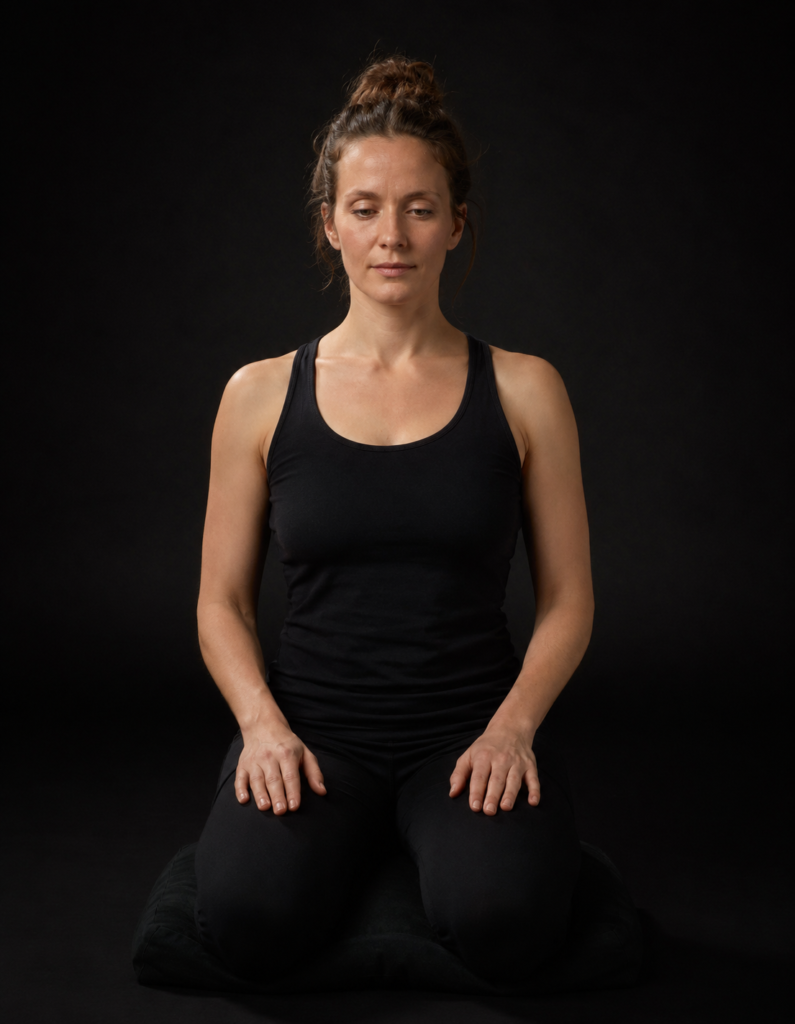
When we next sit in meditation, we can begin with a blank slate. “Blank” is in quotes because the mind is still full of thoughts, habits, and the momentum of our actions. But we can step back from the display rather than becoming caught in it. Each time we notice we’ve wandered, we gently return to the object of meditation—the breath, a mantra, an image, or a candle flame. That return creates space and perspective.

The technique is wonderfully simple. Follow it with patience and persistence. When we’re lost in thought, notice it, accept it, release it, and return. When we notice ourselves judging, planning, or reacting, do the same. Every return loosens the grip of the thinking mind and allows its natural openness to emerge.

In Vajrayana Buddhism it’s said that the space the mind encompasses is the same space the universe encompasses, and that this space is imbued with intelligence. That word can be misleading. This isn’t intelligence in the sense of being clever; it’s raw wisdom. In Tibetan Buddhism it’s called rigpa—the awake quality underlying experience itself. It’s easily overlooked because it is so simple and so open. And it is that openness that allows us the space to see clearly.

That bit of philosophy is really just background. The practice itself remains uncomplicated. Keep returning to the object of meditation and allow the mind to reveal the space to reveal the mind. The mind knowing itself is a process best kept prosaic rather than mystical. Scientists don’t get overly dramatic during the investigation.

What we often discover isn’t mystical at all. We might simply notice, My mind is very reactive today. Or, I’m exhausted. Or, I’m feeling needy. When those observations arise, treat them like any other thought: notice them, acknowledge them, release your grip, and return to the practice. One profoundly beautiful aspect of meditation is that this simple process creates space for flashes of insight. The temptation, of course, is to grab hold of them. Look how smart I am.

Trungpa, Rinpoche, described the proper relationship as touch and go.” Appreciate the insight, then let it pass. We’re not dismissing it. We’re simply refusing to interrupt the mind’s natural capacity to continue discovering. Grasping, by definition, narrows the mind. Releasing our grip allows the space for the mind to have glimpses of itself. Over time these brief glimpses accumulate. We develop a more cooperative relationship with our own minds. Instead of being led around like an animal with a ring through its nose, we begin to stand beside this remarkable gift we’ve inherited through evolution. We gain the freedom to respond rather than merely react.

One final disclaimer: these glimpses are only the beginning. Here we’re talking about the relative mind—the mind we take out the door each morning to meet the world. Yes, there are deeper dimensions of awareness explored in contemplative traditions. And no, You Tube likely won’t get us there. But before reaching for extraordinary experiences, it’s wise to become familiar with the ordinary mind we already have.

In Vajrayana Buddhism they believe it’s the ordinary mind that reveals the mind’s magic.

It may be that one of the most profound things we can do is simply learn to work with that relative mind, presenting ourselves to the world in a functional, creative, and compassionate way—responding with intention instead of habit. In this way, everything is fresh.

Life recreates itself in every breath.

OFFERING

Making Space For Life

I think we all feel that we have enough on our minds. Maybe too much. I remember the cartoon of the school child raising their hand, “ma’am can I be excused, my brain is full.”

In truth our minds are capable of accessing astronomical amounts of information. It’s simply that the part of the mind we believe is ourselves sits in a narrowly defined space without much processing space. I imagine a cluttered desk in the corner of a dark room. With the curtained windows revealing the beautiful grounds if we only had time to look up fro our work.

Borrowing an analogy from computers, when our RAM becomes overloaded we might move files to an external drive or into the cloud to free up space. We’re not really losing anything; we’re creating room for the system to operate more efficiently. The result is greater fluidity of mind and better access to the life outside our windows.

Our brains can stand in on an episode of hoarders. Meditation is a step in clearing the space just enough for us to access our own heart. Just enough space to recognize ourselves in the crowded room.

One of the oldest spiritual principles, found in many traditions, is the practice of offering. We might think of offering as a kind of information offloading. Whether we imagine it as uploading, downloading, or simply making space we’re creating room for the mind to function more freely.

In recovery traditions we speak of turning what we cannot change, but need to accept, over to our higher power. Whatever we believe about god or not god, the operative point is that we are offered a means to free up space. We just need to offer it.

From a materialist perspective, offering can feel like loss because we’re conditioned to believe that having more means being more. In traditions shaped by guilt, we may even feel that an offering must hurt—that only by surrendering something precious can we earn the favor of a deity or satisfy a reward-and-punishment version of karma.

This isn’t the Buddhist view.

To punish ourselves by giving things away simply because we want them is just another form of ego. We create a story of sacrifice that proves how good, pure, or virtuous we are. The Buddhist understanding of offering is much simpler. It is the gradual relinquishing of whatever we’ve mistaken for ourselves. It is opening. It is letting go. Our aim is to strip me down to our essential being without the entrapments of the world.

In this regard, offering need not be punitive because punishment is a form of aggression. Reward and punishment belong to the larger samsaric cycle that keeps us trapped in habitual patterns. Buddhist practice points instead toward freedom from those cycles, which is why the Middle Way avoids both indulgence and self-denial.

So I don’t think it’s cheating to begin by offering the very pain we don’t want. If we’re honest, we may discover that beneath our pain lie the attachments keeping us bound to suffering. What are the things weighing us down? What continually pulls our ship off course? What in my life am I still carrying that no longer needs to be carried?

Why? Because suffering begins when we mistake impermanent things for permanent ones. We believe our identities, possessions, opinions, relationships, and even our thoughts possess an enduring solidity that reality simply doesn’t support.

Emptiness, on the other hand, allows for the spontaneous creation of new realities. The Buddhist path can be understood as progressive stages of letting go, progressive stages of opening, or, as Khenpo Tsultrim Gyatso Rinpoche beautifully described it, “progressive stages of emptiness.”

Perhaps offering is best understood as relaxing our grip.

If our grip is too tight on the things we love, we’re likely to strangle them. Love cannot flow where control dominates. Letting go becomes our love language. We release our fear. We loosen our grip on our children so they can become who they were meant to become. Above all, letting go means allowing ourselves to see what is actually here rather than clinging to our fantasies about what should be.

Ultimately, every act of offering is practice for the greatest letting go of all.

Death is the one appointment we are certain to keep. Of the many appointments we scurry to make throughout our lives, this is the only one guaranteed.

If our purpose were simply to live life as fully as possible until that moment, we might relax into the unfolding of the process. Instead, we apply the brakes. We turn the wheel. We try to swim upstream. We cling to memories. We cling to grievances. Yet none of those things is happening now. Even when we imagine ourselves stepping backward, time continues carrying us forward.

According to Buddhist tradition, when death arrives the body returns to the elements from which it arose. Our ordinary, RAM-like mind falls away, while the deeper continuity of mind proceeds according to the momentum it has cultivated.

That isn’t heaven. It isn’t salvation. It is simply another opening.

If we stop holding on, we release ourselves from the weight of imprisonment and become available to whatever comes next. And if we resist the temptation to name it, define it, or expect it to conform to our wishes—if we remain genuinely open—we may discover that the journey itself is far more extraordinary than any destination we could have imagined.

WARTS AND ALL

A Living Buddha

The notion of a living Buddha is that following the Buddhist path our relationship with the Buddha is alive, experiential and developmental. We are not relating to a thing, an icon or an idea. We are relating to a living part of ourselves.

This is a present tense experience happening whenever we remember. This connection is presently knowing, understanding and caring for ourselves and our world. The work in our daily meditation practice is to develop the capacity to remember this True Nature of ours and to learn to trust it. And, hence, learn to trust ourselves.

And, we don’t have to shine our shoes, watch our manners, cut our hair, or do anything other than be who we are as we are.

I often made the mistake of thinking that becoming one with the Buddha meant my body, spirit and mind had to become something else, something perfect. But I’ve come to realize that connecting to Buddha means accepting of all of me.  The parts I’m proud of and the parts I’m embarrassed by; the things I do that are virtuous and many things that are selfish and petty. There’s little value to waking up in our brain and having lots of pristine ideas about realization, if our body and heart are unable to follow.  So we need all of us talking to the rest of us and no one left behind.

Buddha Nature is the notion that our truest, most fundamental nature is perfect, free of obstruction, neurosis, duplicity and hatred. Those add-ons come from our social upbringing and seem to be devised to help us navigate the world around us. But, as we know, these patterns are not always helpful. In fact, they are primarily defensive and quite limiting. They keep our potential dampened and cause us to live lives much smaller than they might be.

But, how can we transcend these patterns, defenses and defects if we don’t see them? Buddha means “Awake” – the base of our Buddha Nature is wisdom, which is seeing, understanding and knowing. The method of our liberation from limiting patterns and ignorance is to see them and know them. These patterns grow in our ignorance of them. But if we’re able to expose them and are willing to see them, eventually we’ll grow tired of them and they will fall away. Our neurosis is part of our connection with the Buddha. In Tibetan Buddhism they see neurosis as an offering.

Buddhism has progressive stages of development. Each of these has a different relationship between the student and the Buddha. The first sees the Buddha as a leader and an example someone who has liberated themselves from ego suffering, thus affording others the opportunity to follow. The second stage relates to the teachings of compassion. From this point of view Buddha is seen as a transcendent being who radiates love and compassion for all beings. We are encouraged to nurture the seed of Buddha Nature within ourselves.

The third relationship to the Buddha is based on the teachings of luminosity and emptiness. These indicate that our full experience is a manifestation of the mind of the Buddha. There is no separation between us. And that all beings have Buddha nature. And we can learn to recognize Buddha Nature as our basic nature. From this point of view, there is nothing to change, nothing to develop and nowhere to go. We need only remember who we are.

The Bodhisattva Shantideva wrote, “may I not be a stain on the faultless noble family (of the Buddha).”  But what would cause a stain? I think this is different in Buddhism than it might be in other religious contexts. In Buddhism the primary “sin” is ignorance. Ignorance leads to negative actions caused by not knowing. So, our process is to expose these actions by accepting that we do them and to cease pretending otherwise.

The “stains” on the noble family would be to turn away from our allegiance to waking up. This is when we willfully choose not to know. It is when we shut down, turn away, and cut ourselves off from the vibrant source of wisdom in the universe, our Buddha Nature. And if we do cut ourselves off from our Buddha Nature? The remedy is to recognize this, and to remember. Simply that.

When we lose our mind, we come back.

The word for meditation in many traditions also means recollection. Remembering our connection. Remembering who we are. Recognizing when we are deluded and remembering who we are. In time, coming back, coming back, coming back cuts through the veils of our ignorance. We begin to see the parts of our being that are defenses and the part of our being that is indestructible. In time, our allegiance will change and we will begin to identify with our true nature.

In some traditions a deity offers salvation and a seat at the table of endless perfection. This is seen as our future reward. But, Buddhism is about what’s happening now.  The Living Buddha is something we feel in the moment, because it is something we are. There is nothing we need to change. And nothing we need to do but remember.

We can wake up sitting on the toilet with our head in our hands after a very full night of not -so-wakeful activity. We could wake up in a job we hate. We could wake up walking through crowds in our aggressive city. We could wake up making love to someone. We could wake up in the morning. We could wake up in the evening. We could wake up literally anytime we remember.

It’s possible that that moment of clarity might cause us to be embarrassed or self-conscious. But if, in that of authentic moment of awake, we  just see ourselves “in process” with love and affection, then we are seeing through the eyes of the Buddha at all our goodness and imperfection.

__________

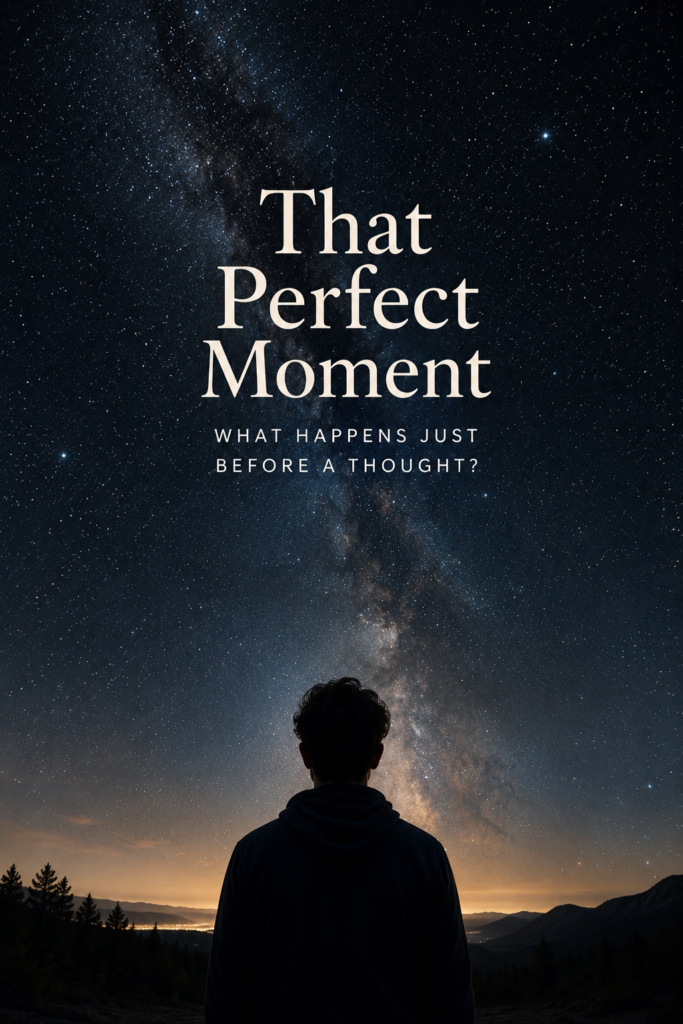
That Perfect Moment

What happens before a thought?

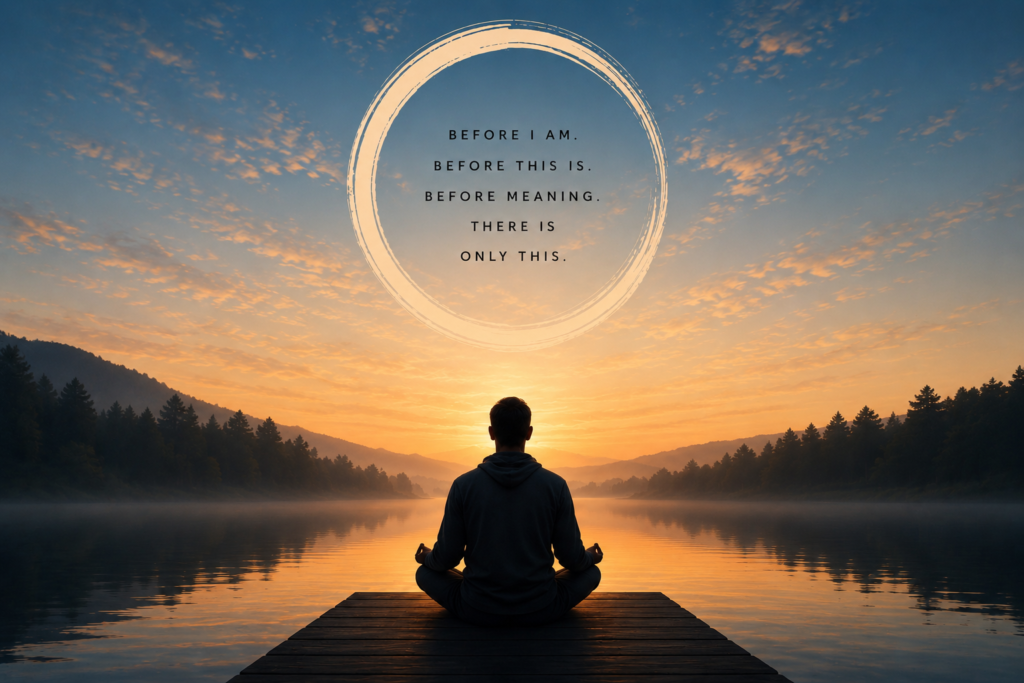
Is there an instance of space that opens? Before we fill it with a cognition? Before we decide what this moment means? Before the notion of “me” arises again? Maybe in this perfect moment of open space anything and everything is possible.

I wonder whether the birth of a thought is analogous to the birth of the universe. What happened in that impossible moment preceding the Big Bang? Was there a perfect stillness before everything burst into being? Or is that simply another story our minds tell because we cannot imagine beginnings without a “before”?

And is it even possible to reduce our thinking to a singular thought, or reduce the birth of our universe to a singular event. Neither is likely true. Thoughts arise in astonishing succession, perhaps even simultaneously, from different regions of our mind. We notice one. We cling to one. Or perhaps, one chooses us and carries us away into its narrative.

Maybe the universe is no different. Perhaps there are countless beginnings happening all the time. Countless worlds appearing and disappearing, all interacting.

We act as though what we are thinking has always been here and will always remain. Once a thought captures our attention, it suddenly feels solid. Real. Obvious. We stop seeing it as an event occurring in consciousness and begin treating it as reality itself.

The cosmologist Jenna Levin suggests that labeling something “infinite” is intellectually lazy. To declare something infinite may simply mean we’ve reached the edge of our understanding. We’ve stopped asking what might be after we’ve reached our cognitive event horizon.

Perhaps our attempts to find an edge to the universe is an attempt to map the extent of what we know. Once we’ve defined a conceptual edge – or determined that there is no edge – we are trying to define it. To hold it. To accept it as a given. To make it something we can inhabit.

Perhaps we do the same with our thoughts. Rather than investigating them, we crown them with permanence. We believe them. We inhabit them. We defend them. We mistake them for truth rather than recognizing them as temporary appearances arising in the universe of awareness.

One anxious thought becomes my anxiety. One political opinion becomes what I stand for. One heartbreak and my life is over. Before long, we’ve constructed a reality around something that, moments earlier, did not exist.

Meditation can show a snapshot of this process. And that snapshot might offer a glimpse of freedom from it. You see, believing our thoughts disables our ability to see them as thoughts. This is a form of imprisonment because it locks us into living and reliving only what we already know. As comforting as this is, it comes at the expense of everything else we might become.

If we sit quietly and follow the “prime directive” – which is to notice what arises without interference, such as judgement, desire, preference, et al. We will see that thoughts don’t actually arrive in a neat line. They bubble up from nowhere, overlap, interrupt one another, disappear without resolution, and occasionally dissolve before they’ve fully formed. Sometimes there is the faintest glimmer of gap—a tiny opening before the machinery of interpretation begins again.

Gap is intriguing. It is almost impossible to catch. Yet it opens the door to everything that isn’t a thought. Which is to say, everything else. The moment we recognize the gap, another thought has already arrived to congratulate itself for finding it. This kind of mental selfie interrupts the prime directive and invites us to believe what we are thinking. And believing is not seeing.

Perhaps that’s why contemplative traditions place so much value on resting in awareness rather than chasing thoughts. Not because thoughts are bad, but because they are astonishingly persuasive. Every one arrives announcing itself as reality.

And every one eventually disappears.

So, perhaps with meditation we are stepping back and gaining a perspective. What gives us perspective is space. Gap is a glimpse into opened undefined space. In time, singular moments of gap become perspective from which we can see without believing or interfering.

Maybe the “perfect moment” isn’t something mystical waiting somewhere outside ourselves. Maybe it is simply that immeasurably brief instant before experience hardens into certainty. Before we decide what this is, what it means, who we are, or what comes next.

Not because certainty is wrong.

But because that tiny opening reminds us that things are not solid, or defined by the limit of our understanding. Reality is alive. Much of it is beyond our understanding, but that should not stop us from looking. If we release ourselves from beliefs, from hopes and fears, from right and wrong, we may accept what’s there. Not agreeing or disagreeing, just seeing. Seeing everything we see whether we see it or not.

Our universe—whether out there among the galaxies or in here among our thoughts—is not a finished object but an ongoing event. And remembering that every thought, no matter how convincing, came from, and will return to, that perfect moment of gap where everything is possible.

DON’T START BELIEVING

Just Connect to the Feeling

The title is a play on the Journey song. Though it was a massive hit, I’m not a fan of the band, nor the sentiment of the song. Don’t stop believing? What would we do if we didn’t have to believe anything?

Beliefs are things we have to squint our eyes to see. We have to force them. Beliefs are ideas. And, tho ideas can greatly affect reality, ideas are not reality. And isn’t attaching ourselves to a belief, or a belief to ourselves, clinging? Clinging often comes at the expense of alternatives. But not always. Sometimes a belief is temporary and leads us to a next stage of development.

But sometimes they become solid and last throughout our lives. We lug them around, even when they’ve become obsolete. They have such gravity they tend to warp what we see, bending reality to their particular point of view. For instance, many people hold strong spiritual beliefs that place our nuanced reality in black and white terms. This offers a great deal of certainty. I sometimes envy that. When I feel overwhelmed, it would be comforting to find such surety. Surety in what? People fill the tabernacle with song and praise, but are any two people of those people believing the same thing?

It seems to me that each of us has an inner life informed by our particular experiences. Beyond that, there is so much we do not understand. Yet we always seem to need to know something. If we can force ourselves into believing something that many other people believe along with us, we feel comforted and strong. And if we believe our belief is right, we are often inclined to define that by believing someone else is wrong.

We may even come to believe they are a threat to our belief. In this way, we turn the whole world with its colors and dynamics into a binary contention.

When we meet the world with inquisitiveness, we open ourselves to discovery. But all too often anxiety causes us to clamp down on belief with white-knuckled tenacity. We find it reassuring to be certain about something. In doing so, we cease discovering. We believe something is true and therefore imagine we have found something. That something becomes a fixed reference point.

A path of discovery is an open system. Once we decide something is absolutely real and true, we begin to close the system.

Buddhism speaks of “non-dual” experience. This is to say that subjective experience is inseparable from, and concurrent with, external phenomena. Seeing a waterfall is an experience that happens in the mind as it happens in the space before us.

If we believe the waterfall is self-existing and imbued with magical properties, we might conclude that the sound of falling water is speaking directly to us. We might align ourselves with others who hear these magical utterances and accept them as real. As we fixate on the experience, we may fail to notice how loneliness, longing, or need is shaping our faith.

There is nothing wrong with hearing the poetry of a waterfall or experiencing it as healing. But turning that into a universal truth may be an attempt to make ourselves feel important. When Buddhists speak of emptiness, they are not denying the existence of the waterfall. They are questioning the solidity of the mental interpretations and elaborations that arise between the waterfall and our direct experience of it.

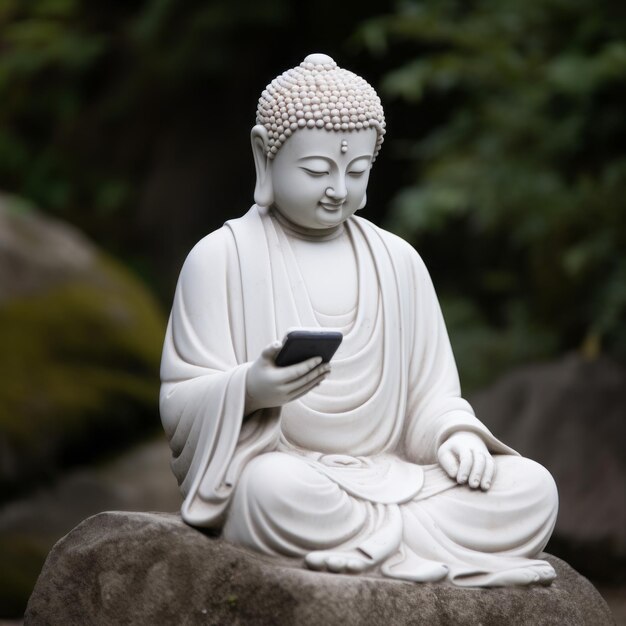
The mind is very busy. Meditation trains it to rest on one thing while allowing everything else to unfold around it. We hear the waterfall and feel healed. But when we immediately reach for our phones, searching for likes and validation, we may be turning the experience into a commodity.

It seems we often lack the confidence to let life be what it is without turning it into something larger than necessary. Chögyam Trungpa Rinpoche often said, “NBD” — no big deal. Perhaps we make events feel significant so that we can feel significant. When others feel the same thing, the experience can become euphoric. And that can feel wonderful and life-affirming.

But euphoria is not reality. It is a temporary hijacking of the senses, including our higher mental faculties. Falling in love is so powerful that it has inspired centuries of poetry and music. It can be spiritually transformative. Yet transformation, by definition, is temporary.

Relationships that endure allow the feeling of falling in love to become something else. If the bond is strong, it may evolve through many creative forms. The Beatles eventually stopped writing love songs. As disappointing as that may have been for some listeners, it gave them the freedom to explore a much broader creative landscape.

And at some point, of course, the dream was over.

What do we do then?

Shorn of belief, we’re left with ourselves. With our experience. And our life does need not be explained, apologized for, fixed, aggrandized or diminished. Perhaps that has been the point all along. Not to believe, but to simply feel. To experience life directly before rushing to explain it, own it, or turn it into certainty. It will never be certain. Yet, the waterfall still falls. The heart still breaks. Love still comes and goes. Joy still visits. Grief still teaches.

Life continues to unfold whether we understand it or not.

Maybe our task is not to arrive at certainty, but to remain open to the mystery.

OPENING TO LIFE . . .


And Living the Life We’ve Been Gifted

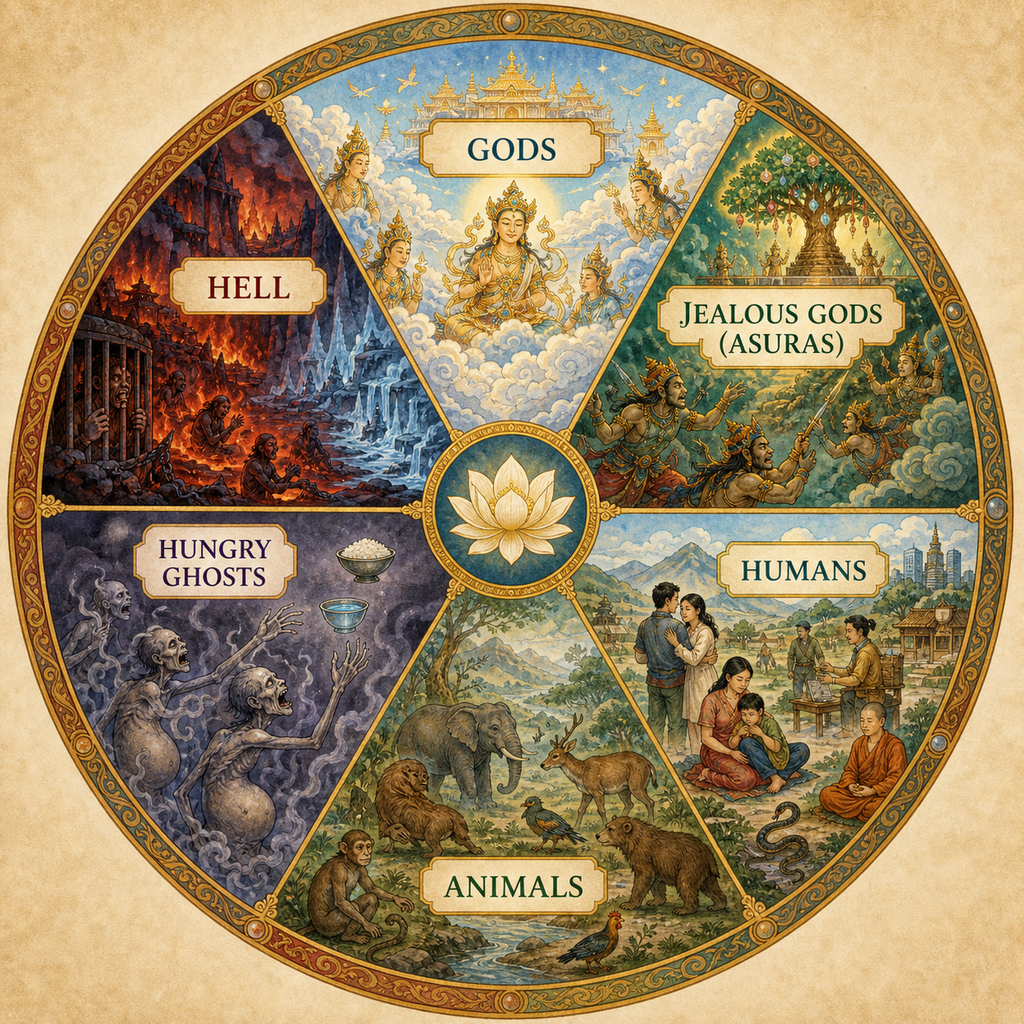
In some readings of Buddhist thought, there is the interpretation that desire is problematic—that people on a path to awareness shouldn’t be desirous. We shouldn’t want anything, and we most certainly shouldn’t hold onto it if we did.

I can’t think of a better way to forestall someone’s development on the Buddhist path than to turn them away from their basic human instinct.

The purpose of meditation is to wake up, or you might say, learn to pay attention to our life. If we are awake in our meditation, then we may wake up in our life. If we are awake in the world, then our senses would likewise be awake. In Buddhist practice, these senses are sometimes referred to as gates as these sense gates are our connection to the world.

I suppose, for the sake of developing calmness we could keep these gates locked. We could shutter our ears, wrap out mind in a cocoon, look to the ground, and live out life dutifully waiting for it to pass. We might move to a cave and lock ourselves away from everything. But even then there may be interesting stalagmites, stalactites, rock formations, and dark secrets that exist in this subterranean world.

As long as we have a mind, we will have no shortage of things that grab our attention. But shutting down the mind would be to shut out life. I think it’s a much braver to be willing to open our senses to the world. But how can we do this and keep our equilibrium?  With consistent meditation practice we can train our mind not to grasp at everything it sees, thus getting thrown out of balance.

Perception and desire are not the cause of suffering. Suffering happens when we grasp at things, often with a gripping panic as if holding on for dear life. This becomes problematic with our unbridled appetite to devour all the things we see, feel, taste, touch and think. Likewise when we lash out attacking all the things we disdain. And likewise ignore everything we deem beneath our attention.

Passion, aggression, and ignorance are the three seeds that are the cause and condition of the clinging and grasping that throws us off balance and causes suffering when we land on the ground.

Suffering comes from the friction between our solidification of things we desire, disdain, or deem unworthy, against a reality that is always moving and changing in continual dynamic flux.

The world is moving. It’s singing. It’s dancing. And we’re invited to join the party.

But if we see something we want, our attention will narrow and focus on the desired object. That’s problematic. When we objectify anything we turn it into something solid and fail to see it clearly. This is not reality. Believing in things that are not reality causes harm.

As much as anyone loves to be desired, it’s a rare circumstance when people want to be owned and objectified. Life wants to be seen. Life wants to be understood. Life wants us to dance, not growl at the wedding table because our partner is dancing with someone else.

By the same token, there are certain attachments that are entirely natural—for instance, parent and child, any of us and the pet that loves us, our favorite music, poetry, or favorite places on the beach or in the woods.  This is natural.

It becomes unnatural when we are grasping and clinging at objects  driven by a need to control. Our need to control comes from insecurity, from a disbelief within ourselves.

And hence we hold on to things that we deem valuable, things that we believe will increase our status if we cling to them, or manipulate them into clinging to us in some codependent dance. This is the dance of insecurity, not the open and flowing dance of life. Neurotic clinging and control is a stumbling, drunken reeling across the floor, bumping into tables and chairs, knocking things over. It is out of step with the natural flow of life. And it is precisely this dissonance—being out of step with the flow of life—that causes suffering, pain, and anxiety within us.

The more anxiety we feel, the tighter we cling. The tighter we cling, the less in the flow of life we are, and the more pain we are likely causing.

If we grip hard enough, we might believe for limited periods of time that we have gotten what we want, that we have wrestled that which we desire into our grasp and placed it in an immovable straitjacket. But it will never really please us, and it certainly won’t please the objects that we cling to and refuse to truly see.

We fall in love, and then we go into this state of blind gripping that keeps us from actually knowing and understanding the very thing we covet. We would rather keep a bird caged than experience birds in their natural beauty and majesty.

So how do we allow ourselves to feel natural attachment without falling into clinging and grasping?

Like everything, it takes training.  We sit in daily meditation practice and finbd the stability to see and release all that we perceive.  If we are willing to open our mind in meditation, and release ourselves from the grip of compounded thinking  then we are learning to open our eyes in life.

We start the process of releasing our grip when we see something that attracts us. Rather than grabbing and narrowing down on it, we could open up to it.  That opening can lead us to further perceptions.

We could see one thing we love and rather than narrowing down on it like a predator we can open top it in appreciation.  The same is true of things we hate, disdain, or fear. When we grab onto hatred, or really want something feared to leave us, we are still clinging. And we are imbuing it with much more power. By struggling with them, we are making ourselves smaller than the things we struggle against.  When we are smaller than an adversary, we are prone to lash out and grapple. But in the martial arts, for instance, students are trained to remain relaxed, open and balanced.

So the work here is to open up to that which we fear. Opening up simply means allowing ourselves to see the object clearly. We are not increasing the fear so much as opening to it and seeing what is actually there. And opening our eyes is the best defense.

Releasing our grip, lifting our gaze, and opening our senses to the world is not only brave, it’s an effective way to live.

It doesn’t mean we have to agree with anything. It doesn’t mean we have to like what we see. It simply means we are joining the party and becoming part of life.

So to me the two steps are simple:

open my eyes and remain open to what I see.

And when I inevitable collapse into grasping panic, I forgive that as basically human and seeing it as a departure from reality return to something present, such as out breath or our body.

There is nothing wrong with perceiving our world. There is nothing wrong with appreciating our world. There is nothing wrong with healthy attachments.

But there is nothing wrong with going wrong and clinging for dear life, as long as we realize it’s not reality and are willing to let go of the fantasy, and return to reality.  It’s okay to make mistakes. Notice them. Release your grip and come back to the flow of life in the present.

The art of being human is based on the practice of making mistakes and having the bravery to return to openness.

SPRING AWAKENING!

Good morning.

Chögyam Trungpa often began his talks with that salutation. Regardless of the hour, he would hold his golden fan open and proclaim “Good Morning.” Even though he sometimes began his talks very late at night, there was no irony intended. He was inviting everyone to wake up.

Good morning.

Any moment can be a fresh start when we’re awake to greet it. This very moment, right in this moment, can be an invitation to open to life.

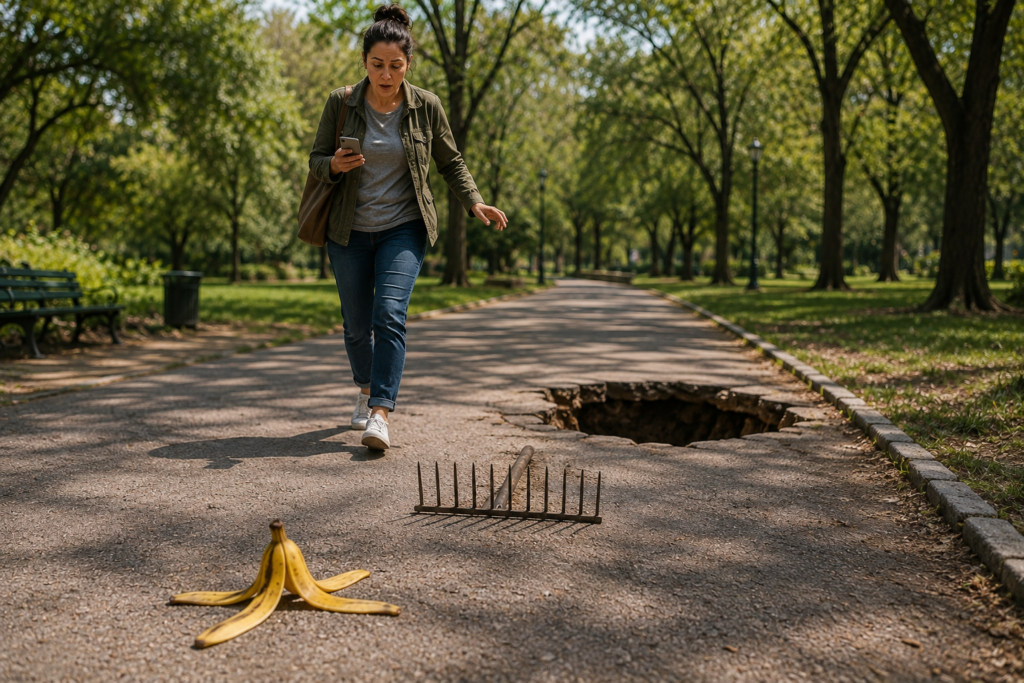
So much of our lives are lived sleepwalking. We move through our days inside protective cocoons of habit, belief, and repetition, until we stub a toe against reality. In recovery parlance we talk about “islands of clarity” – moments of awake when we see beyond ourselves with more perspective. Unfortunately, for most pre-enlightened beings, we fall back into our brown out almost instantly. The pull of our sleep is so very strong.

People say “wake up and smell the coffee”.  But I can smell the coffee just fine from bed.

Dilgo Khyentse, Rinpoche said that the difference between the dreams we have at night and the dreams we walk through in life is duration. Dreams at night last mere seconds, despite the fact that they feel much longer. In the same way, our lives feel long and solid. In truth, our lives are startlingly brief. In fact, we are dying the moment we are born. Each moment of life ends and gives birth to the next. Yet, though we know life is short, we live as though we are permanent. We believe our pain is permanent. Our fear is permanent. Our identities are permanent.

We believe in the bubble.

We often live inside bubbles made of belief—sealed worlds of fixed assumptions about who we are, what is possible, and how long our suffering will last. Once we expand as far as we can within that enclosure, we begin to dull and atrophy.

Then something merciful happens. The bubble bursts. Fresh air rushes in. And for a moment, life feels miraculous. And what is a miracle if not the sudden rebirth from what seemed lifeless?

Yet so often we try to preserve that miracle, clutching it this is like someone opening a window for fresh air and then quickly shutting it so the freshness cannot escape. But rebirth is not a possession. It is a cycle.

Nature teaches this relentlessly: winter gives way to spring, death to life, ending to beginning. They are not opposites so much as two expressions of the same movement. I once heard a Tibetan teacher ask a room full of students, “How many of you have accepted the reality of death?” It being a Buddhist gathering a few hands went up.

Then he asked, “How many of you understand that you are dying right now?”

That question remains with me.

The death of winter is already the birth of spring. The end is already the beginning. And just as surely as every beginning comes from death, every life leads to this same destination.

In birth we leave behind of the dark and protected enclosure that first held us. In our life, living to our fullest is leaving the soft enclosure of our cocoon and learning not to squint so much at the sun. But looking ahead, we always miss what’s behind. It pulls us. What we’ve experienced feels so much more real than what we’ve yet to experience. Beginning is always a barter with something we lose.

I think of my niece on her wedding day, radiant in the doorway beside her father, suspended in that extraordinary moment before stepping forward. The future seemed so luminous that I had to go and offer my blessing.

As I drew closer, she was l cursing in that abrupt jersey way that the damned dress was cutting into her ribs.

There it was all at once: the transcendent and the corporeal, the sacred and the profane, the perfect image and the very human discomfort beneath it.

Every human birth is beautiful and painful and horrible. Because awakening is not abstract. It happens precisely here, in the tender recognition that life is moving, changing, dissolving, and renewing in every moment.

Many years ago, I found myself in a mountain community of practitioners who had been deeply shaken by the death of their teacher. There was grief everywhere, yet also an extraordinary honesty and warmth.

In that open mountain space, my own heart began to soften. Something in me that had been encased began to thaw. What I discovered was that there are two kinds of containers. One is the bubble of self-protection, which suffocates possibility. The other is the cradle of love and kindness, which allows something truer to be born.

The first imprisons. The second incubates.

Perhaps this is the real invitation of spring: not merely to admire rebirth in nature, but to allow it in ourselves. To understand that every awakening asks for a small death.

Every fresh morning is also the ending of the night. So whether the weather is good or gloomy, if we’re sad or glad, any movement of mind is precious and everything we encounter is an invitation to wake up.

Good morning.


IN THIS TOGETHER

The Power of a Self-Healing Community


A basic premise of recovery and healing is that isolation incubates pain, expanding it into suffering. On the other hand, communication, community, and connection allow space for healing.

It is true that when we are triggered, wounded, or overwhelmed, crawling into our protective space is often needed in the initial stages of healing. There is a wisdom to retreat. Sometimes the first act of sanity is to step back, become quiet, and allow the nervous system to settle.

But more quickly than we might find comfortable, isolation begins to have diminishing returns. At some point, if healing is to continue, we need to open up and connect with others, or the wound begins to fester.

Part of the reason is that the isolated mind reflects only itself. In that closed loop, it begins to feel different, separate, unique. We suffer in a way that seems as though no one else could ever understand. When we try to communicate we may feel as though no one gets us. And while this is true to some extent—no one knows the exact particulars of our experience—we are, as Maya Angelou reminds us, “more alike than we are different, my friend.”

By sharing our private pain with a trusted community, we allow ourselves to see it from a different perspective. We also give others the opportunity to empathize, often because they have lived their own version of something remarkably similar. We may begin in isolation until we are strong enough to reach out. And this makes us stronger. The stronger we become the wider our community is likely to become. At some point, our community may include those with differing opinions and points of reference. But, as the Buddha instructed the soldier, take the arrow out first. This is akin to the “putting your gas mask on first” trope.


HEALING.

When we are wounded—frightened, defeated, antagonized, or simply exhausted—it feels personal, as though we are being attacked by the world itself. It is reasonable that our immediate reaction is to strike back, assign blame, or clench our fists against the forces that seem to be victimizing us. But our reactions are not really the point. Blame blocks healing. Healing comes from feeling. Or, as is said, “feeling is healing.” Blame is something that happens in the head while feeling happens in the heart.

And it is our heart that has been wounded. The heart doesn’t have the same logic or language as does the mighty brain. The heart paints in abstract colors. We can only listen in and hold space for ourselves with loving patience until the infection abates.

The point is that we have been hurt and we need to acknowledge this. It’s not about who did what. It’s about what is. And what is, is pain.

The first step in working with hurt is to acknowledge it. Not what caused it. Not what it says about our personality or our place in the world. Not the story. Simply the hurt itself.

Can we face it directly?

Once we face the hurt, acceptance becomes the next important step. In time, we can train the mind to experience pain without immediate elaboration—psychological, social, or philosophical. We begin to see what is there without rushing to explain it.

Then acceptance opens into inquisitiveness. We become interested. Where is this pain happening? How do I feel it in the body? Is this pain being amplified into suffering or finding the space to heal?


COMMUNITY.

At some point, we may be to turn outward and speak it aloud to others. This is a brave step in the healing process. To let go our healing and begin to feel with others. This creates more space for the wound to continue to heal. There are many ways to do this: therapy, spiritual friendship, meditation communities, recovery groups, or simply trusted friends.

Sometimes just allowing someone to speak their pain exactly as it is—without fixing, changing, or judging—gives them the opportunity to hear themselves more clearly. In that simple act of being heard, something often softens. And when others respond not by solving but by speaking their own truth in a way that resonates, the person may feel less lonely, less cut off, less singled out by life.

Of course, each modality has both strengths and shadows.

Therapy can be profound, though there is always the risk of dependency on the relationship itself. Community spaces that discourage crosstalk can offer a neutral and nonjudgmental container, though at times they may feel emotionally distant. Informal conversations with loving friends can provide warmth and support, though sometimes those closest to us may only echo what we already want to hear.

To me, an ideal healing community contains something of all of these elements. Warmth. Heart connection. Support. Space. Camaraderie. A sense of being understood and a willingness to understand. One of my mentors, Michelle Killoran, introduced this to me as “the self-healing community.” We are seeking a community, built on empathy and understanding, that allows the next stage of our healing journey.

We are more alike, my friends, than we are different.

How can we help one another without adding further confusion—either through subtle judgment or through over-support of each other’s neuroses? How can we help one another see our own minds and our own path toward healing? And just as importantly, how can each of us become clear enough within ourselves to communicate what we truly need from the group, ourselves, and each other?

Sometimes we need simply to be held, physically or metaphorically. Sometimes we need clear advice and instruction. Sometimes we need silence. Sometimes we need witness. My hope is that this community can become a place where all of that is possible.

We are more alike, my friend, than we are unalike.

THE JOY OF SADNESS

HELP


______