
LIBERATION FROM OUR STRUGGLE WITH FEAR

A dedicated, consistent meditation practice will uncover our body/mind experience and awaken our innate awareness. We begin to see the world more clearly, but also begin to understand ourselves more deeply. Our burgeoning awareness uncovers psychological and physical blockages that inhibit our deeper knowing. We begin to see obstacles that we have unwittingly created as a reaction to fear.
As we gain confidence in our process we find the strength to take ownership of these obstacles which, in turn, give us the opportunity to overcome them. When it comes down to it, it’s about fear. We all have fear – in fact it’s a necessary part of our psychology. But, from a transformational point of view, Franklin Roosevelt was wrong. Then, as now, there is much to fear. The issue becomes how we react or respond to those fears. Can fear lead us to opening? Or will it ever relegate us to patterns that keep us locked in to ourselves?
When our body registers fear, its usual reaction is to grip to itself in protection. This gripping actually amplifies the fear, and closes us away from uncovering a sane response. As these gripping fears, and their associated constrictions, become apparent in our meditation practice, we begin to understand how much we have limited ourselves and our lives. This highlights a claustrophobia we had heretofore felt mostly unconsciously. So, as the obstacles to our liberation become more apparent, this claustrophobia feels heightened. We see how we’re hiding from our life, yet the most effective form of relief, however, is not escape—but recognition. Mindfulness of our fear, and taking responsibility for our reactions to it are uneasy and disquieting, but nonetheless essential to liberation from our fear. We are reprogramming ourselves not to run from the discomfort, but to use the discomfort to see ourselves. Perhaps, this is what we’ve been looking for. Not love, not the great job, not an escape. Maybe what we’ve been looking for us to understand ourselves so we can move beyond our grip.
When we learn to stay present with our experience and gently redirect the mind toward strength, presence, and compassion, something opens. Many of the limitations we face are fear-based, rooted in early childhood trauma or even inherited intergenerationally. Language itself, shaped by culture and survival, may carry trauma. These influences can cause us to shut down in subtle or dramatic ways, shrinking our sense of freedom, openness, and understanding. Love has the power to will open us to the world and so we seek it out. But the fear of losing love keeps us locked into patterns of manipulation and coercion in order to establish a power we have never had. The power is love itself. As soon as it becomes “ours” it becomes limited. When we lock in the love, we also lock in the fear and close ourselves off to understanding.
Shutting down—often a reaction to fear—gives rise to ignorance: not-knowing. This is an obstacle to developing wisdom. And wisdom is key to freeing ourselves from these cycles of suffering. We begin to see a distinction between a “locked-in” self—constructed in response to fear and doubt—and our deeper, more dynamic existential being. Some might call this “essential being” or even “soul,” though in general, Buddhism doesn’t regard the soul as a fixed entity destined for reward or punishment. Instead, it recognizes an inner spirit—the energy of development, change, and awakening. It is up to us to encourage that development if we choose.
This spirit is not defined by fear-based structures. Yet we nonetheless fabricate constricting forms to safeguard the very spirit they are limiting. This is like having open windows on a beautiful day and decide to close them in order to keep the fresh air in. Our reactions to fear obscure our natural expression—our basic goodness, our Buddha nature. The remedy is to open to the windows and step back from the fear. Recognize and accept it so we can have a conversation with ourselves. Our luminous nature is bound in a straitjacket, with parts of us internally scratching at the ground, yearning to be free. This friction—this discernment—can give birth to wisdom if we’re willing to take a moment to understand.
The precursor to the process of uncovering ourselves to recognition and acceptance. The point is to see the fear, to see how its limiting us. and to feel the claustrophobia we have wanting to be free. Yet, liberation is not an escape. Its an acceptance of our condition so that we can have a loving conversation with ourselves. We will never be free of fear – if we’re awake we’ll see much to fear. But with dedicated practice with the view of training the mind to see beyond itself we can let fear be an ally. Instead of following thoughts propelled to imagined catastrophes, we can take the very brave step and turn inward back to ourselves and feel. Not think about what we feel, but come back to ourselves again and again until we gain the strength to face what is actually happening.


 These obstacles show up in both our ability to receive love and our willingness to express it. Most often, these blocks are rooted in
  In Tibetan Vajrayana, the deity


 When Michelangelo was asked how he created his masterpiece, the statue of David, he replied that he did not create David — he simply chipped away everything that was not David. David, he said, was already there, hidden within the stone.
 Yet, because our neuroses were originally defensive strategies, they can be met with kindness. They were formed to protect us, and even now, they carry a trace of basic goodness. As we become aware of them, we can acknowledge them with warmth and gradually release them. This doesn’t happen all at once. It requires patience — and acceptance — because these patterns can be embarrassing or even infuriating when they arise. Antagonism only entrenches them. What’s needed is a smile, a light touch.
 The essential self — the one that was always there — begins to shine more clearly.


 We freeze, believe, identify. Then we’re off to the races as we script our story with ourselves as the protagonist, whether it be victim or hero. The more we are triggered, the more our universe feels real. But what’s real is that we are at the center of that universe. This very solid Me rolled from bed into a universe of defeat.
 But, we are part of our world, and so Compassion begins with us. Not exaggerating our self importance and our pain, but activating our empathy. If we settle our heart, mind, and body, we can see past the fog of panic. By simply taking our seat and sitting tall, we access natural wisdom. That’s wisdom, not wisdoom. Not believing the worst, but seeing what there is – everything there is. Like sediment settling in water, clarity dawns. We see what is—not an exaggeration of fear.

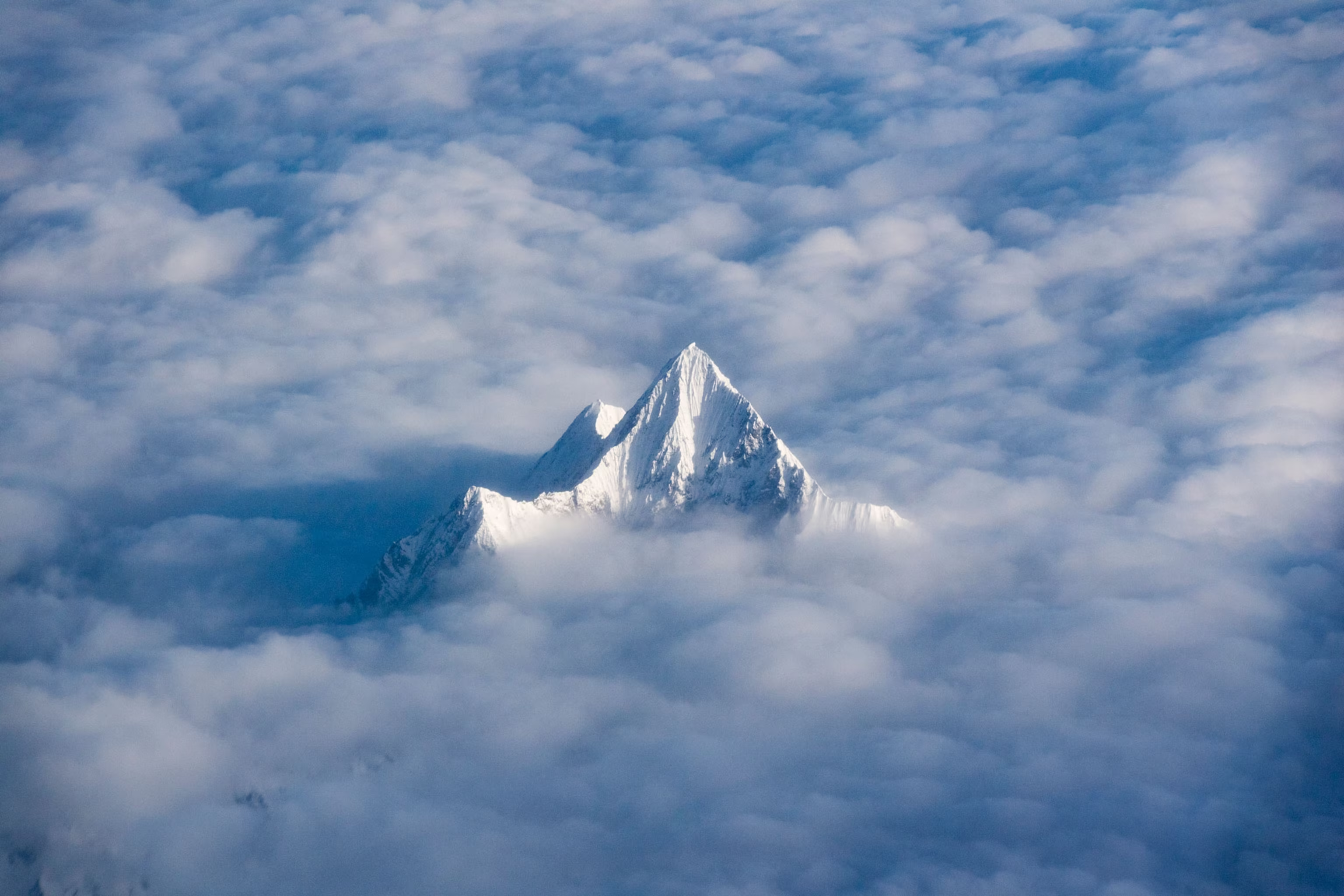
 complaint, and performance. But if we can take a moment, feel our feet on the earth, lift our gaze beyond the horizon of habitual thought, and simply be—without pretense, artifice, or struggle—we reconnect to ourselves, our moment, and to the greater energy all around us. Trungpa called this the “rising sun view”: a world suffused with goodness and possibility. He contrasted it with the “setting sun” view of cynicism, doubt, and complaint. The setting sun leads to darkness and stagnation. The rising sun view—based on recognition of our own and the world’s fundamental goodness—opens us to the Kingdom of Shambhala.
 We don’t have to be without fear. We just have to be willing to come back again and again—to our seat, our breath, our inherent dignity. The Tibetans call the awakened warrior Pawo—not someone who fights, but someone who has transcended the paralysis of fear and discovered bravery in their very bones.
 Tibetan yogis compare the wisdom path to a snake moving through a tube—it cannot turn around. Zookeepers use restraining tubes to calm snakes, and unlike us, the snake doesn’t waste energy resisting. It may not be happy, but it surrenders to the reality of the moment.
 When we stop struggling and instead relax into our constraints, we begin to see them. We feel the fear holding us in place. This transforms obstacles from obstructions into transparent aspects of experience. What if our struggles lost their oppressive weight and became part of our wisdom? I lock myself in my room and refuse to move. But when I turn inward and map the experience, I loosen its hold. Negative actions create negative consequences, reinforcing themselves. The same is true of positive actions. We become obligated to these loops, whether good or bad.
 Padmasambhava, known as Pema Jungné—“Lotus Born”—was said to have been born fully awakened atop a lotus. The lotus grows from the muck, yet blooms into open awareness. The story illustrates that awakening is not something we become, but something we uncover. The path is long, requiring full acceptance of our imprisonment, yet awakening is instantaneous because it has always been there—like a lotus opening to the sun. We will never become enlightened someday; we can only become enlightened now.