
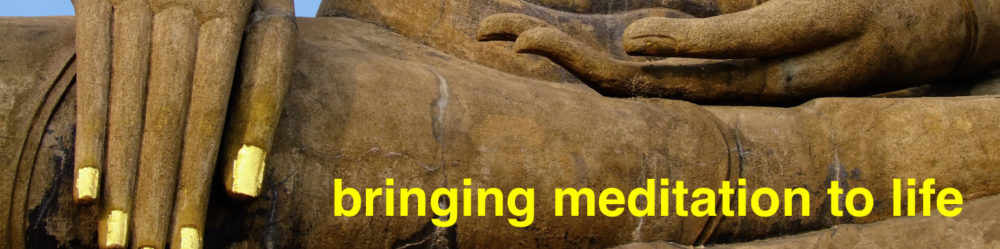
The balance of mindful awareness allows us to navigate life and practice.

Mindfulness is an overused term these days. It might refer to anything from a meditation practice, to a lifestyle choice, to a fragrance. I wanted to narrow the focus down to a practical application of the term. Mindfulness refers to the natural function of the mind to contact an object in the present moment. MIndfulness allows us a tactile connection to our world that is psychologically grounding.
In meditation practice, we generally choose an object to be our contact point. Intermittent connection to an object of meditation is a reference that allows our practice to stabilize. Once we are grounded in the present moment, we are naturally able to relax into the meditation. This relaxation leads to an expansive and open awareness. That open awareness is the source of insight. Yet, that openness is dependent upon the grounding we develop by contacting the present with our mindfulness. The ideal practice situation can be seen as a balance point between mindful contact to the present and a larger sense of awareness around that contact. We are mindful of the breath, but also aware of our body and the space around us.
This mindful awareness practice easily translates to life. MIndfulness of the steps we take going down the street, allows us to relax and open to the flow of the traffic around us. In Meditation as in life, this is a balancing act. If we are too nervously connected to our mindful contact, we lose the fun and inspiration of the space around us. The point of a walk is more than our feet on the ground, just as the point of our meditation is more than our breathing. The point of a walk is to get to where you’re going,but also to enjoy the process along the way. The point of our meditation is liberation from the dull authority of our egoic limitations, which is to say, waking up. But, if we get too fixated on our insights, or become lost in the space around us, we might lose contact with reality and begin to live in our head. Living in our head often translates to falling on our head.
So, in meditation, as in life, we are balancing the practical humility of present contact, with a letting go into the space and movement of our process. It is very much a dance. Like a dancer who trains long hours to gain the muscle memory of the choreographed steps of their piece, the point of the training is to let go into the flow of the music and the performance. Just as the dancer has trained themselves to be mindful of the steps, just so we can train ourselves to be mindful of the moments of our life. While, mindfulness implies the humbleness to be simple and connect to the moment, we need not feel restricted or leaden. That would be like a dancer who just looks down at their feet, never smiling. We have the humbleness to contact the present and the confidence to let go and relax into the space.
The balance point is in the body. I use the heart or the gut as the energetic centers of my meditation. Breathing into the gut is extra grounding. It calms the nervous system which, in turn, allows us to relax into the movement of our practice. The conjoining of Mindfulness and Awareness is an experience of flow;. We are always moving forward in time. It’s a misunderstanding to believe that the present moment is sedentary. Contacting the present is grounding, yes. But the point of that grounding is to let go into the flow of the practice, just as we let go into the flow of our life.
Awareness of life is the point of our practice in the first place. But we can become lost in that space without the grounding contact of our mindfulness. In this way, mindfulness offers the ground that allows the confidence to let go into the enjoyment of the process. In my day, I am aware of balancing between getting lost in the flow, and hence submerged into non-awareness. The remedy is to reconnect to the earth, feel the breathing in the body, and then relax and let go into life. Mindfulness is not an imprisonment. It’s the intermittent contact to the present that keeps us on course.
 the higher mind universal. But universal wisdom is not always accessible, especially when it’s most needed. Sometimes we need to rely on the guy instinct. When we feel attacked our impulse is to tighten the gut and react. This is not gut knowing, it is defensive reaction. We might punch back, run away, or freeze in place. But reactions happen with our eyes closed. We think we are defending ourselves, but we are usually lashing out blindly in the dark. And blind reactions are rarely an effective defense. Blind reactions are hijacking the mind, not employing its full potential.
 When we talk about joy, we think of moments of pure happiness. But, it is said that joy is deeper than simple happiness. Happiness exists in the absence of suffering, even if that absence is temporary. We are happy for the moment. And moments of happiness are very important for stress release and building mental resilience.
 The Buddhist path is said to be vast and profound. Profound refers to the notion that the teachings reach below surface standard cognition penetrating to the depths of our being into our human experience. Vast refers to the many manifestations that the Buddhist journey takes and the many methods it employs to illuminate profound understanding.
 From the moment we first cried out for our bottle to the time we sidled up next to someone at the bar hoping to have them buy us a drink, we’ve learned to manipulate our world. More specifically, we’ve learned to manipulate our feelings in order to manipulate others into the impression that we can get what we want. The fact that we frequently don’t know what we want doesn’t seem to deter us.
 Learning to work with anxiety is an important practice for anyone trying to maintain mindful balance in their lives. How often are we thrown off-course in life due to reacting unmindfully when prompted by our fear. Something feels wrong, and before we can look into what that may be, we spring forward as if to escape the discomfort. I can’t count the times I have made missteps in my life by lurching blindly.
 The unreliable narrator is a technique used by writers to tell their story from a point of view that is changing, altered, or diminished in some respect. This creates a sense of un-ease in the reader. However, despite its temporal unreliability, this technique often reads as organic as it feels closer to how our minds actually work. One mistake uncreative the writer makes is to try and force the organic flow of reality into a two-dimensional, linear narrative. There is a sense of comfort in aligning the forces of our life inside the lines, but it is simply not the way our mind naturally flows. Nor, is it how the reality around us actually works.