
Context, Release and Healing with Humor
In times of seemingly relentless anxiety and stress, laughter might feel inconsequential or even inappropriate. But just as we often forget to breathe under pressure, we also forget to smile. And just as it’s helpful to breathe through stress, we can choose to smile—or even belly laugh—when things become hard. That may sound crazy, but maybe that’s the point. Laughter is an irrational counter to the over-thinking, rational mask we use to face the world.
There’s a saying in the Zen tradition: half an hour of meditation is like an hour in the bath, and a good laugh is like half an hour of meditation.
Laughter is a full-body release that gives us a moment of reprieve, allowing body, spirit, and mind to reboot. Rather than our habitual slumping or caving in when we feel depressed, we can sit up straight. This may seem irrational, but in fact, we are helping the body release tension more effectively. When that happens, the mind finds clarity and confidence.
Just as laughter in the face of anxiety or fear seems counterintuitive, humor allows us to step back from the attack and access a broader frame. This shift in perspective releases tension, helping us feel strong, confident, and in control.
Muhammad Ali was the greatest boxer of his generation. As boxing is physically degenerative over time, he developed a technique he called the “rope-a-dope.” When hit, rather than let emotion or pain overwhelm him, he trained himself to relax against the ropes, shielding himself from further blows—as he and the crowd watched. This gave him time to reset. It was especially effective when he’d been hit hard—disheartening to an opponent who knew they had landed a brutal blow. Ali just danced against the ropes, laughing. It was a tactic that, while hilarious, seemed very disrespectful to some—including his opponent and their corner. And that was also the point.
Humor can be subversive. It can upend expectations and expose guarded truths. It might seem inappropriate to laugh during a panic attack on the bus, but we can learn to smile inside and gain silent mastery over our panic. And just like meditation, we can practice laughter therapy—out loud—at home or in the theater.
Whether it’s a belly laugh, smile, or giggle, humor gives us the context to see the bigger picture. Stress is inherently reduced by space. Our habitual somatic reaction to stress is to tighten parts of the body in an attempt to defend ourselves from something that isn’t there. This squeezing increases pressure on the brain, which registers a problem—though it’s not sure what’s actually happening—so it overthinks and catastrophizes. This often subsides over time, but residual hormonal effects can linger. Untreated stress and tension wear down the body. And often—most of the time—there’s nothing really happening. Why don’t we see that as irrational?
Smiling in the face of panic might be the most reasonable thing we can do. Smiling provides context—a space in which stress can be reduced. Laughter is an actual full-body release, and humor, in any of its forms, allows us to step back from panic and see it in a different light.
Humor is not only subversive to the powers that be in society—it also overturns the temple tables of our own ego system. Instead of reflexively shutting down, humor gives us perspective. Smiling offers strength. Laughter provides the release that opens us to the world.
A venue of people laughing at the same joke is a profound experience—even if they all hear it differently. The joke is only the transport system. It’s the gut punch of the joke that does the heavy lifting for our release.
 Jokes are good when they make us laugh—but even bad jokes are good when we’re thinking that way. A good joke is an expression of technique. But it’s the timing and delivery that make it special. And when that timing and delivery aim at social injustice or psychological limitation, there’s real depth. Humor punches through the walls of limited thinking and lets a bit of air and space into the equation. Sometimes it hurls itself headlong into the wall. But if it’s spot on, it will enliven us, release us, and bring us into community.
Interestingly, that “community of humor” can also be divisive. And in the best of times, it turns conflict into conversation.
And if we bring humor into our meditation, we might learn to not take ourselves so seriously. And this might provide the space to smile.
_____________
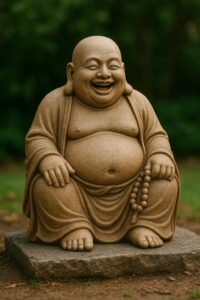
The pictures in this post are of a Hotai, often mistaken in the West for the Buddha, who in classical depictions was actually quite svelte. (Think Keanu Reeves.) The figure represents wealth, happiness, and the joy of life along the Buddhist path. It’s meant to bring good luck, good fortune, and a reminder to smile.
Smiling, laughter and humor are all indications of victory over adversity.
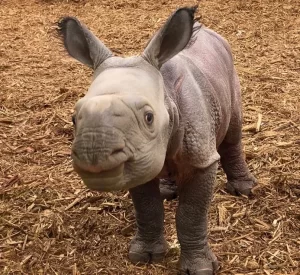
The second picture is one I use often because I just love it: a baby rhinoceros, which always makes me smile. Baby Rhinos are awkward and ungainly, yet so utterly joyful as they bounce around clumsily, as though they were puppies, completely unaware of how improbable they are.
Both images remind me of the power of cheerfulness and joy.