There is something about the comfort of a darkened theater that allows us to open ourselves to difficult emotions. We follow the hero into danger. We feel fear as the villain approaches. We fall in love with characters we have never met, and we feel the ache when that love breaks.
Stories are valued when they make us feel. Even painful emotions serve a purpose. In the theater we allow ourselves to cry or feel afraid because the experience is being held. The darkness, the screen, the story—together they form a container for our emotions. Yet while we will gladly pay money and sit shoulder to shoulder with strangers just to feel heartbreak on a screen, we often avoid those same emotions in our own lives.
We like heartbreak in a movie, but when emotions such as sadness appear in our own lives we feel overwhelmed or victimized. We cover the experience with shame and guilt, feeling we are the only ones who have ever experienced this. And, well, while we are the only ones experiencing our feelings everyone feels human. And as the comedian Ruby Setnik says “I find the experience of being human profoundly uncomfortable.”
But pleasant and unpleasant emotions are part of being human. Why would we rob ourselves of that, when we can work with them. Learning to accept them gives our lives a wider palette. But many of us cling tightly to the edge of sadness. Perhaps what frightens us most is not sadness itself, but the unknown. Even in the darkest movie we trust the story will eventually resolve. However painful the narrative becomes, we believe the final girl will be alive at the end. We know we will walk from the theater back into our life.
Sadly, real life offers no such assurance for the final girl. All she can do is face life one frame at a time and feel all there is to feel. And personal struggles can feel endless. A moment of sadness may appear to open the door to a despair we cannot handle. And so we tighten ourselves against the possibility of feeling too much.
But sadness itself is not the enemy.
Sadness is a deeply human emotion. In fact, it may offer one of the clearest windows into our own hearts. When we feel sadness, we recognize loss, longing, tenderness, and love. Sadness is said to be the most genuine emotion because we are not cranking anything up. We are just being how we are.
Sadness is often dismissed as a bad mood or a downer. But if we allow ourselves to feel it without judgment—simply experiencing as it arises—we may discover that sadness is a gateway to a deeper experience of ourselves. Accepting sadness loosens our defenses which opens us to the world, but also allows us to feel more exposed.
This might not be practical in every moment of life. But in meditation, in solitude, or among people we trust, we can create something like Nicole Kidman’s theater—a space large enough to hold whatever emotions arise. Meditation practice can train us to hold ourselves in order to hold space for what we are feeling. In meditation we sit quietly and observe experience without trying to control it. Thoughts come and go. Feelings rise and fall. Awareness itself becomes the container.
We might even warm the awareness up a bit with loving kindness. Doing Loving Kindness practice regularly will help us to feel the space around us as loving.
Rather than trying to eliminate sadness, we allow it to rest within loving awareness.
Chögyam Trungpa described this as placing the mind of fearfulness into the cradle of loving-kindness. In the Sacred Path of the Warrior he wrote:
‘Through the simple practice of sitting still and following the breath, we begin to develop genuine sympathy toward ourselves. We discover that our emotions—even the difficult ones—are part of our humanity.”
Trungpa spoke of what he called the genuine heart of sadness. This sadness is not a mistake or a defect. It is something already present within us. In this sense, sadness is basically good. When something is basically good, it is genuine rather than contrived. It is simple unless we complicate it. Sadness does not require explanation. It is part of the ocean of feeling that moves through us.
Sometimes sadness rises to the surface and eventually it moves back, just as other emotions do. If we can resist the urge to judge it, fix it, or push it away, we may begin to see that sadness is not shameful or dangerous. It is simply human.
Emotions are not “for” or “against” us. They are like the weather. It’s not our fault it’s raining. Although it may be our fault for not having an umbrella. In the same way, it’s not our fault we’re sad. It may be inconvenient. But it provides an opportunity to work with it. Not to push it away, but to slow down and feel it. Something in your heart wants to be heard.
Meditation invites us to work with our situation exactly as it is. And when we begin to rest with sadness in this way, something surprising happens. Instead of becoming heavier, sadness often softens. It may begin to feel tender rather than overwhelming. The sharp edge of resistance dissolves, and what remains is something vulnerable and open.
This tenderness can be uncomfortable at first. When we open ourselves without our usual defenses, we may suddenly notice how sharp our feelings are. But tenderness is not weakness. So the work is to open to it, and stay with it until its ready to shift. Haha. That’s like saying the brain is not the boss of me. There are other parts of us that likely don’t have words, but still need to be heard. And those parts need a part of us to be fearless enough to hold space.
Remaining present with sadness without running away from it gives rise to a quiet courage. Pema Chödrön describes this simply as learning to stay.
Just stay.
Feel the sadness without turning away from it. Allow the tenderness and remain open. Like every emotion in the ocean, sadness eventually moves on. When we allow the world to touch our hearts—our raw and vulnerable hearts—we begin to discover fearlessness.
Fearlessness does not mean the absence of fear. It means the willingness to remain open even when we’re fearful. Even when life is uncertain or painful. From that openness we become more capable of sharing our hearts with others.
The genuine heart of sadness, it turns out, is not the opposite of joy. It is the doorway to it. Genuine Joy is a feeling larger than happiness. Happiness is dependent on not feeling sad. But joy is large enough to hold space with sadness, fear, doubt and all the feelings we would push aside to feel happy. Joy is big enough to feel sadness.
And sadness, when we allow it to rest within loving awareness is true enough to feel the soft and tender joy of being human.

 Nations are not fixed. Political movements are not fixed. Generations are not fixed. Every “how it is” is already unraveling into what it isn’t. Each new wave of voters arrives with a different nervous system, different media diet, different mythology. What continues isn’t permanence. It’s momentum.
 And this rings the alarm of our defenses. The protective systems in our mind resist it. They tighten the walls. They reinforce the story. They tell you that outside the box is chaos, threat, annihilation. But maybe it’s freedom. Maybe it’s the annihilation of an older purpose. And like every form of life since there was life, maybe old purposes give way to new life.
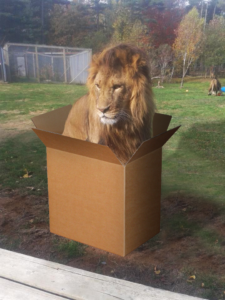 That image sent me down a cat rabbit hole. Large, ferocious animals squeezing boxes that could not possibly hold them, yet they somehow get inside and find peace. What became obvious is that support and safety was never structural. It was pure feeling. Even when the box fails, the animal still experiences safety in the feeling of enclosure.
 Alternately, I’ve seen those accomplished in meditation who met their deaths as a new beginning, or a next stage. They have experienced their own ego deaths any times – each time they stepped from their box. From outside the box, they could see impermanence, they understood the box game and knowing there was nothing to hold on to, when the time came they were in acceptance.
 Buddhist teaching suggests that death removes the box entirely, and rebirth is shaped by the boxes we inhabited. Whether or not one accepts that cosmology, it is undeniably true psychologically. We are continuously rehearsing our confinement.
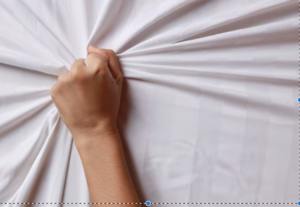 When I’m passionate about something I hate the idea of letting go. It’s mine, damn it, even if it’s hurting me. But that’s me. Everyone has their own style of attachment. And attachment will always lead to struggle because we’re trying to hold something still in a universe that is always moving. Reality is stretching and expanding, dissolving and moving away from us, as we desperately cling and grab to anything we can. Oh what joy when we find that bone to gnaw!
 Once I’m engaged in a struggle, I seem to have to prove something to somebody. I’m going to save this relationship, or I’m going to tell this person off though I never do and just toss about in my bed all night. At some point, I’m just struggling for the struggle. I’m attached to the energy. Attachment brings suffering—I’ve done the research—and it’s a pretty universal human experience. When we grab hold of something we deem important, we don’t want to let it go. Our ego latches on, and whatever grand justification we started with, the war becomes all about us.
 altogether. We keep going because after all the investment, letting go feels frightening. Being right and refusing to listen can feel like strength, like clarity—but it isn’t clarity at all. It’s ego blindness. The part of us that needs to prove a point takes over. Our view becomes so narrow, so refined, so focused on our objective that it feels like certainty.
 Letting go in spirit means releasing our attachment to how the struggle makes us feel—powerful, victimized, justified. Letting go in the mind is harder. We don’t just “stop thinking.” We replay arguments in bed at night. The way out is through love and kindness, drawing the attention out of the body. Until we let go of attachment to feeling bad or feeling victorious, we keep planting seeds of suffering.