
TAKING MY FINGER OFF THE TRIGGER
How can we be less impacted by circumstances as we move through life? Friction in our friendships, difficulties at the office, contention between family members, are common clashes. As well, worry over an uncertain future and thoughts triggered from a wounded past provoke from within. We seem to have triggers everywhere. Some of these we may not be able to change. But we can change our relationship to any of them.
We make difficult circumstances more difficult when we allow the mind to go into  adjacent worries, recrimination and judgment. For instance, there is drilling happening not far from my apartment. It’s annoying and incessant. I’m here having to work on a post about creating peace with this going on in the background. It becomes especially painful when the background becomes the foreground, as is happening now as I’m referring to it. However in the course of writing, I’ll refocus on my work and forget the noise. This cessation of suffering comes and goes and yet the drilling is continuing unabated. Sometimes I’m aware and sometimes not. Each time I’m aware of the drill I forget all about the periods of relative peace. It seems this drilling has been going on my entire life and will continue forever. I cannot help but take this personally.
If I cannot change a situation it falls in the category of pain. Pain is unavoidable in life. Yet any pain can become amplified when it’s cloaked in mental, physical or emotional struggle. This is suffering. And as is said, pain is inevitable, but suffering is optional. The key is being able to accept pain and access the space to see how we can reduce the suffering. Oh, and not take it personally, of course.
Our lives would be so much lighter and more direct if we could accept our pain and move through it without complicating at every turn. So, sitting here with the drilling thinking ‘why did I move to this place?’ Or ‘maybe I should call city services’ is not only an unnecessary complication, it opens the door for further complication. ‘Of course, I can’t call city services, I’ll be on the phone for hours. And then no one will listen.’ The mind piles on more and more evidence that our life is tragic, and we are woefully misunderstood. All the while, I forget that I can just walk into another room. Sometimes I think I like to suffer and feel sorry for myself. Kind of like an auto Munchausen syndrome.
These complications create suffering and distract us from the present. “Distracted” means we are not paying attention. We might think we are present because we are bitching about it, but in reality, we are lost in mental cycles of suffering that have little, if anything, to do with what is happening. Unfortunately, not paying attention leaves us vulnerable. That vulnerability creates anxiety in the part of the mind charged with monitoring our self-defense. When triggered the body grips itself in a faux-protective tension that instigates feelings of unease. The mind tries desperately, to rectify this by reiterating scenarios it hopes to control. As the mind is where we think we live, we believe these stories that are triggered by anxiety, memory and speculation. These narratives, with ourselves at the center, keep us enthralled and distanced from reality.
In Meditation, each time we recognize distraction we have the choice to create a gap in which we are able to come back to the present. This process extends to triggering situations in life. We can return to the body breathing – which is happening in the present. As we train the mind to leave its dream world behind, we begin to see that operating more closely to reality allows us to recognize and become familiar with the fears we always live with. We become able to work with things that frighten us, until they become workable.
However, as we step out of our cocoon, we still need protection. But, we change our allegiance from fantasy to awareness. The further we awaken the more danger we perceive. As we step from the cocoon the world is more vibrant because we are leaving a sensually dampened state and stepping into clarity. The world is more vibrant, but that means sirens are louder, people more irritating, and danger more apparent. It is said that irritation is the vanguard of awareness. Sometimes, we retreat. Yes. But our work is to notice when we are closing down, and to encourage ourselves toward opening when we are able, as we can.
So, how do we step from our cocoon and remain confident as we do so?
Rather than the faux protection of our panicked thinking, Meditation practice allows us  to create a gap between input and impulse, which serves as a mote or buffer of aware space. Whether we are triggered by someone else, or drilling outside the window, all instigating impulses happen in our mind. When the mind builds it cocoon it compounds itself into a hall of mirrors. Turning the attention from this brain constipation toward the aerobic movement of breathing interrupts the process and allows the claustrophobia to abate. When we turn our attention from the overwhelmed brain to the body breathing, we go return to something grounding. And while simple awareness of the breath may seem inadequate to address how impacted we feel, it actually creates a gap that allows the mind more clarity to see clearly.
So how do we work with our thinking? Buddhists believe that our every thought travels the same cyclic journey as as does our life. Each life travels the same cycle as every epoch in history, or any structure in society, every fad and trend. Everything that happens is born in darkness and matures through a process that flowers into consciousness and fades eventually into entropy, death and reconfiguration. At death, a momentum remains to shape the next reconfiguration. Born in darkness, these cycles remain unknown to themselves, unless something interrupts the pattern.
In meditation practice we begin to see aspects of these cycles in our mind. With practice, we actually learn to interrupt the cycle and allow awareness. The most reliable point of interrupting the cycle happens as a feeling arises. This is a red flag, of sorts. Our feeling might be pleasurable, neutral or painful. We generally don’t pay attention to our feelings and move past them toward the next stages in the cycle, craving and grasping. Craving can be wanting something we want, but it can also be yearning for relief from situations we don’t want. The next stage, grasping is when we take hold and make a meal of it. When experiencing painful situations, we naturally crave relief and cling to a struggle that sometimes expands our pain into suffering. If we are not aware, we become lost in a fantasy cocoon fueled by feelings of victimization and retribution.
The interruption point comes as we become conscious of the cycle. The more we meditate, the more we are familiar with the mind, the sooner we are able to impose a gap of awareness. The most reliable entry point lies between craving (wanting things to change) and grasping (beginning to struggle.)
In simple language, when we notice something unpleasant that has the capacity to engulf us into a cycle of suffering, we can interrupt the process before we take anything personally. We can pick up the laptop and go into another room. If we cannot change the circumstances, we can change our relationship to it. And the best remedy, I have found, is to create internal mental space as a buffer. When we recognize we are in pain, we can interrupt the mind cycle by releasing our grasping and letting go, return to the breath. We are moving from struggling with things we cannot change, toward what we can, our breath. We can slow down and disengage.
By relaxing the nervous system our mind becomes clear and from the vantage of aware space, the situation may reveal itself as entirely workable.

 In a world filled with endless information and impulses, the idea of simplifying life to a single breath may seem overly reductive, especially in contrast to the overwhelming chaos of our triggered states. And while chaos is part of life these days, perhaps there is a way to navigate this chaos. Instead of trying to control the flood of thoughts and data, we can shift our focus from the mind into action. And we can take that action one step at a time. The question becomes: What is the next right step?
 While it is important to be in the moment, each moment is leading to the next. To make this next authentic action practical, it helps to determine where we are going. If we have a commitment to work for the benefit of all beings then it becomes clear. By “all,” beings we are including ourselves. Helping others at the cost of our own wellness is not truly helpful. So, what is the next step that leads toward helpful engagement with our world? Once we know this, the next step we take is a natural action. By natural we mean not rooted in confusion or external expectation, but what needs to be done for the benefit of everyone, including ourselves. Taking that step will clarify the next step and in so doing reveal the journey ahead. We move toward helpfulness and harmony, and away from reactive patterns that keep us entangled in life’s struggles.
 holidays are often described as loving and warm, but it can also feel cold and threatening.
 False binaries dominate our consciousness, good versus evil, left versus right, wonderful versus horrible. We live squeezed between these exaggerations. The Buddha taught that the truth lies not in extremes but in the “middle way.” This teaching urges us to be present in our lives and act rightly in the moment. Similarly, the 12-step traditions speak of “doing the next right thing.” According to the Buddha, the next right step depends on the specific circumstances of the moment. Instead of fabricating extremes, the middle way turns our attention to what’s really happening.

 Therefore, distinguishing pain from suffering is key. It is said that pain is inevitable, while suffering is optional. Pain may accompany growth or even be necessary for it. Working through pain brings physical strength and emotional maturity. However, our interpretation of pain often complicates our view and tension amplifies it into suffering. We take pain personally, becoming entangled in hypotheticals, judgment, and resentment. Instead of meeting pain, as it is, in order to work with it, we struggle against it, giving it power over us. This creates great Suffering. Yet, since suffering is optional, it can be addressed and reduced.
 But this talk is not about back pain. This talk is also about our mental and emotional health and how with meditation we are retraining the mind away from reflexive reactions so we have a way of working with pain that allows us to gain mastery over suffering. The title of this talk is “Sit Down and Rise Up.” Or, maybe “Rise Up and Sit Down” depending on its whim. By sitting down and connecting to the earth, we ground ourselves in the present. With practice, we grow comfortable with our own presence and begin to connect to our innate dignity, confidence, and well-being. Rising up in a gently uplifted posture lengthens the spine, creating space for tension to release and openness to dawn. With practice we become confident with openness. Openness, in turn, engenders more confidence in not just our spirit, but our body. With practice we become familiar with the warrior’s seat, and are able to return to it.
 For example, Muhammad Ali trained himself to relax and release tension when struck by an opponent, by famously using the “rope-a-dope” strategy. By leaning back on the ropes, dancing and smiling, not only replenished his energy, but seriously disheartened his opponents. When balanced, he faced the moment rather than retreating, demonstrating mastery over both his body and mind.
 On the flip side, sometimes we place so much pressure on the present moment that we take it too personally, making things harder for ourselves and others. The present is just a blip in our flow—we meet the moment and move on. But when we hit a snag, it can occupy much more of our time and energy than is helpful. If we could retrain our minds to notice and let go, we might see difficulties as opportunities to learn who we are and how we behave, freeing ourselves from the habitual patterns that keep us stuck.
 I once dated an astrologer who, after reading our charts, told me we had a rare but perfect astrological conflict called the “heartbreak clash.” It seemed insurmountable, and everything we read suggested it was impossible to overcome. But along with the clash came an undeniable attraction. We felt drawn to the conflict, as if we had to overcome it. “I always go for damaged angels” or “every partner I choose is the wrong one”—maybe we’re all damaged angels, and there’s no such thing as a “wrong” partner. Maybe there are only partners who push the right buttons to unlock parts of us.
 But the other person isn’t directly touching our wounds; they’re triggering the defenses we’ve placed around them. More importantly, we’re not seeing our wounds; we’re seeing them through the lens of our defenses. The easy way out is to blame—to fixate on the other person, diverting attention from ourselves. This blocks our ability to learn. Another shortcut is judgment: believing the other person is wrong by some standard. But what does that really mean? By whose standards? Humans notoriously adjust ethical scales to serve their own self-interest. We can quote the Bible, the Buddha, or any law book to justify our point, but all we’re really doing is hiding our fear of what lies beneath.
 suffered, and even lost their lives so that the rest of us may live relatively free and open lives. Veterans include not only those who served in the military, but also the families of those who died in service. However, there are many who have sacrificed for the cause of freedom and liberation within our own shores. The first black children integrated into schools, the first students who spoke out against an unjust Vietnam War, and those who currently challenge human participation in climate change, racial violence and societal hatred. With great respect for those who have served our military, I also want to recognize all who have suffered and been wounded in life, yet continue to face the world with courage.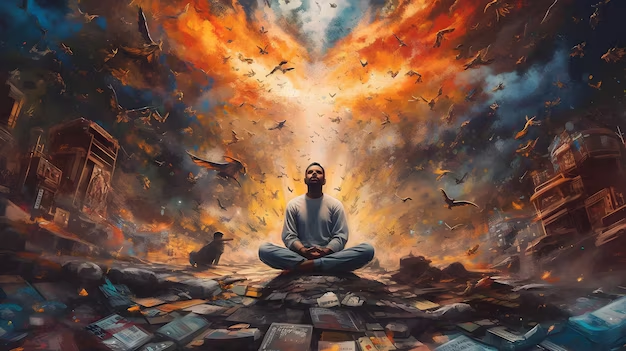

 Facing the possibility of change with an open heart, a strong back and a clear mind is nonviolent warriorship which is the seat of the bodhisattva. Connecting to our inner life force, we find a strength that can lead us forward. Sit down, rise up and meet the change. There is great strength in this. Finding false strength in what everybody else is doing or in reacting to what everyone else is doing, which is the same, are just expressions of being controlled by fear. On the other hand, bravery is sitting in the maelstrom, open and aware, feeling our fear and remaining open and clear. Doing this as a training practice every morning is how we remain spiritually fit and connected to our life.