
I had a friend who was a poet. I felt he was closing off to me and I asked if I had hurt his feelings. He replied, “I only have one feeling, and it’s always hurt.” He was a difficult and complex person and yet everyone wanted more of him. This wounded soul asked nothing from anyone but to write and be left alone. Bob Dylan once said, if he wanted happiness, he wouldn’t have been a poet. Both Dylan and Jim Storm avoided adulation because they knew it created binding contracts their creativity could ill afford.
Obligation is not a show of compassion as much as it is a desperate clinging to something that makes us feel secure.
I, on the other hand, could never share my broken heart because I was afraid to know it. I remained buried under the excess weight of my belly. Hence, I remained so protected I couldn’t heal. My wounds festered and became sore to the touch. So, I avoided bumping into this inflamed pain and would seek comfort in other’s approval. I suppose this let me feel I was securing my place on the planet. And because I wanted others to value me, I was forever the overconfident clown. I believed that if people loved me, I would be indispensable to them. This maladaptive grasping for security assured I was always getting hurt, always disappointed and forever let down. The more I grasped, the emptier I felt. The more I sang for my supper, the greater my resentment grew. I created lists of everything I did for everyone. I created resentments when those gifts were never returned.
Because I could not feel my hurt, I went right to blame and resentment, fixating on how no one got me. All of my performing, joking and hiding myself was actually a great burden for me to carry. I would avoid going out, because I had this inflated idea of ME to uphold. I couldn’t just show up as myself, could I? It was like spinning plates to prop up this façade anyone but me could see through. What was I protecting inside?
I was a wounded kid who grew up in an environment that I never felt strong enough or big enough and so I was always compensating. I was forever trying to grab on to everything and anything in my world that gave me purpose, worth and value because I didn’t feel those things for myself. I ended up as something of an emotional hoarder. I wouldn’t allow space into my life because space seemed to remind me, I wasn’t enough. I would hold on to other people and try to extract their love and praise and when I didn’t get it, I would hold on to the resentments. With no trust to let go and allow space, I was unable to see anyone. Space affords perspective. Without space my mind was a jumbled mess from which only need and resentment grew. Rather than feeling an inner wealth that I could share with others, I walked around constantly disappointed in their lack of following my directives. I was asking way too much of my world
I had a dear friend who was dying of cancer. One night after a party he through with his settlement money, I asked why he never laughed at my jokes. He said because he felt coerced into laughing at them. He didn’t feel there was any agency from him I was requesting. I began to see that people didn’t trust me because I didn’t trust them. I didn’t trust space. And I mistook emptiness for a bad thing. Rather than lack, emptiness can be seen as room. I was skillful enough at the art of speaking that I kept everybody giggling and appropriately focused, but I was also not giving any space for their feelings. It has lately become important for me to touch into the emptiness I fell feel inside. It’s important for me to become familiar with feeling emptiness and see it as an opening. From a meditation point of view, every experience we encounter is good. Awareness is the essence of realization, as is taught. The greater our awareness, the more agency we have in life. Awareness is born of confidence, and in turn engenders confidence. Confidence allows us the strength to offer rather than take We’ve all heard “it’s better to give than to receive” but that always felt like a burden to me as though we’re giving up things we need to please or appease others. But when we give if we are giving appropriately, we are letting go and letting go creates space both for us and for those to whom we’re giving. And the greatest gift we can give is our acceptance, which is our awareness turning toward them with the space for them to be as they are. There moments of contact are precious and more meaningful than all the things we clutter our mind with.
We cannot gain self-worth through external means. The things to which we cling are only distractions from the real work, which is to find what we need by building our spirit. That is certainly what I have been looking for and what I am committed to now in the new year. Be the one who loves you. It is human nature to want those who possess themselves. Conversely, it is also natural to avoid those with excessive needs that aren’t addressed. We can sense that pit of need which actually manifests as demand. We demand, cajole, manipulate in order to fill a space that doesn’t need filling.
Maybe we are the very one to heal our broken heart. And from there we have a full heart to share. No one owes us anything. But we owe ourselves all the love we have.
====
 adjacent worries, recrimination and judgment. For instance, there is drilling happening not far from my apartment. It’s annoying and incessant. I’m here having to work on a post about creating peace with this going on in the background. It becomes especially painful when the background becomes the foreground, as is happening now as I’m referring to it. However in the course of writing, I’ll refocus on my work and forget the noise. This cessation of suffering comes and goes and yet the drilling is continuing unabated. Sometimes I’m aware and sometimes not. Each time I’m aware of the drill I forget all about the periods of relative peace. It seems this drilling has been going on my entire life and will continue forever. I cannot help but take this personally.
 to create a gap between input and impulse, which serves as a mote or buffer of aware space. Whether we are triggered by someone else, or drilling outside the window, all instigating impulses happen in our mind. When the mind builds it cocoon it compounds itself into a hall of mirrors. Turning the attention from this brain constipation toward the aerobic movement of breathing interrupts the process and allows the claustrophobia to abate. When we turn our attention from the overwhelmed brain to the body breathing, we go return to something grounding. And while simple awareness of the breath may seem inadequate to address how impacted we feel, it actually creates a gap that allows the mind more clarity to see clearly.
 In a world filled with endless information and impulses, the idea of simplifying life to a single breath may seem overly reductive, especially in contrast to the overwhelming chaos of our triggered states. And while chaos is part of life these days, perhaps there is a way to navigate this chaos. Instead of trying to control the flood of thoughts and data, we can shift our focus from the mind into action. And we can take that action one step at a time. The question becomes: What is the next right step?
 While it is important to be in the moment, each moment is leading to the next. To make this next authentic action practical, it helps to determine where we are going. If we have a commitment to work for the benefit of all beings then it becomes clear. By “all,” beings we are including ourselves. Helping others at the cost of our own wellness is not truly helpful. So, what is the next step that leads toward helpful engagement with our world? Once we know this, the next step we take is a natural action. By natural we mean not rooted in confusion or external expectation, but what needs to be done for the benefit of everyone, including ourselves. Taking that step will clarify the next step and in so doing reveal the journey ahead. We move toward helpfulness and harmony, and away from reactive patterns that keep us entangled in life’s struggles.
 holidays are often described as loving and warm, but it can also feel cold and threatening.
 False binaries dominate our consciousness, good versus evil, left versus right, wonderful versus horrible. We live squeezed between these exaggerations. The Buddha taught that the truth lies not in extremes but in the “middle way.” This teaching urges us to be present in our lives and act rightly in the moment. Similarly, the 12-step traditions speak of “doing the next right thing.” According to the Buddha, the next right step depends on the specific circumstances of the moment. Instead of fabricating extremes, the middle way turns our attention to what’s really happening.

 Therefore, distinguishing pain from suffering is key. It is said that pain is inevitable, while suffering is optional. Pain may accompany growth or even be necessary for it. Working through pain brings physical strength and emotional maturity. However, our interpretation of pain often complicates our view and tension amplifies it into suffering. We take pain personally, becoming entangled in hypotheticals, judgment, and resentment. Instead of meeting pain, as it is, in order to work with it, we struggle against it, giving it power over us. This creates great Suffering. Yet, since suffering is optional, it can be addressed and reduced.
 But this talk is not about back pain. This talk is also about our mental and emotional health and how with meditation we are retraining the mind away from reflexive reactions so we have a way of working with pain that allows us to gain mastery over suffering. The title of this talk is “Sit Down and Rise Up.” Or, maybe “Rise Up and Sit Down” depending on its whim. By sitting down and connecting to the earth, we ground ourselves in the present. With practice, we grow comfortable with our own presence and begin to connect to our innate dignity, confidence, and well-being. Rising up in a gently uplifted posture lengthens the spine, creating space for tension to release and openness to dawn. With practice we become confident with openness. Openness, in turn, engenders more confidence in not just our spirit, but our body. With practice we become familiar with the warrior’s seat, and are able to return to it.
 For example, Muhammad Ali trained himself to relax and release tension when struck by an opponent, by famously using the “rope-a-dope” strategy. By leaning back on the ropes, dancing and smiling, not only replenished his energy, but seriously disheartened his opponents. When balanced, he faced the moment rather than retreating, demonstrating mastery over both his body and mind.
 On the flip side, sometimes we place so much pressure on the present moment that we take it too personally, making things harder for ourselves and others. The present is just a blip in our flow—we meet the moment and move on. But when we hit a snag, it can occupy much more of our time and energy than is helpful. If we could retrain our minds to notice and let go, we might see difficulties as opportunities to learn who we are and how we behave, freeing ourselves from the habitual patterns that keep us stuck.
 I once dated an astrologer who, after reading our charts, told me we had a rare but perfect astrological conflict called the “heartbreak clash.” It seemed insurmountable, and everything we read suggested it was impossible to overcome. But along with the clash came an undeniable attraction. We felt drawn to the conflict, as if we had to overcome it. “I always go for damaged angels” or “every partner I choose is the wrong one”—maybe we’re all damaged angels, and there’s no such thing as a “wrong” partner. Maybe there are only partners who push the right buttons to unlock parts of us.
 But the other person isn’t directly touching our wounds; they’re triggering the defenses we’ve placed around them. More importantly, we’re not seeing our wounds; we’re seeing them through the lens of our defenses. The easy way out is to blame—to fixate on the other person, diverting attention from ourselves. This blocks our ability to learn. Another shortcut is judgment: believing the other person is wrong by some standard. But what does that really mean? By whose standards? Humans notoriously adjust ethical scales to serve their own self-interest. We can quote the Bible, the Buddha, or any law book to justify our point, but all we’re really doing is hiding our fear of what lies beneath.
 suffered, and even lost their lives so that the rest of us may live relatively free and open lives. Veterans include not only those who served in the military, but also the families of those who died in service. However, there are many who have sacrificed for the cause of freedom and liberation within our own shores. The first black children integrated into schools, the first students who spoke out against an unjust Vietnam War, and those who currently challenge human participation in climate change, racial violence and societal hatred. With great respect for those who have served our military, I also want to recognize all who have suffered and been wounded in life, yet continue to face the world with courage.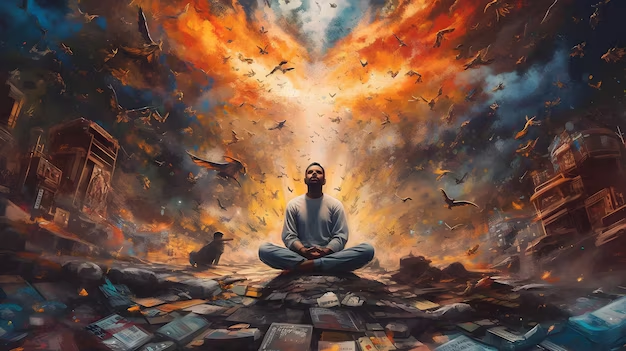

 Facing the possibility of change with an open heart, a strong back and a clear mind is nonviolent warriorship which is the seat of the bodhisattva. Connecting to our inner life force, we find a strength that can lead us forward. Sit down, rise up and meet the change. There is great strength in this. Finding false strength in what everybody else is doing or in reacting to what everyone else is doing, which is the same, are just expressions of being controlled by fear. On the other hand, bravery is sitting in the maelstrom, open and aware, feeling our fear and remaining open and clear. Doing this as a training practice every morning is how we remain spiritually fit and connected to our life.