
Stepping Past Mental Confusion.
Walking through life one breath at a time sounds very beautiful and Buddhisty. Yet to our everyday brains, it feels pretty impractical.
 In a world filled with endless information and impulses, the idea of simplifying life to a single breath may seem overly reductive, especially in contrast to the overwhelming chaos of our triggered states. And while chaos is part of life these days, perhaps there is a way to navigate this chaos. Instead of trying to control the flood of thoughts and data, we can shift our focus from the mind into action. And we can take that action one step at a time. The question becomes: What is the next right step?
It is often said that action leads to clarity of mind. Action is simple. It is the next step we take, or the next breath we notice. When we remain stuck in our minds, we overwhelm ourselves with outcomes, variables, and possibilities, all echoing endlessly. But reducing this confusion to one practical step can help us move forward. Once we identify that one step, the following steps often reveal themselves naturally.
“Move a muscle and change your mind,” it is said.
When we are stuck, movement leads to clarity. But it is crucial that this movement is an action taken in confidence, and not a reaction based in fear. The key is a mindful pause, that allows us to turn the lights on, before we step. Reactions born of fear such as defensiveness, anger, or frustration only add to confusion because they are blind. They are shaped by past pain that we unconsciously relive. In contrast, the next right step is free of this conditioning. It arises consciously, rooted in the present.
So how do we remain conscious and move beyond our mental entrapment? When the mind gets lost in itself, it can feel as though we are battling others. We fixate on them, or the weather, or the traffic, demonizing any available external. Yet in truth, we are not seeing anything but our projections. This does not help anyone, least of all ourselves. To counter this, we can follow a simple process of turning the mind from itself toward the breathing body and align with the breath. The breath is reliably in the present. By coming back to the present, we turn the mind from darkened reaction, to seeing more simply and the next action often reveals itself. This pause cuts through negative, programmed reactions and allows us to take an authentic step forward—one unclouded by past experiences or future expectations. Free of impulse, this step can follow our higher self or spiritual being.
 While it is important to be in the moment, each moment is leading to the next. To make this next authentic action practical, it helps to determine where we are going. If we have a commitment to work for the benefit of all beings then it becomes clear. By “all,” beings we are including ourselves. Helping others at the cost of our own wellness is not truly helpful. So, what is the next step that leads toward helpful engagement with our world? Once we know this, the next step we take is a natural action. By natural we mean not rooted in confusion or external expectation, but what needs to be done for the benefit of everyone, including ourselves. Taking that step will clarify the next step and in so doing reveal the journey ahead. We move toward helpfulness and harmony, and away from reactive patterns that keep us entangled in life’s struggles.
But, a view of developing ourselves to be a benefit to others, also sounds Buddhisty and impractical. But, what is happening here is very practical. We are not reaching beyond ourselves, or trying to gain anything that is not already here. We are simply adjusting our view away from self-centered desires that actually are impractical. If our view is only our own happiness, than we have created a very narrow space. Happiness is dependent on other things, our livelihood, our relationships, the weather. It is actually, out of our control and largely theoretical. Real happiness comes to us. It is a product of living a life we believe in, and is connected to al beings. We are part of life on this planet, and part of the consciousness of the universe. But, this is only accessible in the present – right here, right now. And should we adopt the view that we are here to benefit our world, we are connected to a vastness that is inspiring.
Many traditions speak of karma, each with its own interpretation. In Buddhist teachings, karma reflects vast interactive forces that guide us into certain life situations, like currents in a river. When lost in the river, we cannot fully understand these currents. However, we still have choices: to fight, to succumb, or to guide ourselves through. By choosing to guide, we release ourselves from struggle, moving one stroke—or one breath—at a time, away from danger and toward safety.
If we panic, we create more waves and confusion, making progress even harder. But when we understand the right direction—away from the waterfall, for example, and toward a safe dock—we can calmly take one stroke at a time. It is not necessary to comprehend the full scope of karma to reduce its influence. Instead, by waking up and becoming aware of the present moment, we stop creating new karma through ignorance or momentum. Awareness allows us to choose the next right action, breaking free of preprogrammed reactions.
If our higher mind aligns with the benefit of ourselves and others, each step we take—each breath—becomes the next right action toward that view.
The Four R’s: A Tool for Moments of Confusion
When confusion arises, we often try to fight through it, only to find our destination slipping further away. Instead, we can use the Four R’s:
- Recognize the confusion. Acknowledge it without judgment.
- Release your grip on the struggle. Let go of what is causing or worsening the confusion.
- Return to the rhythm of your breathing. Anchor yourself in the present moment.
- Realign with the flow of life. Allow the next action to arise naturally.
By employing this process, we can release ourselves into the natural flow of life. One breath at a time. And by training in returning to the breath in meditation practice, we are training to return to life whenever we are caught in our mind.

 holidays are often described as loving and warm, but it can also feel cold and threatening.
 False binaries dominate our consciousness, good versus evil, left versus right, wonderful versus horrible. We live squeezed between these exaggerations. The Buddha taught that the truth lies not in extremes but in the “middle way.” This teaching urges us to be present in our lives and act rightly in the moment. Similarly, the 12-step traditions speak of “doing the next right thing.” According to the Buddha, the next right step depends on the specific circumstances of the moment. Instead of fabricating extremes, the middle way turns our attention to what’s really happening.

 Therefore, distinguishing pain from suffering is key. It is said that pain is inevitable, while suffering is optional. Pain may accompany growth or even be necessary for it. Working through pain brings physical strength and emotional maturity. However, our interpretation of pain often complicates our view and tension amplifies it into suffering. We take pain personally, becoming entangled in hypotheticals, judgment, and resentment. Instead of meeting pain, as it is, in order to work with it, we struggle against it, giving it power over us. This creates great Suffering. Yet, since suffering is optional, it can be addressed and reduced.
 But this talk is not about back pain. This talk is also about our mental and emotional health and how with meditation we are retraining the mind away from reflexive reactions so we have a way of working with pain that allows us to gain mastery over suffering. The title of this talk is “Sit Down and Rise Up.” Or, maybe “Rise Up and Sit Down” depending on its whim. By sitting down and connecting to the earth, we ground ourselves in the present. With practice, we grow comfortable with our own presence and begin to connect to our innate dignity, confidence, and well-being. Rising up in a gently uplifted posture lengthens the spine, creating space for tension to release and openness to dawn. With practice we become confident with openness. Openness, in turn, engenders more confidence in not just our spirit, but our body. With practice we become familiar with the warrior’s seat, and are able to return to it.
 For example, Muhammad Ali trained himself to relax and release tension when struck by an opponent, by famously using the “rope-a-dope” strategy. By leaning back on the ropes, dancing and smiling, not only replenished his energy, but seriously disheartened his opponents. When balanced, he faced the moment rather than retreating, demonstrating mastery over both his body and mind.
 On the flip side, sometimes we place so much pressure on the present moment that we take it too personally, making things harder for ourselves and others. The present is just a blip in our flow—we meet the moment and move on. But when we hit a snag, it can occupy much more of our time and energy than is helpful. If we could retrain our minds to notice and let go, we might see difficulties as opportunities to learn who we are and how we behave, freeing ourselves from the habitual patterns that keep us stuck.
 I once dated an astrologer who, after reading our charts, told me we had a rare but perfect astrological conflict called the “heartbreak clash.” It seemed insurmountable, and everything we read suggested it was impossible to overcome. But along with the clash came an undeniable attraction. We felt drawn to the conflict, as if we had to overcome it. “I always go for damaged angels” or “every partner I choose is the wrong one”—maybe we’re all damaged angels, and there’s no such thing as a “wrong” partner. Maybe there are only partners who push the right buttons to unlock parts of us.
 But the other person isn’t directly touching our wounds; they’re triggering the defenses we’ve placed around them. More importantly, we’re not seeing our wounds; we’re seeing them through the lens of our defenses. The easy way out is to blame—to fixate on the other person, diverting attention from ourselves. This blocks our ability to learn. Another shortcut is judgment: believing the other person is wrong by some standard. But what does that really mean? By whose standards? Humans notoriously adjust ethical scales to serve their own self-interest. We can quote the Bible, the Buddha, or any law book to justify our point, but all we’re really doing is hiding our fear of what lies beneath.
 suffered, and even lost their lives so that the rest of us may live relatively free and open lives. Veterans include not only those who served in the military, but also the families of those who died in service. However, there are many who have sacrificed for the cause of freedom and liberation within our own shores. The first black children integrated into schools, the first students who spoke out against an unjust Vietnam War, and those who currently challenge human participation in climate change, racial violence and societal hatred. With great respect for those who have served our military, I also want to recognize all who have suffered and been wounded in life, yet continue to face the world with courage.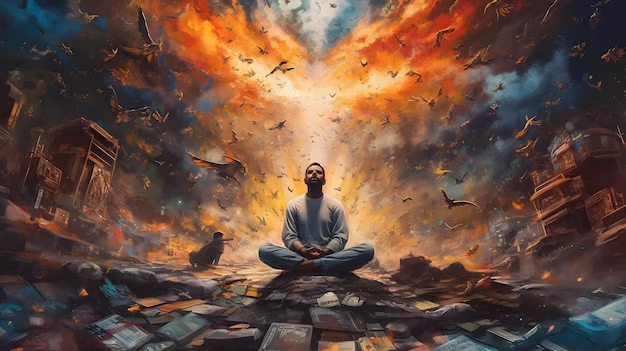

 Facing the possibility of change with an open heart, a strong back and a clear mind is nonviolent warriorship which is the seat of the bodhisattva. Connecting to our inner life force, we find a strength that can lead us forward. Sit down, rise up and meet the change. There is great strength in this. Finding false strength in what everybody else is doing or in reacting to what everyone else is doing, which is the same, are just expressions of being controlled by fear. On the other hand, bravery is sitting in the maelstrom, open and aware, feeling our fear and remaining open and clear. Doing this as a training practice every morning is how we remain spiritually fit and connected to our life.

