
Opening to Compassion

The ideal of a mother’s love as being nurturing and sustaining is an archetype deeply embedded in nature and consciousness. Regardless of the individual relationships with our mother, the essence of motherhood—the embodiment of love and loving-kindness—pervades our experience. This ideal is not just a sentimental notion; it is a foundational aspect of the path of wisdom.
Wisdom alone can become cold, sharp, even unyielding. But when united with love, wisdom finds true expression. Love and loving-kindness are essential forces that balance and ground wisdom in compassion. They bind the clarity of insight to the warmth of connection, allowing both to flourish together.
In many spiritual traditions, this love is awakened through devotion—whether to a teacher, a lineage, a deity, or even our ancestors. For some, it comes from connection to a godhead: a creator or a divine messenger such as the Father and the Son. My grandfather, a pastor in a small community church, had a banner above his pulpit that read: “God is love.” He believed that this was an essential truth. Not a god of war or wrath, but a god that is love. This love is nurturing, caring and complete. This love is larger than us, but one one that we could grow into.
Love and loving-kindness are natural to sentient beings. Because they are part of our primordial nature, we don’t need to acquire or construct them from outside ourselves. Instead, devotion—to a teacher, to the divine, or to life itself—can awaken the love already within us. This process has been described as a mother and child reunion—not only by Paul Simon, but in the sense that our opening heart reconnected to the primordial love that gave birth, and continues to nurture, the universe.
On a journey to developing transcendent compassion we are not seeking to possess this love. Rather, we allow it to ignite our own inner capacity for love. It is not about gaining something new, but uncovering what has always been there—our inherent ability to respond to the universe with love.
So our task is not to create love, but to liberate it. We open to it—not by striving, but by dissolving the obstacles that prevent it from flowing freely.
 These obstacles show up in both our ability to receive love and our willingness to express it. Most often, these blocks are rooted in fear. Fear causes us to shut down and react from our most primal conditioning. Biologically and psychologically, this manifests in what Western psychology calls fight, flight, or freeze—and what Buddhist psychology identifies as passion, aggression, and ignorance. We are either grasping toward something, pushing it away, or dissociating from it. These reactions are not mindful; they are reflexive, often pre-conscious. They hijack our awareness before we even realize what’s happening.
Tibetan teacher Zigar Kontrul, Rinpoche and his student Pema Chödrön refer to this as “shenpa“—the experience of being “hooked.” While often translated as “attachment,” shenpa more accurately describes that moment when something grabs us and pulls us out of our natural state. Before we even choose to cling; the experience has taken hold of us.
In classical Buddhism, passion, aggression, and ignorance are all forms of desire—desire to grasp, to resist, or to escape. While it is possible to open to desire, and release the clinging, when fear is involved, our clinging is closing down. This blocks the radiance of our natural passion and love. To love is to open—and clinging – even when we believe we are expressing our love, is actually the opposite of opening. Sometimes, the power of our love, causes us to be fearful and cling, such as when we expresses our love through control, manipulation or aggression.
True love arises when we open to experience without grasping or avoidance. But this kind of openness is deeply challenging, even excruciating. To stay still and present while a storm of emotion passes through us requires discipline, training, and deep courage. We are learning to remain still within the fire.
 In Tibetan Vajrayana, the deity Vajrayogini embodies this teaching. She is depicted as a young woman standing within flames—the flames of compassion and passion. In one hand she holds a skull cup filled with Amrita, a nectar that intoxicates fearful beliefs and allows us to let go; in the other, a curved knife that cuts through clinging. Together, these symbolize the essence of love and wisdom—complete openness coupled with sharp discernment. We open fully to love but do not cling, possess, or manipulate it. We do not run toward or away; instead, we stand still and dance within the flames.
In certain tantric rituals, such as Chöd or Tsok, practitioners visualize themselves as the deity, allowing all fear, negativity, and clinging to be consumed by the flames of compassion. In doing so, we burn away our neurosis and awaken our natural capacity to love.
On a practical level, we can trust this: we are loving beings. We are the result of love. The Mahayana ideal tells us that all beings, at some point in the cycle of existence, have been our mother—and we theirs. Whether or not we believe in literal reincarnation, the message is clear: we are all interconnected through the web of care, nurture, and compassion.
Our role is to accept love, to recognize it, to avoid clinging to it, and to offer it back to the world—without expectation. Like the rain, which falls without concern for whether flowers will bloom, we offer our love freely. And in doing so, we create the conditions for the blossoming of life wherever it can take root.

 We freeze, believe, identify. Then we’re off to the races as we script our story with ourselves as the protagonist, whether it be victim or hero. The more we are triggered, the more our universe feels real. But what’s real is that we are at the center of that universe. This very solid Me rolled from bed into a universe of defeat.
 But, we are part of our world, and so Compassion begins with us. Not exaggerating our self importance and our pain, but activating our empathy. If we settle our heart, mind, and body, we can see past the fog of panic. By simply taking our seat and sitting tall, we access natural wisdom. That’s wisdom, not wisdoom. Not believing the worst, but seeing what there is – everything there is. Like sediment settling in water, clarity dawns. We see what is—not an exaggeration of fear.

 The ideal meditative state—clarity and acceptance—rests on the openness and settledness of the body, heart, and mind. However, life rarely offers us perfect conditions. For me, morning practice often begins with a scattered or resistant mind. The first step, then, is acceptance—meeting the mind as it is and not as I wish it to be.
 Once again, meditation isn’t about fixing; it’s about seeing. The mind of meditation arises in awareness like a point in space. And as the space of awareness is relieved of the pressure to fix itself or chose a side, it remains loving and supportive. It is a state of grace. By stepping into the grace of awareness, we don’t need to force change—we simply allow what we notice to be with us, remembering none of it is as real, solid or urgent as our fear suggests. Trungpa Rinpoche famously wrote, “good, bad, happy, sad – all thoughts vanish like an imprint of a bird in the sky.” Once we release ourselves from the grip of control, we see everything as ephemeral, diaphanous and in dynamic transition. Sakyong Mipham calls this the displaysive activity of mind. All of our worries are the mind revealing itself. Many of our worries are kid fears. And like kids, they need to be loved and accepted, but not always believed.
 In a world filled with endless information and impulses, the idea of simplifying life to a single breath may seem overly reductive, especially in contrast to the overwhelming chaos of our triggered states. And while chaos is part of life these days, perhaps there is a way to navigate this chaos. Instead of trying to control the flood of thoughts and data, we can shift our focus from the mind into action. And we can take that action one step at a time. The question becomes: What is the next right step?
 While it is important to be in the moment, each moment is leading to the next. To make this next authentic action practical, it helps to determine where we are going. If we have a commitment to work for the benefit of all beings then it becomes clear. By “all,” beings we are including ourselves. Helping others at the cost of our own wellness is not truly helpful. So, what is the next step that leads toward helpful engagement with our world? Once we know this, the next step we take is a natural action. By natural we mean not rooted in confusion or external expectation, but what needs to be done for the benefit of everyone, including ourselves. Taking that step will clarify the next step and in so doing reveal the journey ahead. We move toward helpfulness and harmony, and away from reactive patterns that keep us entangled in life’s struggles.
 False binaries dominate our consciousness, good versus evil, left versus right, wonderful versus horrible. We live squeezed between these exaggerations. The Buddha taught that the truth lies not in extremes but in the “middle way.” This teaching urges us to be present in our lives and act rightly in the moment. Similarly, the 12-step traditions speak of “doing the next right thing.” According to the Buddha, the next right step depends on the specific circumstances of the moment. Instead of fabricating extremes, the middle way turns our attention to what’s really happening.

 suffered, and even lost their lives so that the rest of us may live relatively free and open lives. Veterans include not only those who served in the military, but also the families of those who died in service. However, there are many who have sacrificed for the cause of freedom and liberation within our own shores. The first black children integrated into schools, the first students who spoke out against an unjust Vietnam War, and those who currently challenge human participation in climate change, racial violence and societal hatred. With great respect for those who have served our military, I also want to recognize all who have suffered and been wounded in life, yet continue to face the world with courage.
 I started my journey with meditation when I was most confused about how to move forward. Each step forward seemed to be met with a step back—sometimes a frozen moment, sometimes a lashing out, sometimes a dive into extreme tequila to numb the pain of indecision. These may sound like champagne problems—or in my case, a tequila-and-cocaine problem—but it still kept me from fully participating in life. I was always healing, always beginning again, but the object of healing was undefined, so this process only supporting my impairment. It wasn’t until I began looking at the things that were blocking me that I could begin to heal.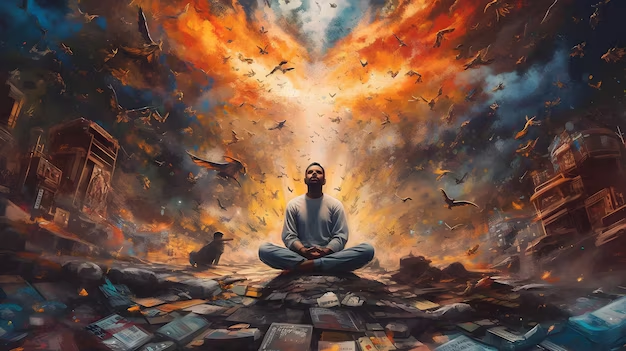

 Facing the possibility of change with an open heart, a strong back and a clear mind is nonviolent warriorship which is the seat of the bodhisattva. Connecting to our inner life force, we find a strength that can lead us forward. Sit down, rise up and meet the change. There is great strength in this. Finding false strength in what everybody else is doing or in reacting to what everyone else is doing, which is the same, are just expressions of being controlled by fear. On the other hand, bravery is sitting in the maelstrom, open and aware, feeling our fear and remaining open and clear. Doing this as a training practice every morning is how we remain spiritually fit and connected to our life.