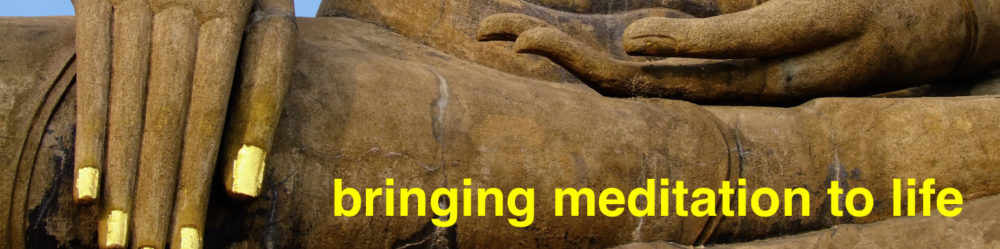
The Coming of the Light

BUDDHA’S LUMINOUS PROMISE


The holiday season is marked by lights that shimmer and glisten in the cold darkness of long nights. This tradition of surrounding ourselves energetically with radiant color harkens back to the earliest experiences of the human race. In ancient times, humans had fewer distractions and were more attuned to the world around them and the sky above them. They felt the sun rising and felt it falling and diminishing. Like all life on our planet, they learned to live in conjunction with these rhythms.

As human consciousness grew more acute, we developed ideas about concepts that began to separate us from direct perception of our life. Feeling the sky move around us, we imputed meaning to those movements. As our life was dependent on things that lay beyond our control. So we created stories. In time those stories became beliefs. This was the blessing and curse of our developing awareness. We ended up believing our beliefs.

While animals move naturally toward warmth or rest, humans began to think about these cycles. Imbued with conceptual meaning, we tried to understand what was happening. We saw the sun sink lower in the sky. and experienced nights growing longer until they reached their nadir. The longest night of the year became, for many cultures, the coldest and darkest moment of our survival.

To lift their spirits through the dark, humans lit fires, created rituals, and celebrated to urge the light’s return. After two or three days, they noticed the subtle shift—the light was coming back. Many traditions arose around this moment, celebrating the return of the sun. Certain dates were singled out as markers such as December 25th. These times were—and still are—marked with celebrations of light. As fires became torches, and torches became electric lights, the fundamental energy of the sun continued to transmit hope, stability, and wellness. From lights we string grandly across our homes to candles glowing quietly in our room, an energetic message of possibility is transmitted deeply within us. We feel the light because we are light. Every atom, molecule, and element that composes life on this planet came from our sun. When we experience light, it is said to a child recognizing its mother.


The notion of a sacred world as an orientation of mind is essential to what is known as the Third Turning of the Buddha’s teachings. In the Vajrayāna schools of Tibet, we recognize three essential epochs of Buddhist transmission. The first centers on the Buddha’s teachings of the Four Noble Truths and the Three Marks of Existence. These teachings form the foundation for everything that follows. Schools emphasizing this turning are commonly referred to as Theravāda, meaning the ancient or early schools. The First Turning occurred at Deer Park, where the Buddha gave his first sermon articulating the possibility of seeing ourselves and the world as we are.

The Second Turning of the Wheel of Dharma took place at Rājagṛha, on Vulture Peak Mountain, and emphasized the teachings of emptiness (śūnyatā) and compassion. There is a deep symbiosis between these two. In everyday life, emptiness can be understood quite practically: our ideas, constraints, and prejudices are simply thoughts. Until we act on them, they are just energy—something we can see through and choose not to solidify. A teacher once told me, as I was suffering a period of angry depression, “Nothing is happening. There is nothing here but your mind.” At the time I felt insulted and diminished. But years later I don’t recall what had me so upset. I recall her advice to me.

Nothing is happening.

Veterans of the Vajrayāna tradition of Buddhism often say that life is like a dream. This is not meant to diminish life’s importance, but to help us take things less personally. Taking things personally points to the solidification of the self—the ego that feels compelled to defend, prove, or promote itself. Imagine moving through life without that constant burden. Imagine how freely we could benefit the world, and how naturally we might benefit ourselves.

At the same time, caring for family, concern for the climate, or awareness of political consequences are all valid responses to life as it unfolds around us. The practice is to engage without personal fixation—without the need to defend or proclaim our beliefs. Reality has real consequences, and yet it is not solid except insofar as we react to it. Therefore reality is both real and not real. Science echoes this insight: what appears solid is composed of atoms that are mostly space and energy, and those components dissolve further upon investigation. As the Buddha taught, all things arise dependently; nothing exists as a separate, permanent, immutable entity.

This paradox—that things function and yet lack inherent substance—is known as the inseparability of form and emptiness. Because experience is ephemeral, we are free to manifest loving-kindness and compassion. Nothing truly obstructs this except our own limiting beliefs. The Buddha taught that compassion is natural to sentient beings, that all beings possess bodhicitta—the awakened heart-mind. This union of heart and mind reflects the truth that emotions and needs is real in experience yet empty of fixed essence. When resistance is seen as empty, compassion radiates freely.


So what in our lives is both seemingly solid and empty? Light. Light can be focused to cut through the toughest metals, yet when diffused we can walk through it and be nourished by it. Life is born of light.

The Buddha gave his third and most esoteric teachings at Vulture Peak and in refined settings such as royal courts and celestial realms—teachings later known as the Third Turning of the Wheel of Dharma. This turning emphasized Buddha-nature, the innate luminosity of mind, and the sacredness of lived experience. It returned us to the understanding that life is profoundly beautiful and that goodness is not only possible, but fundamental.

A traditional way of pointing to this truth is the contemplation of ourselves and all beings as beings of light. Life is alive. It is not a thing. It is a dynamic interactive experience. At our deepest level, there need be no doubt, no confusion, no self-limitation—only the responsibility to work compassionately with the circumstances of our lives in order to benefit our world.

Because life appears and functions while remaining empty of inherent solidity, we can come to see all existence as the expression of Buddha-nature. Goodness, in this sense, refers to awake, clear, crystalline knowing—pure awareness itself. When perception is not clouded by fear or prejudice, life is revealed as workable, even benevolent. Life does not need to be battled, owned, or subdued. Ultimately, it need not be feared, because there is nothing to lose.

Buddha-nature provides the ground from which we see all life as sacred, just as it is. While this view does not prevent death, it transforms death from an ending into a continuation. We are the universe waking up. We are the vanguard of Buddha-nature, vast as all creation, expressed here in our little corner of the cosmos.

When Vajrayāna speaks of being one with everything, it means both the vastness of the outer universe and the equally vast inner expanse of awareness. Life is energy—appearing as form yet vastly exceeding any fixed notion of being. And this is true of everything, including awareness itself. Awareness and compassion are not things we possess; they are experiences we are.

So enjoy the holiday lights. They connect us to our truest nature. Whether good, bad, happy, sad, rich, poor, sad or glad the light is always there. Whether we feel it or forget our nature it’s always art of our nature with us, because it is our nature. Our Buddha Nature.


AWAKENING

Uncovering Our Buddha Nature

The Buddha grew up in relative luxury for the time and the conditions of the city-state in which he was raised as a prince. In his teens he began to exhibit a restlessness not uncommon to people at that age. He wanted to know more than he could see within the walls in which he was ensconced. He didn’t know it initially, but he was trapped by his father’s love to protect him, as well as by the comforts he was afforded. Contemporaneously, we refer to this as the “golden chains” syndrome—where people are bound by comfort, love, and care, but ultimately kept separate from developing their essential selves in the world.

Birds struggle when they leave the nest and learn to fly. Caterpillars becoming butterflies must go through the stress and turmoil of that process. Tests were done where the cocoon was cut open to make it easier for the butterfly, and when the butterfly emerged it was unable to fly because it had not developed the necessary strength. Adversity, strength, danger, and fear are things loving parents try to protect their children from. And when a child is raised with the considerable means of a prince, there is seemingly no end to the distractions and comforts by which one may become imprisoned.

The Buddha learned archery and falconry. He enjoyed romantic connections with many women. He studied languages and the philosophies of his time. He had no shortage of challenges in martial training, sports and studies, and was supported at every opportunity in the actualization of his dreams. But where they his dreams? Or was he being directed toward his father’s and his society’s expectations? And did this leave something unfulfilled within him?

The restlessness inside a young person does not adhere to logic. It is not bound by the constraints of conventional understanding. It is an itch, an urge—something that pushes and pulls. Like a chick breaking through its shell, it can be painful, and it can lead a young person into painful situations. There were dangers on the streets in the Buddha’s time. Particularly, there was a social upheaval sometimes compared to Paris in the 20’s or Western World in the 1960’s.  Young people were pulled away from societal and religious convention into the contemporaneous turbulence of influence. There were ascetics who had abandoned the safety of convention. And this has always been threatening to the status quo. In the Buddha’s case, his father, as King of the Sakya clan, had very specific ideas about his son’s calling. Siddhartha Gautama who was expected to succeed his father was expected to live a life commensurate with wealth and power of his station.

Yet, the Buddha was pulled toward his own path. Like kids jumping from their bedroom windows at night—the Buddha eventually snuck out of the palace in order to glimpse the world. Not yet ready to leave his environment entirely, he simply wanted to see what lay beyond the walls. He encountered the basic marks of existence, birth, old age, sickness and death, that he had been shielded from. This was eye-opening to him. He saw an old man. He saw a funeral with a corpse. He saw a sick man, beggars, monks. He saw suffering and dissolution. And naively asked why. Why did people suffer?

Rather than fleeing back to the safety of the palace, these discoveries strengthened his resolve to move further from away from the confines of comfort and into a deeper understanding of the nature of humanity. This became the essential characteristic that defined the Buddha throughout his life: the need to see further, to seek more clearly, to understand with direct connection what the world was beyond the usual assumptions that kept his people trapped in cycles of suffering.

He left his position, his family and his clan and traveled, studying with different ascetics and engaging in many practices and techniques—some very extreme. Having been raised in great comfort, he was nevertheless an exemplary student of meditation and yoga. He demonstrated a profound ability to abandon the trappings of the world in order to discover what was actually occurring in his heart and mind. He understood relatively early that the trappings of the world were distractions and, ultimately, sources of discomfort. There was something within human beings he wanted to reach. How could true happiness be found? How could samadhi and serenity—promised by his teachers and guides—be realized in his very life?

At some point, fasting and meditating left him exhausted, depleted, and emptied. He sat beneath the Bodhi tree. He no longer had the energy to focus his mind or apply effort. All that remained was surrender—a state of profound acquiescence. A woman came to him offering sustenance. She saw his weakened state but also sensed his presence and power. He simply needed enough energy to place his mind fully in the present moment in order to move beyond.

In this state of deep surrender, he broke his vow accepting what was offered and ate a small amount of rice milk porridge. Soon after, his strength returned, and with it the ability to settle and clarify his mind. He opened to a state neither of great pleasure nor of great pain, but beyond those designations—into a serenity that transcended good and bad, pleasure and suffering. He reached the essential state of being human. It was not an exalted place befitting a king. It was rock bottom, empty of expectation. It was just so.

As he continued to sit beneath the tree, eating modestly and rebuilding his energy, he realized an extreme clarity which stabilized into an experience referred to as enlightenment.

Some say he attained Nirvana. But Nirvana is the absence of suffering, and suffering is one of the primary human experiences. So, Enlightenment is the realization of Nirvana within samsara—it is seeing Nirvana not apart from the world but expressed within it. This is the inseparability of samsara and Nirvana, the point at which duality dissolves and we become one with experience itself.

Stepping back, we can see a process unfold. First, there is the indescribable urge to understand more, to experience more. This urge often becomes distorted when we seek shortcuts—through excessive drugs, alcohol, material accumulation, or superficial experience. The search begins inward, with personal experience. The Buddha realized the essence of being human, who he was in the present moment beyond concept. When the path is channeled into direct, embodied experience rather than abstract theory, a vast richness is revealed.

Is this experience available to us in the busy absorption of our busy lives? It sounds good, and while the Buddha’s trials have pathed the way for us, is important to make offerings of our attachment, and attachment to our comforting yet limiting, concepts of how we think we are. Our righteous anger, our justifiable love and the veils of ignorance we hide behind.

Can we do this?

The experience of the Buddha indicated we can. But the Buddha can’t affect realization for us. The Buddha is gone. But to Buddhists the Buddha is the example. He laid the groundwork for how we can journey to awakening, incrementally, with great patience. And this is entirely possible because the same components –  inquisitiveness, a longing to know more and the empathy for the suffering of beings – exist in all of us. This Buddha Nature is our human birthright.

The Buddha’s awakening, is our awakening.


THE ONLY PLACE TO BE

Is Where We Are

The good news is, you’re already here. The trick is to remember that.

And to recognize that.

And to experience that here, now.

It’s easy. Maybe too easy? We seem to want dramatic solutions to dramatic problems. We take classes in cognitive awareness, feel crystals, and throw the I Ching. The more anxious we feel, the more effort we think we need to escape. But when our thinking is hijacked by an inflamed brainstem, simply coming back to now can bring us into alignment and return us to an optimum mental state. As humans, we have evolved to employ higher mental functioning, but we need clarity of mind to fully access that state. Unfortunately, we’ve retained shadows of a less awake, fearful, scurrying mind that sometimes hijacks or clouds our reasoning. Reasoning becomes overthinking,  catastrophic thinking or distracted escapism. When our thinking is compromised, we would do well to pay less attention to the narrative of our thoughts and more attention to recognizing when the mind is distracted it’s thinking.

When we train in meditation, we are training to notice when the mind is distracted and to bring it back to the present. We don’t need deep psychological reasoning for this process. In fact, the simpler we keep it, the better. We notice, we return, and we do all of this with no judgment, no explanation, no concepts at all.

Quite simply, what is happening now? What am I experiencing now in the simplest, most tactile way? Not grand ideas, but simply the experience of my hands, feet and breath.  Letting go of ideas of what we think is happening, we turn our attention to our feet on the ground. I mean really do that. Really feel your feet on the ground. Not think about it. Just feel your hands on the desk or your thighs. Bring yourself back home. You can do this walking around your kitchen when anxiety arises. Come back to  the experience of your feet on the floor. It’s that simple to break the momentum of panic, thinking and fear.

Aside from placing a gap in the panic, being aware of ourselves, and parts of ourselves, is comforting to the frightened part of us that can take over our whole day.

Mindfulness of mind means noticing when the mind has hijacked us, taking center stage with some thought or idea that obscures everything else we might see. Mindfulness of being awake in the present moment reminds us to come back to what is verifiably happening, such as the breath or our posture. When the mind notices itself, that noticing is happening in the present. But when the mind gets lost in the narrative of its thinking, we are no longer in the present. We are removed from it.

Most of the time we are lost in regret over some past action or anticipation of some future occurrence, and both of these are imagined circumstances. When we bring ourselves back to our body, that is actually happening here. We can take solace in that. We can begin to feel grounded when we return.

That said, coming back to the present and then judging that experience—such as noticing how distracted the mind is or believing we have to apply ourselves further—are also thoughts that are not actually in the present. They are closer to the present than imagining we are in Tahiti on the beach, but they are still one step removed because we are talking to ourselves about the present. The experience of the present is nonconceptual.

There is a great irony in the art of meditation: being grounded in reality is not what we think. Being grounded in reality is an experience. Mindfulness of mind is the experience of stepping back and seeing what the mind is doing from a grander perspective. It is like a snapshot, and as soon as we start commenting on that snapshot, we darken our connection to the experience. We confuse it. We complicate it.

The aim of meditation is not to become better, smarter, or more productive. The aim of meditation is to become here and be awake right now, in this moment. As simple as that sounds, this is considered both the primary practice and the pinnacle experience of meditation training in the Tibetan Buddhist systems. When we are fully here, we are fully connected to the inherent wakefulness of the universe. As soon as we think about that, we take a step away from the experience.

Mindfulness, then, is the subtle and nuanced process of stepping back in order to see our experience without stepping into conceptualization. We are looking at the mind rather than being lost in the mind. The mind seeing itself is considered a sacred moment in the Tibetan Buddhist tradition. As soon as we congratulate ourselves or conceptualize the process, we step away from that experience.

The pinnacle position for the meditator is to be in the present experience without comment, concern, or criticism. When those things arise, as they naturally do, the process of recognizing them and coming back to the breath, the feet, and the hands is the process of waking up. We are training the mind to recognize distraction and to recognize presence.

The process of coming back here becomes easier and more efficient when we train ourselves to recognize both distraction and what it feels like to be here. Without complication, our feet are on the ground, our hands are on our thighs, and the mind is returning to its resting on the breath. This gives us a base to which we can return anytime.

As Lennon sang, “wherever you are, you are here.”


ANXIETY

FACING THE DANGER

We all feel it. Some of us live with it all the time. That live-wire sense of urgency seems to compel us to do … something. Anything. The intensity with which it hits seems to urge action.

Anxiety is, if nothing else, uncomfortable.

We sometimes gird for the danger locked in straight jackets of tension. At other times we freeze in place while piles of unanswered demands keep growing into mountains around us. And other times we just want to run, looking out the window dreaming or doom scrolling for a dopamine rush as we try in vain to keep our mind on a task.  Strangely, as urgent as it is, we  can’t focus 0ur attention.

But the way out of this, is the way in. Recognize it is a fit of anxiety, accept that as a normal process gone a bit off kilter, and look into our experience instead of pushing past the experience. We miss the point and forgo an opportunity when we choose a blind exit strategy.

Wait. It’s okay. You’ve seen this before. This is only the nervous system’s clickbait. Don’t fall for it. Hold your seat and feel in to the experience. You can master this. Or at the very least learn to work with it. But working with something requires we learn more about it. So let’s pause, breathe and take a look into this.

Anxiety is a future-oriented state of apprehension—an emotional response to perceived threats, uncertainty, or the possibility of negative outcomes. It differs from fear, which is tied to an immediate and identifiable danger. Fear has an object we can see, feel, taste, or touch. Anxiety, by contrast, is fear directed toward the unseen and speculative: the imagined scenarios, the “what ifs,” the landscapes of uncertainty our minds project ahead of us.

From an evolutionary perspective, anxiety developed as a survival mechanism. It heightens our vigilance so we can scan for potential threats, and it prepares the body to act quickly—whether through fight, flight, or freeze. In moderate doses, this system is useful, even beneficial, sharpening our focus and improving performance when we face challenges.

However, when anxiety becomes chronic or unmanaged, it begins to reshape both the brain and the body. The amygdala can grow more reactive, making emotional responses quicker and stronger. The hippocampus may shrink, which affects memory and emotional regulation. The prefrontal cortex—responsible for reasoning, planning, and calming the mind—can become impaired, making it harder to talk ourselves down from fear. At the same time, the autonomic nervous system may dysregulate, leading to persistent muscle tension, digestive issues, and disturbed sleep.

Psychologically, anxiety often reflects a pattern of overestimating threats while underestimating our ability to cope. It thrives on intolerance of uncertainty and a constant search for control. Catastrophic thinking and rumination loops can reinforce each other, trapping us in cycles of worry that feel increasingly difficult to escape.

Working with anxiety begins in the body and daily life. Regular exercise helps regulate cortisol and raises endorphin levels, improving mood and resilience. Good sleep hygiene is essential, as poor sleep dramatically amplifies amygdala reactivity and emotional sensitivity. Balanced nutrition stabilizes blood sugar, which directly influences anxiety levels. Simple breathing practices—especially slow diaphragmatic breathing—activate the parasympathetic nervous system and can reduce acute anxiety in real time.

Training the mind adds another layer of support. Mindfulness meditation quiets amygdala activity and strengthens the prefrontal cortex’s ability to regulate emotion. Cognitive Behavioral Therapy helps reframe catastrophic thoughts and builds a more balanced internal dialogue. Exposure therapy gradually teaches the nervous system that feared situations can be tolerated, reducing avoidance patterns over time. Somatic practices such as yoga, body scans, and grounding exercises help soothe physiological hyperarousal and reconnect the mind with the body.

Medication can be an important option when anxiety is persistent or overwhelming. SSRIs are often used for chronic or generalized anxiety because they help regulate mood over the long term. Benzodiazepines may provide short-term relief during episodes of intense anxiety, though they carry risks of tolerance and dependence. Beta-blockers can help manage the physical symptoms of performance-related anxiety, such as trembling or rapid heartbeat.

From a spiritual or contemplative standpoint, anxiety is often viewed as a misalignment with impermanence and uncertainty—an attempt to make solid what is fundamentally fluid. In Buddhist and related traditions, the practice is not to eliminate anxiety but to observe it as a transient mental event rather than a fixed identity. By approaching anxious states with compassion, acceptance, and curiosity, we loosen their grip and begin to transform our relationship with them. Anxiety becomes an experience to understand rather than an enemy to fight.

Anxiety is a natural response encoded in ancient survival circuits. It becomes problematic when it entrenches itself in chronic patterns shaped by neurological, cognitive, and behavioral loops. Yet by understanding how anxiety works—biologically, psychologically, and philosophically—we gain the tools to meet it more skillfully. This i9s to say we learn to work with it.  When we learn to work with something our relationship becomes less contentious.

In the long term, with lifestyle care, cognitive reframing, somatic grounding, and contemplative insight, anxiety becomes less of a barrier and more of a guide.

In the moment of discomfort, remember don’t act. Be cognizant of your breathing. Long slow out breaths.  Calm the system so the mind can become clear. Breathing into the panic is more effective than we might think. Big problems seem to want big remedies. But keeping it simple may be the best way into understanding.

  • it’s anxiety
  • it’s okay. It’s here to help. It’s just become inflamed.
  • how can I make a relationship with this?
  • how can I ease the pressure?
  • breathe.
  • It’s not about me. It’s an ancient reaction to modern life

WAKING UP IS HARD TO DO


Struggling Through the Hangover of Delusion

There was a song by Neil Sedaka in the 60’s called “Breaking Up is Hard to Do”. Many of us have been there. It is hard to let go of someone to whom we’ve grown attached.  First we try to let them go, only to find the part of us who identified as their partner also had to be let go. It’s not easy to see beyond the love bubble. It’s not easy seeing beyond me.

Waking up in life can be similarly difficult. Arising after a long, wild night we are cloudy and unsure as we try and reconstruct the events of the night before. It seemed like so much fun, I think. Maybe. But why am I suffering now? And why do the few things I remember make me cringe?

In the same way, after years, even lifetimes, of believing the delusional states we sleepwalk through, waking up can be disconcerting, embarrassing and painful.

“Waking up”refers to the glimpses or stabilization of realization that is a consequence of regular meditation practice. It might begin with flashes of insight that permeates our practice, but in time fuses into a sense of panoramic knowing. We begin to see ourselves in context to the world around us rather than being lost in ideas to which we’re conditioned. This seems like a good thing, and yet a part of us resists this. We would rather cling to sleep finding excuses to stay in a routine of non-awareness. Perhaps we can set the phone to “snooze”, but that doesn’t really work. Once we’ve seen the sunshine our slumber is ruined. We toss and turn but at some point rolling out of bed becomes choiceless.

Waking up in the spiritual sense can be disorienting because there’s seeming comfort in delusion, as we hide within layers of protective self-deception. (My autocorrect had written “stealth deception,” which is serendipitous because much of the way we fool ourselves lies deep in our psychology and goes uninvestigated.) We take “me” for granted, assuming everything we do is the same me doing it. We fail to notice how that me shifts from circumstance to circumstance. We may be one me with our mother, another me at work, another me in a bar and several others with each drink as each releases another layer of me.  I can’t tell you how many times I’ve excused myself with, “I’m sorry, I wasn’t wasn’t myself last night.”

“Stealth deception,” indeed.

So much of our ego — the part charged with defending us and keeping us socially acceptable — lies unseen. Buddhism describes ignorance as the primary manifestation of ego.  Various ego states (plural because despite seeming solid they constantly change) shape who we think we are, yet lie uninvestigated, beyond reach. We accept the brother me, the son me, the teacher me or the pupil me without question. Hence, when we’re angry, we assume it’s justified, fixating our ire on some person or object. When we feel attraction, it must be love. We rarely go deeper and ask what else we might feel. For instance, anger covers over doubt, sadness and confusion because it’s an energy we can grasp. Anger feels strong while vulnerability feels, well, vulnerable. Since ego protects us, vulnerability isn’t its go-to — unless we’ve learned to use it manipulatively. So we sleepwalk through life, replaying the same strategies we used in the crib to get our bottle.

At work I’d grumble sarcastically “yeah, I slept like a baby, I woke every three hours screaming for my bottle.” When I quit drinking, I committed to continuing the waking-up process I’d begun in meditation. I’d come far in understanding the world and the Dharma, and developed empathy for others — but that empathy was still at the service of ego – it was provisional depending on how irritated I might be. I cared for others in order to secure my sense of worth. I couldn’t see behind the firewall into the inner workings. I could cajole, demand, intimidate to get what I wanted. Yet I never investigated what it was I actually wanted. It’s possible I never knew.

The meditation master Dilgo Khyentse, Rinpoche used to say the only difference between the dreams we have at night, and the dream of our life, is duration. We believe our life has meaning, as we believe our dreams do. Yet we don’t fully remember either, because we’re not fully cognizant of either.

I held a special ire toward those who punctured my dream-logic. Nothing got me angrier. I felt they were stupid or didn’t understand me. I believed I knew more than anyone as I lived in my dream bubble. I held the belief that I was special secret genius in a tight emotional fist. It took me a while to loosen that grip and begin to see I wasn’t so special. So, yeah waking up is freaking galling. But it’s worth it. And once we start – once we get a glimpse outside the cave – we can’t go back. Saturday night is never the same once you find out.

In order to secure our nascent awakening, I recommend getting out of bed a bit earlier, tired as we may be, and meet our mind as it may be – just as we find it. Just sit there and be with ourselves waking up slowly in order to synchronize with ourselves as we are and discover the day as it is.  Our morning meditation can begin organically before we bound out of bed to a screaming alarm, rushing down the street behind our triple latte.

I sometimes joke: Have you ever woken up next to someone you didn’t know and tried to sneak out unnoticed? That happens to me every morning — and I live alone. I try to escape before I have to recognize myself. I’d jump on the subway, rushing and habitually late, never having to look at myself because I was busy navigating chaos. Fearful of disappointment, I constantly created confusion so I could dig myself out of it and avoid ever seeing who I was.

Meditation slowly changed that. It let me peel back layers of me. At the beginning of meditation, we’re groggy and unsteady. We’re learning to stand without the crutches that once propped us up. We must nourish and protect this early wakefulness.

Waking up is hard to do because we’ve never experienced the alternative. It’s easier to roll and over stay warm than it is to turn and face the ch-ch-change. But we’re missing our life in the process. At some point Ignorance may not be enough.

A sign from one of my favorite coffee shops read:


Good Morning!

Gratitude Without Demand


Good morning.

I’m writing this on a spectacular morning at the dawn of winter. The sky is blue, a few white clouds drifting by, and the weather is gentle for the week before Thanksgiving. It reminded me that Trungpa Rinpoche used to begin many of his talks, no matter the hour, with Good morning. Even at 11pm, with people possibly  waiting for hours, he’d beg with “Good Morning”. The point was simple: meditation offers a fresh start. A neurological reboot. It doesn’t solve our problems, but it does give our system a moment to soften, refresh, and reset—like refreshing your computer.

Every time we return to the breath in meditation, we are rebooting. Coming back from the intriguing of our thinking, saying good morning to yourself, especially with a small smile, has a real neurological effect. We tend to believe difficult times require huge remedies. When life becomes extreme, we assume our response must be equally extreme. Psychologically, socially, culturally, this is a trap. In daily life that strategy is exhausting. Defensive systems take enormous energy to build and maintain, and they always generate blowback. Aggression breeds aggression. Many of us inherited defensive habits from family dynamics, even generations of them. We are born into lineages of fear and resentment.

It’s up to us if we choose to continue this. A sane antidote is is to interrupt the stream of aggression, by interrupting our thoughts.  Interrupt not uproot. We may benefit from knowing the history of our trauma but intermittently interrupting the flow of suffering may be more profound than we know. It’s certainly easier. All it takes is remembering. And the willingness to train to remember. Which is what meditation is. Just learning to remember to come back.

Good morning.

Said with a real, gentle smile, it can open the smallest gap in the wall-to-wall urgency of life. Rebooting means we can lay down, even briefly, the baggage of defensiveness, doubt, weariness, confusion, complaint.

Writing this on the eve of Thanksgiving and the dawning of winter, I’m reminded of both gratitude and harvest. We reap the goodness we’ve sown and offer it to family and friends. That offering draws us toward the long night ahead, lighting it with appreciation. Gratitude has a genuine neurological impact. In darkness, a single light matters. Instead of dwelling on cold, scarcity, or whatever “toxicity” is in our cupboard, we can choose to feel grateful simply for another day—another chance to live.

This doesn’t make everything easy or abundant. It simply gives us a moment of respite. Good morning, with a smile. In meditation, every return to the breath is a quiet declaration: I’m grateful for this moment. I’m here. With each return, we loosen the grip of our thinking and open ourselves to fresh possibility.

Simple acts of kindness—especially those with no expectation—recharge us. A smile doesn’t need to be worn all day; that would look odd and take too much effort. But an inner smile, a small encouragement toward ourselves, goes a long way. Good morning. A new moment. A simple acceptance of where we are.

Today, at the dawn of winter and just days from Thanksgiving, I am grateful for all of you. I am grateful for anyone who reads this, for anyone who’s benefited from any work I’ve done, because it means the teachings have moved somewhere. I’m grateful for my practice and training, for the ability to return—again and again—to this moment, offering myself kindness with no expectation that it changes a single thing and no demand that we reap what we want to sow.

When we notice, we see how amazing nature growing around us is – how miraculous, how alive. When we smile with gratitude we are joining the world of the living. That’s all we need to do. It’s simple. Trees don’t ask for applause. Birds building nests don’t need approval. Blades of grass pushing through concrete don’t need anything other than soil and sunlight.

Good morning.

With all the demands we place on our life, moving out of our house, getting our teenagers to love us, finding meaningful work, finding a lover who meets our endless list of demands, maybe we can just look with softer eyes and smile in gratitude for the moments that lie between all of these things. We can be grateful for things, of course. But we can just smile just because we’re alive and part of the life around us.

We seek happiness, always. And we have so many ideas of what that means. However, ideas become expectations and expectations become demands. All of this sets ourselves up for disappointment when we fail to get what we think we want, or further expectation when we succeed. This is all so very complicated. Perhaps this is why Chogyam Trungpa made a distinction between happiness and cheering up. Simply said, happiness requires effort and often carries baggage. Happiness also demands freedom for struggle or pain. But cheering up is simple. Smiling in the face of pain, smiling despite our struggle, smiling just for a moment to lighten the load.

That simple neuro-hack won’t change everything.  It may change nothing at all other than that moment.  But life is only moments. So, we are adding sunlight in small increments. That may offer enough release to open our life altogether. Good morning.

And thank you.

BELONGING

Turning Loneliness Toward Aloneness


Everybody wants to belong. That drive, a primal self-defense embedded deep in our psychology, is so strong that when we don’t belong to something it feels empty and frightening. We often interpret that as a failing on our part. Hence, for some of us, being alone is torturous. I would fill up the space with an overactive brain. I have a joke I tell that every sexual encounter I’ve ever had was a threesome: me, my partner, and my brain.

I was the eldest child, and the oldest of my closest cousins. My affinity was for adults, and I had a mild disdain for other kids. Like a lady cat who feels affection for her owners, but has no time for other animals. Hence, I spent a lot of time with the ladies in the kitchen or alone in my room. My mom said I would “explode,” making screaming crowd noises when I imagined myself leading a rock band, or make bomb noises exploding when I was leading troops into battle. I would be the hero, have no fear, and experience no pain. I learned to find some simple genius in my room and occupied the space that otherwise so frightened me. I carried that soothing albeit violent noise around my head growing up, never understanding the life I was missing.

In time, that nagging sense of missing out on something led me to search for meaning, belonging, or anything that might calm the scratchy uneasiness I felt. I would sit in bookstores and thumb through books from Crowley to Ram Dass. I tried meditation in many traditions. At the Zen Center, I was asked to sit in the hall because I couldn’t sit still.

Eventually I came across the work of Chogyam Trungpa. The fact that he was rather infamous appealed to a rebellious part of me that feared indoctrination. Discovering meditation gave me a way of filling that inner space with experiential learning.

My inner conversations began to turn from entertaining myself toward personal development. I was still filling up space, but now I had something useful to tell myself. Trungpa made a distinction between loneliness and aloneness. Loneliness was a suffering ego state, that was so narrow we were not accepted and had no place to belong. Ego had grown too inflamed to fit anywhere, and hence I was never feel comfortable in the ordinary space of life. “I don’t belong here” might have been less about others looking down on me, bullying me, or not accepting me, and more about me trying to bully myself into being more than I needed to be. Maybe I didn’t belong because I was trying so hard to be accepted.  Maybe I had forgotten how to be who I was.

Or maybe I never knew. Maybe none of us do. Perhaps the only ones who feel comfortable in themselves are those who aren’t looking. I loved the scene in Annie Hall when Woody Allen wonders why some people seem so together and decides to ask a beautiful couple passing on the street. “What’s your secret?” he asks. They stare blankly back, blink, shrug and say that they are simply vapid and superficial.

So are we destined to writhe in the turmoil of unsettled being or simply check out and join a cult? Many people driven by the insecurity of loneliness join movements led by charismatic figures who seem to supply them with the confidence they lack. That dynamic becomes heightened when the leader points to those we should blame for our woes. Once we have the bogey people, we can feel united with others in our ire. People lacking in self-acceptance and awareness are ripe to be led. The drive for acceptance is so strong we will sell our souls to feel united.

Thank goodness for the congenitally cynical. A slogan posted at Trungpa’s center said, “A healthy distrust of the rules will bring success.” He didn’t encourage anyone to be a joiner. He didn’t expect anyone to believe what they did not discover for themselves. Meditation, free of manipulation, is pointing to what is already there, not making shit up to make us feel better. Tara Brach teaches about “radical acceptance” — accepting the shadow, the doubt, the fear, and the loneliness.

Accepting loneliness means we can rest in our unease without trying to fix it. When we are able to rest in the places we are less comfortable, when we are less willing to throw ourselves away just to belong, we begin to really know ourselves. Loneliness becomes aloneness. Aloneness is a space of self-acceptance. When we accept ourselves, our ego can relax and become less inflamed. Then there is more space for everything else — for everyone else. People have room to be themselves instead of feeling coerced. Self-acceptance allows others to feel less pressured and more inclined to accept us. Ironically, the crippling need to be accepted had become an obstacle to acceptance.

Once free of the need to occupy myself, once I was willing to accept me and the moment I was in, once I loosened the grip of needing acceptance from others, I found I could make decisions for myself. If I was wrong, then it was mine. Nothing is set in stone except our gravesites.

The fact is we were born alone despite all the fuss around us. And we will die alone despite all the fuss. If we accept being alone, we can become free of the crippling need to belong to anything just to be part of something. Then I think it’s possible to become part of everything.

Or, like Buddha’s hot dog — one with everything.


EINSTEIN’S BRAIN

Building the Brain’s Neuroplasticity and Connectivity Through Meditation


After Einstein’s passing in 1955, the pathologist performing his autopsy quietly removed his brain. When researchers eventually examined it, they expected something extraordinary—more neurons, unusual size, some physical marker of genius. But by all conventional measures, Einstein’s brain was unremarkable. The one meaningful difference was the density and organization of his neural connections, particularly those supporting information processing and communication between the hemispheres. His brain was wired for unusually high interneural integration and conceptual thinking.

Einstein’s brain was structurally similar to ours, but his unique relationship to learning allowed him to cultivate an exceptional degree of openness and connectivity. The brain is not fixed; it changes in response to experience. Through meditation, we deliberately train the mind toward greater receptivity, presence, and spacious awareness. In Shambhala teachings, we practice opening our senses to awaken the mind and connect with the world as it is. This very act forms new neural pathways that keep the mind vibrant, youthful, and capable of creative insight. Zen Master Suzuki Roshi simply called this “beginner’s mind.”

Despite his groundbreaking discoveries, Einstein remained approachable and playful. He had a sense of humor and was able to speak with anyone—children, workers, scholars—without losing the depth of his insight. This mirrors how the Buddha was described: someone who could address a child, a soldier, and a priest in the same teaching and reach all of them. The Buddha’s brain was just like ours. What differed was how he trained his mind to rest in profound openness. Our basic human mind is already capable, but like Einstein and the Buddha, we can cultivate that capacity through practice.

Einstein didn’t possess more brain power—he used his brain differently. The most striking discovery from the neuroscientific studies of his brain was a thicker corpus callosum, the band of white matter that connects the left and right hemispheres. If we imagine the brain as a city, the gray matter represents the neighborhoods where different types of processing occur, and white matter represents the roads and highways that allow those neighborhoods to communicate. Most of us work with a handful of small roads. Einstein had an eight-lane expressway. He didn’t have more “buildings”; he had better “roads.”

And those roads didn’t appear by accident. Connectivity grows through use. Structure invites capability. Use builds mastery.

Einstein didn’t become a genius by thinking harder. He created conditions in which insight could emerge. His creativity came not from grinding thought, but from spaciousness. He often took long, aimless walks, allowing his mind to wander. Neuroscience now recognizes that this activates the brain’s Default Mode Network, the system responsible for daydreaming, imagination, memory integration, and spontaneous insight. Rest isn’t the absence of thought—it’s the space in which new connections form.

He also engaged in elaborate visualizations, conducting what he called “thought experiments.” He imagined riding alongside a beam of light long before he developed mathematical models. Imagination preceded analysis. And he valued downtime. “I stop thinking, swim in silence, and the truth comes to me,” he once said. Stillness was not avoidance—it was incubation.

Meditation develops these same capacities. We don’t meditate to stop thought. We meditate to stop chasing thought. Meditation allows us to step back and recognize the patterns of our thinking rather than getting lost in their content. It doesn’t change our genetic blueprint, but it optimizes the connectivity that already exists. Through consistent practice, the mind becomes more spacious, more flexible, and more capable of creativity and insight.

Neuroscientific research confirms that meditation produces measurable shifts in the brain. It increases white matter and strengthens communication between hemispheres. Creativity and clarity begin working together. The prefrontal cortex—associated with executive function—coordinates more efficiently with regions involved in imagination and visual-spatial reasoning. The mind becomes more integrated.

Meditation is not about quieting the mind. It is about opening awareness. It is not about forcing insight. It is about creating space for insight.

You do not need Einstein’s brain. You already have the same basic architecture. What matters is how you use it. With presence, spaciousness, and a willingness to return to beginner’s mind, you can cultivate the connection and creativity that lead to genuine insight.

Meditation builds connection.

You just need enough silence for your own breakthrough to arrive.

WE HAVE EACH OTHER

When We Give Ourselves

Giving of ourselves doesn’t mean getting rid of ourselves for another’s sake. What can we offer if we have nothing to give? Perhaps it’s about loosening our grip so we can offer everything. And by offering everything, we lose nothing — we gain everything. It’s like opening our hands, our arms, our heart to another. It means releasing our defensive, me-first nature and connecting as equals, discovering strength together.

Clinging to ourselves or others is a symptom of panic and fear. We often believe that letting go — of our defenses, or even of someone we love — will leave us empty. But when we release our grip, our panic, our hoarding of self, we uncover what we truly are. We think nothing will remain — but we’re wrong. Everything remains.

Caring for others doesn’t diminish us; it empowers us. We access and strengthen our natural confidence by giving to others. From Buddha’s perspective, this isn’t self-abandonment but the softening of our defenses so we can truly see another — what they need, and how we might help. Yet this requires strength. Compassion is not submission; it’s a dynamic, equal relationship.

Countless songs, stories, and films tell us another person is “everything” to us: You are the sun and the moon. You are all I need. Beautiful, yes — but also red flags. If you are nothing without me, what can you offer me? How can love be mutual if it isn’t equal?

When under pressure — attacked, afraid, or exhausted — our instinct is to inflate ourselves in defense. But that self-inflation closes us off. We may feel we have nothing to give, yet what we can always offer is connection — even in asking for help. When we hold each other in hardship, we discover mutual strength. When we’re pushed to the wall, we can let the wall hold us and still reach out to hold another.

There are countless stories of people once in conflict who, through shared adversity, forged deep bonds. One photograph shows a fawn and a kitten cuddling — found by firefighters after a blaze. The image is both heartbreaking and heartwarming. Perhaps that’s the synthesis: heart-opening.

Our hearts break just enough to crack our defenses, allowing connection. That being — holding us in turmoil — touches our heart as we touch theirs. This goes beyond gender, religion, culture, or attraction. It’s the raw human pulse beneath all that.

You could say our world is at a crisis point — and all we truly have to rely on is each other: our hearts, hopes, dreams, and shared aspiration to live with kindness and respect.

If we want a world of kindness, we can’t wait for others to model it. Nor can we carry it alone. Compassion is a mutual agreement among beings.

Buddhist compassion asks us to look beyond labels and see the truth at the heart of being. What makes us human, animal, alive — part of this planet — isn’t hatred, fear, or violence, even for survival. Our survival depends on union and communication.

Benjamin Franklin said, “If we don’t hang together, surely we will hang separately.”

At the root of compassion, in the heart of the Mahayana tradition, lies the knowing that our heart is vast, capable, and strong. Our limits are not imposed by others or society — they are imposed by our belief in those limits.

When we trust the vastness of our heart, extending it to others becomes natural. And necessary. We have the freedom, power, and strength to do so — not for reward or debt, but for shared survival.

This isn’t a power play. It’s an act of mutual care that may be accepted or misunderstood. Still, we return to letting go — not discarding anything, but keeping the heart of kindness intact. Letting go of the outcome. Letting go of ourselves — not to diminish, but to open, open to the sadness and the joy, the beauty and the dross, the fear and our bravery in the face of it all.

We don’t need to put others down to lift ourselves up, nor shrink to help anyone rise. The weak claw their way over others; fomenting hate to get ahead.  True strength comes from openness — from seeing ourselves in one another.

And our bravery in the face of it all.

THE UPSIDE DOWN

When the Universe Falls on Your Shoulders

That feeling of overwhelm — when everything seems to reach critical mass — is unsettling. Yet it can also be an invitation: a chance to practice mindfulness within crisis, not apart from it.

Often, what we call a “crisis” is simply too many things happening at once for us to navigate. This makes it hard to see what’s what. The pressure compounds because in the mess there are always few tasks that must get done — or else they might turn into a crisis. Letters unopened, emails unread, a bed unmade, laundry spilling over the hamper like it’s coming to get me. Most of this happens in a dimly lit room — and somehow this feels heavier on a beautiful day. It’s as if I’ve come to resent the sunlight.

Maybe that’s a New York thing.

I once heard a story about the Ramones’ first trip to California — they bought umbrellas. People laughed and said, “It doesn’t rain that much here,” and they said, “No — they’re for the sun. We can’t go back with tans; that would ruin us.” Everyone seems slimmer, happier, more functional — while I’m here staring at a pile of papers, an inbox full of needs, and laundry whispering my name. My throat tightens; my shoulders rise. It feels like I’m living in The Upside Down — to borrow from Stranger Things.

This “upside down”  might a self-imposed form of defense, as though chaos is our invisibility cloak. But the more we hide, the more life keeps calling from outside the door, and the higher the piles get, the more overwhelmed we feel.  Avoidance doesn’t stop the demands of living. It just enables more pressure.

So, how does anyone seeking balance, keep their sanity when life feels like it’s closing down on us from all sides?

Before any tasks are attempted it’s important to eliminate what we don’t need. Self-recrimination, distraction, longing looks out the window.  Let’s turn toward the chaos, so we can navigate a way through it.


R A I N

One helpful approach is the RAIN method:

R — Recognize that life has become unmanageable.

A — Accept that this may stem from a lack of mindfulness or attention.

It’s been said that the only real mistake we make is failing to pay attention — because if we’re truly present, we have the capacity to meet whatever arises.

The less attention we give, the more pressure builds, and the less capable we feel.

I — Investigate what’s happening. Sometimes that simply means doing one small thing to get started. Maybe its triage, just creating a list of things we need to address in descending order.

I once had a coach who told me, “Today, just organize your paper clips. Nothing else.”

That’s from Kaizen — a Japanese method of steady improvement. It’s based on the idea that we aren’t failures; we just haven’t yet learned to succeed. We don’t accomplish what we wish to because we’ve never learned how to look.

And finally, N — Non-identification through Nurturing. Don’t take the overwhelm personally. It’s not a verdict on your self-worth. It’s not a punishment. It’s just a state that we can see best by stepping back and taking a clinical view.

What can I do now?

In an advanced coaching seminar, my assigned mentor asked, “What are your goals?” I said, “I just want to be competent.” He frowned and pushed for a grander ambition. But honestly, that was it. I had come to see that chasing something “grand and wonderful” often creates more pressure — more weight — and keeps me from seeing the ordinary, manageable things right in front of me.

It is said that people tend to overestimate what they can do in the short term and underestimate what they can do in the long term. The antidote to both is simple: take the pressure away. Pressure is not conducive to mindfulness. Mindfulness is essential for competence and simple competence is what builds the confidence to learn more.

Learning more about our unmanageability does not require unpacking the labyrinthine motives of  self-sabotage. We can just acknowledge a manageable problem and begin to take the simple steps toward it – instead of pulling away from it.

TRIAGE

So, we’re talking about a kind of triage for our lives — a way to sort what’s essential from what’s noise. Much of what overwhelms us is self-recrimination: “I should be walking more… I should be meditating longer… I should be better by now.” We seem to love piling on and then feeling incapable because we can’t see our way clear. “Unless I can do it all perfectly, it’s not worth doing at all.” We’re trying to comb through the chaos and still having conversations with our parents in our head. Just stop. Be a scientist. Let all the unnecessary voices go. Maybe we can figure it all out. But what can be done now?

We can love ourselves now. We can encourage ourselves to regain mindfulness.

The first priority must be our own well-being — physical, mental, spiritual. Without that, mindfulness itself becomes hard to reach. So start small: ten minutes of meditation, then look at the work you wish to accomplish and break it down.

What can I do today? How can I prioritize the tasks?  Then break it down. If you’re like me it’s too much, so break it down. Do less so you can learn to do it better.

One task at a time. One breath at a time. Learn how to accomplish less right now, so you can accomplish more over time. Breath  And let all the unnecessary judgment fall away. Self-punishment doesn’t motivate; it corrodes. We don’t need to prove our worth by suffering harder.

Feel your body. Tension doesn’t help. It never helps.

Breathe. You’re a human. Treat yourself with respect. Pull away and go back. Find your flow and since you’re so expert at avoidance, avoid all tomorrow’s tasks, so you can learn to work with what is here now.

Then the Upside Down begins to turn right-side up again.