
Reconnecting to our Basic Human Dignity
We’re all familiar with the trope of a good angel on one shoulder and a bad angel on the other. This seems grandly narcissistic, as though each of us is caught in a cosmic struggle between ultimate good and ultimate evil. Many of us live under the influence of such external beliefs, and though we may not adhere literally to this idea, we are nonetheless inwardly pressured by the clash between goodness and evil.
 False binaries dominate our consciousness, good versus evil, left versus right, wonderful versus horrible. We live squeezed between these exaggerations. The Buddha taught that the truth lies not in extremes but in the “middle way.” This teaching urges us to be present in our lives and act rightly in the moment. Similarly, the 12-step traditions speak of “doing the next right thing.” According to the Buddha, the next right step depends on the specific circumstances of the moment. Instead of fabricating extremes, the middle way turns our attention to what’s really happening.
Unfortunately, our brains are not attuned to the middle, especially when we are emotionally triggered. When we feel threatened we are able to easily grab extremes like little kids pounding their fists on the bed. “I hate you! I hate you!” As a child, we don’t really mean that and the universe cuts us slack. But in our adult life, we provoke consequences when we act. Where is our fist pounding leading? We can recognize the middle way when we question extreme beliefs. If we think, “This is horrible!” we should ask: Is that entirely true? Is there nuance? By examining what’s actually happening, we can orient ourselves toward a larger view of where our life is heading. The next right step becomes clear when we have a sense of direction. If our ultimate goal is to be compassionate, open, and helpful, we might ask does this step lead me toward or away from that view? This approach creates a more practical binary. Which action leads me to where I really want to go?
Where are we heading?
The Buddhist path always returns to the present. The next step is just one step, yet it leads toward the larger trajectory of our life. Where are we heading? By freeing the concept of karma from societal binaries, we see it more accurately as action. Karma is the dynamic interplay of energy. Much of the energy relating to us is shaped by our actions. Karma is vast and multifaceted, yet the middle way simplifies this: What are my actions creating right now, and where are they leading me?
Buddhist teachings encourage us to cultivate a broad, meaningful vision of our lives while connecting to the small, actionable steps within our reach. Material possessions, though significant to society, can be seen as means to an end, not the ultimate goal. Many people claim to be motivated by money but are often paralyzed by fear of it, doing little to address their concerns. In contrast, spiritual fulfillment, which I believe is the union of emotional growth, physical wellness, and mental clarity, motivates us deeply. These qualities thrive when we orient toward benefiting others and the world around us.
The Three Motivations
Buddhist teachings describe three motivations for walking the path:
- Self-Care: The foundational motivation is to care for oneself. We might meditate, exercise, or connect with others to feel better. While essential, this focus is limited; if feeling better is the only goal, we may falter when life doesn’t cooperate. Instead, self-care should build strength and resilience to navigate challenges. This step lays the groundwork for deeper growth.
- Realization: The second motivation is to seek greater understanding. In the 12-step tradition, people often say, “I came for the drinking, but I stayed for the thinking.” This captures the idea that addressing immediate problems leads to self-discovery. The journey progresses from acknowledging weaknesses to cultivating meditation, spiritual connection, and eventually helping others. This motivation deepens our commitment to transformation.
- Benefit to Others: The third motivation involves being of service to the world. This doesn’t mean proselytizing or seeking recognition. Instead, we embody our growth and offer it through our actions. With a clear vision and ample space for motivation, we can focus on the present moment and discern what needs to be done.
WALKING PAST RESTRICTIONS
Rather than clinging to oversimplified notions of good and bad, we can ask: Does this next step bring me closer to happiness, fulfillment, and the ability to contribute to my world? On one shoulder, we might have the voice of motivation, encouraging us forward. On the other, a doubtful voice may say, “You’re not ready,” or “The world isn’t deserving of your efforts.” This voice, born of past pain and fear, resists liberation because liberation challenges the familiar and the comfortable. But, many of have grown weary of treading the same circular path, and we become – or are sometimes forced to become – ready to drop the load and move more freely.
The second motivation—the pursuit of realization—helps us overcome fear. Its scary to change. Its painful to live. And moving forward on the path isn’t always easy or enjoyable, but once we get a glimpse of realization, it is the only direction to take. By aligning ourselves with the goal of liberation, we shed the binaries and constraints that hold us back. Liberation isn’t a grand ascension but a practical return to our natural state—our true selves.
Ultimately, walking the warrior path means shedding what no longer serves us and embracing openness and presence whenever it feels safe. It’s about reconnecting with who we truly are and living in alignment with our highest potential.

 Therefore, distinguishing pain from suffering is key. It is said that pain is inevitable, while suffering is optional. Pain may accompany growth or even be necessary for it. Working through pain brings physical strength and emotional maturity. However, our interpretation of pain often complicates our view and tension amplifies it into suffering. We take pain personally, becoming entangled in hypotheticals, judgment, and resentment. Instead of meeting pain, as it is, in order to work with it, we struggle against it, giving it power over us. This creates great Suffering. Yet, since suffering is optional, it can be addressed and reduced.
 But this talk is not about back pain. This talk is also about our mental and emotional health and how with meditation we are retraining the mind away from reflexive reactions so we have a way of working with pain that allows us to gain mastery over suffering. The title of this talk is “Sit Down and Rise Up.” Or, maybe “Rise Up and Sit Down” depending on its whim. By sitting down and connecting to the earth, we ground ourselves in the present. With practice, we grow comfortable with our own presence and begin to connect to our innate dignity, confidence, and well-being. Rising up in a gently uplifted posture lengthens the spine, creating space for tension to release and openness to dawn. With practice we become confident with openness. Openness, in turn, engenders more confidence in not just our spirit, but our body. With practice we become familiar with the warrior’s seat, and are able to return to it.
 For example, Muhammad Ali trained himself to relax and release tension when struck by an opponent, by famously using the “rope-a-dope” strategy. By leaning back on the ropes, dancing and smiling, not only replenished his energy, but seriously disheartened his opponents. When balanced, he faced the moment rather than retreating, demonstrating mastery over both his body and mind.
 On the flip side, sometimes we place so much pressure on the present moment that we take it too personally, making things harder for ourselves and others. The present is just a blip in our flow—we meet the moment and move on. But when we hit a snag, it can occupy much more of our time and energy than is helpful. If we could retrain our minds to notice and let go, we might see difficulties as opportunities to learn who we are and how we behave, freeing ourselves from the habitual patterns that keep us stuck.
 I once dated an astrologer who, after reading our charts, told me we had a rare but perfect astrological conflict called the “heartbreak clash.” It seemed insurmountable, and everything we read suggested it was impossible to overcome. But along with the clash came an undeniable attraction. We felt drawn to the conflict, as if we had to overcome it. “I always go for damaged angels” or “every partner I choose is the wrong one”—maybe we’re all damaged angels, and there’s no such thing as a “wrong” partner. Maybe there are only partners who push the right buttons to unlock parts of us.
 But the other person isn’t directly touching our wounds; they’re triggering the defenses we’ve placed around them. More importantly, we’re not seeing our wounds; we’re seeing them through the lens of our defenses. The easy way out is to blame—to fixate on the other person, diverting attention from ourselves. This blocks our ability to learn. Another shortcut is judgment: believing the other person is wrong by some standard. But what does that really mean? By whose standards? Humans notoriously adjust ethical scales to serve their own self-interest. We can quote the Bible, the Buddha, or any law book to justify our point, but all we’re really doing is hiding our fear of what lies beneath.
 suffered, and even lost their lives so that the rest of us may live relatively free and open lives. Veterans include not only those who served in the military, but also the families of those who died in service. However, there are many who have sacrificed for the cause of freedom and liberation within our own shores. The first black children integrated into schools, the first students who spoke out against an unjust Vietnam War, and those who currently challenge human participation in climate change, racial violence and societal hatred. With great respect for those who have served our military, I also want to recognize all who have suffered and been wounded in life, yet continue to face the world with courage.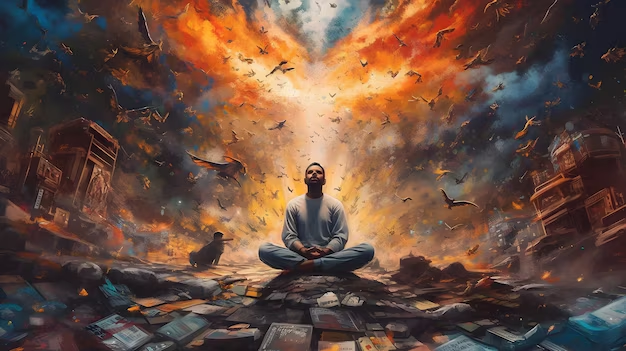

 Facing the possibility of change with an open heart, a strong back and a clear mind is nonviolent warriorship which is the seat of the bodhisattva. Connecting to our inner life force, we find a strength that can lead us forward. Sit down, rise up and meet the change. There is great strength in this. Finding false strength in what everybody else is doing or in reacting to what everyone else is doing, which is the same, are just expressions of being controlled by fear. On the other hand, bravery is sitting in the maelstrom, open and aware, feeling our fear and remaining open and clear. Doing this as a training practice every morning is how we remain spiritually fit and connected to our life.


 Peace is natural to the mind. As a natural state, the cessation of suffering is readily accessible. However, peace is not a fixed state. There is always suffering in our lives, and accepting our suffering is key to finding the peace that is already present. You might say peace is both intermittent and permanent. It is always there, but sometimes it becomes obscured by the tightness and difficulty that suffering induces.
 Finally, the cessation of suffering is both the fruition of the path and a foundational state necessary for any creative endeavor. It is also an ongoing possibility. If we cling to the idea of cessation, we miss the point, turning something intermittent into something perceived as solid—another source of suffering. The possibility of peace is here now, even as we lose it by thinking about it. Peace is a felt sense. It is connecting to a part of our being that has always been there, and according to Buddhist thought, that peace is not diminished or changed by suffering.
