
Landing Back to Earth
Walking the emotional gauntlet of the holiday season is challenging. The  holidays are often described as loving and warm, but it can also feel cold and threatening.
Incidents of familial violence and self-harm spike during this time. Perhaps we try hard to please those we love. Maybe we get caught up in competition over how much we can give. Or perhaps we feel anxious about our financial security and our ability to be generous and offer ourselves to others. Maybe we fall into the trap of need, looking with avarice at all the shining bobbles. Even when we have much for which to feel grateful, sometimes home is where the hurt is.
What does it mean to come home for the holidays when we don’t feel safe at home at any time. And maybe if we don’t feel safe at home, we never feel safe anywhere. What does it mean to offer kindness and love to others when we don’t feel those things for ourselves? We often create more hardship by failing to include ourselves in the love we want to extend. How I feel about myself is no one’s fault. It is, however, my responsibility. How I feel about myself reflects how I feel about the life I live, the world I inhabit, the home I create and the love I extend to others.
Traditional Buddhism teaches about 6 realms of existence from hell to God realms. Yet, the human realm is said to be the most rewarding and the most challenging as humans have the ability to achieve and realize so much and yet that very possibility gives us a sense of unease, expectation, and demand. because we see the possibility, we believe our lives should be bigger, grander, and better. Buddha suggested that the root of our suffering lies in non-acceptance of what our life actually is. And acceptance of our life begins with acceptance of ourselves.
It is not selfish to care for ourselves, especially when this enables us to care for others. Yet, caring for ourselves is not mindlessly grasping for everything we think we want. Because the more we want, the more we need. It’s as though the universe only understands verbs. We pray, “I want this” and “I want that”, but the universe only hears “want, want, want.” So, it sends us more wanting. And the more we want, the less we feel we have. As we cling to the ephemeral, we end up judging life by what we don’t have.
Yet, despite whatever it is we want today, humans need peace, comfort, and kindness everyday. This sustenance may be closer than we realize. But it cannot be realized through grasping, competition, coveting or creating internal pressure around what we think others think. Those ploys only leave us bereft. If I believe that I am worthless—or less worthy than anyone else—then what value can I offer to others? I can only offer my need. “You didn’t call me back”, “you didn’t get my joke”, “You don’t get me.” , “Goddamnit, does anyone get me?” No one gets anyone as their too busy trying to get for themselves. No one wants to prop us up indefinitely. While some may be willing to try, no one is comfortable with the feeling of indebtedness that comes from holding us together. And it does us no good.
But maybe we can find a way to hold ourselves together.
This holiday season, instead of looking to external sources to fill our needs, perhaps we could begin by turning inward. My mother, after being divorced by my father, lived a very modest life. She often lived with others in places that were never truly her own. At one point, we were roommates in a beautiful little home on a river in Colorado, but it was never truly hers. Eventually, she found a humble home behind the most popular bar in town, where drunks stumbled around at night to the sounds of country blues and fist fights.
Despite this, she made that small place her home, furnishing it with second-hand furniture and Walmart discount items. Her heart, her acceptance of others, and her warmth filled that little home. Anyone was welcome. And I dragged some characters through. People would visit—many of whom had greater means than she — and would leave feeling enriched. Even when space was tight, she would welcome everyone, “As long as there’s floor space.” At times, the house was so crowded with animals, guests, and family that it was hard to find that floor space. Yet, no matter how uncomfortable everyone felt comfortable. Over the years, people kept coming back to her home because they felt the love.
Certainly, there have been grander expressions of love throughout history: Helen of Troy, whose face launched a thousand ships; Poe’s dark yearning for his Annabel Lee; F. Scott’s stumbling drunken pursuit of Zelda. Juliette and her Romeo. But sometimes, it’s the quiet moments of affection—a drooling cat kneading biscuits on your chest—that are the most healing. But, it’s not the cat that heals us. It is the power of our affection and connection to our heart. That is how we create a home no matter where we are. It’s not the cat’s responsibility; it’s ours. We have the power to heal ourselves through kindness and affection. Then we can welcome others.
When the Buddha attained enlightenment his profound sense of peace drew others to him. After years of searching and training, the Buddha finally sat down, exhausted, and gave up all concepts, all material desires, and all yearning. When everything settled, he connected to the earth and found profound enlightenment. His contentment was radiant and animals and people alike were drawn to his peace. When asked who he was, he simply replied, “I am awake.” A skeptic asked how he could prove this. Buddha simply touched the earth. “The earth is my witness, ” he said.
In this moment, right here and now, we can be at home. In this moment, right here and now, we can welcome our world. In this very moment, we can drop the anxiety of wanting more and find peace in who we are.

+++
 False binaries dominate our consciousness, good versus evil, left versus right, wonderful versus horrible. We live squeezed between these exaggerations. The Buddha taught that the truth lies not in extremes but in the “middle way.” This teaching urges us to be present in our lives and act rightly in the moment. Similarly, the 12-step traditions speak of “doing the next right thing.” According to the Buddha, the next right step depends on the specific circumstances of the moment. Instead of fabricating extremes, the middle way turns our attention to what’s really happening.

 Therefore, distinguishing pain from suffering is key. It is said that pain is inevitable, while suffering is optional. Pain may accompany growth or even be necessary for it. Working through pain brings physical strength and emotional maturity. However, our interpretation of pain often complicates our view and tension amplifies it into suffering. We take pain personally, becoming entangled in hypotheticals, judgment, and resentment. Instead of meeting pain, as it is, in order to work with it, we struggle against it, giving it power over us. This creates great Suffering. Yet, since suffering is optional, it can be addressed and reduced.
 But this talk is not about back pain. This talk is also about our mental and emotional health and how with meditation we are retraining the mind away from reflexive reactions so we have a way of working with pain that allows us to gain mastery over suffering. The title of this talk is “Sit Down and Rise Up.” Or, maybe “Rise Up and Sit Down” depending on its whim. By sitting down and connecting to the earth, we ground ourselves in the present. With practice, we grow comfortable with our own presence and begin to connect to our innate dignity, confidence, and well-being. Rising up in a gently uplifted posture lengthens the spine, creating space for tension to release and openness to dawn. With practice we become confident with openness. Openness, in turn, engenders more confidence in not just our spirit, but our body. With practice we become familiar with the warrior’s seat, and are able to return to it.
 For example, Muhammad Ali trained himself to relax and release tension when struck by an opponent, by famously using the “rope-a-dope” strategy. By leaning back on the ropes, dancing and smiling, not only replenished his energy, but seriously disheartened his opponents. When balanced, he faced the moment rather than retreating, demonstrating mastery over both his body and mind.
 On the flip side, sometimes we place so much pressure on the present moment that we take it too personally, making things harder for ourselves and others. The present is just a blip in our flow—we meet the moment and move on. But when we hit a snag, it can occupy much more of our time and energy than is helpful. If we could retrain our minds to notice and let go, we might see difficulties as opportunities to learn who we are and how we behave, freeing ourselves from the habitual patterns that keep us stuck.
 I once dated an astrologer who, after reading our charts, told me we had a rare but perfect astrological conflict called the “heartbreak clash.” It seemed insurmountable, and everything we read suggested it was impossible to overcome. But along with the clash came an undeniable attraction. We felt drawn to the conflict, as if we had to overcome it. “I always go for damaged angels” or “every partner I choose is the wrong one”—maybe we’re all damaged angels, and there’s no such thing as a “wrong” partner. Maybe there are only partners who push the right buttons to unlock parts of us.
 But the other person isn’t directly touching our wounds; they’re triggering the defenses we’ve placed around them. More importantly, we’re not seeing our wounds; we’re seeing them through the lens of our defenses. The easy way out is to blame—to fixate on the other person, diverting attention from ourselves. This blocks our ability to learn. Another shortcut is judgment: believing the other person is wrong by some standard. But what does that really mean? By whose standards? Humans notoriously adjust ethical scales to serve their own self-interest. We can quote the Bible, the Buddha, or any law book to justify our point, but all we’re really doing is hiding our fear of what lies beneath.
 suffered, and even lost their lives so that the rest of us may live relatively free and open lives. Veterans include not only those who served in the military, but also the families of those who died in service. However, there are many who have sacrificed for the cause of freedom and liberation within our own shores. The first black children integrated into schools, the first students who spoke out against an unjust Vietnam War, and those who currently challenge human participation in climate change, racial violence and societal hatred. With great respect for those who have served our military, I also want to recognize all who have suffered and been wounded in life, yet continue to face the world with courage.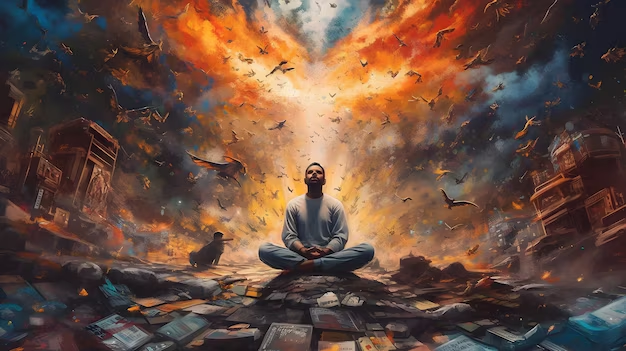

 Facing the possibility of change with an open heart, a strong back and a clear mind is nonviolent warriorship which is the seat of the bodhisattva. Connecting to our inner life force, we find a strength that can lead us forward. Sit down, rise up and meet the change. There is great strength in this. Finding false strength in what everybody else is doing or in reacting to what everyone else is doing, which is the same, are just expressions of being controlled by fear. On the other hand, bravery is sitting in the maelstrom, open and aware, feeling our fear and remaining open and clear. Doing this as a training practice every morning is how we remain spiritually fit and connected to our life.


 Peace is natural to the mind. As a natural state, the cessation of suffering is readily accessible. However, peace is not a fixed state. There is always suffering in our lives, and accepting our suffering is key to finding the peace that is already present. You might say peace is both intermittent and permanent. It is always there, but sometimes it becomes obscured by the tightness and difficulty that suffering induces.
 Finally, the cessation of suffering is both the fruition of the path and a foundational state necessary for any creative endeavor. It is also an ongoing possibility. If we cling to the idea of cessation, we miss the point, turning something intermittent into something perceived as solid—another source of suffering. The possibility of peace is here now, even as we lose it by thinking about it. Peace is a felt sense. It is connecting to a part of our being that has always been there, and according to Buddhist thought, that peace is not diminished or changed by suffering.