

Maybe It Is All About Me
Let’s discuss the elephant in the room. Specifically, that big elephant standing in the middle of everything. This ungainly creature influences and interprets all we perceive, feel taste and touch, yet remains nonetheless unregarded and unseen.
The elephant is standing guard over our precious sense of self. Its primary purpose is to protect us by surreptitiously inserting itself into nearly every situation in an attempt to control nearly everything. As one of its tools is stealth, this unseen elephant is an agent of ignorance. We don’t see it, and it sees only what it’s trained to see, which includes itself. And unless we’re retraining the mind to see clearly, we never see beyond the firewall to ourselves. Buddhist thought delineates a path of developing awareness of the elephant and all the other wildlife in our being so that we might see beyond that which controls us to our life as it is beyond unconscious interpretation. This path develops awareness, which is a sense of panoramic knowing that allows us to navigate life with ease and dignity. The more we see, the better we can care for ourselves and others. Awareness is the essence of compassion. Once we see, we are able to understand. And caring is a natural response to understanding. A life with awareness, dignity and care is a better place to live. So what is keeping us from leading that life?
In the larger picture of things, awareness sees all possibilities. However, our untrained mind does not have the ability to process all of this information. On the practical level, we need to focus our intention within that sea of information to get anything done. Our perception is localized and administered in an aspect of mind Tibetans call “sems”. Sems acts as a mental switchboard that organizes input from our 6 gates of awareness. These gates are our five sense perceptions and the mental interpretation of each. It is important that in Buddhist thinking our mental interpretation is considered a discrete sense. Most importantly, there is a difference between our raw perception and our mental interpretation and sometimes these are not in alignment. It is the purpose of meditation practice to clarify the dissonance between perception and interpretation. This is referred to as developing valid cognition. In time, with consistent meditation practice, we become aware of our mental input and learn to look beyond the elephant to see where life is leading us.
 So, let’s break down the components of this elephant. The elephant stands on the notion of a “self“. At some point in human evolution we became conscious. That localized sense of perceiving began to organize itself into an entity that is aware of itself. This allowed us a vantage from which to navigate an otherwise unmanageable sea of possibility. Yet, that navigation comes at the cost of limiting those possibilities. This notion of self is a necessary limitation in order for consciousness to have a reference point. Ego is a further limitation of those possibilities. Ego happens as self-awareness becomes a self-consciousness that assumes itself to be self-existing. This assumption of “me” can become a self-referential closed loop that reduces awareness to specifically localized points of view. The ego works as a set of patterned functions that reduce what we see of the world. We conflate reality down to serviceable quanta which, in turn, are seen as a means to serve our perceived compensatory needs. These perceived needs are generated to compensate for feelings of lack or vulnerability. In other words, we see what we are conditioned to see and generate feelings that prompt reactions. We generally do this all without much investigation.
It is the role of mindfulness meditation to create gaps in this automatic process, so that we may be able to track reality. Ego solidifies the idea of itself with uninvestigated and unintentional habitual reactions and Mindfulness Meditation allows us to see through this process and unpack the mechanics of our ignorance. Therefore, by insinuating space and awareness into our life, mindfulness meditation creates an existential challenge to ego. This is why we sometimes have resistance to meditation. The gaps created by developing awareness are like cracks in the wall of ego’s fortress.
Ego is created as a protective process, however like all protective processes it is also charged with its own survival. The defensive system has become more powerful than the host it’s enlisted to protect as it serves to also protect itself. For many of us, most of the time, the elephant is running the show. And direct challenges to the elephant are met with further resistance. The way to work with the elephant is to acknowledge its value, and to encourage it to relax. Like everything on the Buddhist path we are encouraged away from antipathy and toward care and understanding. In other words, learn to love the elephant. And again we do this by knowing the elephant. What makes it tick? When is it likely to be inflamed? How can we remember it’s there? How can we learn to treat this creature with love and respect?
Unlike the majestic elephants of the wild, our egos are furiously overworked conductors trying to control streams of information. Sometimes they resort to bullying tactics. The more they are threatened, the larger – and more invisible – they become. Frightened people tend to see only themselves. And this inflammation of self into blind egotism obscures everything – and everyone – else. Narcissists seem overbearing but that inflation of self and their inability to relate to social cues are compensatory defenses for those who feel inadequate and vulnerable. That self-centeredness creates expectations that are hard to live up to. When we feel larger than life, we have so much to carry. After times that ego has arisen in our defense, we become deflated and depressed. We lay there wondering how we can actually manage getting this elephant off our chest. I call this the “Unbearable Weight of Being … Me.”
We wake up in the morning to my alarm clock, take my shower, drink my coffee just as I like it, take my car, to my job. No wonder that when I come home to my house I’m sick of myself. Buddhist teachers will say that the problem is not ego. The problem is cherishing the self. We are clinging to the idea of me and creating this weight that becomes exhausting to carry around. Sakyong Mipham says “what about me” is the incessant mantra we say first thing in the morning and the last thing at night. He went on to suggest that after all this, we should be full of joy. But, we are not. Lastly, ego is an addictive state that cries out to be fed. And the more we feed Seymore, the more it needs to feed.
 The antidote is to stop. Allow a gap. Breathe out. Drop into ourselves and feel ourselves in our body. That is much closer to reality than circular, ego world building. Just drop it. Come home, and be here. This act of self love will allow the elephant to rest. When the elephant rests we can look around and see the world as it is.
WIth the room to see the world, we might find it is quite workable. In the 12-step tradition they say, becoming right-sized we see life on life’s terms. We don’t have to conflate our life, or inflate ourselves just to be here.
_________
 I once wrote an unlove song that went “people suck, and you’re one of them.” Yet life with the irritations of other humans may be worthwhile simply because we have no choice. It is an existential situation that we can either choose to see or turn away from. Sartre’s play was an existential glimpse of a human condition that left us with no alternative, hence the idea of hell. The Buddhists say the cycle of suffering, referred to as l samsara, is endless. And, yet the Buddha predicted that suffering can nonetheless cease if we understand its cause. Our experience of that endless sea of suffering is enacted by the clinging attachment to the straws of life we feel will save us from drowning. Instead of flowing though life with an open sense of discovery, we grasp to the things we love and struggle to get away from things we hate. And in the turbulence of yes and no, wanting and not wanting, we become blind to the rest of our life.
 So, why do we suffer? We become comfortable with the familiar. Seeing what we see, knowing what we know, doing what we do supports our sense of security. As we are social creatures, we search out our clan and dance with the partners we enjoy. However, we can unknowingly become attached to what we know, and experience antipathy toward that de don’t. We assume our point of view is self-existing and inviolable. Humans nestle into comfort without looking into that or beyond themselves. Chogyam Trungpa likened this process to creating a cocoon. Cocoon, in this case, is a womb of repetitive patterns, societal norms and bounded thinking in which we find protection but entirely take for granted. We separate ourselves from the dangers of disparity by surrounding ourselves with the familiar. Each of us has our specific style of protective cocoon that makes us feel safe. Ironically, those who flaunt danger sometimes find solace in the familiarity of repetition of their unsafe behavior. A daredevil approach feels brave, but once we’ve learned how to navigate the danger, it becomes a pattern.
 It is essential for the butterfly to struggle through its cocoon in order to develop the strength to fly. Likewise, it is essential for those on a wisdom journey, to work with the discomfort of waking up. The Tibetans refer to “lakthong” or clear seeing. Lakthong is seeing beyond our reference points and likened to “waking up. When faced with the discomfort of seeing more clearly, a common tactic is to find fault and assign blame. We can deflect the pain of our burgeoning awareness onto a projection of another object. However, this freezes us in place. Once we pinpoint a problem, then it becomes a scapegoat. We are no longer looking, because we are seeing what we believe. Smart people are very susceptible to irritation and blame. People of high intellect can often become impatient with those moving on slower cycles. It’s natural to value our world from the vantage of our own values. Sometimes this conflates into a rigid false binary. Some people are good and some are evil. Assigning a value of evil may be more about pushing away something you find uncomfortable than an absolute value scale.
 At this writing we are heading toward a pivotal, some say existential, national election. The two primary presidential candidates have come under fire. One fending attacks against their age and mental acuity. The other, quite literally, in a narrowly missed assassination attempt. Both of these situations have caused us to stop and reconsider solid paradigmatic points of view.
 Binaries are fictions we create to better understand chaos. There is a good, and there is a bad. We have right and we have wrong. We feel comfort in fending off chaos with these solid beliefs. All of us have something we feel is real. But clinging to those beliefs create suffering as readily as clinging to material things or other people. This is called materialism of view. We believe our ideas are real. Well, good luck with that. I’ve actually come to see that binaries are by their nature never real. They are crude designations, the first step in the mental triage in trying to address the unsettling unknowing of chaos. The remedy? Hahaha. Relax. We are struggling through a natural process of rebirth. There is no reason to struggle. Our disquiet is urging us to discomfort. Our discomfort tells the part of ourselves charged with being in control that we are under siege. And so we prove our mettle by digging in. We turn false binaries in rhetoric and rhetoric into violence. At this point, the chaos in our mind becomes chaos in our life.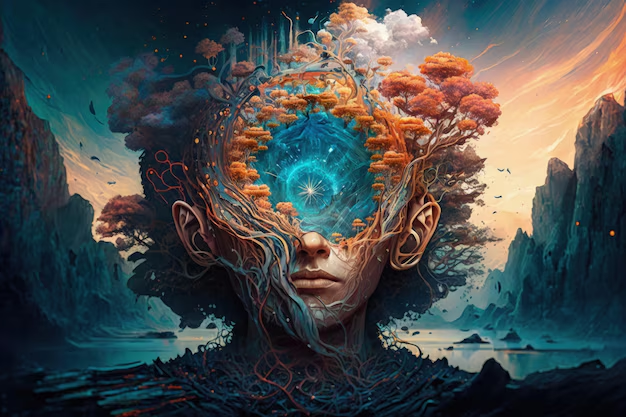
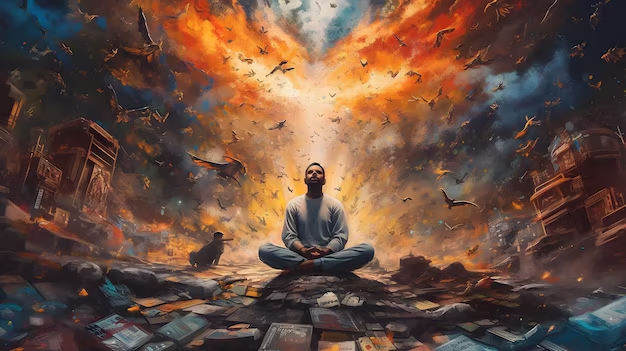
 As this brain grew, it gained the processing ability to go beyond the defensive reaction of its dark beginnings and, learning to see a bigger picture, strategize its way past danger and toward sustenance. This remarkable ascension is still happening and that’s a wonderful thing. Yet, that growth happened so quickly, our minds are developing new skills while our brain is still holding to old processes. This creates a dissonance between a view of what may be possible and what we fear could happen.
 I sadly never got out of my head long enough to let my heart into the equation but maybe it happened at some point. It wasn’t until years later when meditation gave me the courage to allow vulnerability. But, whether it was groping on a high school dance floor, fumbling in the back seat, or sitting on the meditation cushion, the moment of frailty when we “fall” is an important step in our spiritual journey.
 What if instead of paying endless lip service to love, we just deeply kiss the world? What if our politics and our nations were organized around faith in the power of love? I guess the process is to conceive it and then believe it and then let that go and simply be it. Thich Nhat Hanh said, “BE love.” Believe it and be it.
 So, how can we make this large picture practical for us? We can begin by loooking at ourselves, as we are. How can compassion make my life a better place? What can I do today to make my life easier and more productive so that I may better serve? This is not selfish, it’s practical. However, trying to make my life better than someone else’s, or a better place for only me and mine, is selfish because it’s narrow minded and myopic. Compassion is developing the tools to care for ourselves so that we can care for other beings. But, we are one of those beings. In fact, until we learn to effectively care for ourselves we will be unable to care for others.
 Yet, if we accept that we are a work-in-progress then we can learn to gain confidence in ourselves. Self-aggrandizement, like the arrogance it engenders, covers leads to a lack of belief in ourselves. We know inside that we are not the ideal, and so believe we are less than the ideal. But that truth is if we can accept ourselves and vow to discover what we become, we are committing to a path of supporting ourselves. As we develop self-awareness, we naturally gain regard for ourselves. And though this regard for ourselves we begin to see others more clearly. Freed of the veils of defensive self interest we begin to see that we are not as estranged from our world as we had imagined.
 Contacting love in our life is possible if we are free of the turmoil that often occupies our mind. Sometimes this happens accidentally, as when something startles us and stops our mind. Sometimes it happens when our mind naturally notices a flower or bird that opens our mind.
  Compassion is natural to all life. But so is danger. Much of life does what it can to sustain itself and focuses its cellular attention on living, growing and providing, serene in its unknowing. Most life is a natural and necessary part of the dance of the planet. But, the greatest danger to the balance of life comes from the only part of the planet that sees itself. The one who’s acidic stomach is gurgling as it watches the rabbit hop merrily into the wooded shadows. The greatest danger lies within. This is as true of ourselves and our societies. This is the greatest danger because it is the one unseen. We are so attuned to the danger around us, we lie in vulnerable ignorance of the aggression we cause ourselves and others. It is the work of compassion practice to help us reprogram the mind to balance the openness of loving moments with the truth of the dangers in life. We do this by de-emphasizing the importance of ourselves to ourselves that is clouding the picture. THis is not to say that we are not important. We are just not as important enough to suck the air out of life. Humans are a little like drunken blowhards going on about their workout routine at a party. SIr Harold Pinter wrote a play called “The Party” in which a group of haute society people revelled in their intrigues and drama while occasionally, we have seemingly inconsequential references to turmoil in the streets. By play’s end it is clear the turmoil is a violent revolution that will end everything they know.
 Over
Over  direction is too loose. Sometimes we rail against the authority of form, and this stops the flow, but it may be necessary to reboot the process or add freshness to a routine. But once we reboot, finding the groove and waking up in the rhythm of life. Navigating between the extremes of too tight and too loose we find the balance point for optimal creativity in life. A dancer needs discipline, but the point of the discipline is to let go into the piece. No one wants to see anyone work. We want to see them dance. We want the fruit of their labor. So, form need never be seen. The hand of the director should never be seen. The dance should feel as natural as the river.
 This post will introduce the idea of slowing down in order to establish or reestablish a flow that allows us to move more efficiently. Here we will use the analogy of the cat, relaxing in repose, so that it has the energy and calm to spring into action. We are talking about how to maintain synchronicity so that our flow is strong and even. This requires an aware meditation of our energy. If we move too quickly for our present circumstances, we lose connection to synchronicity. Such as when we’re moving so quickly, we fail to see where we are going. In the Tibetan Buddhist tradition it is said that speeding through life is an essential disregard for our humanity. Our personal dignity becomes subsumed by anxiety as we scurry like a hamster. The goal becomes more important than the journey. But, it is said, the journey is the goal. How we approach life is as important as anything else in life. Meditating our speed allows us to move with grace and dignity. It also allows us to move more efficiently. Sometimes we need to slow down in order to get things done. On the other hand, sometimes we need to encourage ourselves to move more quickly in order to maintain our energy. Sometimes we need encouragement to move at all.