EINSTEIN’S BRAIN

Building the Brain’s Neuroplasticity and Connectivity Through Meditation


After Einstein’s passing in 1955, the pathologist performing his autopsy quietly removed his brain. When researchers eventually examined it, they expected something extraordinary—more neurons, unusual size, some physical marker of genius. But by all conventional measures, Einstein’s brain was unremarkable. The one meaningful difference was the density and organization of his neural connections, particularly those supporting information processing and communication between the hemispheres. His brain was wired for unusually high interneural integration and conceptual thinking.

Einstein’s brain was structurally similar to ours, but his unique relationship to learning allowed him to cultivate an exceptional degree of openness and connectivity. The brain is not fixed; it changes in response to experience. Through meditation, we deliberately train the mind toward greater receptivity, presence, and spacious awareness. In Shambhala teachings, we practice opening our senses to awaken the mind and connect with the world as it is. This very act forms new neural pathways that keep the mind vibrant, youthful, and capable of creative insight. Zen Master Suzuki Roshi simply called this “beginner’s mind.”

Despite his groundbreaking discoveries, Einstein remained approachable and playful. He had a sense of humor and was able to speak with anyone—children, workers, scholars—without losing the depth of his insight. This mirrors how the Buddha was described: someone who could address a child, a soldier, and a priest in the same teaching and reach all of them. The Buddha’s brain was just like ours. What differed was how he trained his mind to rest in profound openness. Our basic human mind is already capable, but like Einstein and the Buddha, we can cultivate that capacity through practice.

Einstein didn’t possess more brain power—he used his brain differently. The most striking discovery from the neuroscientific studies of his brain was a thicker corpus callosum, the band of white matter that connects the left and right hemispheres. If we imagine the brain as a city, the gray matter represents the neighborhoods where different types of processing occur, and white matter represents the roads and highways that allow those neighborhoods to communicate. Most of us work with a handful of small roads. Einstein had an eight-lane expressway. He didn’t have more “buildings”; he had better “roads.”

And those roads didn’t appear by accident. Connectivity grows through use. Structure invites capability. Use builds mastery.

Einstein didn’t become a genius by thinking harder. He created conditions in which insight could emerge. His creativity came not from grinding thought, but from spaciousness. He often took long, aimless walks, allowing his mind to wander. Neuroscience now recognizes that this activates the brain’s Default Mode Network, the system responsible for daydreaming, imagination, memory integration, and spontaneous insight. Rest isn’t the absence of thought—it’s the space in which new connections form.

He also engaged in elaborate visualizations, conducting what he called “thought experiments.” He imagined riding alongside a beam of light long before he developed mathematical models. Imagination preceded analysis. And he valued downtime. “I stop thinking, swim in silence, and the truth comes to me,” he once said. Stillness was not avoidance—it was incubation.

Meditation develops these same capacities. We don’t meditate to stop thought. We meditate to stop chasing thought. Meditation allows us to step back and recognize the patterns of our thinking rather than getting lost in their content. It doesn’t change our genetic blueprint, but it optimizes the connectivity that already exists. Through consistent practice, the mind becomes more spacious, more flexible, and more capable of creativity and insight.

Neuroscientific research confirms that meditation produces measurable shifts in the brain. It increases white matter and strengthens communication between hemispheres. Creativity and clarity begin working together. The prefrontal cortex—associated with executive function—coordinates more efficiently with regions involved in imagination and visual-spatial reasoning. The mind becomes more integrated.

Meditation is not about quieting the mind. It is about opening awareness. It is not about forcing insight. It is about creating space for insight.

You do not need Einstein’s brain. You already have the same basic architecture. What matters is how you use it. With presence, spaciousness, and a willingness to return to beginner’s mind, you can cultivate the connection and creativity that lead to genuine insight.

Meditation builds connection.

You just need enough silence for your own breakthrough to arrive.

PUSHING BACK WITH LOVE

The Power of Love to Heal a Broken World.

If we’re unhappy with who we are, how we are, or the world we live in, we must first see our situation clearly before anything can change. The first step is recognition—knowing what’s happening and seeing that whatever arises externally in the world is echoed within our own hearts and minds. This isn’t to say we align with the hatred, bigotry, or aggression around us, but that all of those forces reside in every human being. They’re activated whenever we give them credence, become trapped in their logic, and start believing in the power of hate.
Hating those who hate is a vicious loop—like Ouroboros, the mythical snake eating its own tail. There is no fruit in hatred, no matter how justified it seems. Justification often leans on logic, and logic is easily skewed to support beliefs. If we can’t fully trust the news or the internet, we certainly can’t blindly trust the internal arguments we build to justify anger. We don’t have to clear all darkness within us before trying to change the world, but we do need to acknowledge that we’re all prone to aggression. Those who promote love aren’t free of hate; they’ve learned to see it and step beyond it.

Fear, hatred, and anger are natural human responses—especially in times of struggle. The warrior principle says we can recognize, accept, and then move beyond these reactions of body and mind. I’m depressed—I see that and accept it, but I’m not limited by it. I’m angry—I understand that, but I don’t have to react to it. I can use it as fuel. I’m frightened—seeing that offers power, for how often have my mistakes and aggression been rooted in fear? By noticing fear, even when subtle, and looking into our behavior, we can use it as a stepping stone through the doorway of clarity and compassionate action. Our afflictions may lie dormant and still affect the world, or we can push them away as beneath our virtuous image, or act them out and create more aggression. But there’s another way: accept the feeling and step beyond it.

How do we do this? With love. By recognizing a problem and accepting it, we can look into it and see what motivates it underneath. Then we can affect change through positive means. Positive actions don’t create karma in the same way negativity does. They are steps toward healing, requiring patience, perseverance, and the softening of ego. Negative karma happens instantly—when we lash out in anger before seeing or feeling the situation, we open ourselves to resistance and create more hatred. When we recognize and accept the problem, look under it, and see the forces at play, we find common ground with aggressors. By accepting their behavior as human and historically repeated, we create an opening for change.


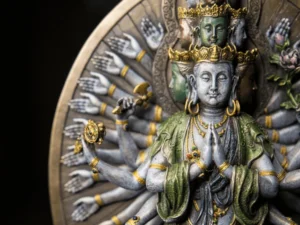
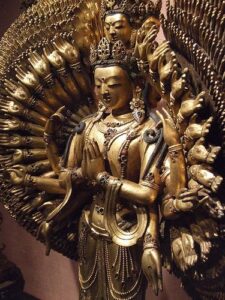
Compassion takes many forms. I think of a video of a baby bear running along a highway against a guardrail, its mother on the other side. When she had the chance, she grabbed the cub and yanked it over the rail, tossing it into the woods. It wasn’t gentle, it wasn’t sweet.it wouldn’t show up on a cute animals video, but it was compassionate—she did what was needed to protect her child. Compassion manifests in many ways, like Avalokiteshvara with 10,000 arms, each representing an expression of love. So when faced with aggression, soft, sweet love may not be our best approach. But reacting from righteousness—believing we’re right and others are wrong—locks us back into hatred devouring itself. We must step back, release panic and inner aggression, accept what’s happening, and look beneath it for energies that can meet in real communication.

Whether soft or fierce, quiet or loud, compassionate action is effective because it’s not a reaction from the lower mind, but a higher power within us radiating healing as best it can. Our work is to step beyond personal aggression and communicate clearly with the world.

Retreat is not surrender. Surrender is not defeat. Defeat is not the end. The end is only a beginning. By surrendering our point of view, anger and hatred, we are able to face the world and see clearly what the most effective way of healing our broken world. That’s love, in whatever form it takes. And love is the most effective step toward change.

By looking at the world, we are showing we care. We are not abandoning it. By acknowledging our own doubt, we can step toward healing. Our work is to persistently, doggedly, continually, push back against hatred with love, humor, and kindness.  Our only justification being that this is the best thing to do.

Perhaps it’s the only thing to do.


ALL ABOUT ME

       THE NARCISSISTIC REFLECTION OF EGO

I like to reference Milan kundera’s The Incredible Lightness of Being when discussing ego by reversing the logic to the incredible heaviness of being … me.

Ego is a shallow reflection, an inordinately pronounced subset of mind charged with aligning ourselves with the societal acceptance. Shallow as it may be the need for societal acceptance is nonetheless deeply ingrained within us. Our need to “fit in” is an ancient protective strategy. Without the acceptance of our clan, we would fend for ourselves.  At some point in our history, that would render us some predator’s lunch. The need to assimilate is, at its core, a protective strategy. Ego aligns us with what society seems to require—sometimes to shield us, sometimes to make us competitive, sometimes to keep us hidden. Whenever we feel threatened—by external pressures or internal doubts—ego steps in. For those who have lived through trauma, the ego’s protective reflex can become inflamed. And like any inflammation, it grows painful, restrictive, and difficult for both ourselves and others to be around.

Ego inflation is not unlike economic inflation, as when the value of currency diminishes, everything else becomes more expensive. Likewise, when ego expands, our sense of worth actually decreases, and we must spend more psychic energy maintaining the story of “me.” The more bereft we feel, the more inflamed ego becomes. It is a costly burden—like lugging around a heavy suit of armor, or as Milan Kundera might put it, the “incredible heaviness of being me.”

Ironically, while ego is designed to connect us with others, it often serves to separate us. The more it inflates, the less it sees—both of the world and even of the self it is meant to protect. Ego seems to operate behind a firewall: impenetrable, self-justifying, resistant to inspection. We rarely glimpse what lies beyond, because ego convinces us its stories are the truth. We see what ego wants us to see. Self-awareness becomes diminished, lost in reflection of a small, superficial self-image.

Yet ego’s strategies are not only aggrandized. It has many “small” strategies such as feeling inadequate, playing the victim, hoping to be seen, or withdrawing because attention feels insufficient. They may look different—grandiosity, self-pity, defiance, or despair—but they share a common thread: they make life all about me. When ego dominates, we are not listening to others. We are manipulating, trying to coerce the world into affirming a version of ourselves that we are desperately telling ourselves.

Sometimes the weight of this self reflection means we expect too much of ourselves and our world. Like an inflamed infection, our ego inflation becomes painful. We are lying in wait for someone of something to insult or disappoint us. I have been avoiding a community meeting which is very large, and I feel no one notices me. This is true, but most of the people there are unnoticed unless they share. But I keep myself bottled up out of fear of looking foolish. This is not humility. Its ego. By withdrawing, I deprive myself of any connection and benefit I might receive. Who am I hurting? Ego, in its fear of invisibility, tricks me into actually vanishing.

This is ego’s paradox. It promises safety by keeping us in control, but the cost is limiting everything to that which it can control.  And that is a much tighter set than makes me feel comfortable. So, I tend to blame others for not knowing me. Not seeing this delicate flower with is poisonous spines.

A classic ego refrain is That’s not me. I could never do that. But not out of discernment, out of fear of failure. And in so doing, ego robs us of the chance to learn, grow, and risk being seen in our fullness. How many opportunities have we refused simply because we lacked the energy to drag our own self-importance along?

The “heaviness of being me” rarely translates into the world in the way ego imagines. Instead, it leads to exhaustion and estrangement. To carry one’s importance everywhere is to carry a burden that no one else asked us to shoulder. The question arises: how important must we be to ourselves? What would it feel like to be less important—to set down this inflated carriage of “me”?

Dylan suggested, “I’m not here.” Buddhism teaches that ego is ultimately empty. My teacher once smiled at a question about how to work with ego and answered, “there is nothing to work with, because it doesn’t exist.” Perhaps the answer is to look beyond the event horizon of self-protection and see that the reflection is entirely made up.

Maybe this challenge becomes an invitation: to loosen the grip of this Michelin-man suit of self-importance, to move more lightly, and to test what life feels like when not filtered through our defenses. How exhausting it is to carrying the weight of “me” everywhere. What would it be to look beyond ourselves and meet the world directly, unburdened and free.

Maybe the key is to stop fixating on the reflection and working so hard to believe it so so we can see what else we can be.

FACING THE MAELSTROM

MONKMODER DOOMSCROLLING


Like monks facing the maelstrom, we have may have our best intentions and ethical training. And yet, we may feel paltry and inadequate standing in the face of hatred and conflict.

Our society is currently at war. Those who have chosen a side may have the luxury of being determined and clear. They are able to push through the chaos with a surety that those who feel deeply cannot. But what of those who wish to understand or listen? Their experience is less assured. In fact, their experience might be disconcerting and painful.

Those trained in the ways of compassion will feel the need to help assuage the violence they see. Yet, how can we do so without declaring a side? Once we have taken a side, the other side will likely no longer be listening. The irony of side taking is that the very people who may need to hear what we have to say, are likely to not listen. This is why commitment to nonviolence is so frustrating in the short term, but yields more effective change over time. So how do we deal with the impulse to react with our guts in knots and our mind aflame?

A Bodhisattva must first train to calm their own passions before they have the clarity to help others.  When facing chaos, we may feel the need to do something. And yet, the nature of chaos is unclarity.  A general rule is when the world is chaotic and uncertain turn our attention to ourselves. Change what we can change.  If we could breath, relax and bring ourselves back to balance, we might see the pattern in the confusion. And like all patterns this has happened before and will happen again. From this point of view, the idea that there is a “right side” is absurdly reductive.

If scrolling through your doomfeed makes you angry, frightened or depressed it’s because 1) you care and 2) you have no idea how to help.  So the Bodhisattva is trained to rest in the chaos until a natural confluence emerges. And how might a natural confluence differ from taking sides? From the Buddhist perspective, the view is fostering kindness and compassion. If the world is falling apart, we can choose to add no harm and sit in the turmoil until our time for compassionate action becomes clear.

Water flows into water — sometimes quite rapidly, with significant turbulence. But this is not the fault of the river. Nor is it the fault of society, the world, or even our political systems when they undergo upheaval. Change is not an anomaly; it’s a basic rhythm of human experience on this planet. The planet changes. The climate changes. Political systems around the world shift, often with great pain or even lockdown. From a data point of view, the problem is not change — it’s the challenge of navigating change when we cannot control the outcome.

The work is for us to relax into not being able to predetermine results. Facing this chaos all while maintaining an upright posture of goodness, dignity, and strength. We might experience fear and resentment, but these, as is said, are like drinking poison expecting our adversaries to become ill. Usually, the others just go on their merry way, defiling and defaming others, and we are left feeling ill. Thus we become weak and unable to help anyone. Our first step in warrior training is to hold our seat and gather our strength. The next step is to adopt a posture of bravery and simply represent goodness without proclamation, arrogance or aggression.

Until we’re able to manifest dignity and strength we may become victims. Or worse yet, we may blindly react and become part of the problem.

This is why we need mindfulness, intention, and clarity about what we are doing. We need to interrupt immediate, automatic reactions. Yet these reactions happen so quickly it’s like trying to corral a bull after it’s broken free of its pen. Wherever we catch ourselves bringing aggression into our body or mind, we can just stop. Avoid blame, as blame, which feels so justified, only serves to perpetuate aggression and blindness. Anytime we become aware of the hijacking of our body by fear — whether anticipating what might happen, experiencing it as it unfolds, or reflecting on it afterward — we become more attuned to this very immediate and incredibly powerful process. Simply said, our mind and body are being hijacked by our own nervous system. It’s no one’s fault. However, it is our chore to work with. The work is to free the body, open the heart and let the mind see before we jump into the fire.

It’s natural to want to protect ourselves. But it is not natural to scapegoat a segment of society, to cling to resentment, or to nurture hatred in our heart. The issue here is not “right-wing” versus “left-wing.” The issue is that when we blame others, we harm ourselves. The violence we inflict on ourselves is profound, especially when we mask it as blame toward others.

When we are awake and open to our immediate experience, our natural human dignity will allow us to do the right thing. When we are reactive, our basic animal instinct only pushes us into ignorance. By creating a gap before acting out retribution, we can hold our reactions lightly, release them, and see more clearly. Otherwise, we’re not only grabbing the bull after its left the pen, we’re letting it carry us as it may — all while blaming someone else for leaving the gate open.


Foundations of Mindfulness

Remembering to  Return


Be here and now, they say. Okay. But where the heck is that?

Some would claim we’re right here. Sure. But can we see that? Do we feel, touch, live and know that? Maybe mindfulness is remembering that we have no idea where we are. Until we do, that is. Until then we might stop believing and remember that we’re being here, now.

But what of believing? I’m going to go out on the end of the donkey and say that beliefs can sometimes be obstacles to mindfulness. Mindfulness is resting the mind on an object in the present moment. Living a mindful life depends on our ability and willingness to hold our mind to the raw, factual, actual reality before us. Beliefs can misguide us when we believe in things that we only think, but which we have no corroborating evidence. We can’t rest our mind on an idea.

This post is an exploration of a traditional Buddhist teaching called “The Four Foundations of Mindfulness”. These are the cornerstones of clear seeing on which the powers of mindfulness rest. Interestingly, the trad texts translate mindfulness as “remembering”, or “recollection.” The point seems to be remembering to remember that we are here. Right now. Problems come when we believe we’re in some internally created reality that doesn’t include very much actual reality. While this is a big problem when we don’t recognize it, in reality, it’s not a problem at all when we see happening. Mind’s wander. They make up stories. They start trouble when they’re bored. Just like kids, the unawakened mind believes make believe. The mind grips so tightly to here that it fails to see see what is happening now.

What’s the problem? Especially when most of us are able to stumble through life, even tho we have no idea where we are? Minds wander. Untrained minds believe the places they wander are real and so, get lost in their stories. They end up wandering out after dark. The fact that we make it home at all allows us to forget how much danger we may have been in. With mindfulness practice we can train ourselves to remember and bring ourselves back home to what is actually here, now.  No matter how far we’ve travelled, we need only remember and we’re home in an instant.

Your body is always here. Your life is always unfolding. Your emotions are always happening. But your mind—it can be anywhere. Mindful living begins when body and mind meet in the present.

Mindfulness of Body

The body never leaves the present. It absorbs our joy, pain, fear, and connection—whether or not the mind notices. Instead of judging it, imagine the body as a loyal friend: imperfect, maybe heavier or slower than you’d like, but always here, always supporting you.

We often see our body through distorted beliefs—like thinking we’re overweight when we’re not, or obsessively poking and prodding to “fix” ourselves. These are false ideas, not reality. True mindfulness of body is not about changing or perfecting. It’s about seeing, accepting, and caring for the one who’s been with you through every moment of your life.

Mindfulness of Mind

The mind spins stories, schemes, and worries. Mindfulness of mind means stepping back and asking: Is this true? Is this useful? Is this about right now? Most stress comes not from the present, but from catastrophic or compulsive thoughts. By noticing them, we can return to clarity in the moment—where life is always more workable.

Mindfulness of Life

Life is not only what happens around us but also how we relate to it. Is your life supporting your well-being, or draining it? Mindfulness of life means recognizing what helps, what harms, and when acceptance—not struggle—is the wisest response. Even in difficulty, people find love and strength when they learn to see what’s really here.

Mindfulness of Feelings

Feelings are not the enemy; they are our life force. Joy, sorrow, depletion—all deserve recognition. By noticing them, we can arrange our life to support inner balance rather than ignore or fight what’s inside us.


At the heart of mindfulness is returning—again and again—to an open body, a compassionate heart, a clear mind and synchronicity with the flow of life. This is our refuge. Even in real danger, presence makes us stronger and steadier. When something signals, pay attention, but forgo the stories. Feel what this part of you is telling you. If nothing else it’s an opportunity to come back. If the body, mind, feelings or life grab your f0cus screaming that THIS is real, remember to return to your whole self. The integrated self, the comprehensive being, the fullness of you in the present is presence.

And don’t forget to smile—with your face, your heart, or even in your imagination. A smile signals confidence, openness, and connection, even when unseen.

Strong body. Open heart. Clear mind. Aligned with life. Conscious and intentional.

And when we get lost, we can remember our body, feelings or life and return the mind from believing to being.  That is the practice.

And, as far as anyone knows, it never ends.

WHERE DO WE RUN?

Understanding Refuge in Modern Times

Ever wish you could just run and hide? Ever play hide and seek with your life because it all becomes too heavy? Do you ever reach for the panic-button in reaction to difficulty? Ever slump in discouragement because it’s all on you, but you just can’t figure it out?

Well, maybe it is on you. But maybe it’s not your fault.

Many of us have never learned to see our lives as they are. Many of us have never learned how to think. We just accept the mind’s confusion, blame our woes on others, and pray for a way out. But maybe there is no way out, except to be here—to learn to see what’s happening and work through it.

We can do this. With patience, kindness, and love, we can gain agency in our lives. We can become players instead of victims—if we are willing to learn. In Buddhism, we look to the example of an enlightened mind, which reflects the enlightenment inherent in all of us.

It takes training to learn to see beyond the compulsive thinking that grasps at the wrong straws. We create more confusion out of a confused world when we blindly reach for what we think will save us. This might be as grand as a lifelong commitment to a nation or spiritual community—or as quick and impulsive as a harsh word, or hitting “send.”

When we feel pressured and need relief—when we’re challenged, triggered, or brutalized by life—our immediate defense is often to lash out. We turn to anger and aggression, or to something or someone we hope will save us. Or we retreat to a private island in our mind, looking for refuge.

But when we seek refuge in something not grounded in what is, we only deepen our confusion. We stop learning.

Throughout history, there have been countless religious, cultural, and commercial icons of refuge. Yet—if you’ll grant me a cliché—wherever you go, there you are.

And if we’re not willing to be here, how can we ever move beyond?

We’ve taken the beautiful teachings of Jesus, Muhammad, and the Buddha and used them to condemn one another—or to save ourselves. Perhaps we spin on a bipolar wheel of condemnation and salvation, swearing off our vices each morning and forgetting by nightfall.

When I was lost in the self-abusive cycles of alcohol and drug addiction, I was blind to any direction my life could take. I spent all my time trying to extricate myself from the sins I’d committed the night before. I took refuge in blame and resentment.

The legal counsel of my rattled brain was perpetually building cases against some system or person. The biggest problem was that I thought I could do it alone. I kept my self-professed sins to myself, spinning outward appearances however they needed to look.

The phrase is “close to the vest”—but “vest” is close to the heart. And putting all that guilt, shame, and doubt into my own heart was as unhealthy as it was ineffective. Because no matter how intelligent we are, it’s our heart that communicates. Whether we understand that—or the recipient of our communication does—we still feel each other. No one needs facts to stop trusting us. If our heart is not in sync with itself, our confusion communicates. And the world responds by withholding trust. This only deepens our isolation, as we carry a broken heart in secret through a world of resentment.

At some point, in utter frustration at nothing working, I just surrendered. There was nowhere left to run. Which left me here. The way out is the way in.

We sit. And we sit. Until we begin to disengage the compulsive mind from the mind’s potential. We get lost in fantasy. We train the mind to recognize that—and return to ourselves, and this very moment. At any time, again and again, as we drift into delusion, we can return to now.

That is our refuge.

In meditation, we train the mind to recognize delusions of blame, shame, doubt, and confusion, and to turn back to trust—in our own heart, and in the present moment.

This is the example of the Buddha. No one saved him. He worked through is shit. He awakened.

With nowhere to run and no external salvation, Buddhism offers practical remedies. We turn to the Buddha—not for rescue, but as an example of a liberation we can achieve. How is this different from running to a god, a savior, a corporation, or a country to save us? Well, the Buddha will not save us. He is long gone. But the enlightened mind he accessed is available to all of us if we follow his example.

But taking refuge in his example means being willing to face ourselves, now in this moment. Not blaming ourselves for the past. We have no control over the past, so how can we be faulted for that which we have no control? Maybe there is no fault, but it is an opportunity to change the present. And no matter how difficult that present may be, it is always better to face it than to turn away.

So when we are triggered, panicked, or confused, we have the opportunity to turn to the enlightened mind within us. You may see this as your higher power, the awakened mind, which offers us the strength to face the moment, through each moment of our life.

Instead of grasping for external salvation, we can turn to the example of an awakened mind, which liberates the awakened mind within us.

The Buddha was not a god. He was a human being—who lived, died, failed, and succeeded. He had no supernatural powers. He was a teacher and student of the Dharma (the path to liberation) who worked diligently to free himself from his own suffering. Because he did the work, he understood how others suffer—and offered teachings to guide people to their own liberation.

Turning to this example is Taking Refuge in the Buddha.

“Buddha” means awake. We are taking refuge in our own wakefulness—both the part that already exists, and the part still developing.

To guide us on the path, we turn to the teachings—a map, not a doctrine. This is Taking Refuge in the Dharma.

The Buddha offered his teachings (the Dharma), and he offered the wisdom of the community around him—the teachers and students walking the path together. This is Taking Refuge in the Sangha.

The idea that we could wake up tomorrow free of guilt, resentment, and limiting patterns might seem like magic. But the Buddha offered no magic—only an ordinary path to learn how to see.

ANXIETY


FACING THE FACELESS DREAD 

Ugh, I’m anxious. I’m so busy and sometimes everything wants my focus. This feeling makes me want to fix change or medicate … uh, something. Something unsettling I can’t identify. Like I’m waiting for an existential jump scare. Washing dishes is good at times like this. Hahaha – but I can’t bring my kitchen sink whenever I get anxious.

So, what is really going on when I feel this unsettling faceless electric dread? Let’s look at it.

Anxiety is a future-oriented state of apprehension in response to perceived threat, uncertainty, or potential negative outcomes. It differs from fear, which responds to immediate danger we can see and touch. Anxiety is fear directed toward unseen speculation, leaving us without a clear framework for resolution.

In anxiety, our nervous and endocrine systems are on high alert without a definable cause. We become cut off, alone, in a state of amplified readiness, scanning for danger that isn’t clear.

At its base, anxiety is natural, it evolved as a survival mechanism that heightens vigilance and prepares us to fight, flight, or freeze. Aside from being a neuro-alert system, it can direct mental focus and enhance performance. When I teach to businesses in the city, I remind people that a touch of anxiety likely drew them to this fast-paced life. As a performer, I’ve learned that a bit of stage fright sharpens focus and presence.

However, chronic anxiety can harm us deeply. It enlarges the amygdala increasing reactivity, shrinks the hippocampus impairing memory and emotional regulation, disrupts the prefrontal cortex, making it harder to calm ourselves, and dysregulates the nervous system causing tension, digestive issues, and sleep disturbances. These affects create a feedback loop between the mind and our nervous system feeding itself with catastrophic thinking, rumination, and the urge to control the uncontrollable.

So how can we train the body/mind system to work with anxiety, so it can guide us without taking control.

Anxiety, Self-Harm, and Compulsions

When anxiety triggers us, we look for an escape like a wild animal. We often reach for habits that soothe in the short term, but ultimately leave us vulnerable and deflated. As a rule, unconscious behaviors ultimately entrench suffering. We might pick our skin, pull our hair, clench our jaw, overeat, drink to numb, or compulsively scroll. Each action offers a brief relief from the discomfort but often creates guilt, physical pain, or more anxiety, trapping us in a loop.

These habits are attempts to manage the unbearable energy of anxiety in the body. They are signals that we need to pause, return to the present, and tend to the body and mind directly, rather than seeking to escape.

Pause before you Act on Anxiety

One of the most helpful rules I’ve learned is to Never act on anxiety.

When we feel anxious, there is an urge to fix, flee, or figure out what went wrong. We want to act, to get rid of the discomfort. But action from anxiety often perpetuate further anxiety, leading to impulsive decisions or words we regret.

Instead, just pause. Allow the anxiety to be there, look at it without feeding it. Then check your body. Are you ready to jump out of your skin? Clenching your fists or jaw? Tapping your feet? On the edge of your seat ready to start doom scrolling at the meeting?

When we pause, we shift from reacting to observing, from doing to being.

The Practice: Stop, Drop, Open

🪐 STOP:

When you notice anxiety, pause. Cut the loop of feeding your brain and having it frighten you in return.  Acknowledge anxiety’s presence. Feel your feet on the ground. If you are walking down the street, rather than speeding up to outrun the discomfort, turn you mind to include the body, slow your pace, and rejoin yourself.

🌿 DROP:

Drop your attention from the spiraling thoughts into your body and breath. Notice the sensations: tightness in the chest, clenching in the belly, tension in the shoulders. Take three slow, deep breaths, lengthening the exhale on each breath to signal safety to your nervous system.

If you are at your desk feeling anxious, take a breath and notice the chair beneath you, the sensation of your hands resting, your feet on the floor. Let your awareness drop fully into your body.

🪶 OPEN:

Once you have paused and acknowledged the body, allow your breath to soften the areas of tension. Breathe into the tightness with warmth, like comforting a frightened child or a barking dog. Anxiety is the body trying to protect a frightened part of you; so treat it with kindness or you will only make things worse. Boycott judgement. Dont think about “relaxing”. Just open and become aware.

Opening means allowing the breath to flow fully and letting the body gradually release its grip. You can place a hand on your heart or belly, reminding yourself:

I’m here with you.”

When our mind and body are present, we are more complete, as though we’ve returned home. There may be fear, but we can handle it together.

This practice counters the cycle of anxiety feeding on itself. By not acting from anxiety, by stopping, dropping, and opening, you shift from reactive patterns to responsive presence. You do not have to get rid of anxiety to learn to live with it.  Just remember it’s stories are never real. Drop the narrative  and feel.

Welcome home.

THE DHARMA OF LAUGHTER

Context, Release and Healing with Humor

In times of seemingly relentless anxiety and stress, laughter might feel inconsequential or even inappropriate. But just as we often forget to breathe under pressure, we also forget to smile. And just as it’s helpful to breathe through stress, we can choose to smile—or even belly laugh—when things become hard. That may sound crazy, but maybe that’s the point. Laughter is an irrational counter to the over-thinking, rational mask we use to face the world.

There’s a saying in the Zen tradition: half an hour of meditation is like an hour in the bath, and a good laugh is like half an hour of meditation.

Laughter is a full-body release that gives us a moment of reprieve, allowing body, spirit, and mind to reboot. Rather than our habitual slumping or caving in when we feel depressed, we can sit up straight. This may seem irrational, but in fact, we are helping the body release tension more effectively. When that happens, the mind finds clarity and confidence.

Just as laughter in the face of anxiety or fear seems counterintuitive, humor allows us to step back from the attack and access a broader frame. This shift in perspective releases tension, helping us feel strong, confident, and in control.

Muhammad Ali was the greatest boxer of his generation. As boxing is physically degenerative over time, he developed a technique he called the “rope-a-dope.” When hit, rather than let emotion or pain overwhelm him, he trained himself to relax against the ropes, shielding himself from further blows—as he and the crowd watched. This gave him time to reset. It was especially effective when he’d been hit hard—disheartening to an opponent who knew they had landed a brutal blow. Ali just danced against the ropes, laughing. It was a tactic that, while hilarious, seemed very disrespectful to some—including his opponent and their corner. And that was also the point.

Humor can be subversive. It can upend expectations and expose guarded truths. It might seem inappropriate to laugh during a panic attack on the bus, but we can learn to smile inside and gain silent mastery over our panic. And just like meditation, we can practice laughter therapy—out loud—at home or in the theater.

Whether it’s a belly laugh, smile, or giggle, humor gives us the context to see the bigger picture. Stress is inherently reduced by space. Our habitual somatic reaction to stress is to tighten parts of the body in an attempt to defend ourselves from something that isn’t there. This squeezing increases pressure on the brain, which registers a problem—though it’s not sure what’s actually happening—so it overthinks and catastrophizes. This often subsides over time, but residual hormonal effects can linger. Untreated stress and tension wear down the body. And often—most of the time—there’s nothing really happening. Why don’t we see that as irrational?

Smiling in the face of panic might be the most reasonable thing we can do. Smiling provides context—a space in which stress can be reduced. Laughter is an actual full-body release, and humor, in any of its forms, allows us to step back from panic and see it in a different light.

Humor is not only subversive to the powers that be in society—it also overturns the temple tables of our own ego system. Instead of reflexively shutting down, humor gives us perspective. Smiling offers strength. Laughter provides the release that opens us to the world.

A venue of people laughing at the same joke is a profound experience—even if they all hear it differently. The joke is only the transport system. It’s the gut punch of the joke that does the heavy lifting for our release.

Jokes are good when they make us laugh—but even bad jokes are good when we’re thinking that way. A good joke is an expression of technique. But it’s the timing and delivery that make it special. And when that timing and delivery aim at social injustice or psychological limitation, there’s real depth. Humor punches through the walls of limited thinking and lets a bit of air and space into the equation. Sometimes it hurls itself headlong into the wall. But if it’s spot on, it will enliven us, release us, and bring us into community.

Interestingly, that “community of humor” can also be divisive. And in the best of times, it turns conflict into conversation.

And if we bring humor into our meditation, we might learn to not take ourselves so seriously. And this might provide the space to smile.

_____________

The pictures in this post are of a Hotai, often mistaken in the West for the Buddha, who in classical depictions was actually quite svelte. (Think Keanu Reeves.)  The figure represents wealth, happiness, and the joy of life along the Buddhist path. It’s meant to bring good luck, good fortune, and a reminder to smile.

Smiling, laughter and humor are all indications of victory over adversity.

The second picture is one I use often because I just love it: a baby rhinoceros, which always makes me smile. Baby Rhinos are awkward and ungainly, yet so utterly joyful as they bounce around clumsily, as though they were puppies, completely unaware of how improbable they are.  

Both images remind me of the power of cheerfulness and joy.

ENLIGHTENMENT

A Beginner’s Guide to The Mind’s Great Awakening

Enlightenment. They say those who have reached enlightenment never speak of it, and those who speak of it have never reached it.

This makes me uniquely qualified to speak about it.

First, we might define this well-worn, well-used term. To me, enlightenment is the experience of a mind stabilized in a state of perpetual wakefulness. Wakefulness is the mind freed from its habitual misconceptions—those distortions shaped by attachment, bias, and ignorance. When the mind is free of ignorance, it naturally reveals its innate wakefulness. In other words, it connects with wisdom. So wisdom, it seems, is the mind’s natural state. So, reaching enlightenment should be easy. All we need to do is identify and remove any obstacles to the mind finding its way home.

Simple, yes. But not so easy. Awakening into our natural state requires dis-believing all the sticky things the world throws at us, as well as the equally sticky parts of a mind that has been conditioned by sticky views based on avarise, aversion and avoidance. Buddhist texts refer to these wrong views collectively as ignorance as they are based on not knowing – or believing our true selves. Ignorance, therefore, is the converse of wisdom.

Wisdom is not the same as knowledge or learning. It is not an accumulation, but an opening—an attunement to something already present, both within and beyond the individual. Some say it is a cosmic state, natural throughout the universe. The experience of that knowing openness is what we call wakefulness. Enlightenment is when this wisdom experience becomes stabilized.

If wisdom is an experience of an open mind rather than a product of accumulated learning, then learning, while important, can also become an obstacle. It develops the mind, yes—but it also risks inflating the ego, which encumbers the mind with things about itself, thus reducing the clarity of mind needed for direct perception. The enlightened mind sees beyond concepts and egoic frameworks to direct contact with reality as it is. Terms like “as it is,” “just so,” or “things as they are” are used traditionally to describe clear seeing. In this sense, enlightenment may not be the exalted or elevated state that some fancy it to be. In fact, enlightenment might be quite ordinary. simply seeing reality, within and without, clearly, as it is.

Just so.

Chögyam Trungpa once suggested that enlightenment is not a higher state, at al but the “lowest of the low of experiences.”  This opening of the mind occurs when the conceptual mind exhausts itself.

The process of exhausting can sometimes be an excruciating. I’m not convinced the path must be torturous, but traditionally, it does involve a dislodging of pride, ego, and fixed identity. That dislodging—the letting go of our tight grip on self— happens to all of us, often through painful experiences. It happens when the world dissolves and our hearts crack open leaving us with no energy to struggle, and no. recourse but to accept and open.

There is a saying: Disappointment is the chariot of liberation. For example, when we break up with a partner to whom we were deeply attached, the pain is twofold. First, we grieve the separation. But more subtly, we also grieve the loss of the identity that was constructed around that relationship. And it is precisely that identity that can obscure sustained wakefulness. Some traditions suggest renouncing relationships for this reason. Others say that enlightenment can emerge even amidst attachment, addiction, and the turmoil we create by continually substantiating ourselves to ourselves.

This leads to the idea of the inseparability of Samsara and Nirvana. Samsara is the endless wheel of attachment, addiction, and suffering—the habitual conditioning of the mind. Nirvana is its absence: the opening to clarity, to wisdom beyond the self. While some traditions aim to withdraw from Samsara entirely, my tradition teaches that we can live within Samsara and still see its emptiness—its insubstantiality—and the illusory nature of what the world claims as true.

Astronauts who have seen Earth from space often describe it as a profound, perspective-shifting experience—one filled with awe, tenderness, and love for this fragile blue orb that nurtures life. In this way, enlightenment can be likened to a vast perspective—one that sees beyond itself, and continues to see beyond itself, again and again. As Pema Chödrön says, it’s like peeling the layers of an onion. The unveiling of misconception and delusion is an ongoing process.

From this point of view, perhaps there is no fixed, stabilized state to attain. Stephen Hawking, in his later work, concluded that there is no single grand unified theory of physics—only different theories that illuminate reality from different angles. Understanding, then, is not about finding the final answer, but about seeing through various perspectives, again and again.

If enlightenment is, in fact, the stabilization of perpetual transition, then it means the mind has trained itself to remain open regardless of circumstance. Tara Brach refers to this as “radical enlightenment”—the mind’s ability to experience, open, experience, open, again and again, never resting in the security of fixed ideas.

Perhaps the enlightened experience is completely present and spontaneous—leading nowhere, clinging to nothing, understanding nothing beyond what is actually here, now. Maybe it is very simple and our journey is to stop complicating it. This open naivete is called “beginner’s mind”.  Not over thinking, but learning. Enlightenment for dummies, you might say. Chics hatching into a new world. Babies opening their eyes. Life all around us, indomitable unstoppable often overlooked but always there.  And we can join that quite simply.

A being in a state of perpetual learning.

THE OUTRAGEOUS ACTION OF COMPASSION

When Cruelty Becomes the Norm

Photos by Maria Lau, on site at “No Kings” NYC

As violence in our culture becomes increasingly normalized, we naturally begin to grow desensitized. This is, in some ways, a psychological adaptation—our minds regulating themselves in order to survive the constant barrage of suffering and threat. But this normalization shifts our internal baselines: what was once unthinkable becomes merely uncomfortable… and then, quietly, becomes acceptable. Like the proverbial frog in water slowly brought to a boil, we may not notice what’s happening until it’s too late—until the flesh falls from our bones. I only hope we make a wonderful human stew.

At a recent No Kings protest, a photographer friend of mine saw a sign that read: “When cruelty becomes normal, compassion seems radical.”

That idea struck me deeply. The forces of hatred and cruelty have become so embedded in our society that speaking out against them can provoke backlash, censorship, or isolation. Yet if we don’t speak out, that same darkness begins to seep inward. As Joe Strummer once warned, “We’re working for the clampdown.” And here we are—told to “get along, get along.”

How does someone committed to nonviolence and kindness push back against a rising tide of ignorance? Perhaps the answer is in the question. If ignorance is the disease, then the antidote is the clear and courageous offering of truth. Wherever we can—through conversation, media, art, or daily example—we must counter distortion with clarity.

This is a time for artists, creatives, philosophers, and writers to rise up—not with dogma, but with presence and heart. We must choose roles that contribute meaningfully to society. Art matters. It always has.

I’m reminded of how, during the Nazi occupation of France, playwright Jean Anouilh staged Antigone as a veiled indictment of collaboration and authoritarianism. The occupying forces didn’t catch the deeper meaning—but the people did. Similarly, Eugène Ionesco’s Rhinoceros warned of creeping fascism through absurdist allegory. Not all protests need to be loud; some speak powerfully through metaphor.

The same applies to our own hearts. If we root ourselves in compassion—true, fearless compassion—we tap into something far more potent than self-righteous anger. The image of the bodhisattva comes to mind: a humble servant, setting aside ego and personal gain in order to benefit others. This isn’t weakness. It’s one of the most powerful stances we can take.

Compassion doesn’t have to be grand. It can start with expanding the circle of our care—from pets, to friends, to strangers, and even to adversaries. If we nurture that inner warrior of compassion, we can become strong in the face of repression, wise amid ignorance, and peaceful in a violent world.

Chögyam Trungpa Rinpoche once used the image of the Garuda—a mythic bird that soars with fearless compassion—to represent what he called the “outrageous” bravery of an open heart. He said this kind of bravery defies our narrow, self-protective instincts. It dares us to leap beyond the smallness of self-concern into the vastness of humanity.

And make no mistake: those who cling to strength through violence, hateful rhetoric, and domination are often the most frightened among us.

How, then, do we respond? By showing up. By being sane, balanced, and clear—even when the world around us isn’t. Each moment of calm presence, each small act of compassion, offers sanity back to a world that desperately needs it. Whether it’s just one person at the coffee shop or a room full of people at a talk—your kindness matters.

Even more outrageously: we may end up benefiting the oppressors, too. That’s the radical nature of true compassion. No enemies. No kings. No victims. No heroes. Just human beings—some who will listen, and some who won’t. But compassion doesn’t require agreement. It requires courage.

When I hear the phrase “We are all children of God,” I feel the deep equality of sentient life. In Buddhism, we speak less of God as a figurehead, and more of the innate Buddha nature in all beings that sparks awakening in us all. That is the wellspring of our strength. Tapping into this goodness allows us to face cruelty with clarity, to stand in danger with dignity, and to act with courage.

When cruelty becomes the norm, those who remain awake become strong reminders of sanity.

But have as we face cruelty in our world can we face the cruelty in own mind? How do we treat ourselves? How do we speak to ourselves? We don’t have to follow along with oppression, even our own. We can take the brave step of facing our own life with kindness, so we have the strength to face the world. The Shambhala teachings urge us to be “kind to ourselves and merciful to others.” It all starts with “Maitri” or lovingkindness for ourselves.

When we choose kindness in the face of cruelty, whether in our society or our mind we are taking an outrageous step—not just to change the world, but to trust in our own basic goodness. And if that changes nothing but our belief in ourselves we’ve taken an outrageous step forward.

 And maybe that changes everything.