
I would like to talk about facing tomorrow. In some cases, this could be looking directly into the face of danger – or many dangers. If we’re honest, we just don’t know. And, it’s natural to be frightened when we are unsure of an outcome. But are we ever really sure of a future outcome? Or is surety based on safely believing what we are compelled to believe? “Everything happens for a reason.” “God will protect us.” “Karma means the good guys win in the end.” We grasp for easy answers to assuage our fear. And frequently none of these answers are true.

Fear is a natural response to not knowing. Grasping for something seemingly tangible just to feel secure ironically leaves us vulnerable and unprotected. It is no value to pretend we know what we just don’t know. But, what we do know is that awareness is the best defence. To arm ourselves with awareness, it is essential that we are willing to see what’s happening. Fear happens, not knowing happens. If this is the case, it’s important to acknowledge that. We don’t know what will happen, and we are frightened. But fear does not need to limit us. Fear can either be a doorway or a wall. With courage and belief in ourselves we can accept our fear, admit we don’t know, and face what happens. We can do this if we develop confidence in our own goodness, and the goodness of our awake nature.
Confidence and fear are not mutually exclusive. Fear is an experience humans have had throughout existence. Fear has kept us alive, awake and present. If we don’t recoil from the experience of fear, fear will create an edge that keeps us awake. In fact, it is a mistake to believe that fear signifies a problem. Fear might signify the possibility of a problem, but if we pay attention, we can move forward and see what actually lies before us. And knowing the truth is always 0ur best defense. To have our life, our joy, our spirits subsumed in worry over things we cannot control is is not protecting us, although it is robbing us of our life. The life force within us is more powerful than we understand. Maybe one of the most powerful forces in the universe. The stream of life is a powerful experience that we can tap into whenever we are present and aware.
Buddhist teachings suggest that our life force stems from our life source. Our humanity is an expression of that source. We can learn to rest in source. It is at once universal and personal. It is our Buddha nature. When we rest in that awake nature we are doing all we need to maintain our humanity. We don’t have to be bigger, stronger, funnier or louder than how we are feeling. Circumstances outside of our control often force us to deny our humanity by reacting in ignorance and becoming something we are not. This is quite dishonest. We follow paths because other people lead us and sometimes these paths are not to our benefit or the benefit of our world. We believe that mindlessly following the status quo, or our elite subset of the status quo, will provide us what we need for security and happiness. And we need any number of things to supply the basic requirements for life. However, to the broken parts of us, none of this is ever enough so we want what we don’t have. We mistake things we want for what we need. Often we are searching for what we want so relentlessly we ignore the things we need. This keeps us agitated and unhappily trying to find happiness as we become more and more depleted of our vital spirit. Wanting is, by definition, not accepting. Wanting is desiring different circumstances than what we have.
If, for instance, we really want love in our life, there is evidence that finding that love within ourselves is a necessary requisite. If we love ourselves, we are less inclined to be led by circumstances that are not to our benefit. If we love ourselves, we have a gift that no one can take from us. We can find strength in that love. And we can build confidence in that love. However, this “essential love” is not indulgence. It is not self-cherishing or self-defending which are the province of ego. Our ego proclaims itself so loudly it does not need encouragement. Ego proclamation is a reaction to fear. We get frightened, so we puff up like a blowfish porcupine. But, it is hollow and never enough.
Also, most reactions we have to fear only make us more vulnerable and less able to actually protect ourselves. The single most important thing we need for protection from danger is awareness. But, awareness comes from a stable and open mind. In other words, a stable and open mind rests on acceptance of what is happening here and now. When we are lost in a state of fearful confusion we are giving up on ourselves. We are allowing ourselves to be led by the nose. We are likely to become victims. Aggressive forces throughout societal evolution have instilled fear in the populace to gain control. Fear of immigrants across the border. Fear of witches in the village. Fear of our own urges under our bed sheets. All of those fears make us vulnerable to be led by anybody wishing to control us. It’s ironic that people who believe so much in the strength in their own individualism as we Americans do, can be led into situations where others can steer them quite effectively. The more aggressive we are, the more easily we are led.
 Facing the possibility of change with an open heart, a strong back and a clear mind is nonviolent warriorship which is the seat of the bodhisattva. Connecting to our inner life force, we find a strength that can lead us forward. Sit down, rise up and meet the change. There is great strength in this. Finding false strength in what everybody else is doing or in reacting to what everyone else is doing, which is the same, are just expressions of being controlled by fear. On the other hand, bravery is sitting in the maelstrom, open and aware, feeling our fear and remaining open and clear. Doing this as a training practice every morning is how we remain spiritually fit and connected to our life.
But we don’t have to perform or be supersized to show up for life. We can just do it. We can step past the fear. We can meet the day with humility and grace and trust in our basic goodness. Standing at the door we might be afraid that if we walk through we won’t be up to the task. But all we have to do is simply be present. Let your mind be busy, let the world be crazy, let other people pull and tug but remain in your seat like a spiritual warrior. That is your birthright.
Love yourself so that you can love your world.
Whatever happens tomorrow is what happens tomorrow. Take this opportunity to connect to your awake nature finding strength in that, remain steadfast and present in promoting love and goodness in your world.
 Peace is natural to the mind. As a natural state, the cessation of suffering is readily accessible. However, peace is not a fixed state. There is always suffering in our lives, and accepting our suffering is key to finding the peace that is already present. You might say peace is both intermittent and permanent. It is always there, but sometimes it becomes obscured by the tightness and difficulty that suffering induces.
 Buddhist teachings highlight that fear of impermanence is one of the causes of our suffering. Our inability to let go of aspects of our mind and life that are needing to change or come to an end creates great friction. Ironically, while impermanence is painful, it is also what provides relief—because suffering is impermanent too. So, how can something always present be impermanent? Things are “intermittently permanent.” They are always with us, but like the weather, they are always changing. There are times when the weather is beautiful and times when it is threatening. While it’s important to enjoy life when the skies are clear, it may also be important to evacuate when hurricanes come. Florida is a poignant example—paradise that is intermittently deadly.
 Finally, the cessation of suffering is both the fruition of the path and a foundational state necessary for any creative endeavor. It is also an ongoing possibility. If we cling to the idea of cessation, we miss the point, turning something intermittent into something perceived as solid—another source of suffering. The possibility of peace is here now, even as we lose it by thinking about it. Peace is a felt sense. It is connecting to a part of our being that has always been there, and according to Buddhist thought, that peace is not diminished or changed by suffering.
 Although masculine and feminine are inseparable, we can separate them to examine the distinct qualities each energy entails. The Tao Te Ching posits that the receptive complements and completes the creative. By considering this provisional binary, we can recognize that each of us has both assertive and receptive qualities. As we become more aware of these energies, we can learn to balance them.
 Feminine energy cannot be owned; it is the very nature of the universe. Recent explorations of “dark matter” may be investigating this ancient energy, which existed before light. As all things—past, present, and future—exist in space and the universe, that ancient energy still holds and drives the expansion of the universe. The suggestion is that feminine energy is dark energy, predating creation and birth. Light, as a masculine energy, illuminates the dark, allowing us to perceive it, but the preceding, self-existing condition is feminine. Therefore, light is crucial to the creation of our universe and consciousness, but the darkness of the womb is the primordial state.
 The mother cares for and protects the child on the most intimate level. We can extend this concept to include the creation of any kind—such as art, spirituality, or poetry. Personally, I write my creative work with a feminine voice, as it connects me to the sensitive, delicate part of myself essential for writing. The mother upholds our creative being, giving birth to the creator and nurturing the maturation of that creation. Regardless of societal or personal dynamics, every aspect of reality is connected to the feminine. The mother holds, nurtures, and creates us.
 The maiden is symbolized by the dakini, often depicted in her late teens or early maturity. The dakini’s energy is linked to sexual awakening and discovery, which can sometimes lack compassion. While the dakini entices and softens the creative energy to approach her, she follows a deeper wisdom. Though often depicted as naked, in flames, and dancing in the sky, her connection is to the sacred feminine space of the universe, an energy predating all things. Her energy might seem capricious because she is linked to a higher order or her own feminine clan or community, making her actions incomprehensible to a more rigid, linear, masculine perspective. Thus, the maiden is always one step ahead of comprehension, dancing in flames in space. Though youthful and sexually appealing, the maiden exists within all of us. You can see her in the eyes of an older person in love or feel her in the embrace of someone who pushes you away for no discernible reason. In our male-dominated society, there has been an attempt to dominate and control this capricious energy, but the dakini cannot be controlled or possessed. She can be held, calmed, or tamed, but only provisionally. Like fire, with which she is associated, she warms, enlightens, reveals darker truths, but can also burn and move from one source of fuel to the next.
 At that point, the dakini may leave us, her purpose fulfilled. Alternatively, this energy may transform into a more sustainable form, like the nurturing energy of the sister, akin to ducks that mate for life, swimming together in balanced harmony. Or it may evolve into the protective energy of the mother, who guides and shelters her brood.

 So, let’s break down the components of this elephant. The elephant stands on the notion of a “self“. At some point in human evolution we became conscious. That localized sense of perceiving began to organize itself into an entity that is aware of itself. This allowed us a vantage from which to navigate an otherwise unmanageable sea of possibility. Yet, that navigation comes at the cost of limiting those possibilities. This notion of self is a necessary limitation in order for consciousness to have a reference point. Ego is a further limitation of those possibilities. Ego happens as self-awareness becomes a self-consciousness that assumes itself to be self-existing. This assumption of “me” can become a self-referential closed loop that reduces awareness to specifically localized points of view. The ego works as a set of patterned functions that reduce what we see of the world. We conflate reality down to serviceable quanta which, in turn, are seen as a means to serve our perceived compensatory needs. These perceived needs are generated to compensate for feelings of lack or vulnerability. In other words, we see what we are conditioned to see and generate feelings that prompt reactions. We generally do this all without much investigation.
 The antidote is to stop. Allow a gap. Breathe out. Drop into ourselves and feel ourselves in our body. That is much closer to reality than circular, ego world building. Just drop it. Come home, and be here. This act of self love will allow the elephant to rest. When the elephant rests we can look around and see the world as it is.
 I once wrote an unlove song that went “people suck, and you’re one of them.” Yet life with the irritations of other humans may be worthwhile simply because we have no choice. It is an existential situation that we can either choose to see or turn away from. Sartre’s play was an existential glimpse of a human condition that left us with no alternative, hence the idea of hell. The Buddhists say the cycle of suffering, referred to as l samsara, is endless. And, yet the Buddha predicted that suffering can nonetheless cease if we understand its cause. Our experience of that endless sea of suffering is enacted by the clinging attachment to the straws of life we feel will save us from drowning. Instead of flowing though life with an open sense of discovery, we grasp to the things we love and struggle to get away from things we hate. And in the turbulence of yes and no, wanting and not wanting, we become blind to the rest of our life.
 So, why do we suffer? We become comfortable with the familiar. Seeing what we see, knowing what we know, doing what we do supports our sense of security. As we are social creatures, we search out our clan and dance with the partners we enjoy. However, we can unknowingly become attached to what we know, and experience antipathy toward that de don’t. We assume our point of view is self-existing and inviolable. Humans nestle into comfort without looking into that or beyond themselves. Chogyam Trungpa likened this process to creating a cocoon. Cocoon, in this case, is a womb of repetitive patterns, societal norms and bounded thinking in which we find protection but entirely take for granted. We separate ourselves from the dangers of disparity by surrounding ourselves with the familiar. Each of us has our specific style of protective cocoon that makes us feel safe. Ironically, those who flaunt danger sometimes find solace in the familiarity of repetition of their unsafe behavior. A daredevil approach feels brave, but once we’ve learned how to navigate the danger, it becomes a pattern.
 It is essential for the butterfly to struggle through its cocoon in order to develop the strength to fly. Likewise, it is essential for those on a wisdom journey, to work with the discomfort of waking up. The Tibetans refer to “lakthong” or clear seeing. Lakthong is seeing beyond our reference points and likened to “waking up. When faced with the discomfort of seeing more clearly, a common tactic is to find fault and assign blame. We can deflect the pain of our burgeoning awareness onto a projection of another object. However, this freezes us in place. Once we pinpoint a problem, then it becomes a scapegoat. We are no longer looking, because we are seeing what we believe. Smart people are very susceptible to irritation and blame. People of high intellect can often become impatient with those moving on slower cycles. It’s natural to value our world from the vantage of our own values. Sometimes this conflates into a rigid false binary. Some people are good and some are evil. Assigning a value of evil may be more about pushing away something you find uncomfortable than an absolute value scale.
 At this writing we are heading toward a pivotal, some say existential, national election. The two primary presidential candidates have come under fire. One fending attacks against their age and mental acuity. The other, quite literally, in a narrowly missed assassination attempt. Both of these situations have caused us to stop and reconsider solid paradigmatic points of view.
 Binaries are fictions we create to better understand chaos. There is a good, and there is a bad. We have right and we have wrong. We feel comfort in fending off chaos with these solid beliefs. All of us have something we feel is real. But clinging to those beliefs create suffering as readily as clinging to material things or other people. This is called materialism of view. We believe our ideas are real. Well, good luck with that. I’ve actually come to see that binaries are by their nature never real. They are crude designations, the first step in the mental triage in trying to address the unsettling unknowing of chaos. The remedy? Hahaha. Relax. We are struggling through a natural process of rebirth. There is no reason to struggle. Our disquiet is urging us to discomfort. Our discomfort tells the part of ourselves charged with being in control that we are under siege. And so we prove our mettle by digging in. We turn false binaries in rhetoric and rhetoric into violence. At this point, the chaos in our mind becomes chaos in our life.
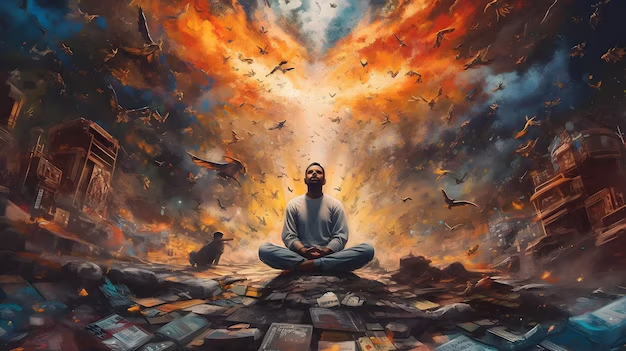
 As this brain grew, it gained the processing ability to go beyond the defensive reaction of its dark beginnings and, learning to see a bigger picture, strategize its way past danger and toward sustenance. This remarkable ascension is still happening and that’s a wonderful thing. Yet, that growth happened so quickly, our minds are developing new skills while our brain is still holding to old processes. This creates a dissonance between a view of what may be possible and what we fear could happen.
 So, how can we make this large picture practical for us? We can begin by loooking at ourselves, as we are. How can compassion make my life a better place? What can I do today to make my life easier and more productive so that I may better serve? This is not selfish, it’s practical. However, trying to make my life better than someone else’s, or a better place for only me and mine, is selfish because it’s narrow minded and myopic. Compassion is developing the tools to care for ourselves so that we can care for other beings. But, we are one of those beings. In fact, until we learn to effectively care for ourselves we will be unable to care for others.
 Yet, if we accept that we are a work-in-progress then we can learn to gain confidence in ourselves. Self-aggrandizement, like the arrogance it engenders, covers leads to a lack of belief in ourselves. We know inside that we are not the ideal, and so believe we are less than the ideal. But that truth is if we can accept ourselves and vow to discover what we become, we are committing to a path of supporting ourselves. As we develop self-awareness, we naturally gain regard for ourselves. And though this regard for ourselves we begin to see others more clearly. Freed of the veils of defensive self interest we begin to see that we are not as estranged from our world as we had imagined.