I lay in bed this morning, unable to get motivated, pondering the deep existential question why bother? And when I get like this the only answer to why bother is … eh, fuck it.

In meditation training, we learn that every experience is worthy of investigation. Yet this sense of “why bother” is one I reject outright. Its insidious banality suggests “keep moving, there’s nothing to see here.” So I lay there, scratching about the corners of my brain, scrolling through the internet, seeking distraction, or maybe even a little self-reinforcing negativity. One positive about our world these days is there’s no lack of material to support a depressive state. Despite my worst intentions, I stumbled upon a You Tube short of Jim Carrey’s. I assumed it would be a laugh. Instead, I caught him talking about depression. He quoted his teacher Jeff Foster’s notion that “depressed” could translate to “deep rest”. Carrey said depression was the body’s way of telling the brain “Fuck you, I don’t want to be this avatar you’ve created anymore.” My ideas about myself are so much to live up to.
Then I began to see my morning malaise as a strike, of sorts. A part of me had grown tired of being ignored and unseen. My social self—what Martha Beck calls the “pretend self”—is built around teaching, coaching, being available to others. I love this work, I feel at home in it. And yet, this is only a part of myself. It’s clear there are parts I’m not comfortable seeing or sharing. When this happens, maybe the mask I’ve created has become too heavy for the rest of me to wear.
Sometimes depression is angry and volatile. This angry depression is sexy enough to keep me interested. But these wet blanket moments when the world is dull and uninspiring are truly maddening- or would be if I cared enough to get mad. Perhaps this dull depression is designed to keep me from looking beneath the surface, from uncovering what may be really happening. Maybe before I could decide what’s really happening beneath, before I analyze anything further, I could apply Ockham’s Razor and reduce it down to what is actually happening right here. Right now, I’m stuck.
Stuck.
In my meditation training they would call this resistance. And they would say that resistance is the path. When I first heard this, it seemed to absolve me of my natural reluctance, it made me feel like it was OK and part of the process. However, many years later, I’m becoming impatient with these delays in the progress of my life and it feels galling. But that’s not looking from where I am, it’s looking from the point of view of the avatar, my imaginary-supposed-wanna-being. Being stuck in my resistance is what is happening now, all that is happening now. I’ve experienced this often in my life, so maybe it’s time I decided to look at it. Instead of thinking “dammit, not you again” I might invite the experience in, let it have a seat and get to know it. When we meet our resistance, we are touching the path itself.
 Resistance is where the rubber meets the road or, as the Tibetans say, “when rock hits bone.” This initially may shock us into numbness. All we feel is that erie Lackawanna, like a 2 year old’s mantra of “NO NO NO!” But maybe I can just look at this. Maybe it’s not a grand existential crisis, not a dramatic psychological wound, maybe it’s—just I don’t want to. Instead of assuming I should be different, I could explore what it actually feels like to be here not wanting to be here. Resistance is not an obstacle to the path; resistance is the path. It’s the moment we are forced to sit down, to feel the discomfort fully, and to learn from it. The more uncomfortable it is, the more there is to see. Instead of searching for complex explanations, maybe the truth is simple: my body and mind are saying, Pause. Feel this. I sometimes look out my window at people working, doing jobs I have no interest in, and yet I feel guilty. They’re working hard, supporting their families, and I’m lying here chewing on my own thoughts. But maybe this is my work—to investigate my own experience, to make sense of it, to translate it. Maybe these periods of shutdown are moments of resynchronization.
I think a lot of depression hides behind this deep exhaustion that makes even the smallest movement seem impossible. I thrive on offering myself to others, in being present for them, but there’s a disconnect when it comes to directing that same care toward myself. It’s not that I’m incapable of engagement—I’m deeply engaged when it comes to others. But when I turn inward, that engagement becomes resistance, inertia, even paralysis. It makes sense that this might be an invitation, a signal to pause and investigate: Where am I not living truthfully? When I’m with others, my next steps are clear—I listen, I hold space, I respond. But alone, lying in bed in the morning, wondering why I should bother, I feel lost. Depression, I suspect, creates a loop where each time it returns, it feels like it has always been there. And since I spend so much time in this inert state, maybe it’s time to stop resisting it, to really experience it instead. Not to judge it, not to push it away, but to let it unfold and see what’s there. We often want change without fully acknowledging what is. But how can we move forward if we don’t first accept where we are?
 Depression, when experienced as deep rest, may be a forced resynchronization, a way to reset the system. The Japanese philosophy of Kaizen suggests that when we’re stuck, it’s not because we’re failing but because we haven’t yet learned how to succeed. It teaches that small, incremental steps can help us move forward. If my room is a mess, my desk is piled high, and my taxes loom over me, tackling it all at once feels impossible. But if I decide that today, I will write this, meditate for a few minutes, and make a good cup of tea, those are small, doable actions. I don’t need to force myself into massive leaps—I need to align with what is possible right now. It’s strange how we expect ourselves to emerge from depression with force, to suddenly regain clarity and momentum. But what if the way forward is softer, more patient? What if, instead of pushing myself to break through, I let myself dissolve into the experience fully? Depression doesn’t mean I am broken. It means something inside me is asking to be heard, asking to rest, asking to be real. And maybe the more I resist that, the more it holds on.
Maybe the real work isn’t about changing myself to fit a mold. Maybe it’s about becoming synchronized with who I actually am. Not who I think I should be, not who I wish I were, but this person, in this moment, as I am right now. And maybe that’s all we need right now. Then we can ask the big questions. Where am I not living truthfully? Are there things I want to feel, but can’t? Am I frightened?
Maybe today I can forget where I’m going and discover who I am beneath the heavy mask. The method here is holding space and asking questions, just as I would do for clients or friends. Discovering implies learning something new. We are not obligated to do anything with the information, except listen. Sometimes our inner voices want the wrong things. Sometimes they may be yelling from the rooftops. But, all they really want is their voice.
Sometimes they just need to be heard.
 In Trungpa Rinpoche’s Dharma Art course, the very first class begins with students sitting in a circle. There is a blank white sheet spread on the floor. This experience, which he called Square One, was designed to immerse students in the energy of clear, open space. The entire premise of Dharma Art—creating authentic expression within one’s environment—relied on the understanding that Square One was completely empty.
 Just as the universe created itself, humanity may have evolved to perceive, feel, and interact with that unfolding creation. When we gaze at the night sky, we see a seemingly static and reliable expanse. Yet, in reality, it is dynamic and ever-changing. The stars we see may no longer exist as they appear; their light has taken years, even millennia, to reach us. The sky is a snapshot of creation in motion. When we quiet the mind—acknowledging our thoughts but resting in the space between them—we create the silence needed for inspiration to arise.

 There is an old Zen saying: “Disappointment is the chariot of liberation.” But what does that mean? Is it simply wishful thinking when things go wrong? Not quite. It points to a fundamental aspect of the path toward liberation. What are we liberating ourselves from?
 human behavior is that we will do the extra work of fabricating a fiction, rather than simply relax with what is. This is where mindfulness comes in: the ability to slow down, synchronize with the moment and rest our attention with what is happening. This allows the space for us to see a perspective grander than one constrained by habittual reaction. With mindfulness we are able to see if the next action is leading to freedom or reinforcing habitual patterns that limit us. And we can take the next step. If we are brave enough, we might step through the veil. When we are controlled by fear, we might cycle back to habit.
 Even when we believe we are succeeding within a particular frame, we may only be reinforcing the walls that separate us from deeper understanding. Every mistake, problem, or disappointment is an opportunity—not for blame, but for insight. What we call “failure” often arises from the expectations of the frame we are living within. We didn’t get the job, the person didn’t call back, we failed to reach our goal weight—these disappointments expose the treadmill of habitual thinking that keeps us confined. But when these expectations are disrupted, we have a chance to reset, to step beyond the frame and see our lives with fresh eyes.
 In Buddhist teaching, Patience is taught as one of the six paramitas. The Paramitas Generosity, Patience, Discipline, Exertion, Meditation and Wisdom are activities that transcend our conventional frame into a more expansive or “transcendent” expression of experience. This transcendence is sometimes referred to as “the other shore,” as we move from a self-centered, habitual interpretation to one imbued with greater depth and perspective. From this larger perspective, patience can be viewed as a positive application for the development of wisdom. We are not clamping down or tightening up; rather, we are allowing space between an impulse and our action. This space provides the opportunity for us to become cognizant, intentional, and mindful. Transcendent Patience is a momentary pause for us to find the most appropriate response to whatever situation confronts us. More importantly, that space allows us to connect with our natural serenity and peacefulness of mind. Through consistent, dedicated meditation practice, we can develop the ability to recognize these moments of pause—often just before we bite down or cling to our next reaction.
 Patience, in its transcendent form, is not merely about waiting for external circumstances to shift. It is about cultivating space within the mind to introduce awareness into our processing. Patience allows us to see our thoughts as they form, granting us the opportunity to respond thoughtfully rather than react impulsively. In Tibetan, this reactive “hook” is referred to as shenpa; Pema Chödrön describes it as the feeling of being hijacked by familiar patterns of reactivity.
 Patience also applies on a behavioral level, especially when we are cultivating something new—a relationship, a creative project, or a business. In some spiritual traditions, practitioners “turn it over to God.” In Buddhism, we turn it over to space itself, trusting that space is imbued with the same intelligence and compassion others may attribute to a deity. Rushing a project or relationship may bring temporary gratification but rarely yields sustainable growth. Patience allows the natural rhythms of the process to unfold, supporting more authentic and enduring outcomes.
 importance of creating safety for not only himself but also the Dharma and for his students. The need for protection grew alongside his rapidly expanding community. In Tibet, monasteries were safeguarded by monks trained in awareness and nonviolent crowd control. Trungpa’s close attendant, John Perks, a British armed forces veteran, played a pivotal role in this initiative. Perks, who passed away on January 31st, was an outrageous and endlessly creative figure whose book The Mahasiddha and His Idiot Servant captures the spirit of the time.
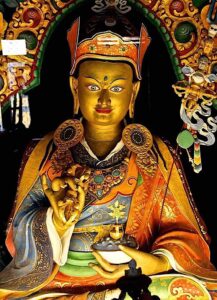 These principles trace back to the 9th century when the Indian Mahasiddha Padmasambhava introduced Buddhism to Tibet at the invitation of King Trisong Detsen. Padmasambhava encountered numerous obstacles, as Tibet’s rich mystical traditions were diverse and often aggressive. While some practices were positive, others were rooted in fear and superstition. The Tibetan king sought to unify his people through a central spiritual framework, seeing Buddhism’s ideals of nonviolence and compassion as tools for governance. Inspired by India’s spiritual renaissance, Padmasambhava aimed to refine Tibet’s spiritual landscape.
 The ideal meditative state—clarity and acceptance—rests on the openness and settledness of the body, heart, and mind. However, life rarely offers us perfect conditions. For me, morning practice often begins with a scattered or resistant mind. The first step, then, is acceptance—meeting the mind as it is and not as I wish it to be.
 Once again, meditation isn’t about fixing; it’s about seeing. The mind of meditation arises in awareness like a point in space. And as the space of awareness is relieved of the pressure to fix itself or chose a side, it remains loving and supportive. It is a state of grace. By stepping into the grace of awareness, we don’t need to force change—we simply allow what we notice to be with us, remembering none of it is as real, solid or urgent as our fear suggests. Trungpa Rinpoche famously wrote, “good, bad, happy, sad – all thoughts vanish like an imprint of a bird in the sky.” Once we release ourselves from the grip of control, we see everything as ephemeral, diaphanous and in dynamic transition. Sakyong Mipham calls this the displaysive activity of mind. All of our worries are the mind revealing itself. Many of our worries are kid fears. And like kids, they need to be loved and accepted, but not always believed.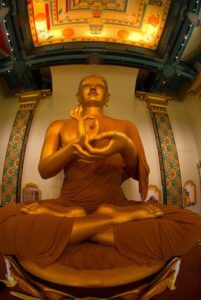
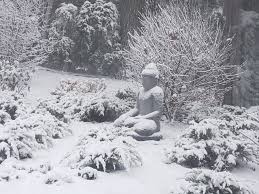 Ego which can be seen as the very limited defensive nature of the mind, serves to reduce our world to a controllable space. Its logical extension is the propagation of surety, dogma and doctrine. The opposite of ignorance(ma-Rigpa) is knowing (Rigpa), and therefore, egoless being is sees and knows what is happening. And it always has. This is Buddha Nature – our natural state. Because it is accepting reality as it is, it is not at war. Thus, Buddha Nature is said to be indestructible. It has never changed. It is the life of the universe and the very life around us. And though our lives will pass into other configurations, our essential nature is said to be part of all of nature. Ego clings to temporal things in order for us to believe that temporary things give us solace and sustenance. We can squint our eyes and believe what we are happy but, inside us, we know that happiness is immaterial. Material things are “like a banquet before the executioner leads us to our death.” Revenge, retribution, and displays of grandiosity masquerading as leadership are fleeting and meaningless. They are basically good, because they are there. But they are expressions of ego and ultimately fleeting.