
CARING FOR THE CRAZY

Awakening Our Loving Kindness


Our minds are huge—larger than we understand—capable of being incredibly sane, clear, and beautiful. But at times, quite the opposite. We can get lost in cul-de-sacs of unresolved reasoning, like a kid in a hall of mirrors distorting and reflecting upon itself.

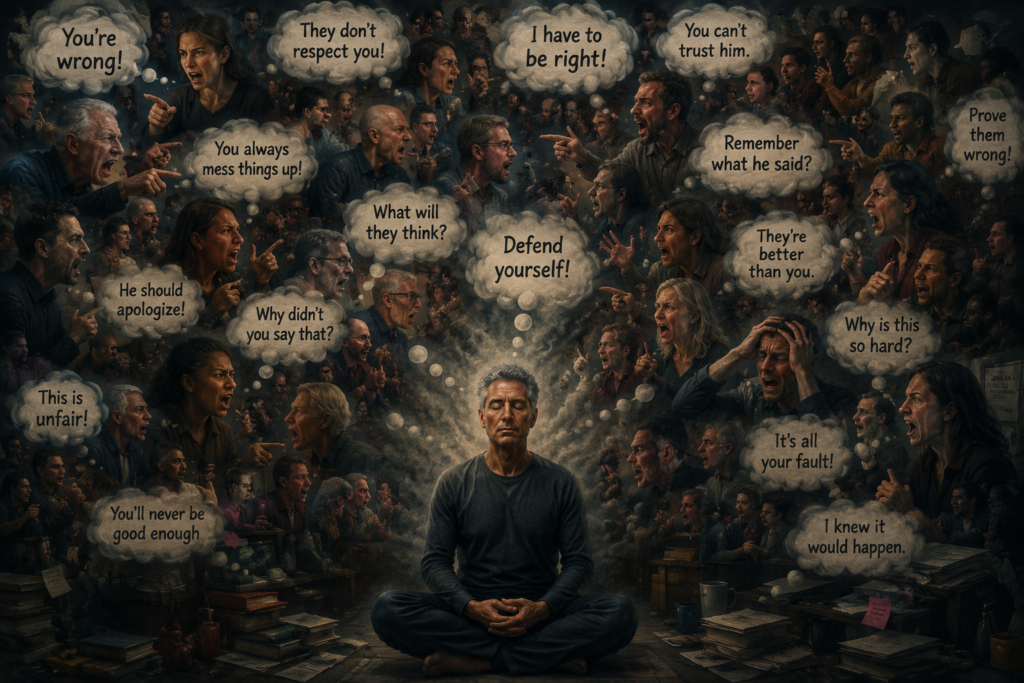
Today I want to address the circular, repetitive, sometimes violent thoughts that bang around our minds from time to time. Often at the worst times. Perhaps on the eve of a busy day while trying to get to sleep our brain instigates an imaginary dialogue, as if trying to resolve an unresolvable equation.

I should have said this. I could have said that. Why didn’t I just get up and leave?

One particularly curious part of this game is when there seems to be a false resolution. We roll back toward slumber, but after a moment of peace the mind shoots up again: Waiut! I could have said this!  I should have told them that …

When this happens, we are too focused on trying to sleep. And that’s a problem. Each time we look at the clock, we calculate the remaining hours until the alarm rings, we are focused on something that is not the issue. The problem isn’t that we can’t sleep. We sleep almost every day. The issue is that we can’t stop our brain. We can’t let go of something.

When I get stuck with something after I’ve been triggered, I can feel how compromised my inner world becomes. My thoughts, my feelings, and my concerns around the issue stop being trustworthy. I am trapped in a self-referential world, trying different experiments to free myself, only to arrive at the same unhappy result. A crazy person once said this was the definition of insanity. I am flagellating myself, desperately fixated on what I can’t resolve.

But what is actually happening?

Let’s look at the particulars. This endless, expansive, extraordinary mind of ours was originally developed as a defensive organ. As humanity evolved, we lost our fangs, our claws, our venom—but we gained cerebral processing power. In early times, when we were threatened, our minds had the ability to strategize and escape. Likewise, we could strategize ways to increase sustenance for ourselves, our family and our clan. The mind became the great problem-solver. And to this day, it will try to solve problems—whether or not we have a problem. All it needs to initialize is to be triggered. And then, although the lions our ancestors ran from are no longer here to chase us, we are still running. We are still strategizing. We are still trying to find a release from danger.

Unfortunately, when nothing is actually happening—when we are not facing a tiger but simply a feeling of being threatened—the mind can’t find the culprit. Without a real object to land on, it spins freely, unable to find what isn’t actually there. Sometimes we’re trying to find a way out of a problem we can’t find.

So how do we work with this? I have come to think of it in five stages.

  • The first stage is knowing that it will leave.

This matters because when we are caught in the cycle, it feels permanent. We are in pain, and we are desperately trying to find a way out. But even in the most intense moments, there are gaps—moments of forgetting, moments when the deluge softens, when the mind is calm, even for only a moment.

This stage is about recognizing that those moments of peace are not accidents. They are evidence. When the storm returns, it is not because the temporary storm is stronger. It is because the calm, which is the mind’s true nature, is trying to break through.

  • The second stage is recognizing what is happening now.

If we trace the experience backward—looking for causes and conditions—we can quickly open a Pandora’s box. Whatever is happening now likely connects to past wounds and future fears. But this stage is about cutting through all of that with Occam’s razor, or the sword of Manjushri. What is actually happening?

Not what we wish were happening. Not “I’m not getting enough sleep.” Not “I’m driving myself crazy.” No judgment, no speculation. Just simple recognition: This is what is happening. We can’t stop our mind. That’s what’s happening. You might call this “facing the crazy.”

But stop calling it crazy.

  • The third stage is

Instead, look at what’s happening without judgment or speculation. Allow it to be as it is. There is a basic law here: until we accept something we can’t discover how to work with it. And until we do that, we’re kind of stuck with it. So, before we do anything, we have to stop labeling it as broken and simply say: This is what’s happening.

Acceptance does not mean approval. It means we stop fighting. It means acknowledging reality.

  • The fourth stage is beginning to work with it.

This is usually quick up to this point, but here’s where the work begins. Once I have recognized and accepted this experience, and once I have stopped judging or trying to fix something I don’t yet understand, I can turn toward it with care. Maybe even respect. Damn this is some powerful shit.

I can ask: What is this really about? What does this need?

Usually, the surface story is not the whole story. Anger may be covering fear. Fear may be covering hurt. But beneath all of that, something more immediate is happening.

This stage is about listening rather than solving. We are not trying to fix anything. That fixing impulse can be aggressive—a kind of inner patriarchal clampdown. Instead, we are opening to something sensitive and delicate inside us, something that may be wounded. We need to proceed with caution. We’re holding space and listening in. And by doing this we’re accessing a larger part of the mind that sees and cares for the spinning.

A mind that can navigate past the defensive layers, and without triggering them, touch that wound directly. And that does not need words, language, prescriptions, or explanations. It needs to be felt, acknowledged and held.

Why can’t the wounded child go to sleep?

  • The fifth stage is loving-kindness.

Rather than struggling to change anything, we can recognize, accept, and work with the experience through love and kindness. By taking the time to do this with love and care it becomes clear that we are not the turmoil. We are the love. Rather than being victimized by the torrent of mind, we access the greater mind of loving acceptance. We are that mind. We can rest in her arms.

When a child runs into the room because it fears monsters, it does not need a clinical explanation. It does not need a scientific breakdown of why monsters do not exist. It does not need to be yelled at or pushed back into bed. It needs to be held. Comforted. Assured that it is safe.

Even as adults who know there is no danger, something inside still needs to feel that safety before it can rest. Before we send the child back to bed, we might ask: Are you okay to be brave now? Are you brave enough to sleep? We are not speaking to logic. We are speaking to feeling. We are taking the time to find the tenderness, to feel it, and to listen. If this process robs me of sleep, it will have been worth it—because I have learned how to work with something I cannot control.

The tigers of mind and the monsters beneath the bed are not what’s real. What’s real is the power of our love, and the truth of our suffering—that we have been hurt, that we have been shaped by experience, but that we can learn to care for ourselves.

And sometimes we’re late for work.

________________________


Can’t sleep?

Can’t still your raging mind?

Can’t find serenity in the storm? 

Turn your attention away from the clock

To your heart 

Let the anxiety remind you

You have access to a heart so big

It can hold a screaming mind 

A heart so strong it can ease your panic.

A heart so steady it can still the storms we all endure 

The brain screams loudly

And loving kindness is quiet

so it needs to be awakened and engaged

Awaken loving kindness

And let that hold you 


THE JOY OF SADNESS

HELP


______

Red Light, Green Light

Navigating the Traffic of Life


In my coaching I use the analogy of traffic lights to illustrate how we might move through life with grace.

Some people rush through life as though red lights were a personal challenge. They think they’re outrunning danger by never slowing down — like someone racing home before the consequences catch up. Others never take their foot off the brake, as though they’ve forgotten the point of being in traffic in the first place is to move toward a destination. They inch from red to cautious yellow but never relax into the open, fluid travel that makes for a joyful life.

Neither approach is particularly graceful. Neither is mindful.

If we want to travel through life with fluidity, we need both mindfulness and awareness. Mindfulness pays attention to what we are doing right now. Awareness senses where we’re headed and what lives at the edges of our experience. The cooperative interplay between the specificity of mindfulness and the expansiveness of awareness is exactly what we train for in meditation practice. And it’s transferable to life.

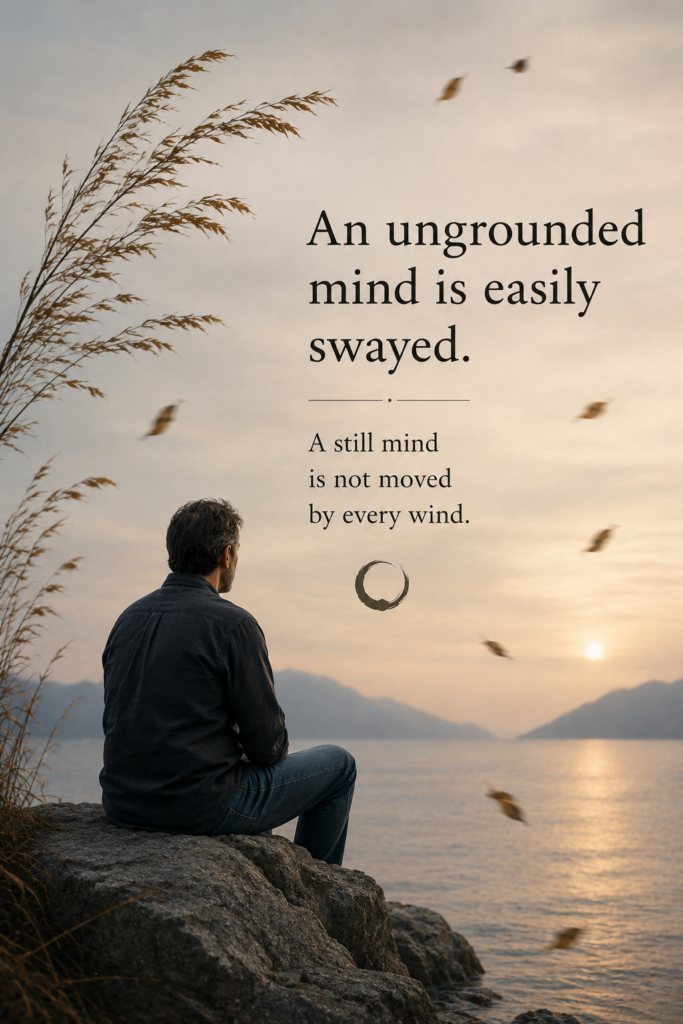
Mindfulness without awareness can become narrow and dutiful. We focus so closely on the task at hand that we lose sight of the larger landscape. Awareness without mindfulness can become ungrounded — expansive but drifting, easily pulled off course.

What we’re cultivating is balance. A cooperative relationship between grounding and spaciousness. I like to think of their union as mindful awareness — attentive to the point we occupy while conscious of the flow surrounding it.

We often talk about developing flow in life. But what about danger?

When something feels off, that’s often a yellow light — not red. Yellow means slow down. Pay attention. For example, if someone we’re dating is harsh toward children or animals, that’s a signal to pause and look more closely. A red light would be something unmistakable — physical abuse, clear harm. Red means stop.

Yellow is different. Yellow is dropping into a lower gear while climbing a steep hill. You’re still moving — just carefully, consciously, with heightened awareness.

The problem is that some of us live as though every light is red. Or we forget to shift back up once the hill has leveled out.

Traveling carefully through perceived danger requires discernment. But when the road opens, we must allow ourselves to move freely again. Green means go. It means trust the conditions. It means flow.

This is especially true in relationships. Sometimes we need to slow down, let go of our personal momentum, and resynchronize with our partner. But we cannot live forever in repair mode. We cannot make a home at the yellow light.

A common pattern I see in clients is that their relationship becomes a series of red lights. All complaint. All caution. All obstruction. So they go elsewhere to find green — work, hobbies, friendships, even fantasy. Inside the relationship, they believe there’s no open road left.

But there is almost always some way forward. The question is whether we can find it together. That may require slowing down first — synchronizing — before gently pressing the gas again.

This is true with our relationship with ourselves. We may find places in our body, heart and mind that we are stuck. Places we just don’t want to go. Shadows in the mind, create blockages in our body, that manifest as limitations in life. Sometimes the red lights in life have their roots from red lights in our mind. We can run the lights, pushing past our doubts, with eyes on a supposed destination. But this is a disregard for our actual experience. The experience we need to learn.

Patience is so important. Finding the gentle perseverance to keep moving forward one step at a time, one day at a time, and stopping to synchronize as we need. But always remembering to allow ourselves to move forward.


OUTSIDE THE BOX

The   S  P    A       C        E   Between

Opportunities appear when we open to possibility. Opening is releasing the grip of tension. Despite conventional renderings, or panicky manifestations, thinking we know what we want doesn’t always help. When we cling to a specific outcome we miss whatever else life may present.

And sometimes getting what we want is its own particular torture.

As the Bard wrote, “ah, there’s the rub“. When we are opening to our desires, we are also exposing ourselves to the possibility of danger.  So, to hedge our bets, we close in on something, as if to capture it. Rather than opening to desire, we are closing down on the things we desire.

In this way, we are living in expectation rather than possibility much of the time .

Living in possibility requires we step outside the box. We move through life jumping from box to box like cats. Boxes soothe us. They define us. They protect us from the overwhelming vastness of everything that doesn’t fit neatly. There’s nothing inherently wrong with the mind building these cradles of protection. The problem begins when we believe they’re real and forget we’re inside one.

That’s when belief starts masquerading as truth.

Belief does not equal truth. In fact, the stronger our belief, the less we see. The more we cling, identify, defend, and perform, the narrower our vision becomes. Belief hardens into a thing. And things, block the view.

Things pretend to be solid. They look self-contained. But they are designations — temporary labels slapped onto dynamic processes. What we call a thing is usually just the visible tip of an interdependent, interdynamic iceberg beneath.

Take any object. A chair.* A body. A flag. Reduce it to atoms. Then reduce those atoms to subatomic particles. Many of those don’t even behave like tangible matter. Even protons and neutrons dissolve into stranger, less graspable components. With each reduction, solidity fades into pure energy.

The Buddha taught that there is no independent, permanent thing. No thingness, you might say.

Time tells the same story. The chair I’m sitting on feels solid enough. But it’s degrading as I write this. It was once a seedling, then a tree, then lumber, then furniture. One day it will be firewood, ash, soil. Compared to the age of the planet, its entire existence is a flicker.

Everything is in flux. And yet we try and freeze the flux by singling out a parcel and gripping to it with all our might. We turn movement into identity.

“I’m a good son.”; “I’m the black sheep.”; “I’m a patriot.”; “I’m progressive.”; “I’m conservative.”; “I’m spiritual.”

I’m a Buddhist.

But even that is a box if I think it makes me something. In fact, there is nothing to hold on to with any certainty.  We crawl into these psychological enclosures and call them reality. We defend them. We argue from inside them. We build whole lives around them. And because we believe them, they feel solid.

But belief does not equal truth.

The more tightly we hold a belief, the more it becomes an obstruction. It filters out contradiction. It edits complexity. It reduces the living world to manageable pieces. It trades reality for control.

Here’s something unsettling: what’s most real might not be identifiable things at all. It might be the space between them.

In a live talk, I sometimes ask students to shout out everything they see in the room. They call out the ceiling, the lights, the cushions, the walls, the other people. Then I ask: what is most prevalent here? What is most prevalent, by far?

Space.

There is more space in the room than anything else. More space between objects. More space within objects. More space between atoms. More space inside the atom itself. If you include the space between things and the space inside those things, space dwarfs everything. There is more dark matter, and (thusfar) unknowable space in space.

And yet, everything is born from space.

Everything we see, and believe to be real, is only makeup on space. Yet, we don’t notice space. We notice surfaces. And from those surfaces we build belief systems. We construct narratives. We freeze dynamic reality into slogans and identities.

We do this personally. We do this politically. We do this culturally.

Nations are not fixed. Political movements are not fixed. Generations are not fixed. Every “how it is” is already unraveling into what it isn’t. Each new wave of voters arrives with a different nervous system, different media diet, different mythology. What continues isn’t permanence. It’s momentum.

Yet we cling as if the box will hold forever.

We rarely notice how we slide from one enclosure to the next. Somehow we move from curious children into solid, themed adults without recognizing the transition. We inherit boxes. We decorate them. We defend them. We mistake them for ourselves.

We do this because boxes feel safe.

The first step toward freedom isn’t smashing them. It’s noticing them. The second step is seeing that they have no solid walls.

If nothing is fixed, how do I stand? If identity is fluid, who am I? If beliefs are provisional, what anchors me?

But emptiness doesn’t mean nothing exists. It means nothing exists independently or permanently. Everything arises in relationship. Everything depends on everything else. That’s interdependence.

Subjectively, this can feel like release. An opening. A loosening of tension. In Buddhist language, it points toward Nirvana — not annihilation, but the end of clinging. The end of defending the box as if your life depends on it.

Between the boxes lies space. And space feels dangerous because space is undefended. It’s exposed. There’s no script in space. No ready-made identity. No tribe guaranteeing your place. Just awareness without enclosure.

We crave that openness. You can feel it when your life starts to itch. When the role you’ve been playing gets tight. When the identity that once felt powerful now feels like a costume. So, we long to step out. We read saying like “life begins at the end of your comfort zone.” Sounds good, but stepping into space feels naked.

And this rings the alarm of our defenses. The protective systems in our mind resist it. They tighten the walls. They reinforce the story. They tell you that outside the box is chaos, threat, annihilation. But maybe it’s freedom. Maybe it’s the annihilation of an older purpose. And like every form of life since there was life, maybe old purposes give way to new life.

So the real question isn’t whether boxes exist. They do. The mind will keep building them. The question is whether you know you’re in one.

Are you defending yourself? Or are you defending the box? Are you believing a story? Or, are you watching the story from a vantage of clear seeing?  Because be boxes — in that uncomfortable, undefended space — is the possibility of something far more alive than certainty.

And that’s terrifying.

And liberating.


  • *The late Sir Harold Pinter wrote an exchange between 2 brothers: The older brother Teddy, who is a Philosophy Professor, patronizingly tells Lenny, a streetwise pimp, to “take a chair”. “I prefer to Stand”, Lenny declines and then asks Teddy why philosophers are always saying things like “take a chair”. But once you’ve taken it, then what?
  • Lenny goes on the defensive and says Lenny operates “in” things, but he, the philosopher, operates “on” things. This is an explanation of in and out of the box. Lenny, we find our in Act 3, is simply in a larger, more insidious, box.


_________________________________________

THE FIRE HORSE

Hello everyone, and happy Lunar New Year.

I’m inviting everyone to join me this evening for a simple ceremony and conversation reflecting on the coming year. If the ancient traditions are to be believed, this year may be volatile. For many of us, life already feels that way. This may be a good time to speak with one another, to support one another, and to orient our minds toward compassion, empathy, and psychological and emotional health.

This invitation is very last minute, and I’m not assuming there will be a large attendance. But I’ve found—especially within the Dharmajunkies community—that when gatherings arise this way, the people who come are the people who need to be there. Recently, one of our members, Sherri Rosen, suggested that during this time of difficulty, change, and winter—communicating and being present for one another is especially important. I think it would be wonderful to follow that suggestion and gather tonight at 7:00 PM simply to be together: to celebrate, to find joy, and also to talk honestly about the joys and challenges we are experiencing.


THE FIRE HORSE

The Lunar New Year differs from the standard Western solar calendar in that it is organized around the moon’s cycles as they appear to us from Earth, rather than the Earth’s revolution around the sun. The solar calendar takes precedence in the West because it structures our daily lives and institutions, yet—as we see with leap years and uneven month lengths—it is not a perfect system. The lunar year, by contrast, is deeply organic. It aligns with the cycles of the moon, the tides, and many of our internal rhythms—the basic biological and ecological rhythms of life on this planet. Importantly, the lunar cycle corresponds across hemispheres, offering a shared global rhythm.

In many Asian cultures, each lunar year is associated with an animal that represents the energetic quality of that year. These animals combine with elemental forces—such as fire or water—to create a repeating cycle. Beyond being culturally symbolic (and, yes, the source of the placemats in Chinese restaurants), this system offers a way of reflecting on how energy moves through time.

Because lunar calendars differ slightly between cultures, some people celebrated yesterday and some celebrate today. This variability reflects the organic nature of human systems themselves. This year, many who observe the lunar cycle recognize it as the Year of the Fire Horse.

Traditionally, the Year of the Fire Horse is associated with intense energy, independence, volatility, and radical change. Fire combined with Horse amplifies passion, speed, and momentum. It is often seen as a year of disruption, upheaval, and breaking from tradition. It is linked to strong-willed individuals—especially women—who resist control. Historically, it has even been feared in some cultures as a time of social instability or misfortune. At the same time, it symbolizes fearless momentum, revolution, and catalytic transformation.

In short, the Year of the Fire Horse is fast, fierce, uncontrollable—and transformative.

Considering the upheavals we are already experiencing in culture, politics, and climate, this year feels like a kind of clarion call. That call may point to external circumstances, to our inner lives, or—most often—to both. While there may not be a direct causal relationship between how we feel and what is happening around us, the two are frequently in conversation.

Most people who observe the Lunar New Year live within Asian societies—some of the world’s oldest continuous cultures. These traditions often emphasize understanding natural rhythms as a way of relating wisely to present circumstances. While surface-level cultural expressions differ widely, beneath them we find shared human rhythms and basic truths.

The Buddhist traditions I study and practice center on the idea of Buddha nature—sometimes called basic or fundamental goodness. This view holds that all life, in its essence, has its own purpose and truth. While this fundamental goodness is often obscured by the conditions of social and psychological life, the teaching suggests that, at our core, we are not broken. We are already whole.

Whether or not one can prove this philosophically, living as though it were true can change how we relate to ourselves and others. Rather than assuming we are flawed and need fixing, we might experiment with the idea that we are fundamentally good and that our task is to uncover what is already there. The audacious implication of this view is that believing in our own goodness—and in the goodness of others—reduces the impulse toward violence, defensiveness, and overcompensation.

Losar, the Tibetan New Year, is traditionally a time of renewal and reconnection with this wakeful, good heart. From this perspective, working with the energy of the coming year begins with the assumption that the energy itself is not wrong or bad, even if it is challenging. If we believe in ourselves and in the basic goodness of humanity, then even volatile conditions can become workable.

Like learning to ride a horse, engaging this year’s energy calls for flexibility, clarity, and determination. We don’t dominate the horse, nor do we abandon ourselves to it. We synchronize. We adjust. We ride.

This year invites us to honor ourselves, to honor the spirit within us, and to learn how to ride that spirit toward the manifestation of goodness. It is a year to honor women. A year to honor change. A year to honor fear without being ruled by it.

By honoring fear, I mean respecting the warning signals that arise—ignoring them would be foolish. But red flags do not erase green ones. Pausing to regrip, to recoup, and to resynchronize does not mean we cannot move forward. Once we find our balance with this volatile but powerful energy, we may be able to let ourselves move with it—clearly, compassionately, and with discernment.

BETWEEN THE BOXES

PART 1 – The Comforts of Limitation

I’ll admit a small secret: I watch cat videos. I particularly love cats in boxes, especially big cats. My favorite is a tiger fighting its way into a box far too small for its body. It squeezes, contorts, until it bursts the cardboard apart—and then lies there, content, half inside a ruined container that clearly offers no real protection. The perfect caption read: “He is a cat, after all.”

That image sent me down a cat rabbit hole. Large, ferocious animals squeezing boxes that could not possibly hold them, yet they somehow get inside and find peace. What became obvious is that support and safety was never structural. It was pure feeling. Even when the box fails, the animal still experiences safety in the feeling of enclosure.

Anyone who has lived with cats knows that cats find the smallest, darkest hidey-holes everywhere in the house. We shake the food bag, jingle the cat bell, call their name—only to discover them calmly folded into a space we didn’t know existed. Sometimes just glowing eyes in the darkness. This is ancient mammalian behavior: nesting, concealment, protection.

Humans are mammals too, but with a difference. We’ve developed cognitive reasoning that sometimes overrides instinct—and sometimes merely disguises it. Our protective urge is still alive, but instead of crawling into physical boxes, we build psychological ones. This is the humamamalian quandary. The predator and the prey both live inside us, and they both want shelter.

Serial killers are often described as animals or monsters, yet to their perspective many describe killing as euphoric, making them feel godlike. My ethical framework refuses to accept this as anything other than a catastrophic illusion—but the illusion itself is revealing. The experience of being “beyond the box” can feel like absolute freedom. The difference is crucial. The serial killer’s god-experience is ego at its apex: “I am at the center.” Awakening, by contrast, is the collapse of the center altogether.

The serial killer has a solid center and is a only a god only from the point of view of the mouse they feel themselves to be. Sometimes the box bears no resemblance to our reality.

Recovery programs talk about “rational lies”: the mind constructing stories to justify acting out. When we believe these lies, we fail to see the box that enslaves us. We hide inside frames that feel like full states of being but are actually partial. That limitation is the price we pay for comfort.

Humammalian boxes have evolved to be efficient in a modern society with its multifarious information streams. We don’t carry crates, we switch identities. The phone rings and it’s our mother—suddenly we are someone smaller, older patterns activated. We arrive at work and assume another form entirely, a professional self designed to manage stress, competition, evaluation. Each box offers a perspective and a presentation. We become the person of the box we’re in.

Like cats, we often enter these boxes even when no immediate threat exists. The mere sight of the box is enough. From inside, we forget the box and simply experience the world as “safe enough.” Sometimes we scan the environment. Sometimes we fall asleep.

The problem is not that boxes exist. They are adaptive. They can even be brilliant. The problem is that they are fragile and temporary, and we forget that. No matter how ferocious we feel inside a box, it will eventually fail. Like my cat Roger hiding in an empty suitcase to avoid the vet, all the box does is delay the inevitable. Roger still got his shot. At the end of his life, he hid under the bed, refusing comfort, choosing his own final enclosure. His last moments were on his terms, in his own way, in his own box.

We do this too. Especially when we’re afraid.


PART 2 – The Space Between Boxes

I’ve served as a hospice caregiver, and I’ve watched people approach death by crawling into familiar patterns. An old man who wanted a drink before he went. A woman who smoked until the very end. We retreat into behaviors that once soothed us, even when they no longer protect us. Sometimes especially then.

Alternately, I’ve seen those accomplished in meditation who met their deaths as a new beginning, or a next stage.  They have experienced their own ego deaths any times – each time they stepped from their box. From outside the box, they could see impermanence, they understood the box game and knowing there was nothing to hold on to, when the time came they were in acceptance.

But, for most of us, clinging to the frail and changing boxes we think are “me”, we are afraid of death as it will tear us from everything we are attached to. For this reason, we construct boxes everywhere throughout our life. Over time, these boxes harden. What once was adaptive becomes restrictive. Sadly, we begin to live beneath the bed long before we die.

In relationships, we say things like “don’t play games with me,” yet games are simply boxes interacting with other boxes. To see yourself manipulating another person for love—causing pain in order to secure pleasure—is fascinating – when we see it from beyond the box.  But if someone points out our manipulation, we might jump back in and defend the box. Threatened boxes become rigid. Our available responses narrow.

At any given moment, we are the box we’re in. And yet each box has an edge. Between boxes there is space. That space may feel an uncomfortable contrast to the supposed safety of a box. So we hop from identity to identity like the floor is lava: worker, rebel, lover, child, controller, pleaser. The space between feels like annalization.

Meditation is learning to tolerate that fall.

Contrary to fantasy, meditation is not about finding a better box called “a clear mind.” That, too, is a trap. Although a clear mind exists and is considered a mark of meditation training clarity appears, and will disappear. Cloudy mind replaces it. without warning.  Thinking mind. Dozy mind. The movement of mind is natural unless we freeze it. Turning any of these into an identity is a fool’s game. Literally, we are fooling ourselves into believing nothing just because we’ve frozen an idea in place.

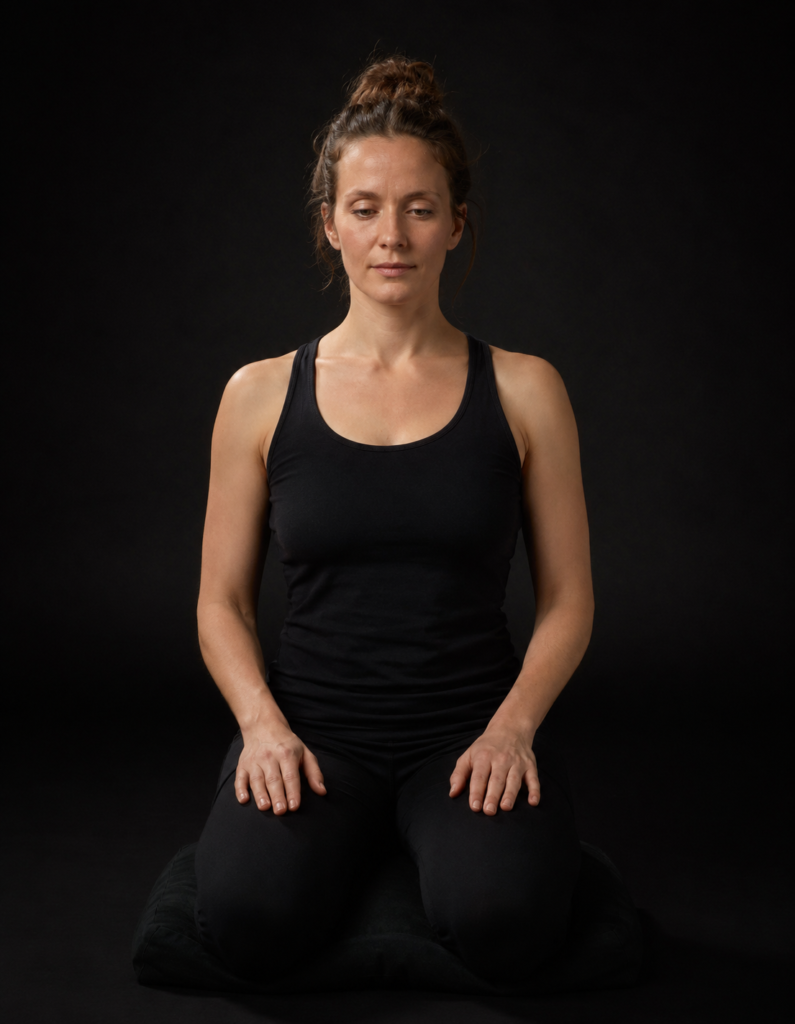
The only box we need in meditation is the body. Sitting. Breathing. Not because the breath is sacred, but because it is present. Each time the past arises, we notice it, feel it, and return. Each time the future tugs at us with anxiety, we notice and return. Not to suppress—but to release the grip of limitation.

One of the sneakiest boxes is the one that says, “I am meditating.” It rejects experience in the name of progress. But awakening is not refinement; it is spaciousness. The difference between a god-experience and awakening is simple: one puts me at the center, the other removes the center entirely.

Animals reset. Humans accumulate. We carry neurological echoes of fear long after the threat has passed. Over time, the boxes we retreat into become fewer and more solid. Eventually, there is a final box waiting. But moment to moment, we are reborn into boxes constantly. Each unnoticed transition is another quiet imprisonment.

Buddhist teaching suggests that death removes the box entirely, and rebirth is shaped by the boxes we inhabited. Whether or not one accepts that cosmology, it is undeniably true psychologically. We are continuously rehearsing our confinement.

Liberation does not require destroying boxes. It requires seeing them. Feeling the discomfort of the space between them. Trusting that openness will not kill us—though it may unseat us.

The tiger rests because it feels safe enough to see the world clearly. Not because the box is strong, but because the animal is at ease. Practice is learning that same ease without needing the boxes.

That is real strength. Resting in the space between the boxes we can see the boxes as an ever morphing game. Like kids playing fort, we believe the game, yet know its not real life.

Can we rest in the space outside our boxes without being locked into them?

THE ATMOSPHERE OF VENUS

For Valentine’s Day 


Valentine’s Day is set aside to commemorate falling in love. Saint Valentine, roses and chocolate, Cupid, and Venus—the morning star named for the goddess of love—are classic symbols of romantic love.

But, as with romance itself, surface appearances often conceal deeper realities. St. Valentine was a tragic figure. Roses have thorns. Chocolate spikes blood sugar and precipitates an emotional crash. Cupid is a hunter with the aim of a baby. And Venus, the planet named for the goddess of love, so beautiful as the first glimmer of hope in the morning sky, actually has a surface temperature of 450°F, a claustrophobic atmosphere of Methane gas. It rains sulfuric acid. It’s seismic disquiet has earthquakes and volcanic eruptions daily. It spins backwards, and each day lasts as long as a year.

And yes—this is the planet named for the goddess of love.

Not to rain acid on anyone’s parade, but problems with romantic love arise when we fail to look beyond our projections to see the truth beneath.  We will never truly see another if we fail to recognize ourselves. Everything we grasp becomes poison if we fail to grasp ourselves. Loving another without knowing ourselves is like putting on silken finery without having bathed. Surface beauty disguises disillusionment without internal clarity.  When we look to someone without self-awareness they will remain mere projections in our internal dramas. We cannot know another if we fail to know ourselves. We cannot love another if we do not love ourselves.

Self-love is the requisite for loving. We talk a lot about this idea of self-love. But what does that actually mean? Practically speaking, terms like self-reliance, self-respect, and self-support may be more useful. We cannot fully love what we do not understand.

The idea of self-love is vague and undefined, much like much of our cultural language. To make self-love practical, we can look at the actions that lead toward it. For meditators, that may mean developing awareness, wisdom, and clarity about ourselves—and the willingness to go beyond ourselves and work with the world around us. However, we little help to our community, to the other beings that make up the life we are part of, if we lack self-familiarity and have not developed self-reliance, self-respect, and self-support leading to self-awareness.

Without self-awareness, our world is reduced transactions with two-dimensional tools: I want this. I want that. The path of meditation suggests we can step beyond ego’s base needs and begin to see and function clearly in the world. In relationships, we often hear that we must place another’s needs above our own. Yet, seeing ourselves requires that we don’t lose ourselves.  Honoring ourselves enough to go beyond ourselves without giving ourselves away; it is setting aside primal reactivity and learning to listen. Listening does not require believing. In fact, it works best when belief is suspended. With self-familiarity—developed through meditation—we can hear what the other person thinks they need. And that distinction matters. Wants, desires, and needs are not the same. “I need you to be quiet right now” is not the same as “please be quiet right now.” Our needs are often confused with wants. By becoming fixated on the surface experience of what we think we want, we often lose ourselves and actually fail to support our needs.

Pining away whining for someone else to love us nor provide for us will bring only insecurity and dependence. And news flash: dependence is not love. Hurting, yearning, self-flagellation are all very dramatic, but they are not love. Pain is not an expression of love. Pain is often the self-absorption that comes from lack of awareness.

This can be remedied through meditation. By sitting with ourselves patiently we develop familiarization which naturally leads to self-respect and self-awareness. And from self-awareness, love—caring and affection—arises on its own. Our base nature is clear, kind, and compassionate. In the Buddha’s later teachings came the radical notion that all beings possess Buddha-nature—an innate seed of wakefulness. This wakefulness can be recognized and refined through self-awareness, cultivated through meditation. Returning to the present moment is like Occam’s razor, cutting to what is essential so we can see clearly.

So beginning a meditation practice is like a courtship. We are slowly, deliberately and patiently learning to trust ourselves enough to open and reveal our Buddha Nature.

Loving ourselves doesn’t mean we have to like ourselves all the time. But if we look beyond judgment, assumption, and neglect, meditation may offer us the self-awareness and dignity to recognize someone we might like. And all of this is an act of loving.  Sitting there with yourself, quelling the storms by seeing the storms, learning to hold space for the longest relationship you’ve had in this life. Learning to fall in love with no one else around.

And from there, we can look beneath the surface and begin to love others.


LEARNING TO SURRENDER

Where Do We Go If We Let Go?


I was heading into a massage session when the instructor entering behind me gently touched my upper back. She leaned over my shoulder and whispered in my ear, “what do you think will happen if you let go” and pressing the point said, “right here?” It was stunning. My tears welled up. I didn’t know what it was, but I had been carrying it around since I was a child forever being the good soldier.

Why not let go? What will happens if I lose? What the hell am I trying to prove? What is it I’m carrying?

I can be like a dog with a bone sometimes. When I’m passionate about something I hate the idea of letting go. It’s mine, damn it, even if it’s hurting me. But that’s me. Everyone has their own style of attachment. And attachment will always lead to struggle because we’re trying to hold something still in a universe that is always moving. Reality is stretching and expanding, dissolving and moving away from us, as we desperately cling and grab to anything we can. Oh what joy when we find that bone to gnaw!

The late absurdist auteur, David Lynch, once drew a multi-frame cartoon he called “The Angriest Dog in the World.” It was a picture of a dog straining against its tether growling fiercely, that was copied in several frames unchanging, as day turned to night, the the seasons changed around him.

I kind of loved that guy. I think we admire people who are fighting cancer, or refusing to go gently into the night. There seems to be virtue in struggling against the laws of the universe.

One thing about human experience is when something goes awry, it reminds us how little control we have. This makes us feel small. When things don’t go our way, it’s not a punishment. It’s an opportunity to adjust and even grow. But it generally feels pretty bad.

On the other hand, when things work out the way we expect, or better than we expect, there is no end to the auto-backslapping. Perhaps it’s best to employ the middle path and not to take too much credit. It’s just life. It happens to all of us.

But it’s not about any of us.  Still, this stubborn Taurus often feels there must be something at the end of the struggle other than a pile of discarded discord.

Once I’m engaged in a struggle, I seem to have to prove something to somebody. I’m going to save this relationship, or I’m going to tell this person off though I never do and just toss about in my bed all night.  At some point, I’m just struggling for the struggle. I’m attached to the energy. Attachment brings suffering—I’ve done the research—and it’s a pretty universal human experience. When we grab hold of something we deem important, we don’t want to let it go. Our ego latches on, and whatever grand justification we started with, the war becomes all about us.

Whether we’re gnawing on a bone to pick or basking in a relationship we hope will never end, we’re stuck in attachment. No matter the rationale, the outcome is suffering.

When we grip tightly enough, we lose sight of the suffering altogether. We keep going because after all the investment, letting go feels frightening. Being right and refusing to listen can feel like strength, like clarity—but it isn’t clarity at all. It’s ego blindness. The part of us that needs to prove a point takes over. Our view becomes so narrow, so refined, so focused on our objective that it feels like certainty.

Neil deGrasse Tyson says one obstacle in science is when people know enough to think they’re right, but not enough to see they’re wrong. Since we actually don’t know, the wiser move is to let go.

Letting go doesn’t mean we’re wrong. It isn’t judgment or punishment. It’s a physical experience of loosening our grip.

Dogs eventually have to drop the bone to eat. Children eventually leave the tattered, saliva-ridden doll behind when they go to school. The attachment was soothing—but it isn’t sustainable.

Everything changes. Everything is subject to the movement of the universe. Things only appear solid and unchanging. Great pain comes from believing “this is the way it is,” or knowing it will change but insisting it change our way. Needing control, we choose to suffer, holding onto it, growling if anyone tries to take it away.

I once said to a struggling student, “Have you noticed how when you’re tired and underslept, everything feels more important and more dangerous?” She stared at me with dagger eyes and said “no.” An amazing teaching: sometimes the best thing is to shut up and let people discover it themselves.

Surrender means letting go with body, spirit, and mind. Wherever we’re gripping, there’s tension in the body. Feeling that tension, knowing it’s causing discomfort, and doing nothing to fix the story is the first step. We get addicted to the drama because it feels like control.

Letting go in spirit means releasing our attachment to how the struggle makes us feel—powerful, victimized, justified. Letting go in the mind is harder. We don’t just “stop thinking.” We replay arguments in bed at night. The way out is through love and kindness, drawing the attention out of the body. Until we let go of attachment to feeling bad or feeling victorious, we keep planting seeds of suffering.

Love naturally brings openness and surrender. Mindfulness helps us remember that whatever we latch onto becomes inaccurate and becomes suffering—for us and often for others.

In 12-step communities they say, let go and let God. In the Pentecostal tradition I grew up in, surrender was physical—tears, release, catharsis. In Buddhist tantric traditions, a transmission can release gripping in an instant, sometimes with nothing more than a clap of the hands. Letting go doesn’t have to be heavy. It can be joyous. A relief. An offering.

As we surrender and let go of proving anything, our body softens, the struggle ends, and we sit upright and open. We are making an offering to the universe, while allowing ourselves a fresh start.

CUTTING THROUGH

The Signal in the Noise


Cutting Through is a term coined by Trungpa, Ripoche. It was inspired by a Tibetan Buddhist practice called “Trekcho” which is a series of practices used to cut through obstacles.

This notion was foundational to Trungpa as he developed his teachings for the West. Faced with the profusion of conflicting and confusing information in his new home, it seemed the energy of cutting through was a very good place to begin. The first book he published in the United States was the seminal Cutting Through Spiritual Materialism in which he wrote about releasing ourselves from the trap of using spiritual practices for material ends. More generally, cutting through refers to a fundamental energy that can be developed to cut past mental complication and confusion. It is not something we need to try to do but simply a natural aspect of our mind that we can isolate, develop and employ when needed.

We tend to think that extricating ourselves from webs of confusion would be a complicated practice. This is not necessarily so. Rather than adding complexity to complication, the practice of Trekcho is a like lightning strike or a hot knife through butter. When confusion arises instead of getting bogged down in the minutia of clashing narratives, we could simply cut through and effortlessly move past. This is an assertive application of mind that can be employed, as needed, to clarify and simplify situations in life.  It is essential, however, that our view is to help rather than harm all concerned.

A cat mom will swipe at an unruly kitten to keep it in line. The strike is instructive and after the lesson is conveyed, there are no residual hurt feelings. Unlike humans who imbed psychological narratives to everything, mammals just do and move on. This is natural. Trekcho is natural. It is action in its purest form. This “clean” cat mother action is representative of the Vajra family in the Tibetan Five Wisdom tradition. It is cutting through the noise directly to the signal. In its wisdom form, Vajra energy is characterized by sharpness, clarity and decisive action. But Vajra has a shadow side. When in the service of self, the energy manifests as anger, frustration or impatience. The inflection point between the wisdom of clarity to neurotic anger comes as we are pulled from doing what is needed for all concerned, into self-interest, prejudice or resentment.  When the energy is self-serving it becomes destructive rather than constructive.

Vajra energy is so potent it becomes very important to remind our psyche that we are employing it for the benefit of beings.  When we say, “benefit of beings” we mean all beings concerned –  including, but not exclusively, ourselves. As it is so easy to slip into self interest, all formal Trekcho practice begins with acknowledgement of a wisdom lineage and an assertion of the Bodhisattva Vow.

Like mom cat we are not analyzing, we are doing. Cutting through is pure action. Just make it simple. Occam’s razor is a scientific principle the states when you have a preponderance of possibilities, the simplest possibility is our first step. Usually, it’s right in front of our face.

Finding the signal within the noise, or the point in the profusion of life’s information, means we are not adding further complication but instead cutting through discursiveness and ignorance. This is an application of a stabilized mind. Often people mistake ignorance for meditation. Spiritual bypassing is employing what we’ve learned in meditation to avoid the sharp edges of reality. Trungpa famously said “meditation is not a vacation from irritation.”  It is about dealing with life and learning to keep balance and poise in the turmoil. It is not jettisoning to a dissociative state free of other people’s worries.  We are other people.  Lofty ideals make us feel we’re destined for something greater while we’re up to our knees in swamp water. We might notice the slow, steady movement of crocodiles or alligators or whatever the heck it is in the swamps. If we want to help others we have to cut through the judgments, doubt and noise and admit we’re in a vat of trouble.

Cutting through is hard medicine for hard times.

The image for cutting through is the sword of Manjushri, the Bodhisattva of Wisdom. However, the sword he wields not a sword of destruction. It is sword of wisdom.  It is said the sword is so sharp it cuts through the noise without violence. The sword of Manjushri cuts past the obstacles with not credit or blame. It is so sharp it moves through obstacles as if they weren’t there. This is possible, because, in fact, they aren’t really there. Most of the obstacles that we face are made-up or fake news or our own judgment, doubt and shame.  Rather than creating more noise by arguing the point we just cut through to the point.

The sword of prajna that is so sharp sometimes merely gripping its handle is all we need. Remembering that this is all made up. Remembering elaboration and complication are never the point.  Having the confidence to know that and then let go.  A dull knife cannot cut, so you hack maybe saw, but you make a mess and infinitely more pain.  By developing clarity and sharpening our wisdom we cut past hacking and sawing to cutting through.  through but the sharpest knife but without even application it just sees the confusion and we’re past it effortlessly and decisively.

Decisive and effortlessness. Sometimes we think the antidote to complications and confusion would be a more aggressive complication. But that “fire with fire” approach is the dull knife of our ego assertion.  Vajra decisiveness is so clear, and so sharp that cutting through is effortless. We don’t antagonize the obstacle, nor do we try and assert our point. We just simply cut through and step beyond.