What happens before a thought?
Is there an instance of space that opens? Before we fill it with a cognition? Before we decide what this moment means? Before the notion of “me” arises again? Maybe in this perfect moment of open space anything and everything is possible.
I wonder whether the birth of a thought is analogous to the birth of the universe. What happened in that impossible moment preceding the Big Bang? Was there a perfect stillness before everything burst into being? Or is that simply another story our minds tell because we cannot imagine beginnings without a “before”?
And is it even possible to reduce our thinking to a singular thought, or reduce the birth of our universe to a singular event. Neither is likely true. Thoughts arise in astonishing succession, perhaps even simultaneously, from different regions of our mind. We notice one. We cling to one. Or perhaps, one chooses us and carries us away into its narrative.
Maybe the universe is no different. Perhaps there are countless beginnings happening all the time. Countless worlds appearing and disappearing, all interacting.
We act as though what we are thinking has always been here and will always remain. Once a thought captures our attention, it suddenly feels solid. Real. Obvious. We stop seeing it as an event occurring in consciousness and begin treating it as reality itself.
The cosmologist Jenna Levin suggests that labeling something “infinite” is intellectually lazy. To declare something infinite may simply mean we’ve reached the edge of our understanding. We’ve stopped asking what might be after we’ve reached our cognitive event horizon.
Perhaps our attempts to find an edge to the universe is an attempt to map the extent of what we know. Once we’ve defined a conceptual edge – or determined that there is no edge – we are trying to define it. To hold it. To accept it as a given. To make it something we can inhabit.
Perhaps we do the same with our thoughts. Rather than investigating them, we crown them with permanence. We believe them. We inhabit them. We defend them. We mistake them for truth rather than recognizing them as temporary appearances arising in the universe of awareness.
One anxious thought becomes my anxiety. One political opinion becomes what I stand for. One heartbreak and my life is over. Before long, we’ve constructed a reality around something that, moments earlier, did not exist.
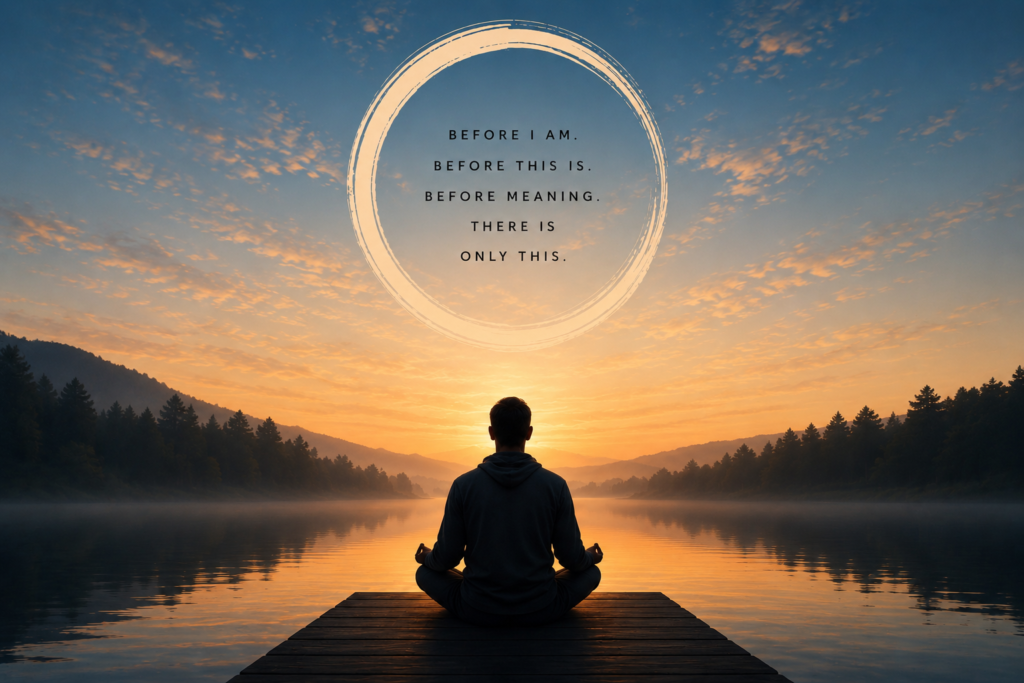
Meditation can show a snapshot of this process. And that snapshot might offer a glimpse of freedom from it. You see, believing our thoughts disables our ability to see them as thoughts. This is a form of imprisonment because it locks us into living and reliving only what we already know. As comforting as this is, it comes at the expense of everything else we might become.
If we sit quietly and follow the “prime directive” – which is to notice what arises without interference, such as judgement, desire, preference, et al. We will see that thoughts don’t actually arrive in a neat line. They bubble up from nowhere, overlap, interrupt one another, disappear without resolution, and occasionally dissolve before they’ve fully formed. Sometimes there is the faintest glimmer of gap—a tiny opening before the machinery of interpretation begins again.
Gap is intriguing. It is almost impossible to catch. Yet it opens the door to everything that isn’t a thought. Which is to say, everything else. The moment we recognize the gap, another thought has already arrived to congratulate itself for finding it. This kind of mental selfie interrupts the prime directive and invites us to believe what we are thinking. And believing is not seeing.
Perhaps that’s why contemplative traditions place so much value on resting in awareness rather than chasing thoughts. Not because thoughts are bad, but because they are astonishingly persuasive. Every one arrives announcing itself as reality.
And every one eventually disappears.
So, perhaps with meditation we are stepping back and gaining a perspective. What gives us perspective is space. Gap is a glimpse into opened undefined space. In time, singular moments of gap become perspective from which we can see without believing or interfering.
Maybe the “perfect moment” isn’t something mystical waiting somewhere outside ourselves. Maybe it is simply that immeasurably brief instant before experience hardens into certainty. Before we decide what this is, what it means, who we are, or what comes next.
Not because certainty is wrong.
But because that tiny opening reminds us that things are not solid, or defined by the limit of our understanding. Reality is alive. Much of it is beyond our understanding, but that should not stop us from looking. If we release ourselves from beliefs, from hopes and fears, from right and wrong, we may accept what’s there. Not agreeing or disagreeing, just seeing. Seeing everything we see whether we see it or not.
Our universe—whether out there among the galaxies or in here among our thoughts—is not a finished object but an ongoing event. And remembering that every thought, no matter how convincing, came from, and will return to, that perfect moment of gap where everything is possible.