Developing Compassion in Action
 The word compassion evokes many ideas—some relatable, others unrealistic or vague. This lack of definition makes it more of an idea than an experience. We often equate it with kindness and softness, but rarely with strength and resilience. Can it be all of the above?
I want to look at compassion from a practical point of view. What is our lived experience? And how can we draw on that experience to remain strong amid the turbulence life throws our way? When frightened, we often retreat from experience and hide behind ideas.
Ideas are maps—they help us identify events, but they remain separate from lived reality. In Buddhism, we value experience over concept. And while it’s good to study the teachings on compassion, what does compassion look like in everyday life?
If we pay close attention, we might find that compassion, kindness, and love are available to us all the time. Petting a kitten, playing with a dog, holding a child—these simple moments of goodness are opportunities to communicate directly with life.
Rooted in loving-kindness, these ordinary acts help soothe our overtaxed nervous systems and reconnect us to the living world. Yet we often overlook their profundity because they seem so ordinary. In truth, compassion is happening all the time, everywhere—and, as the movie put it, all at once. Every time a flower blooms, a tree sways, or birds sing, nature is communicating. But because we’re conditioned to prioritize the negative, it’s negativity that often colors our view of the world.
When we face great difficulties, we assume we need powerful remedies. This “fight fire with fire” approach keeps aggression center stage. But it’s surprisingly easy to turn our minds toward the goodness available to us right now. Just breathing isn’t as glamorous as swinging a hammer against injustice, but we help no one if we can’t replenish ourselves with love. The birds singing outside my window, like Leonard Cohen’s “bird on a wire,” are an amazing and accessible reminder of our connection to life—if I care to listen.
That said, birdsong alone is no match for the hatred and destruction we encounter daily. The horrors of war, aggression, terror, and greed are very real—but they exist within the greater framework of a living, nurturing planet. If we look only at one side of this equation, we miss the big picture.
It would be a mistake to divide the good from the bad entirely. We live in a world that frightens us. We read the news, and it frightens us further. To escape, we go on retreat and cultivate compassion, kindness, and love. And for a moment, we feel relief. Then we return home, and within days that feeling fades. Deep self-care is valid, but the relief it offers is unsustainable unless we integrate it into everyday life. A mud bath does not encompass the full range of our experience.
Perhaps the healthiest and most practical approach is to weave together the negativeand the positive—to hold the full picture of existence. Seeing only the good is shallow and ignores the privilege many of us enjoy. Seeing only the bad can become a form of masochistic narcissism—doomscrolling until we’re depleted and numb. Neither extreme offers real respite, and both limit our ability to stay joyful and engaged. Either way, it’s still all about me.
If we stop viewing “positive” and “negative” as opposites and instead see them as energies—one promoting connection, the other disconnection—we can begin to use compassion as a tool for healing both personal and collective suffering. The teachings on compassion invite us to retrain the mind to see all things as equal parts of a greater whole. Just because we don’t like something doesn’t mean it’s evil. Do we have the hubris to make that call? Humility lies at the heart of the big view. Compassion invites us to STFU and see it all.
We will never eliminate pain, suffering, or injustice. But we can be voices for balance, comfort, kindness, and peace. “Peace,” in this case, doesn’t mean utopia. It means peace within turmoil.
 I love the audacity of John and Yoko’s campaign: War is Over (If You Want It). It wasn’t just a slogan—it was a vision, splashed across Times Square in 1970. Can you imagine? Yet, as some readers will point out, Lennon was often aggressive, even violent. In response to accusations he had abused his wife Cynthia and assaulted friends, he admitted that his own violence was what taught him the value of peace. He had to confront himself and make a vow to change. His public message was an attempt to use his privilege to help the world.
The compassionate view isn’t that we can get rid of suffering, but that we can wake up and make conscious choices. We can share with others what we’ve learned about ourselves—the cruelty within our own psychology, and how we’ve worked to transform it. As the saying goes, compassion begins at home.
It’s unrealistic to think we can heal a chaotic world if our own lives are out of balance. But it’s equally dishonest to pretend we’re perfect. In fact, our imperfections can become bridges. Because we all share pain, our struggles can help us connect. Aligning with principles of goodness allows our lives to lean toward openness—and from there, wisdom can arise. But we must do the work: look within, face the damage, and also honor the goodness we’ve received. It is not a crime to notice the life and love all around us.
If we let cruelty defeat us, we burn out. But if we hold our seat and restore our inner strength—our windhorse—then simply by being awake, alive, and available, we can choose compassion before reacting from ignorance. When we pause to heal ourselves, we benefit our families, our communities, and the world.
We don’t need to fix the world. It’s not on us to change the course of ignorance. But if we want to cultivate compassion, it is on us not to contribute to ignorance. The world has existed for over four billion years and will go on long after humanity is gone. We may not destroy the planet, but we can certainly destroy ourselves. And even if ecosystems collapse—as they have five times before—life will return. Life is resilient. It grows from rock, from ash, from mud.
And that same resilience lives in us.
We can draw strength from the world’s goodness. We can tune into that growth. We can learn from it. We can become like seedlings pushing through the cracks in the asphalt—proud of our strength, humble enough to take our place. As we grow, we nourish the world simply by being alive. And we reduce harm by reducing self-importance.
We are not more special than anything else in nature. But we do have the gift of conscious choice. And we can use that gift wisely if we remain conscious. Too often, we turn self-reflection into a weapon—against ourselves and others. But maybe we can stop using our wisdom as a cudgel, and instead cultivate true awareness—not self-centeredness, but self-knowledge that sees beyond itself into the fullness of life.
And maybe we can learn to care for ourselves and be more present in our lives.
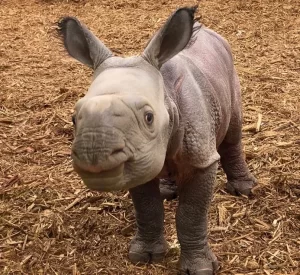
I don’t know why I posted the picture below, except that I love this lady. She makes me smile. And everytime I smile, an angel in my brain gets wings. But she’s also inspiring. She’s fine with her looks and weight. She seems unbothered by the defensive skin she’s covered in. That’s her way. Much of her life may be hard—but in this moment, she doesn’t seem to mind. She just naturally does the next right thing.
And I feel like she loves her mother very much.
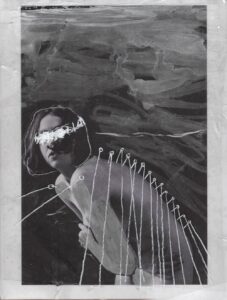
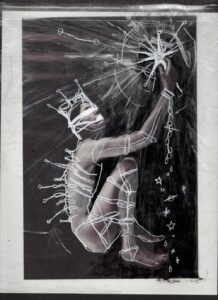 strength, presence, and compassion, something opens. Many of the limitations we face are fear-based, rooted in early childhood trauma or even inherited intergenerationally. Language itself, shaped by culture and survival, may carry trauma. These influences can cause us to shut down in subtle or dramatic ways, shrinking our sense of freedom, openness, and understanding. Love has the power to will open us to the world and so we seek it out. But the fear of losing love keeps us locked into patterns of manipulation and coercion in order to establish a power we have never had. The power is love itself. As soon as it becomes “ours” it becomes limited. When we lock in the love, we also lock in the fear and close ourselves off to understanding.

 These obstacles show up in both our ability to receive love and our willingness to express it. Most often, these blocks are rooted in
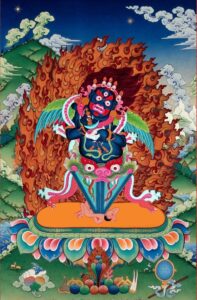
 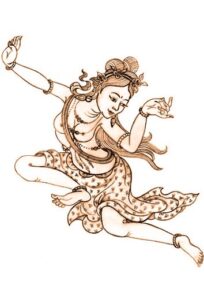 In Tibetan Vajrayana, the deity
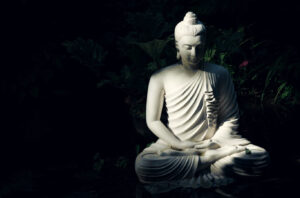
 When Michelangelo was asked how he created his masterpiece, the statue of David, he replied that he did not create David — he simply chipped away everything that was not David. David, he said, was already there, hidden within the stone.
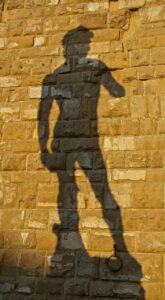 Yet, because our neuroses were originally defensive strategies, they can be met with kindness. They were formed to protect us, and even now, they carry a trace of basic goodness. As we become aware of them, we can acknowledge them with warmth and gradually release them. This doesn’t happen all at once. It requires patience — and acceptance — because these patterns can be embarrassing or even infuriating when they arise. Antagonism only entrenches them. What’s needed is a smile, a light touch.
 The essential self — the one that was always there — begins to shine more clearly.



 We freeze, believe, identify. Then we’re off to the races as we script our story with ourselves as the protagonist, whether it be victim or hero. The more we are triggered, the more our universe feels real. But what’s real is that we are at the center of that universe. This very solid Me rolled from bed into a universe of defeat.
 But, we are part of our world, and so Compassion begins with us. Not exaggerating our self importance and our pain, but activating our empathy. If we settle our heart, mind, and body, we can see past the fog of panic. By simply taking our seat and sitting tall, we access natural wisdom. That’s wisdom, not wisdoom. Not believing the worst, but seeing what there is – everything there is. Like sediment settling in water, clarity dawns. We see what is—not an exaggeration of fear.