Understanding our Mother, Sister and Maiden
When exploring the feminine principle in human experience, we’re not specifically referring to women, but rather using the image of women as a gateway to understanding this essential energy. Everyone possesses both feminine and masculine energies, which together make up the whole integrated human experience.
 Although masculine and feminine are inseparable, we can separate them to examine the distinct qualities each energy entails. The Tao Te Ching posits that the receptive complements and completes the creative. By considering this provisional binary, we can recognize that each of us has both assertive and receptive qualities. As we become more aware of these energies, we can learn to balance them.
Today, we focus on the receptive qualities of feminine energy. Receptive does not mean submissive; it is, in fact, a very powerful energy. In classical Tibetan Buddhism, the feminine is represented by the mother, sister, and maiden. These stages provide entry points to understanding this powerful energy. The mother symbolizes birth and nurturing. Space itself can be seen as feminine, as it contains and gives rise to all things. In some instances, assertive energy is required for creation, but it is always the feminine that nurtures that creation. The creative, assertive energy tends to proclaim itself, often competing with other masculine energies. Consequently, our temporal understanding is often skewed, viewing things predominantly from the masculine perspective.
We have recently lived in a time dominated by masculine energy. However, the masculine is ultimately at the service of the feminine, its mother. This interlocking energy dynamic shows the masculine creative energy dominating other masculine energies to serve the feminine. This has been misunderstood as the masculine choosing, with the feminine in service to it. In our materialistic society, we value things based on monetary concerns. Thus, the male providing money for the family’s safety has been misinterpreted as an act of dominance rather than service. The most important aspect, from a spiritual point of view, is the sacred bond of the family. The feminine gives birth to the family and should be protected by the creative energies within herself, her partner, and society.
 Feminine energy cannot be owned; it is the very nature of the universe. Recent explorations of “dark matter” may be investigating this ancient energy, which existed before light. As all things—past, present, and future—exist in space and the universe, that ancient energy still holds and drives the expansion of the universe. The suggestion is that feminine energy is dark energy, predating creation and birth. Light, as a masculine energy, illuminates the dark, allowing us to perceive it, but the preceding, self-existing condition is feminine. Therefore, light is crucial to the creation of our universe and consciousness, but the darkness of the womb is the primordial state.
From a Tibetan Buddhist perspective, feminine receptive energy should be protected. In our contemporary society, this protection could come from the society, culture, laws, and the world itself, rather than a single male figure. The saying “It takes a village” reflects the importance of a communal nurturing and protection for the creation birthed by the receptive.
 The mother cares for and protects the child on the most intimate level. We can extend this concept to include the creation of any kind—such as art, spirituality, or poetry. Personally, I write my creative work with a feminine voice, as it connects me to the sensitive, delicate part of myself essential for writing. The mother upholds our creative being, giving birth to the creator and nurturing the maturation of that creation. Regardless of societal or personal dynamics, every aspect of reality is connected to the feminine. The mother holds, nurtures, and creates us.
The sister represents the feminine energy that is connected to us at all times, an equal and vital part of our experience. Although we live in a time that favors masculine energy—due to a preference for survival over thriving—feminine energy remains equally important. Acknowledging, accepting, and bonding with the feminine can be seen as a supportive element. When we think of protection, procreation, and health, we might initially evoke strong masculine energy, but often the nurturing, friendly aspect of sisterly feminine energy is more appropriate. While men tend to create linear structures and hierarchies, women often foster horizontal communal energies. Soldiers referring to themselves as a “band of brothers” are describing the essence of sisterhood. This sisterhood involves an egalitarian, communicative, and connective quality. When we bond emotionally with our world, environment, or each other, we express this feminine energy.
The maiden represents the youthful, attractive, and capricious quality of sexual energy. The maiden entices, challenges, and playfully engages the creative. It’s important to stress that we are discussing essential energies, not men and women. The maiden can be represented by the partner in a sexual union who embodies the playful, receptive, and challenging aspect of the relationship. While many relationships have a blend of masculine and feminine qualities, each of us can connect with and invoke this youthful sexuality within us. The mother, sister, and maiden exist concurrently as well as consecutively, both within us and in the energies we invoke in others. Gender fluidity recognizes that regardless of one’s identification, all of us exist on a spectrum of gender possibilities.
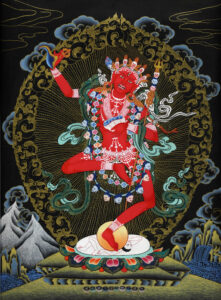
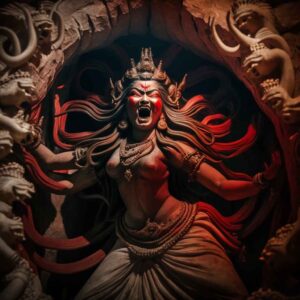
 The maiden is symbolized by the dakini, often depicted in her late teens or early maturity. The dakini’s energy is linked to sexual awakening and discovery, which can sometimes lack compassion. While the dakini entices and softens the creative energy to approach her, she follows a deeper wisdom. Though often depicted as naked, in flames, and dancing in the sky, her connection is to the sacred feminine space of the universe, an energy predating all things. Her energy might seem capricious because she is linked to a higher order or her own feminine clan or community, making her actions incomprehensible to a more rigid, linear, masculine perspective. Thus, the maiden is always one step ahead of comprehension, dancing in flames in space. Though youthful and sexually appealing, the maiden exists within all of us. You can see her in the eyes of an older person in love or feel her in the embrace of someone who pushes you away for no discernible reason. In our male-dominated society, there has been an attempt to dominate and control this capricious energy, but the dakini cannot be controlled or possessed. She can be held, calmed, or tamed, but only provisionally. Like fire, with which she is associated, she warms, enlightens, reveals darker truths, but can also burn and move from one source of fuel to the next.
In Tibetan culture, men were part of a nomadic hunting-gathering system in a harsh environment where vegetation and sustenance were scarce. These communities, particularly in medieval times, were ruled by feminine structures. Sexual bonding between men and women was not permanent; as men often left and didn’t return, the community needed to continue procreating. Mothers ruled the roost and were not obligated to the monogamous structures that contemporary society demands. While the mother and sister energies may bond for life, the early stage energy of the maiden is not intended for such structure. She is an energy of capriciousness, embodying the trickster. This is the transformative energy of falling in love. The word “falling” is crucial here. When we fall in love, we leave behind our hardened positions and embark on a journey of transformation. We become something beyond what we have known and fiercely defended. In this process, we are reborn or recreated.
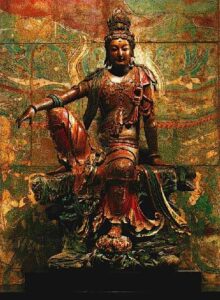 At that point, the dakini may leave us, her purpose fulfilled. Alternatively, this energy may transform into a more sustainable form, like the nurturing energy of the sister, akin to ducks that mate for life, swimming together in balanced harmony. Or it may evolve into the protective energy of the mother, who guides and shelters her brood.
These energies are present everywhere—in the trees, the plants, the wind, and the earth. There is the Goddess of Fire, the Goddess of the Wind, the Goddess of Earth, and the Goddess of the Mind. Most essential is the Goddess of Space, for she is the womb of all creation. Though space can be vast beyond comprehension and even deadly, it is also nurturing, friendly, and inviting. The way to connect with this energy is through gentleness, kindness, patience, and respect. These qualities are accessible to us all, as they are the energies of the goddess within each of us.

 The ideal meditative state—clarity and acceptance—rests on the openness and settledness of the body, heart, and mind. However, life rarely offers us perfect conditions. For me, morning practice often begins with a scattered or resistant mind. The first step, then, is acceptance—meeting the mind as it is and not as I wish it to be.
 Once again, meditation isn’t about fixing; it’s about seeing. The mind of meditation arises in awareness like a point in space. And as the space of awareness is relieved of the pressure to fix itself or chose a side, it remains loving and supportive. It is a state of grace. By stepping into the grace of awareness, we don’t need to force change—we simply allow what we notice to be with us, remembering none of it is as real, solid or urgent as our fear suggests. Trungpa Rinpoche famously wrote, “good, bad, happy, sad – all thoughts vanish like an imprint of a bird in the sky.” Once we release ourselves from the grip of control, we see everything as ephemeral, diaphanous and in dynamic transition. Sakyong Mipham calls this the displaysive activity of mind. All of our worries are the mind revealing itself. Many of our worries are kid fears. And like kids, they need to be loved and accepted, but not always believed.
 In a world filled with endless information and impulses, the idea of simplifying life to a single breath may seem overly reductive, especially in contrast to the overwhelming chaos of our triggered states. And while chaos is part of life these days, perhaps there is a way to navigate this chaos. Instead of trying to control the flood of thoughts and data, we can shift our focus from the mind into action. And we can take that action one step at a time. The question becomes: What is the next right step?
 While it is important to be in the moment, each moment is leading to the next. To make this next authentic action practical, it helps to determine where we are going. If we have a commitment to work for the benefit of all beings then it becomes clear. By “all,” beings we are including ourselves. Helping others at the cost of our own wellness is not truly helpful. So, what is the next step that leads toward helpful engagement with our world? Once we know this, the next step we take is a natural action. By natural we mean not rooted in confusion or external expectation, but what needs to be done for the benefit of everyone, including ourselves. Taking that step will clarify the next step and in so doing reveal the journey ahead. We move toward helpfulness and harmony, and away from reactive patterns that keep us entangled in life’s struggles.
 False binaries dominate our consciousness, good versus evil, left versus right, wonderful versus horrible. We live squeezed between these exaggerations. The Buddha taught that the truth lies not in extremes but in the “middle way.” This teaching urges us to be present in our lives and act rightly in the moment. Similarly, the 12-step traditions speak of “doing the next right thing.” According to the Buddha, the next right step depends on the specific circumstances of the moment. Instead of fabricating extremes, the middle way turns our attention to what’s really happening.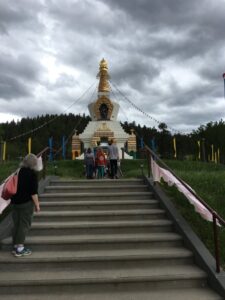
 suffered, and even lost their lives so that the rest of us may live relatively free and open lives. Veterans include not only those who served in the military, but also the families of those who died in service. However, there are many who have sacrificed for the cause of freedom and liberation within our own shores. The first black children integrated into schools, the first students who spoke out against an unjust Vietnam War, and those who currently challenge human participation in climate change, racial violence and societal hatred. With great respect for those who have served our military, I also want to recognize all who have suffered and been wounded in life, yet continue to face the world with courage.
 I started my journey with meditation when I was most confused about how to move forward. Each step forward seemed to be met with a step back—sometimes a frozen moment, sometimes a lashing out, sometimes a dive into extreme tequila to numb the pain of indecision. These may sound like champagne problems—or in my case, a tequila-and-cocaine problem—but it still kept me from fully participating in life. I was always healing, always beginning again, but the object of healing was undefined, so this process only supporting my impairment. It wasn’t until I began looking at the things that were blocking me that I could begin to heal.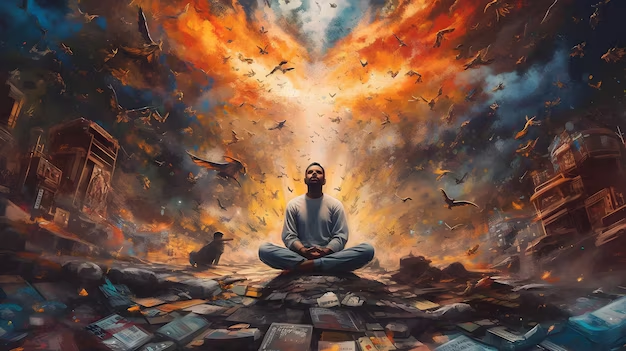

 Facing the possibility of change with an open heart, a strong back and a clear mind is nonviolent warriorship which is the seat of the bodhisattva. Connecting to our inner life force, we find a strength that can lead us forward. Sit down, rise up and meet the change. There is great strength in this. Finding false strength in what everybody else is doing or in reacting to what everyone else is doing, which is the same, are just expressions of being controlled by fear. On the other hand, bravery is sitting in the maelstrom, open and aware, feeling our fear and remaining open and clear. Doing this as a training practice every morning is how we remain spiritually fit and connected to our life.
 Peace is natural to the mind. As a natural state, the cessation of suffering is readily accessible. However, peace is not a fixed state. There is always suffering in our lives, and accepting our suffering is key to finding the peace that is already present. You might say peace is both intermittent and permanent. It is always there, but sometimes it becomes obscured by the tightness and difficulty that suffering induces.
 Finally, the cessation of suffering is both the fruition of the path and a foundational state necessary for any creative endeavor. It is also an ongoing possibility. If we cling to the idea of cessation, we miss the point, turning something intermittent into something perceived as solid—another source of suffering. The possibility of peace is here now, even as we lose it by thinking about it. Peace is a felt sense. It is connecting to a part of our being that has always been there, and according to Buddhist thought, that peace is not diminished or changed by suffering.

 So, let’s break down the components of this elephant. The elephant stands on the notion of a “self“. At some point in human evolution we became conscious. That localized sense of perceiving began to organize itself into an entity that is aware of itself. This allowed us a vantage from which to navigate an otherwise unmanageable sea of possibility. Yet, that navigation comes at the cost of limiting those possibilities. This notion of self is a necessary limitation in order for consciousness to have a reference point. Ego is a further limitation of those possibilities. Ego happens as self-awareness becomes a self-consciousness that assumes itself to be self-existing. This assumption of “me” can become a self-referential closed loop that reduces awareness to specifically localized points of view. The ego works as a set of patterned functions that reduce what we see of the world. We conflate reality down to serviceable quanta which, in turn, are seen as a means to serve our perceived compensatory needs. These perceived needs are generated to compensate for feelings of lack or vulnerability. In other words, we see what we are conditioned to see and generate feelings that prompt reactions. We generally do this all without much investigation.
 The antidote is to stop. Allow a gap. Breathe out. Drop into ourselves and feel ourselves in our body. That is much closer to reality than circular, ego world building. Just drop it. Come home, and be here. This act of self love will allow the elephant to rest. When the elephant rests we can look around and see the world as it is.