True Gratitude

Being Grateful to Everyone

It’s Thanksgiving time. I need to remind myself this time is not only about mashed potatoes and gravy. As delicious as my dinner may be, there is more to my life than hoarding ts goodness. Head down over the plate, shoveling as though someone was chasing me.

Maybe I can try occasionally lifting my head and looking around the table.

Thanksgiving. Giving thanks.

Although, for me, true gratitude is not forced positivity. It is not self-imposed cheer. True Gratitude is a practical way of working with difficult emotions and appreciating the often overlooked goodness of our lives as they are.

If you’re like me, you spend a fair bit of time complaining or trying to fix things in your life. It seems as though my gift of a precious human birth could be made slightly better if only… Maybe fixing the externals will somehow fix me.

But what if I don’t need to be fixed?

And what if my life is fine as it is, simply because it is what it is? Although, I spend more time fidgeting than accepting, gratitude would probably be a much easier way to live. Gratitude is acceptance which seems key to greater understanding. Gratitude reduces the friction between myself and the world. And it turns the mind from problems to the possibilities.

Gratitude is acceptance which, is a requisite for mindful change. In order to change in some awake way, I need my eyes open. Otherwise, I’m just toggling back and forth from one ineffective strategy to another.

And usually the strategies my panicked mind employs have been tried—and failed—many times. The alternative to this constant toggling is to settle down and pay attention to what is here now. I have found my morning gratitude list to be a good way to not only feel better about my life, but also to develop mindfulness. When I’m grateful for something, I am paying attention to it. When I’m grateful, I’m practicing acceptance and understanding.

Acceptance and understanding are the way I translate Maitri and Compassion into a practical format. Maitri, or loving-kindness in contemporary parlance, and compassion, or Karuna in Sanskrit, are the first two of the Four Limitless Ones, a practice of engendering Bodhicitta, or awakened heart/mind. This is a very important practice for me. Maitri is our entry to compassion. We begin with seeing what’s here—regardless of how we might feel about it. And whenever possible, meeting circumstances with a smile.

Frankly, I am not always able to do this. So then I try to meet myself with acceptance. “I can’t deal with this right now.” So I put a pin in it, earmarking it for a time when I have the resilience to meet it with acceptance.

What I try to avoid is encouraging myself to react in an unmindful way. Reactions are my body’s way of defending itself. But my body’s defensive reactivity lacks the awareness to really see my antagonist clearly. Hence, when acceptance is possible, I try to meet the circumstance with wakeful presence. And perhaps a smile for myself.

This is not me agreeing with something harmful. It’s me agreeing to look at what is there.

Compassion is the step where I naturally empathize. Despite the pull of my defensive reactions, I cannot clearly see a situation until I can empathize with my internal or situational antagonist. Not because I agree with the circumstances I’m facing, but so I can better understand how to free myself from the grip of conflicting emotions.

Conflicting emotions, or Kleshas in Sanskrit, are the inner turmoil I feel when I’m triggered. I’m learning to see this as an opportunity for change, not a reason to hide my feelings behind habitual aggression. Granted, sometimes aggression feels warranted. But aggression ultimately gets me nothing but self-inflicted suffering.

The adage, drinking poison hoping that someone else gets sick, comes to mind.

So how can I free myself from the grip of conflicting emotions? Acceptance and understanding. Acceptance is the smile, and understanding is applying love. If I can do this with things that trigger me, I am creating more acceptance and love for myself.

Perhaps this is the meaning behind the Mahayana slogan “Be Grateful to Everyone.” I can be grateful for the good stuff, so I can train my mind away from complaint and appreciate what I have. This practice makes my life a better place to live, and my mind an easier place to work with.

It also helps me build the spiritual resilience to meet negative circumstances with acceptance and understanding. And when I can do this, I feel stronger than the negativity I face. And when that happens, I have more space for appreciation of my life.

Negativity is an opportunity for me to learn more about myself and others. If I can only help myself today, that’s fine. But I can stop hurting myself by allowing negativity to rob me of the joy of the blessings I already have.
The War on Awakening

Some are calling for a “war on woke.” Why are people so threatened by the idea? Admittedly, the term is meant to be provocative, still I can’t help feeling that parts of society harbor an underlying fear of being awake.

What is “waking up”?

Is it seeing past the firewall of self-perception or beyond the structures that govern our lives? If this were the case, then it would certainly be threatening to established structures – especially when those structures have developed to maintain a status quo. While it’s entertaining to throw blind darts toward secret cabals, as meditators we always look to our own mind and psychology.

Shadow governments aside, how are we actually controlling ourselves? What is our experience of hiding behind concepts, ideas and prejudice for safety – often to find a perceived higher ground of judgement?

Stories about awakening and seeing behind the curtain are common themes in literature and movies. From The Matrix, throughout much of science fiction, conspiracy theories and popular culture, we’re fascinated by the trope of our being held at bay by whomever we deem to be holding us. We are being held away from the truth.

Perhaps this dates back to the tree of the knowledge of good and evil in the Garden of Eden. Once Adam and Eve were forbidden to eat the forbidden fruit, a seed—an apple seed, we might say—was planted in their minds. It was only as matter of time. As these were the first people, maybe God was still working things out. But, most of us know that telling someone they can’t do some its a sure way of getting them to do it. gave not In the patriarchal telling, it is the woman who becomes both tempted and temptress, pulling the man from his resolve and toward our demise. Once Eve fell for the snake – and what do you suppose that represents? – and convinced Adam to follow,

Through Eve’s sexual awakening a crack happened in the existential frame of the garden. Allowing perhaps chaos, or maybe light.

Either way everything changed in that instant. And, of course, this is all the lady’s fault. Buddhist scripture offers a striking contrast. In Tibetan Vajrayana, transformative feminine energy is equally disruptive but this fissuring of the conceptual frame—or waking up—is seen as essential to our development of awareness and compassion. This energy is often embodied by the dakini, or “sky dancer,” a beautiful young woman whose role is to seduce people beyond their rigid ideas. Far from blaming the feminine, the tradition exalts her.

There is a wonderful story about Dilgo Khyentse Rinpoche, one of the most revered Tibetan teachers of his time. He stood over six feet tall—“two and a half Tibetans,” as my teacher put it—and in his later years often walked with his hands resting on his attendants’ shoulders.

During a very important empowerment in front of dignitaries, diplomats and students, the great man’s wife burst into the shrine room and began to berate him for some domestic injustice or other. She walked straight toward the shrine, yelling as the ceremony approached its most sacred point. I do not know what had angered her. Dilgo Khyentse simply looked to her and smiled, his face beaming with love.

Years ago, I was driving on an interstate in Maine with my then-partner when the hood of our jalopy came loose and slammed against the windshield. It happened instantly and was literally breathtaking. I managed to reach the shoulder without hitting anything. My heart pounding, I leapt out and began violently ripping the hood from the car, cutting my hands in the process, red-faced and furious.

Then I looked to my partner, a senior Vajrayana teacher and in many ways my teacher, as she stood outside the car that had nearly killed us, laughing. With the same loving gaze I imagine Dilgo Khyentse offering his wife, she said, “We handle surprises entirely differently.”

We cling to our conceptual frameworks with a tenacity that keeps us in the dark, or at least the semi-dark land of habit.

So what is the problem with waking up?

Meditation teachers describe awakening as refining the mind to see beyond constraining frames. Dilgo Khyentse Rinpoche said the only difference between the dreams of sleep and the dream of our ordinary life is duration. Most of us are dreaming most of the time, with only occasional cracks in the facade: a car accident, a breakup, a grave diagnosis.

From the perspective of our attachment to life as we know it, these events are terrible. Yet they may also offer the possibility of awakening—and for a Buddhist, awakening is everything. Even people with deep understanding and strong moral principles still have farther to go if they cannot see beyond those principles toward a truth that helps them communicate with the world as it is. Compassion is communication and communication requires us to look beyond our premises.

What, then, of the war on woke? Some see it as a campaign against chaos. Sometimes it may be. But it may also express a fear of opening the mind and heart to wisdom, to the knowledge of good and evil. Christianity and the Judeo-Christian traditions contain many beautiful, instructive, and transformative elements. Yet, one contrast is that the progenitors of the human race were warned not to look into the mechanism of their existence. Buddhism makes looking its central purpose.

This is not an argument that one tradition is right and the other wrong. It is an illustration: some social structures are designed to preserve order and control; other forces tear open the fabric so that the butterfly can leave the cocoon. The sanest view employs both. We need enough structure to feel secure and to communicate with one another. But when we grip that structure with white-knuckled fury and refuse to let anything new enter, we tighten our eyes and keep ourselves asleep.

Remaining asleep is not as easy as it sounds. We must squint, look away, and actually work not to see.

I imagine that if there were a God, they might point to reality and say, “It has been here all along. Why did you not look? Why did you not see?” Of course, the answer might be, “Because you told us not to.”

But that is another story.

Ultra-conservative movements, including those now exercising power in the government of the country where I live, maintain control by demonizing agents of change. They are agents of fear, fearful themselves and capitalizing on the fears of others. Witches, artists, transformational priestesses, shamans and those who revere nature have long been vilified or struck down for looking beyond established social, political, and religious structures.

You can control a mumbling crowd looking to the ground more than a group of people fostering the power of the earth.

Perhaps because I have attention deficit disorder, I tire quickly of the old tropes used to keep people from thinking. Unexamined stupidity seems to reproduce itself. The real struggle is not against every existing structure. It is against the structures we carry within ourselves by finding the essence of love within. Love allows us to open our eyes. Trungpa Rinpoche said, “Look, look. This is your life. How can you not look?”

To risk a cliché: love is stronger than hate. It may not feel as forceful in the moment as panic or fury, but people who traffic in hate are most likely frightened and insecure. Loving them may be a tall order. Yet refusing to be cowed by their fear—and allowing our own love to develop into empathy—is our transformational imperative.

Holding to beliefs, outrage, or righteous bias with white knuckled fury keeps us from seeing the alternatives around us. We’re using our passion to entirely miss the point.

My indignation about the gross master betas masquerading as strong leaders is understandable, but limited. It keeps me communicating with others in my garden, but not at all with those I wish to influence.

Letting go is the operative action in allowing ourselves to wake up. It’s actually harder to stay asleep. Let go and see the garden, you might say.

So, as Elvis might say, what’s so funny about waking up?

___________

THE IMPROBABILITY OF PURPOSE

Setting an Intention For Our Intention

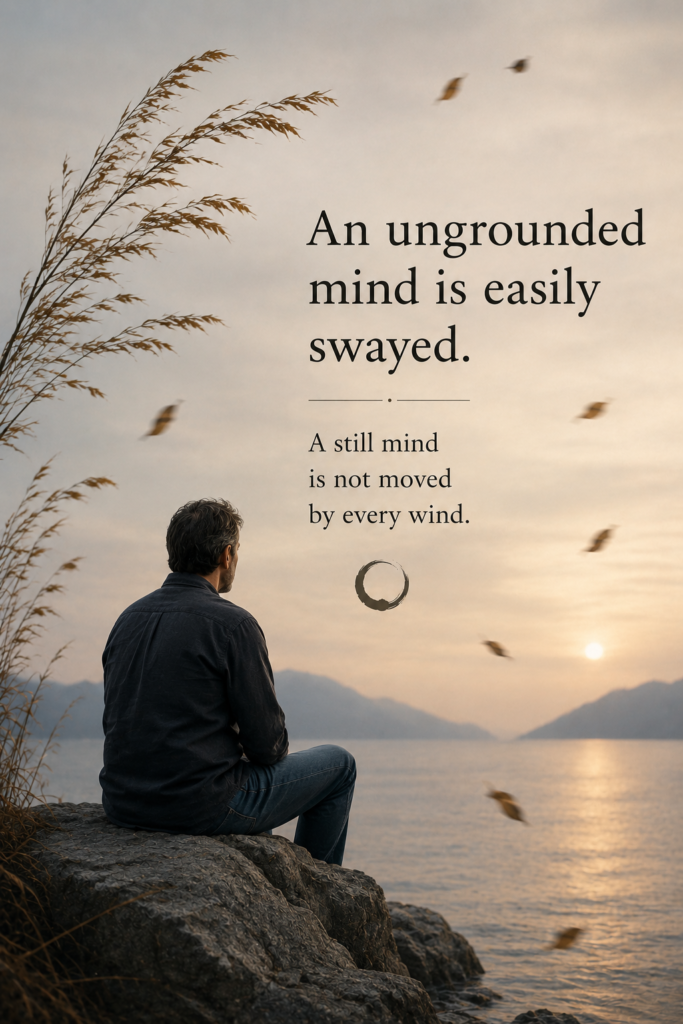
We sometimes find ourselves off course in life. For me this stems from being off course with my mindfulness practice. If I’m not paying attention now, I’m likely not on track down the line. Without mindfulness intentions will to come and go.

Without grounding in Mindfulness successful outcomes are a statistical improbability.

Some of us have very … um … creative minds. Minds that move in many directions simultaneously and wanders back to the point whenever it gets there. Minds that avoid structure like some kids avoid broccoli. You might call this attention deficit hyperactivity disorder. My therapist for instance.

But, our mind is what we have to work with. And I’ve found it rewarding to do the work. To that end mindfulness became very important to me. I had been ashamed of the way my mind didn’t easily conform to social convention. In time, I found my way into the practice by learning that I needn’t force myself into a boxlike arbitrary stillness in order to be present. While my version of present experience might be more fluid than someone else’s both myself and those theoretical someones need to each find our way to working with our minds.

Working with my mind I realized the importance of being present in order to be present in my life. However, I need to find a way to stay present without feeling as though I’m being tied down or forced into someone else’s brain. The truth is, despite years of meditation training, encouraging my mind to rest in the present remains an ongoing practice. It’s less an accomplishment than an application. A daily manual application.

One technique I find helpful is to encourage my mind the time to have my brain feel its way into the present. Not necessarily emotionally. I mean literally feel. Making mindfulness less a mental exercise than an embodied experience. Through repeated practice, presence becomes less something I remember to do and more something my body begins to recognize and remember. Mindfulness in muscle memory, you might say.

This applies throughout the day as it occurs to us. When opening a door, I can feel my hand on the doorknob. Walking across a room, I can feel my feet making contact with the ground. These small moments of embodiment gently interrupt the momentum of distraction and restore a sense of presence. And presence is reassuring. It reminds the fearful part of the brain not to worry because we’re here.

However, it’s not practical to be locked into this. Mindful presence isn’t something we force or hold onto. It is more a place we can return to. We learn to move naturally through our day while remaining grounded in our experience, by coming back as we need to our feet, our hands, our intention.

Until the mind wanders again, that is.

That’s not failure. That’s what minds do. And we can see it as an opportunity to further embed mindfulness into our neuro-stream. In this case we’re embedding full body purpose. The practice is to recognize when we’ve drifted, accept that and remember to return. With patience with our brain we’ll rewire it to recognize, remember, and return. Then our mind can rest more easily where it is placed.

At this point, I should mention that I’m designating our neurological experience its wiring at the “brain” and our ability to establish a purpose in life and experience a spiritual and creative fullness as “mind.” The brain needs to be rewired to remember to return to the tactile present so thye mind can feel calm and clear.

Over time, this embodied mindfulness begins to translate into everyday living. We don’t have to meditate every waking moment. We simply touch base from time to time by reconnecting with the body in throughout our daily life. Lifting our head from the laptop. Feeling our feet in the earth. Remember we’re human and need encouragement as well as purpose.

I’m referring to this as applied intermittent mindfulness. Or, you might say AIM. And the AIM is to flowing through life with ease. Therefore, just as we are seated in our experience, we can be seated in our purpose. You see, the qualities of unconvention make it easy to drift astray for our purpose. How often do we wake up as if out of a dream wondering, as David Byrne notable asked “how did I get here? … Is this my beautiful life?

Our intentions, no matter how noble, are surprisingly fickle when they exist only as thoughts. We think we can do it. Hahaha the “road to hell” and all that. One reason why we can’t keep on track, go off the diet, or forget to get to the meditation cushion is that it’s only an idea. And an idea without a corresponding action is just a thought. If our intentions are only thinking, no matter how well intended, they will change.

Our intentions become reliable when they’re more deeply rooted in the body. Feeling the breath, the feet, the hands, even for a few seconds, gives our purpose somewhere to land. Instead of chasing lofty ideals, we inhabit them. Mind, body, and intention begin working together, and our aspirations become less theoretical and more lived.

We don’t simply intend to be present, compassionate, or wise—we embody those qualities, grounded in one ordinary moment at a time.

In that way, we build a mindful life.

That Perfect Moment

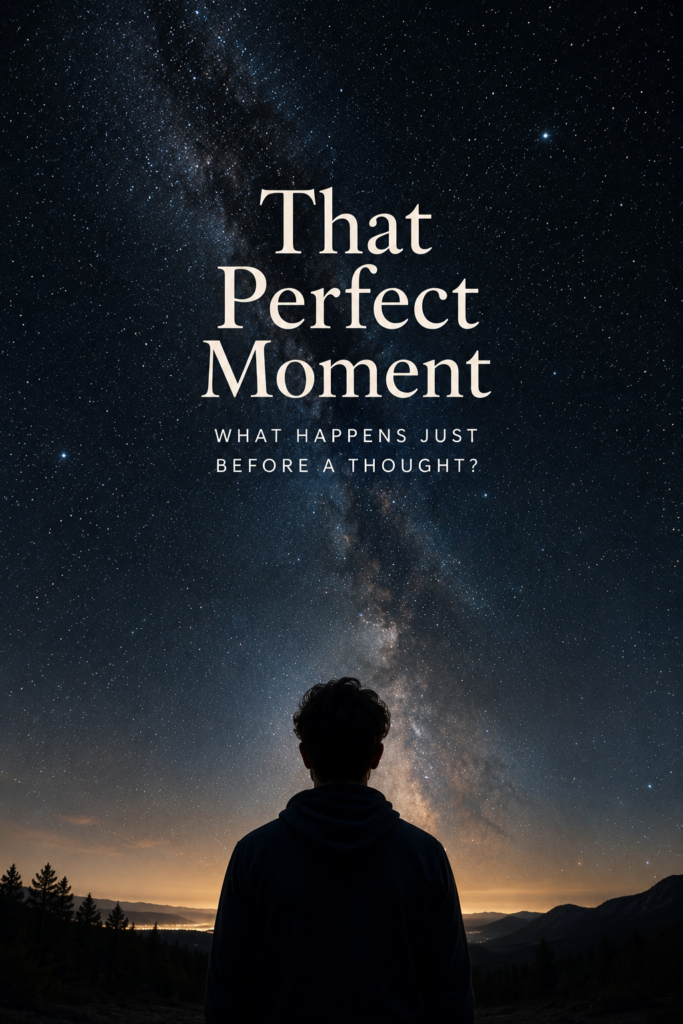
What happens before a thought?

Is there an instance of space that opens? Before we fill it with a cognition? Before we decide what this moment means? Before the notion of “me” arises again? Maybe in this perfect moment of open space anything and everything is possible.

I wonder whether the birth of a thought is analogous to the birth of the universe. What happened in that impossible moment preceding the Big Bang? Was there a perfect stillness before everything burst into being? Or is that simply another story our minds tell because we cannot imagine beginnings without a “before”?

And is it even possible to reduce our thinking to a singular thought, or reduce the birth of our universe to a singular event. Neither is likely true. Thoughts arise in astonishing succession, perhaps even simultaneously, from different regions of our mind. We notice one. We cling to one. Or perhaps, one chooses us and carries us away into its narrative.

Maybe the universe is no different. Perhaps there are countless beginnings happening all the time. Countless worlds appearing and disappearing, all interacting.

We act as though what we are thinking has always been here and will always remain. Once a thought captures our attention, it suddenly feels solid. Real. Obvious. We stop seeing it as an event occurring in consciousness and begin treating it as reality itself.

The cosmologist Jenna Levin suggests that labeling something “infinite” is intellectually lazy. To declare something infinite may simply mean we’ve reached the edge of our understanding. We’ve stopped asking what might be after we’ve reached our cognitive event horizon.

Perhaps our attempts to find an edge to the universe is an attempt to map the extent of what we know. Once we’ve defined a conceptual edge – or determined that there is no edge – we are trying to define it. To hold it. To accept it as a given. To make it something we can inhabit.

Perhaps we do the same with our thoughts. Rather than investigating them, we crown them with permanence. We believe them. We inhabit them. We defend them. We mistake them for truth rather than recognizing them as temporary appearances arising in the universe of awareness.

One anxious thought becomes my anxiety. One political opinion becomes what I stand for. One heartbreak and my life is over. Before long, we’ve constructed a reality around something that, moments earlier, did not exist.

Meditation can show a snapshot of this process. And that snapshot might offer a glimpse of freedom from it. You see, believing our thoughts disables our ability to see them as thoughts. This is a form of imprisonment because it locks us into living and reliving only what we already know. As comforting as this is, it comes at the expense of everything else we might become.

If we sit quietly and follow the “prime directive” – which is to notice what arises without interference, such as judgement, desire, preference, et al. We will see that thoughts don’t actually arrive in a neat line. They bubble up from nowhere, overlap, interrupt one another, disappear without resolution, and occasionally dissolve before they’ve fully formed. Sometimes there is the faintest glimmer of gap—a tiny opening before the machinery of interpretation begins again.

Gap is intriguing. It is almost impossible to catch. Yet it opens the door to everything that isn’t a thought. Which is to say, everything else. The moment we recognize the gap, another thought has already arrived to congratulate itself for finding it. This kind of mental selfie interrupts the prime directive and invites us to believe what we are thinking. And believing is not seeing.

Perhaps that’s why contemplative traditions place so much value on resting in awareness rather than chasing thoughts. Not because thoughts are bad, but because they are astonishingly persuasive. Every one arrives announcing itself as reality.

And every one eventually disappears.

So, perhaps with meditation we are stepping back and gaining a perspective. What gives us perspective is space. Gap is a glimpse into opened undefined space. In time, singular moments of gap become perspective from which we can see without believing or interfering.

Maybe the “perfect moment” isn’t something mystical waiting somewhere outside ourselves. Maybe it is simply that immeasurably brief instant before experience hardens into certainty. Before we decide what this is, what it means, who we are, or what comes next.

Not because certainty is wrong.

But because that tiny opening reminds us that things are not solid, or defined by the limit of our understanding. Reality is alive. Much of it is beyond our understanding, but that should not stop us from looking. If we release ourselves from beliefs, from hopes and fears, from right and wrong, we may accept what’s there. Not agreeing or disagreeing, just seeing. Seeing everything we see whether we see it or not.

Our universe—whether out there among the galaxies or in here among our thoughts—is not a finished object but an ongoing event. And remembering that every thought, no matter how convincing, came from, and will return to, that perfect moment of gap where everything is possible.