
IT’S BEEN HERE ALL ALONG
In meditation today, I noticed myself trying to push my mind toward where I thought it should be. This morning my mind most certainly did not comply. As my focus wavered, ancillary stories began to surface — aging, memory, the need for better sleep. I started vetting strategies like caffeine or ginkgo. None of this was meditation. Then it struck me: my meditation had become an attempt to “fix” my mind. Rather than simply seeing it as it is I was trying to change it. By stepping back and letting go of the pressure to fix, I allowed myself the space to simply see.
 The ideal meditative state—clarity and acceptance—rests on the openness and settledness of the body, heart, and mind. However, life rarely offers us perfect conditions. For me, morning practice often begins with a scattered or resistant mind. The first step, then, is acceptance—meeting the mind as it is and not as I wish it to be.
Acceptance begins with recognition. We notice the mind’s current state— distracted, cloudy, resistant, or grumpy— and then acknowledge what we meet without judgment. This allows us to step away from struggle to control anything. We open the door to meet our mind as it is. Instead of ego’splaining we listen. This acceptance is an act of love. We are opening our mind to accept ourselves in this very moment. Once we accept, synchronization naturally follows. This isn’t something forced but rather a harmonious alignment that arises when we stop struggling and simply allow things to be.
Miraculously, we find ourselves in meditation.
From synchronization grows wisdom. Wisdom sees a larger process unfolding: the mind observing itself, guiding itself, and offering comfort and love to its own experience. Wisdom understands that all states of mind, even those we perceive as negative or incorrect, have value simply because they are part of us. Awareness embraces the distracted, discouraged, angry mind as colors in the painting of the present.
When we are frightened, our mind tightens in defence. When the mind tightens, it reduces what is sees to binaries such as good and evil, right or wrong. Thus triggered, the mind sections itself in order to reduce the landscape of reality into that which is controllable. Although rarely helpful, this narrowing is a natural process we need not fight. But if we don’t buy into the game, and simply listen or see, we connect to the space around the event. This allows the wisdom of awareness to resolve the binary. Wisdom never chooses a side as it holds the entire picture. Wisdom isn’t the opposite of confusion—it’s the space that contains it. This spaciousness lets us recognize, accept, synchronize, and ultimately return to the present, using tools like the breath or an object of focus with a light, precise touch. In this way, the mind naturally meets itself. And it will quite naturally allow itself to develop toward further awareness.
 Once again, meditation isn’t about fixing; it’s about seeing. The mind of meditation arises in awareness like a point in space. And as the space of awareness is relieved of the pressure to fix itself or chose a side, it remains loving and supportive. It is a state of grace. By stepping into the grace of awareness, we don’t need to force change—we simply allow what we notice to be with us, remembering none of it is as real, solid or urgent as our fear suggests. Trungpa Rinpoche famously wrote, “good, bad, happy, sad – all thoughts vanish like an imprint of a bird in the sky.” Once we release ourselves from the grip of control, we see everything as ephemeral, diaphanous and in dynamic transition. Sakyong Mipham calls this the displaysive activity of mind. All of our worries are the mind revealing itself. Many of our worries are kid fears. And like kids, they need to be loved and accepted, but not always believed.
Meeting our mind is meeting our oldest ally. It’s been with us longer than any relationship we’ve had. Accepting it with the loving space of awareness we see its many colors and configurations. Sometimes it displays in black and white, and sometimes it opens into a rainbow painting. When we return to present awareness, we are in a point in space where the colors of life become clear.
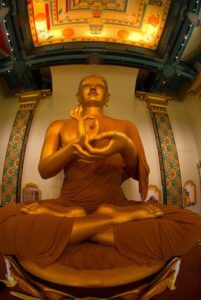
 As well, we also remember the passing of David lynch the great auteur who was deeply dedicated to meditation. His children recommended that a perfect way to commemorate their father would be for the world to meditate today. So today we bring it back home to remembering those who have come before, our meditation practice, who we are, why we are here and what we can do to help bring love and sanity to our world.
 Ego which can be seen as the very limited defensive nature of the mind, serves to reduce our world to a controllable space. Its logical extension is the propagation of surety, dogma and doctrine. The opposite of ignorance(ma-Rigpa) is knowing (Rigpa), and therefore, egoless being is sees and knows what is happening. And it always has. This is Buddha Nature – our natural state. Because it is accepting reality as it is, it is not at war. Thus, Buddha Nature is said to be indestructible. It has never changed. It is the life of the universe and the very life around us. And though our lives will pass into other configurations, our essential nature is said to be part of all of nature. Ego clings to temporal things in order for us to believe that temporary things give us solace and sustenance. We can squint our eyes and believe what we are happy but, inside us, we know that happiness is immaterial. Material things are “like a banquet before the executioner leads us to our death.” Revenge, retribution, and displays of grandiosity masquerading as leadership are fleeting and meaningless. They are basically good, because they are there. But they are expressions of ego and ultimately fleeting.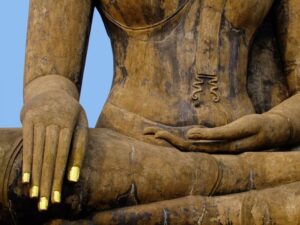
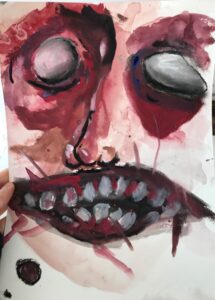 Physical pain awakens us to the possibility of danger or a need to heal. While few of us like pain, it serves a vital function. Some p
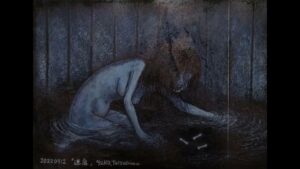 There is nothing wrong with fantasies until they take the place of actual engagement in life. Fantasies allow us to journey into edgy realms with no real investment. By imagining pleasures of the flesh, we have no actual skin in the game. (Yes, bad pun intended.) We can live out fantasies at will in apparent safety. However, as they serve an important creative function, it may be that fantasizing only supports the solitude that allows wounds to fester. Sometimes we analogously recreate the actual wounding we are otherwise unable to look at directly. People may act out abuse sexually by entering a “play space” that is an active dissociation of their primary personality. The “play-space” is a safe space people can act out being unsafe. And whether this is working through their deep wounds or reinforcing them is unclear.
 The present moment rests between the past and the future. Specifically, how we could protect ourselves from this situation or how we can enact laws to protect our community in the future. Or, going deeply into the causes and conditions of what happened to us might lie in the past. Either of these examples might be helpful, but they are more the province of therapy. Meditation looks at what is happening now. That is what we mean by the light. Many of us were wounded so deeply in the past that there is little possibility of contacting the source of that suffering. But we can feel their effect right now if we remain conscious. And as we become more and more conscious of that which lies within us, we become more and more whole.
 adjacent worries, recrimination and judgment. For instance, there is drilling happening not far from my apartment. It’s annoying and incessant. I’m here having to work on a post about creating peace with this going on in the background. It becomes especially painful when the background becomes the foreground, as is happening now as I’m referring to it. However in the course of writing, I’ll refocus on my work and forget the noise. This cessation of suffering comes and goes and yet the drilling is continuing unabated. Sometimes I’m aware and sometimes not. Each time I’m aware of the drill I forget all about the periods of relative peace. It seems this drilling has been going on my entire life and will continue forever. I cannot help but take this personally.
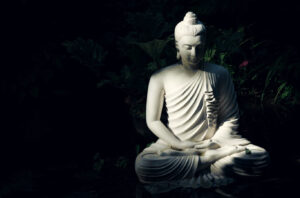 to create a gap between input and impulse, which serves as a mote or buffer of aware space. Whether we are triggered by someone else, or drilling outside the window, all instigating impulses happen in our mind. When the mind builds it cocoon it compounds itself into a hall of mirrors. Turning the attention from this brain constipation toward the aerobic movement of breathing interrupts the process and allows the claustrophobia to abate. When we turn our attention from the overwhelmed brain to the body breathing, we go return to something grounding. And while simple awareness of the breath may seem inadequate to address how impacted we feel, it actually creates a gap that allows the mind more clarity to see clearly.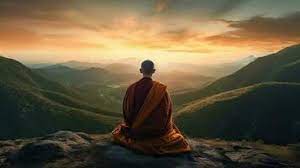
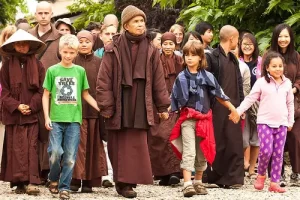 In a world filled with endless information and impulses, the idea of simplifying life to a single breath may seem overly reductive, especially in contrast to the overwhelming chaos of our triggered states. And while chaos is part of life these days, perhaps there is a way to navigate this chaos. Instead of trying to control the flood of thoughts and data, we can shift our focus from the mind into action. And we can take that action one step at a time. The question becomes: What is the next right step?
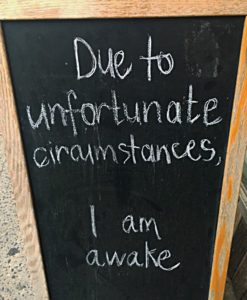 While it is important to be in the moment, each moment is leading to the next. To make this next authentic action practical, it helps to determine where we are going. If we have a commitment to work for the benefit of all beings then it becomes clear. By “all,” beings we are including ourselves. Helping others at the cost of our own wellness is not truly helpful. So, what is the next step that leads toward helpful engagement with our world? Once we know this, the next step we take is a natural action. By natural we mean not rooted in confusion or external expectation, but what needs to be done for the benefit of everyone, including ourselves. Taking that step will clarify the next step and in so doing reveal the journey ahead. We move toward helpfulness and harmony, and away from reactive patterns that keep us entangled in life’s struggles.
 holidays are often described as loving and warm, but it can also feel cold and threatening.
 False binaries dominate our consciousness, good versus evil, left versus right, wonderful versus horrible. We live squeezed between these exaggerations. The Buddha taught that the truth lies not in extremes but in the “middle way.” This teaching urges us to be present in our lives and act rightly in the moment. Similarly, the 12-step traditions speak of “doing the next right thing.” According to the Buddha, the next right step depends on the specific circumstances of the moment. Instead of fabricating extremes, the middle way turns our attention to what’s really happening.
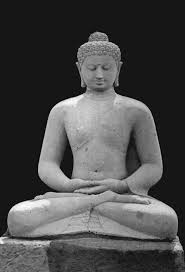 Therefore, distinguishing pain from suffering is key. It is said that pain is inevitable, while suffering is optional. Pain may accompany growth or even be necessary for it. Working through pain brings physical strength and emotional maturity. However, our interpretation of pain often complicates our view and tension amplifies it into suffering. We take pain personally, becoming entangled in hypotheticals, judgment, and resentment. Instead of meeting pain, as it is, in order to work with it, we struggle against it, giving it power over us. This creates great Suffering. Yet, since suffering is optional, it can be addressed and reduced.
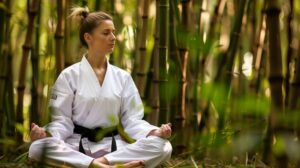 But this talk is not about back pain. This talk is also about our mental and emotional health and how with meditation we are retraining the mind away from reflexive reactions so we have a way of working with pain that allows us to gain mastery over suffering. The title of this talk is “Sit Down and Rise Up.” Or, maybe “Rise Up and Sit Down” depending on its whim. By sitting down and connecting to the earth, we ground ourselves in the present. With practice, we grow comfortable with our own presence and begin to connect to our innate dignity, confidence, and well-being. Rising up in a gently uplifted posture lengthens the spine, creating space for tension to release and openness to dawn. With practice we become confident with openness. Openness, in turn, engenders more confidence in not just our spirit, but our body. With practice we become familiar with the warrior’s seat, and are able to return to it.
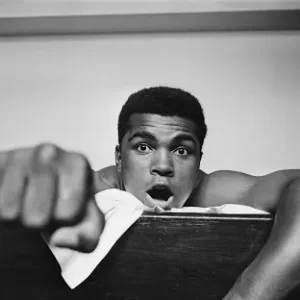 For example, Muhammad Ali trained himself to relax and release tension when struck by an opponent, by famously using the “rope-a-dope” strategy. By leaning back on the ropes, dancing and smiling, not only replenished his energy, but seriously disheartened his opponents. When balanced, he faced the moment rather than retreating, demonstrating mastery over both his body and mind.