
Gaining Mastery Over Our Suffering: the Courage to Face Our Pain
I would like to address rising up and facing our pain as a way of navigating a life of turmoil and challenge. This is not to over dramatize life’s difficulties or to define ourselves by pain. Rather, by facing what is truly happening, we can minimize the suffering in order to work with the pain.
 Therefore, distinguishing pain from suffering is key. It is said that pain is inevitable, while suffering is optional. Pain may accompany growth or even be necessary for it. Working through pain brings physical strength and emotional maturity. However, our interpretation of pain often complicates our view and tension amplifies it into suffering. We take pain personally, becoming entangled in hypotheticals, judgment, and resentment. Instead of meeting pain, as it is, in order to work with it, we struggle against it, giving it power over us. This creates great Suffering. Yet, since suffering is optional, it can be addressed and reduced.
The point isn’t to get rid of the pain. The point is to reduce the suffering we create, so we can address the pain. As we age, when our back hurts its natural and not aimed at us personally. Yet thoughts of how we hate aging, fears of what might come or how we might need to change what is happening and how the government might be implicated in any of it are not helpful. I have found that when I experience back pain, I reflexively curl away from it contorting my body into an unhealthy shape. This supports the disability and promotes a mindset of suffering. Instead of running away from the pain, I’ve learned to lean in to it remembering to breathe and gently ease up past the pain, into my best posture. This is not about pushing into the pain in damaging and dangerous ways. It’s about feeling into it and gently moving past it to a posture of authority. This actually helps diminish the pain and release the suffering we create because of it. I have found that gentle persistence toward regaining somatic authority is possible. I don’t have to be owned by my pain. I can learn to live with it, and even learn from it. And in this way, I can limit the suffering I create in frustration of the inevitable. Frustration is an easy out when we’re in pain, but it is not helpful to healing. Kindness, ease and awareness are essential for us to support ourselves.
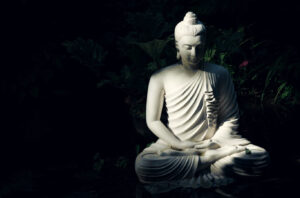
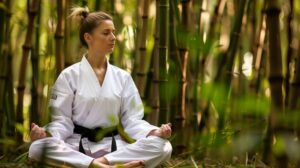 But this talk is not about back pain. This talk is also about our mental and emotional health and how with meditation we are retraining the mind away from reflexive reactions so we have a way of working with pain that allows us to gain mastery over suffering. The title of this talk is “Sit Down and Rise Up.” Or, maybe “Rise Up and Sit Down” depending on its whim. By sitting down and connecting to the earth, we ground ourselves in the present. With practice, we grow comfortable with our own presence and begin to connect to our innate dignity, confidence, and well-being. Rising up in a gently uplifted posture lengthens the spine, creating space for tension to release and openness to dawn. With practice we become confident with openness. Openness, in turn, engenders more confidence in not just our spirit, but our body. With practice we become familiar with the warrior’s seat, and are able to return to it.
Our body and mind are sometimes in cahoots with suffering. The mind might attach to a darkness and the body might tighten in reaction. For instance, defensiveness often triggers a somatic constriction, arrogance has its puffed up posture, and depression is a collapse of body and mind. These physical and mental reactions to fear happen so quickly they feel inevitable. We assume it’s natural to collapse when sad, shiver when cold, or tense up when threatened. But these responses do not protect us, in fact they often amplify the pain, or support the disfunction causing it. Ironically, the tension we instinctively adopt when we feel threatened is entirely counterproductive. Tension reduces the body’s ability to respond and it clouds the mind. No martial arts teacher trains students to be tense, frightened, or defensive. Instead, they are trained to be relaxed and open, ready to respond to what is happening. In life, what is happening is not always what we think. The only reliable defense to an unpredictable world is to pay attention. And paying attention requires relaxation and confidence.
Training the mind to pause when threatened and turn its attention to the body allows us awareness in the present. And, if a threat is real, awareness is our best defence. Therefor the base point of this journey is a relaxed body, open heart, and clear mind. With meditation practice, we repeatedly return to this base point with the breath, teaching our body, emotions, and mind to learn to return to our base point in real-life situations. This posture becomes our command position, where we see more clearly and face challenges with calm strength.
Seeing clearly requires moving beyond judgment-based biases, which are often projections of past wounds. Judgment is a reflexive defense that distances us from the present, limiting clarity and effective action. Instead, we synchronize the mind with the body, breathing through fear until we can assess the situation clearly. Assessment, unlike judgment, is simple and self-reflective. It acknowledges fear without blame and responds thoughtfully.
This principle is critical for martial artists, who remain present and open rather than reactive. In contrast, action movies often glorify revenge or hatred as motivation, creating a satisfying but false narrative. Real strength lies in remaining open and responsive, not closed off by anger or fear.
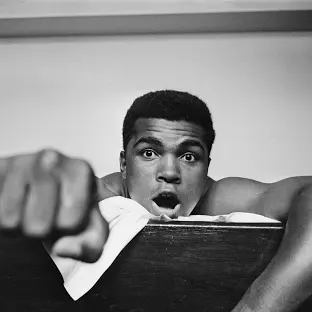
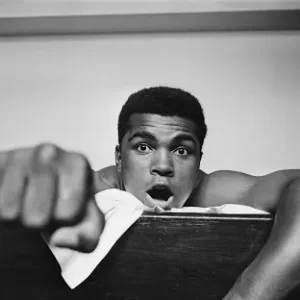 For example, Muhammad Ali trained himself to relax and release tension when struck by an opponent, by famously using the “rope-a-dope” strategy. By leaning back on the ropes, dancing and smiling, not only replenished his energy, but seriously disheartened his opponents. When balanced, he faced the moment rather than retreating, demonstrating mastery over both his body and mind.
Rising up to meet the moment—rather than defeating or escaping it—is a better way to defend ourselves and face life’s challenges. This openness, practiced over time, resonates with even the most fearful parts of our minds. Meeting obstacles with awareness, we align the body, mind, and spirit to face the outer and inner challenges of life. Even adopting an upright posture for two minutes can produce confidence-enhancing hormones, reinforcing our sense of agency over a situation.
Once we learn to rise to pain, we no longer allow fear, anger, or pain to cower us. This reduces suffering, confusion, and mental conflict. It’s as though we rise up and shake off the baggage we once thought was protecting us. Sitting down to rise up is the warrior’s proclamation—a way to cultivate gentleness toward ourselves, which translates into effectiveness in the world.
Living fearlessly does not mean living without fear. True fearlessness is the ability to look at fear and see it as an ally.
 On the flip side, sometimes we place so much pressure on the present moment that we take it too personally, making things harder for ourselves and others. The present is just a blip in our flow—we meet the moment and move on. But when we hit a snag, it can occupy much more of our time and energy than is helpful. If we could retrain our minds to notice and let go, we might see difficulties as opportunities to learn who we are and how we behave, freeing ourselves from the habitual patterns that keep us stuck.
 I once dated an astrologer who, after reading our charts, told me we had a rare but perfect astrological conflict called the “heartbreak clash.” It seemed insurmountable, and everything we read suggested it was impossible to overcome. But along with the clash came an undeniable attraction. We felt drawn to the conflict, as if we had to overcome it. “I always go for damaged angels” or “every partner I choose is the wrong one”—maybe we’re all damaged angels, and there’s no such thing as a “wrong” partner. Maybe there are only partners who push the right buttons to unlock parts of us.
 But the other person isn’t directly touching our wounds; they’re triggering the defenses we’ve placed around them. More importantly, we’re not seeing our wounds; we’re seeing them through the lens of our defenses. The easy way out is to blame—to fixate on the other person, diverting attention from ourselves. This blocks our ability to learn. Another shortcut is judgment: believing the other person is wrong by some standard. But what does that really mean? By whose standards? Humans notoriously adjust ethical scales to serve their own self-interest. We can quote the Bible, the Buddha, or any law book to justify our point, but all we’re really doing is hiding our fear of what lies beneath.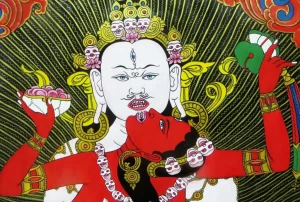
 Facing the possibility of change with an open heart, a strong back and a clear mind is nonviolent warriorship which is the seat of the bodhisattva. Connecting to our inner life force, we find a strength that can lead us forward. Sit down, rise up and meet the change. There is great strength in this. Finding false strength in what everybody else is doing or in reacting to what everyone else is doing, which is the same, are just expressions of being controlled by fear. On the other hand, bravery is sitting in the maelstrom, open and aware, feeling our fear and remaining open and clear. Doing this as a training practice every morning is how we remain spiritually fit and connected to our life.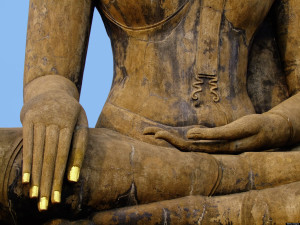
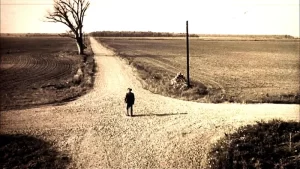
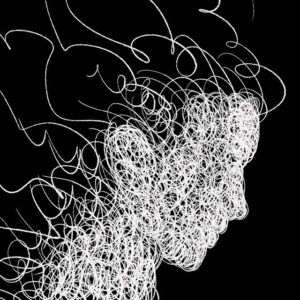 This enhancement of memory served our defensive systems well, allowing us to predict future events based on past experience. Early mammals developed the ability to remember dangerous or painful situations in order to avoid them in the future. Humans evolved to build on this by not only remembering danger but also transferring knowledge from one situation to another, improving our ability to evade risks.
 In those days, particularly in New York City, baseball inspired a sense of loyalty, camaraderie and courage. In a memory burnished into the hearts of sports lovers forever, Babe Ruth famously pointed to where he intended to hit a home run in a 1932 World Series —and then did just that. This kind of magic requires immense courage, but not aggressive courage. It’s a courage that comes from the heart. The root of the word “courage” is cor, which means “heart” in Latin and has similar meanings in French and Old English. So, to have courage is to have heart. It’s a joyful bravery that arises from deep within us, overcoming doubt and confusion. If Babe Ruth had been uncertain, he wouldn’t have been able to point to that spot with such confidence. Confidence, courage, heart—these are the topics of today’s post.
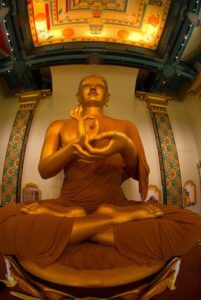 On a personal level, many of us close down our hearts under a false sense of bravery to focus on issues. We seek approval from others, rallying friends who will uncritically support our views, reinforcing our grievances against those we believe have wronged us. While this may create a temporary swell of approval, it is ultimately hollow and fleeting, leaving us feeling manipulated. This might not feel like aggression; it could feel like passion for a cause. Yet, in such moments, we often fall into the trap of preaching rather than sharing something personal.
 In the Dharma Junkies weekly group, we encourage people to speak from an “I” position, expressing how they feel. This approach makes their expressions inviolable, as no one can argue with one’s feelings. We take ownership of our emotions without expecting others to validate them. Equally, we create space for each person to share their own truth, free from argumentation, allowing their truths to resonate with others. This space is a show of respect.

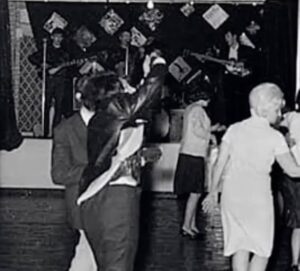 I sadly never got out of my head long enough to let my heart into the equation but maybe it happened at some point. It wasn’t until years later when meditation gave me the courage to allow vulnerability. But, whether it was groping on a high school dance floor, fumbling in the back seat, or sitting on the meditation cushion, the moment of frailty when we “fall” is an important step in our spiritual journey.
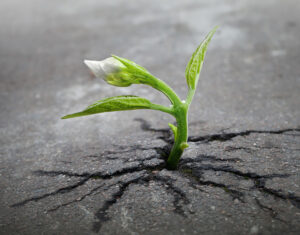 Contacting love in our life is possible if we are free of the turmoil that often occupies our mind. Sometimes this happens accidentally, as when something startles us and stops our mind. Sometimes it happens when our mind naturally notices a flower or bird that opens our mind.
  Compassion is natural to all life. But so is danger. Much of life does what it can to sustain itself and focuses its cellular attention on living, growing and providing, serene in its unknowing. Most life is a natural and necessary part of the dance of the planet. But, the greatest danger to the balance of life comes from the only part of the planet that sees itself. The one who’s acidic stomach is gurgling as it watches the rabbit hop merrily into the wooded shadows. The greatest danger lies within. This is as true of ourselves and our societies. This is the greatest danger because it is the one unseen. We are so attuned to the danger around us, we lie in vulnerable ignorance of the aggression we cause ourselves and others. It is the work of compassion practice to help us reprogram the mind to balance the openness of loving moments with the truth of the dangers in life. We do this by de-emphasizing the importance of ourselves to ourselves that is clouding the picture. THis is not to say that we are not important. We are just not as important enough to suck the air out of life. Humans are a little like drunken blowhards going on about their workout routine at a party. SIr Harold Pinter wrote a play called “The Party” in which a group of haute society people revelled in their intrigues and drama while occasionally, we have seemingly inconsequential references to turmoil in the streets. By play’s end it is clear the turmoil is a violent revolution that will end everything they know.