TURNING THE MIND FROM SAMSARA

Understanding the Grand Cycle of Suffering

Today I want to talk about samsara—a word many of us know, although, unless we are discussing the designer fragrance, most of us do not entirely understand it.

To be honest, few of us understand the fragrance either.

Samsara is a Sanskrit term shared by several Indian religious traditions, though they do not all understand liberation in the same way. In Buddhism, it is the uncontrolled cycle of birth, death, and rebirth, propelled by karma and ignorance. Tibetan Vajrayana Buddhism particularly emphasizes transformation and teaches that awakening is possible—even within this lifetime—through sustained practice.

But samsara means more than moving through a succession of lives. It also describes the dissatisfaction we experience from moment to moment: wanting something, getting it, feeling satisfied briefly, and then discovering that the satisfaction does not last.

In this practical sense, samsara is not merely a place we inhabit. It is a process we continually help create. Thoughts condition actions, and actions have consequences. By becoming aware of that process, we can ask: What are we creating right now? Are we reinforcing suffering, or moving toward liberation?

Buddhism teaches that conditioned existence is pervaded by dukkha—a word often translated as suffering, but which also includes dissatisfaction and instability. Its cause is not simply attachment to material things. We cling to possessions, but also to pleasure, identity, opinions, relationships, status, and our preferred image of ourselves. Because all conditioned things are impermanent, our efforts to make them permanently secure must eventually fail.

We find ourselves grasping at straws while being tossed about in the torrent of life.

At the root of this process is ignorance, particularly our mistaken sense of a permanent, independent, unchanging self. Like all beings, we are changing and dependent upon countless causes and conditions. Yet, believing that the self must be protected or completed, we grasp at what pleases us and push away what threatens us.

Ignorance, attachment, and aversion are called the three poisons because they keep suffering in motion.

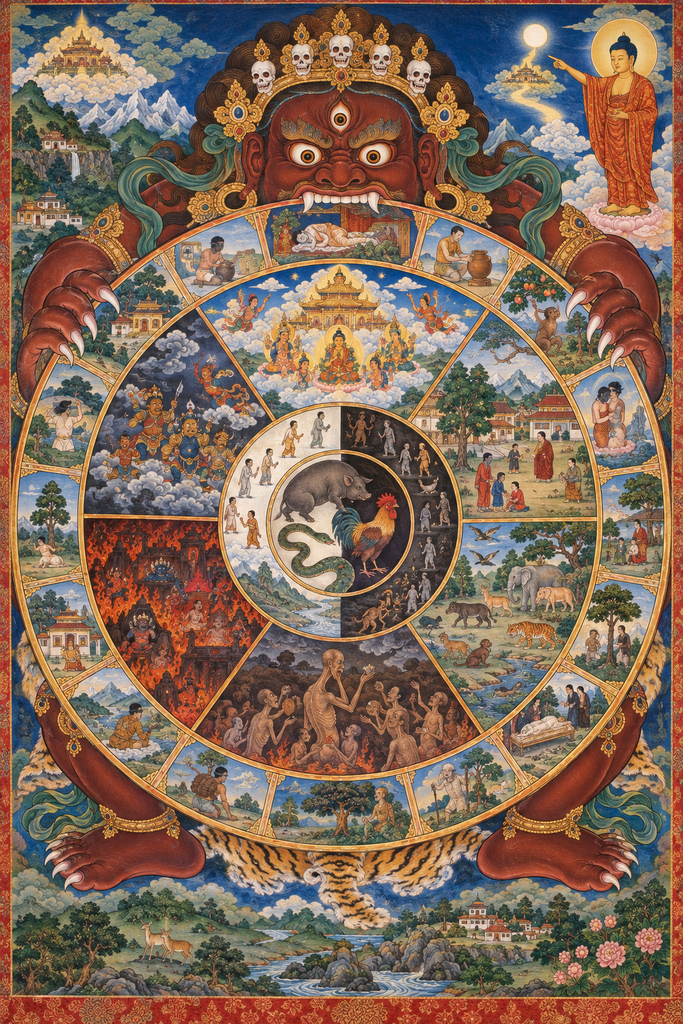
Tibetan Buddhist art makes this process visible in the Wheel of Life. At its center are a pig, a rooster, and a snake, representing ignorance, attachment, and aversion. Around them appear the six realms of samsaric existence: gods, jealous gods, human beings, animals, hungry ghosts, and hell beings.

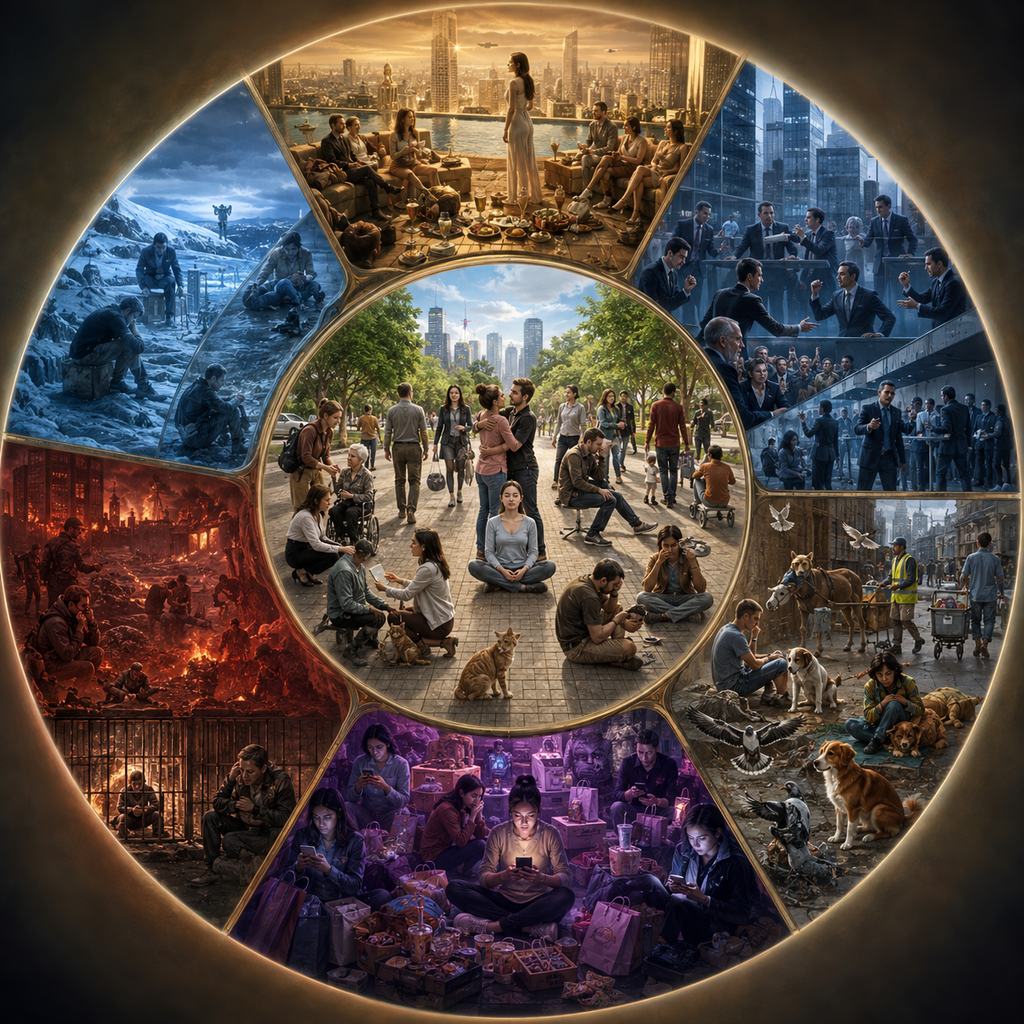
Traditionally, these are realms of rebirth. They can also help us recognize recurring psychological states. When pleasure intoxicates us and we forget it will end, we resemble beings in the god realm. When comparison and competition consume us, we enter the realm of the jealous gods. When desire becomes an unfillable hunger, we become like hungry ghosts. Rage and torment resemble a hell realm, while confusion and habitual behavior recall the animal realm.

Human life contains suffering too, but Buddhism regards it as especially precious. We possess enough dissatisfaction to seek freedom, yet enough opportunity and intelligence to practice.

Samsara is not a punishment imposed by a divine judge. It arises through causes and conditions. Our intentional actions—our karma—shape our habits, perceptions, and future experience. Karma is therefore less like fate than momentum.

That is what makes the Buddhist message hopeful. If suffering arises from causes, changing those causes can change the result. The wheel is powerful, but it is not inevitable.

Liberation from samsara is nirvana: freedom from the ignorance and compulsive grasping that keep the cycle turning. In Tibetan Buddhism, this aspiration is joined to the bodhisattva ideal—the commitment to awaken not merely for personal escape, but for the benefit of every sentient being.

Everyday life then becomes part of the path. Irritation offers an opportunity to study aversion. Desire reveals grasping. Suffering itself can become a teacher when it exposes the habits that bind us.

Each time we believe the next possession, achievement, identity, or experience will finally complete us, the wheel turns again. Each time we meet experience with wisdom, compassion, and less grasping, its hold loosens.

The image accompanying this post is a contemporary rendering of the traditional Wheel of Life. Around its outer edge appear the twelve nidānas, or links of dependent origination. They describe how ignorance and craving condition samsaric existence—and, read in reverse, how the cycle can cease.
TURNING THE MIND

From Suffering to Freedom

What distinguishes the Buddhist path from more rule-based or solely academic traditions is its emphasis on direct experience. Study deepens our understanding, and guidelines provide important direction, but our immediate experience is where the teachings come alive. In the game of rock, paper, scissors, each choice defeats another and is defeated in turn. In practice, however, whatever arises can become part of the path—as long as we are present.

So, what is happening now? Where are we headed?

Sometimes, in order to move forward, we need to stop and remember.

Although Buddhism offers extensive teachings and disciplines, it also provides clear, practical frameworks for applying them. Among these are many numbered lists—simple structures designed to help us remember what matters. One of the earliest and most foundational is known as the Four Reminders, or the Four Thoughts That Turn the Mind from Samsara toward the Dharma.

They are called reminders because we are encouraged to reflect on them regularly, even daily. They point directly to the truths we tend to forget when we become absorbed in striving, distraction, and the endless demands of an acquisitive life.

As we rush from one obligation to another, we forget how precious this life is. As we worry about our failures, we forget that life is impermanent and may end at any time. When suffering arises, we blame circumstances or other people, forgetting that our actions have consequences. And we pursue possessions, status, and experiences as though they could provide lasting satisfaction, even though they often bind us more tightly to cycles of dissatisfaction.

The Four Reminders offer a kind of contemplative retraining. By returning to them, we learn to see our lives more clearly and make wiser use of the time we have.

As a foundational Buddhist teaching, the Four Reminders employ a basic distinction: between the thoughts and actions that keep us trapped in suffering and those that lead toward freedom from it.

We can blame our difficulties on any number of causes and conditions, but our own thoughts and actions are where we have the greatest power to make a change.

The Four Reminders are a blueprint for remembering what is truly important to us—and for orienting our lives toward it.

The Four Reminders That Turn the Mind to the Dharma

Precious Human Birth — This life is precious.

Right now, we have a rare opportunity to become more aware, compassionate, and free. We should not take this moment—or this life—for granted.

This reminder urges us to do something meaningful. That may begin simply: by ceasing to waste our time and learning to appreciate what we already have.

The Truth of Impermanence — Life is uncertain and will end.

Everything changes, and none of us knows how much time remains. What truly matters should not be postponed.

We waste our lives by worrying over what has passed, clinging to what we possess, or assuming that the future is already determined. Impermanence reminds us to meet this life while it is actually here.

The Law of Karma — Our actions have consequences.

What we think, say, and do shapes our experience and affects the people around us. Our choices matter.

Karma is not the reward-and-punishment system we conventionally imagine. Pain is not necessarily a punishment, nor is pleasure necessarily a reward. Grasping at either can lead to suffering.

The Sanskrit word karma means “action.” Where is our mind leading us? Where are our actions leading us? To understand the direction in which we are heading, we begin by looking at what we are thinking, saying, and doing right now.

The Endless Suffering of Samsara — Material things will never bring lasting peace.

Pleasure, success, possessions, and approval may feel good for a while, but they cannot provide permanent security. Thus, it is said, they are “like a feast before the executioner leads you to your death.”

This reminder points to the futility of grasping at—and identifying with—the shiny objects within the vicious cycle. They are like sirens calling to us with seductive logic and rational lies.

Lasting freedom comes not from arranging our circumstances perfectly, but from changing how we relate to experience.


These reminders are not meant to make us fearful or pessimistic. They invite us to wake up: to appreciate this life, accept its impermanence, take responsibility for our choices, and stop demanding lasting fulfillment from things that cannot provide it.

Remembered sincerely, they turn the mind away from confusion and toward wisdom, compassion, and liberation.

Although we are speaking of a radical change in the mind’s orientation, it is possible because we are turning away from a vicious cycle of suffering and toward the openness of freedom, which is something we innately wish for. And all we need to do to change our entire orientation is to remember.

Rather than regarding the Four Reminders as more rules to live under, we can understand them as invitations. Through gentle, daily reflection, we may come to appreciate life more completely—and to live it more fully.

Here is the translation I used daily while living in Gampo Abbey.

Joyful to have,
Such a human birth,
Difficult to find,
Free and well-favored.

But death is real,
Comes without warning.
This body
Will be a corpse.

The Six Realms of Experience – pt2

Mapping Human Experience

It is said that the Buddha, speaking to a community of priests, adepts, and teachers, was asked why he didn’t speak about the gods. His answer was purportedly a rather dismissive, “That’s not important.” This was taken to mean that speculation about the afterlife—and any preexistence we may have had—has only a slight bearing on the present moment we actually inhabit. And it was that present moment that was all-important to the Buddha’s first cycle of teaching.

As Buddhism developed as a religion and theoretical system, it spread geographically and socially, absorbing earlier Hindu teachings and other traditions, including indigenous Himalayan understandings. These were eventually synthesized into the six realms. The six realms differ from our decidedly binary Western understanding of heaven and hell and express two important points in the Buddhist view: first, that all things are transitory and temporary; and second, that one thing always leads to another as its cause, condition, or outcome. Unlike the view that there is a solid hell to which people are consigned forever, the Buddhist view holds that nothing is permanent and that all things are interdependent. The six realms are therefore depicted as a cycle through which one’s mindstream might travel over the course of existence.

The Buddhist hell realms are as dramatic, expansive, and frightening as anything in Dante or Milton. Although Buddhist thought holds that nothing is permanent—in theory because nothing is permanent in life—an experience of a given realm is said to last for eons.

Over time, a more practical reading of these teachings began to emerge. Whether or not we accept, or even understand, their classical rendering, they are extraordinarily descriptive of human experience. For this reason, they became the structural underpinning of Buddhist psychology. By understanding the realms, we better understand contemporary experience and gain a means of becoming more aware of who we are and how we behave. This system is not intended as a fixed account of that experience, but simply as a finger pointing to the moon, helping us develop greater awareness—and hence greater mindfulness—of our daily actions.

As we mentioned last week, the optimum position is the human realm. It is said to be extraordinarily rare and precious to be born human. This points to the expansive cosmology of Buddhist thought and the possibility of sentient experience occurring in many realms and systems throughout the universe, the world, and even within our own being. Sentience is like a Russian doll: the very small exists within the large, which exists within the largest.

Much of this experience is considered dark, meaning that there is no awareness that would allow a being to develop along the Buddhist path toward greater understanding of itself and the world around it. Many of these experiences, realms, or life forms are, by our standards, quite horrific and difficult. In the classical sense, the idea is that being born human is exceedingly rare. In fact, it is said to be as rare as a one-eyed turtle surfacing through a ring randomly tossed into the ocean. Buddhist descriptions are nothing if not dramatic and fanciful.

Along with being precious, our human birth is said to be well favored if we live in circumstances in which we can practice the Dharma. That is, if we are not experiencing so much pain and fear that sitting in meditation would be pointless, or such intense hunger and suffering that we cannot focus our intention. Those of us who can sit upright on a cushion and watch our minds until we begin to understand ourselves—and hence the world around us—are considered free and well favored.

That status is said to be both rare and wonderful, and Buddhist practitioners are encouraged to remind themselves of it daily. There are four reminders: that all things are temporary; that our experience in this lifetime is free and well favored, and therefore something for which we can be grateful; that our actions have karmic consequences; and that samsaric existence inevitably involves suffering.

Karmic consequence means that what we do in our lives shapes what will come, just as our present experience has been shaped by what came before. As we discussed in relation to the realms, our current actions depend upon previous actions and will influence future ones. Life is, in part, a consequence of our actions. This bears little connection to the Western interpretation of karma as reward and punishment; it lies closer to the scientific principle that every action produces a proportionate reaction.

We will explore the four reminders and their importance to Buddhist practice more deeply at some point. For now, the point is that these Buddhist principles are intended to move the mind toward an understanding of human experience through an understanding of our personal experience.

The human realm is where we are fully present in our lives and able to accept success and failure, pleasure and pain, and the entirety of human experience without clamping down or becoming stuck in our reactions. The human realm is therefore said to be quite challenging, because we are presented with so many ways to lose our minds in the reality of the world around us. We are forever tempted by the world’s beauty to grab hold of it and keep it for ourselves, which causes great pain and suffering. And we are forever frightened of the pain and suffering that life presents.

Unlike hierarchical or binary systems, the circuitous system of the six realms—with humanity in its most favorable position—means that heaven and hell are not polar extremes but experiences we will encounter in our lives. Although it may be human nature to strive for higher experiences and turn away from lower ones, the fact is that all of these experiences will likely present themselves to us, sometimes within the course of a single day.

This post will complete our discussion next week.