Understanding the Grand Cycle of Suffering
Today I want to talk about samsara—a word many of us know, although, unless we are discussing the designer fragrance, most of us do not entirely understand it.
To be honest, few of us understand the fragrance either.
Samsara is a Sanskrit term shared by several Indian religious traditions, though they do not all understand liberation in the same way. In Buddhism, it is the uncontrolled cycle of birth, death, and rebirth, propelled by karma and ignorance. Tibetan Vajrayana Buddhism particularly emphasizes transformation and teaches that awakening is possible—even within this lifetime—through sustained practice.
But samsara means more than moving through a succession of lives. It also describes the dissatisfaction we experience from moment to moment: wanting something, getting it, feeling satisfied briefly, and then discovering that the satisfaction does not last.
In this practical sense, samsara is not merely a place we inhabit. It is a process we continually help create. Thoughts condition actions, and actions have consequences. By becoming aware of that process, we can ask: What are we creating right now? Are we reinforcing suffering, or moving toward liberation?
Buddhism teaches that conditioned existence is pervaded by dukkha—a word often translated as suffering, but which also includes dissatisfaction and instability. Its cause is not simply attachment to material things. We cling to possessions, but also to pleasure, identity, opinions, relationships, status, and our preferred image of ourselves. Because all conditioned things are impermanent, our efforts to make them permanently secure must eventually fail.
We find ourselves grasping at straws while being tossed about in the torrent of life.
At the root of this process is ignorance, particularly our mistaken sense of a permanent, independent, unchanging self. Like all beings, we are changing and dependent upon countless causes and conditions. Yet, believing that the self must be protected or completed, we grasp at what pleases us and push away what threatens us.
Ignorance, attachment, and aversion are called the three poisons because they keep suffering in motion.
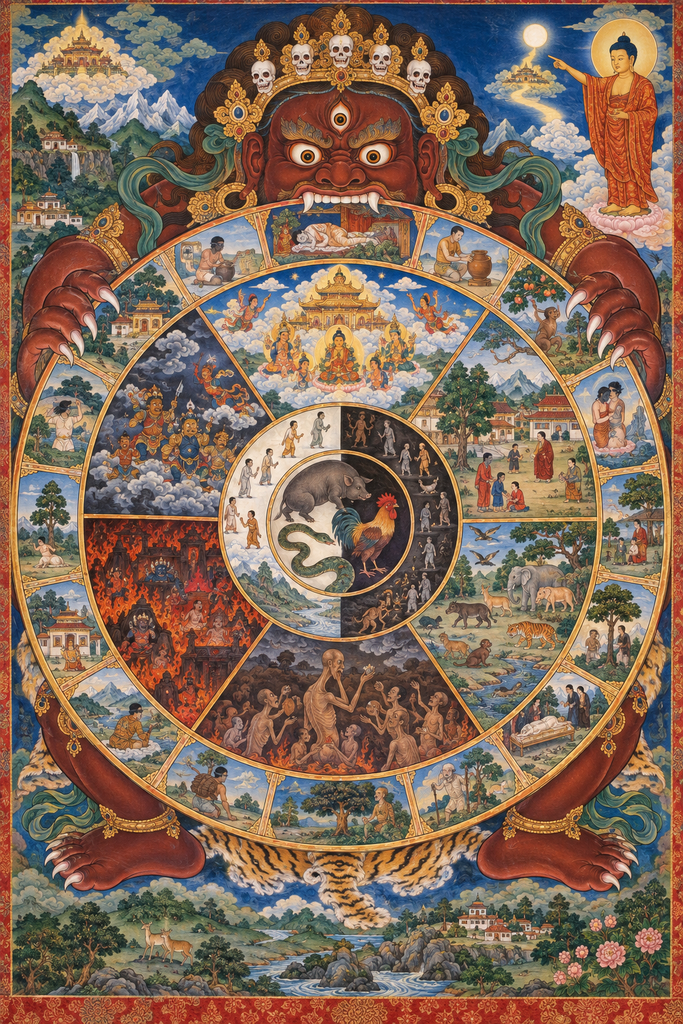
Tibetan Buddhist art makes this process visible in the Wheel of Life. At its center are a pig, a rooster, and a snake, representing ignorance, attachment, and aversion. Around them appear the six realms of samsaric existence: gods, jealous gods, human beings, animals, hungry ghosts, and hell beings.
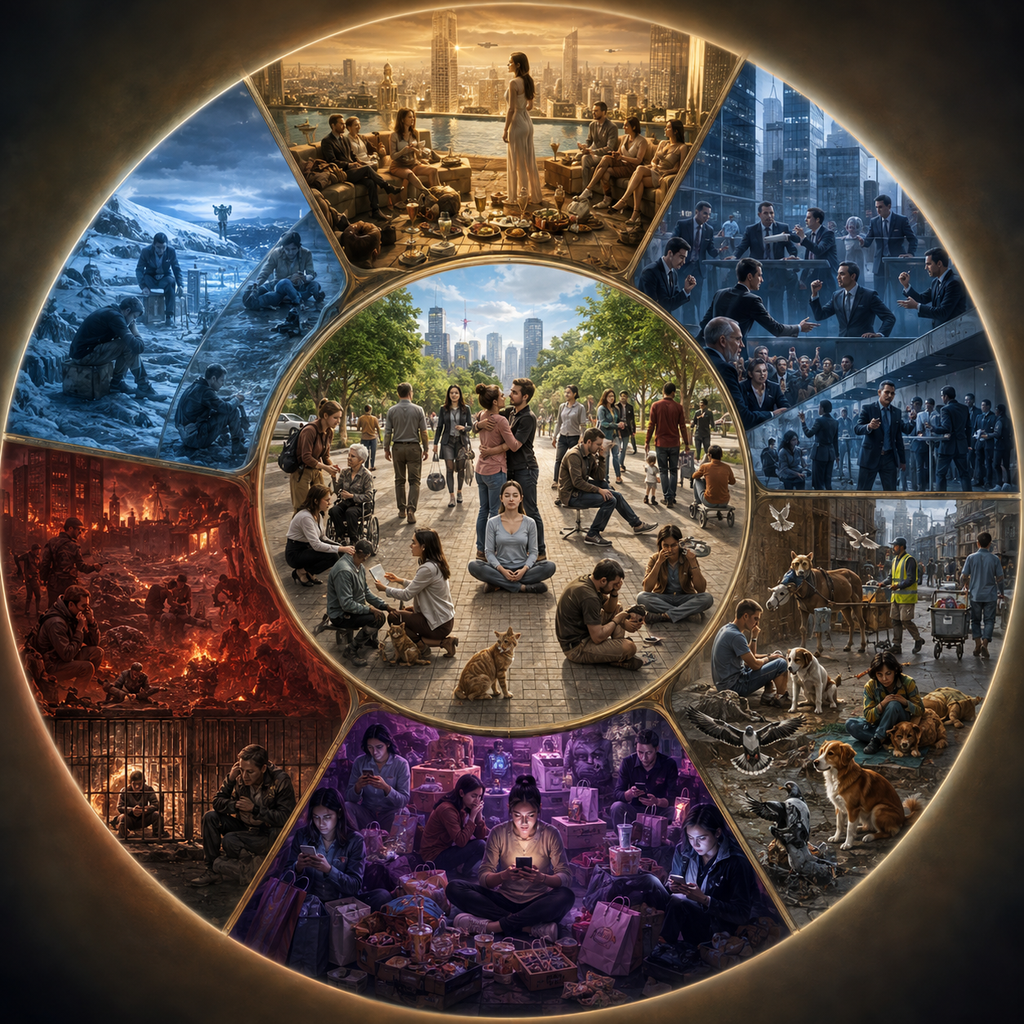
Traditionally, these are realms of rebirth. They can also help us recognize recurring psychological states. When pleasure intoxicates us and we forget it will end, we resemble beings in the god realm. When comparison and competition consume us, we enter the realm of the jealous gods. When desire becomes an unfillable hunger, we become like hungry ghosts. Rage and torment resemble a hell realm, while confusion and habitual behavior recall the animal realm.
Human life contains suffering too, but Buddhism regards it as especially precious. We possess enough dissatisfaction to seek freedom, yet enough opportunity and intelligence to practice.
Samsara is not a punishment imposed by a divine judge. It arises through causes and conditions. Our intentional actions—our karma—shape our habits, perceptions, and future experience. Karma is therefore less like fate than momentum.
That is what makes the Buddhist message hopeful. If suffering arises from causes, changing those causes can change the result. The wheel is powerful, but it is not inevitable.
Liberation from samsara is nirvana: freedom from the ignorance and compulsive grasping that keep the cycle turning. In Tibetan Buddhism, this aspiration is joined to the bodhisattva ideal—the commitment to awaken not merely for personal escape, but for the benefit of every sentient being.
Everyday life then becomes part of the path. Irritation offers an opportunity to study aversion. Desire reveals grasping. Suffering itself can become a teacher when it exposes the habits that bind us.
Each time we believe the next possession, achievement, identity, or experience will finally complete us, the wheel turns again. Each time we meet experience with wisdom, compassion, and less grasping, its hold loosens.
The image accompanying this post is a contemporary rendering of the traditional Wheel of Life. Around its outer edge appear the twelve nidānas, or links of dependent origination. They describe how ignorance and craving condition samsaric existence—and, read in reverse, how the cycle can cease.