The War on Awakening

Some are calling for a “war on woke.” Why are people so threatened by the idea? Admittedly, the term is meant to be provocative, still I can’t help feeling that parts of society harbor an underlying fear of being awake.

What is “waking up”?

Is it seeing past the firewall of self-perception or beyond the structures that govern our lives? If this were the case, then it would certainly be threatening to established structures – especially when those structures have developed to maintain a status quo. While it’s entertaining to throw blind darts toward secret cabals, as meditators we always look to our own mind and psychology.

Shadow governments aside, how are we actually controlling ourselves? What is our experience of hiding behind concepts, ideas and prejudice for safety – often to find a perceived higher ground of judgement?

Stories about awakening and seeing behind the curtain are common themes in literature and movies. From The Matrix, throughout much of science fiction, conspiracy theories and popular culture, we’re fascinated by the trope of our being held at bay by whomever we deem to be holding us. We are being held away from the truth.

Perhaps this dates back to the tree of the knowledge of good and evil in the Garden of Eden. Once Adam and Eve were forbidden to eat the forbidden fruit, a seed—an apple seed, we might say—was planted in their minds. It was only as matter of time. As these were the first people, maybe God was still working things out. But, most of us know that telling someone they can’t do some its a sure way of getting them to do it. gave not In the patriarchal telling, it is the woman who becomes both tempted and temptress, pulling the man from his resolve and toward our demise. Once Eve fell for the snake – and what do you suppose that represents? – and convinced Adam to follow,

Through Eve’s sexual awakening a crack happened in the existential frame of the garden. Allowing perhaps chaos, or maybe light.

Either way everything changed in that instant. And, of course, this is all the lady’s fault. Buddhist scripture offers a striking contrast. In Tibetan Vajrayana, transformative feminine energy is equally disruptive but this fissuring of the conceptual frame—or waking up—is seen as essential to our development of awareness and compassion. This energy is often embodied by the dakini, or “sky dancer,” a beautiful young woman whose role is to seduce people beyond their rigid ideas. Far from blaming the feminine, the tradition exalts her.

There is a wonderful story about Dilgo Khyentse Rinpoche, one of the most revered Tibetan teachers of his time. He stood over six feet tall—“two and a half Tibetans,” as my teacher put it—and in his later years often walked with his hands resting on his attendants’ shoulders.

During a very important empowerment in front of dignitaries, diplomats and students, the great man’s wife burst into the shrine room and began to berate him for some domestic injustice or other. She walked straight toward the shrine, yelling as the ceremony approached its most sacred point. I do not know what had angered her. Dilgo Khyentse simply looked to her and smiled, his face beaming with love.

Years ago, I was driving on an interstate in Maine with my then-partner when the hood of our jalopy came loose and slammed against the windshield. It happened instantly and was literally breathtaking. I managed to reach the shoulder without hitting anything. My heart pounding, I leapt out and began violently ripping the hood from the car, cutting my hands in the process, red-faced and furious.

Then I looked to my partner, a senior Vajrayana teacher and in many ways my teacher, as she stood outside the car that had nearly killed us, laughing. With the same loving gaze I imagine Dilgo Khyentse offering his wife, she said, “We handle surprises entirely differently.”

We cling to our conceptual frameworks with a tenacity that keeps us in the dark, or at least the semi-dark land of habit.

So what is the problem with waking up?

Meditation teachers describe awakening as refining the mind to see beyond constraining frames. Dilgo Khyentse Rinpoche said the only difference between the dreams of sleep and the dream of our ordinary life is duration. Most of us are dreaming most of the time, with only occasional cracks in the facade: a car accident, a breakup, a grave diagnosis.

From the perspective of our attachment to life as we know it, these events are terrible. Yet they may also offer the possibility of awakening—and for a Buddhist, awakening is everything. Even people with deep understanding and strong moral principles still have farther to go if they cannot see beyond those principles toward a truth that helps them communicate with the world as it is. Compassion is communication and communication requires us to look beyond our premises.

What, then, of the war on woke? Some see it as a campaign against chaos. Sometimes it may be. But it may also express a fear of opening the mind and heart to wisdom, to the knowledge of good and evil. Christianity and the Judeo-Christian traditions contain many beautiful, instructive, and transformative elements. Yet, one contrast is that the progenitors of the human race were warned not to look into the mechanism of their existence. Buddhism makes looking its central purpose.

This is not an argument that one tradition is right and the other wrong. It is an illustration: some social structures are designed to preserve order and control; other forces tear open the fabric so that the butterfly can leave the cocoon. The sanest view employs both. We need enough structure to feel secure and to communicate with one another. But when we grip that structure with white-knuckled fury and refuse to let anything new enter, we tighten our eyes and keep ourselves asleep.

Remaining asleep is not as easy as it sounds. We must squint, look away, and actually work not to see.

I imagine that if there were a God, they might point to reality and say, “It has been here all along. Why did you not look? Why did you not see?” Of course, the answer might be, “Because you told us not to.”

But that is another story.

Ultra-conservative movements, including those now exercising power in the government of the country where I live, maintain control by demonizing agents of change. They are agents of fear, fearful themselves and capitalizing on the fears of others. Witches, artists, transformational priestesses, shamans and those who revere nature have long been vilified or struck down for looking beyond established social, political, and religious structures.

You can control a mumbling crowd looking to the ground more than a group of people fostering the power of the earth.

Perhaps because I have attention deficit disorder, I tire quickly of the old tropes used to keep people from thinking. Unexamined stupidity seems to reproduce itself. The real struggle is not against every existing structure. It is against the structures we carry within ourselves by finding the essence of love within. Love allows us to open our eyes. Trungpa Rinpoche said, “Look, look. This is your life. How can you not look?”

To risk a cliché: love is stronger than hate. It may not feel as forceful in the moment as panic or fury, but people who traffic in hate are most likely frightened and insecure. Loving them may be a tall order. Yet refusing to be cowed by their fear—and allowing our own love to develop into empathy—is our transformational imperative.

Holding to beliefs, outrage, or righteous bias with white knuckled fury keeps us from seeing the alternatives around us. We’re using our passion to entirely miss the point.

My indignation about the gross master betas masquerading as strong leaders is understandable, but limited. It keeps me communicating with others in my garden, but not at all with those I wish to influence.

Letting go is the operative action in allowing ourselves to wake up. It’s actually harder to stay asleep. Let go and see the garden, you might say.

So, as Elvis might say, what’s so funny about waking up?

___________

Understanding Karma

Turning the Mind Toward Freedom

Karma is one of the four reminders. The others are the preciousness of human life, impermanence and death, and the unsatisfactory nature of samsara. Together, these contemplations wake us up to our situation and how we create a path to liberation or further embed ourselves in suffering.

This life gives us a rare opportunity to practice. It will not last forever. Our actions have consequences. And habitual acts caused by grasping and fixation cannot provide lasting satisfaction.

Today we’re looking at Karma. People sometimes say “karma is a bitch”. But karma is actually good news. Understanding how we create and live the dynamics of our actions shows us where change is possible. We can pray for guidance and strength, but we actually have the ability to effect change in our lives each moment.

The word “karma” means action. It refers to actions of body, speech, and mind that arise from particular motivations and lead to particular results. Karma is sometimes misunderstood as fate or punishment. When something painful happens, we say, “That must be my karma,” as if karma meant that by suffering we were proven guilty.

But karma is not a system of cosmic reward and punishment. It is a teaching about cause and effect. Certain intentions and actions tend to produce suffering while others tend to toward well-being and freedom. A challenge lies in the way many actions that produce suffering appear to be beneficial at first glance. They are wolves in sheeps lingerie, so to speak. How often do the things we want, need or feel obliged to actually further indebt us to the momentum of samsara?

The conditions of the present have been shaped by many causes, some of which are beyond our knowledge or control. Yet our response in this moment becomes a new cause and that cause will plant the seed for the next condition. We have a choice: we can blindly go along with the momentum we’re generated, or make an active, conscious choice.

Hence, Karma is not our fault, but it is our responsibility. And it is an opportunity for us to wake up and gain agency in our lives. The point is we are conditioned, but not helpless.

Let’s look at our life. Suppose someone criticizes us. Before we have time to think, the body tightens and the mind begins preparing a defense. Perhaps we interrupt, attack the other person, or withdraw into cold silence. The exchange may last only a few minutes, but something has been reinforced. We have strengthened the habit of meeting discomfort with defensiveness.

And, as actions condition the likelihood of their recurrence, the next time criticism comes, that response may arise even more quickly.

Grasping becomes action, actions become habits, and habits shape the world we experience. If we repeatedly rehearse resentment, we inhabit an increasingly resentful mind. If we practice generosity, patience, or honesty, those qualities become more available to us.

Even our thoughts have this quality. A difficult thought may arise without invitation, but what happens next matters. Do we feed it, repeat it, and build an identity around it? Or do we recognize it as a passing mental event and allow it to dissolve?

We may not be responsible for every thought that appears, but we can learn to take responsibility for what we cultivate. Working with Karma is as if we were to become gardeners of the soul. We plant seeds and experience what has been sown. And we fertilize our actions by intention. Were we awake and making a mindful decision to benefit ourselves and others? Or were we acting out of habitual blind reaction? Were we acting our of selflessness or selfishness?

Therefore, in considering karma, intention is crucial. We might give someone a gift out of genuine care, out of obligation, or because we want to control how they see us. The visible action is the same, but the imprint on the mind is different.

Before an important action, we can pause and ask, “What is moving me right now?” Is it kindness? Fear? Pride? Anger? The wish to be admired? The wish to help? We ask because seeing our motivation offers us agency.

A useful practice is to bring three questions into daily life:

  1. What is my intention?
  2. What habit will this action strengthen?
  3. Is this likely to reduce suffering or increase it?

We can ask these questions before sending a heated message, repeating gossip, making a purchase, or entering an argument. We can also ask them before a generous act, so that we consciously recognize and strengthen what is beneficial.

Karma does not concern only dramatic moral decisions. Much of our life is shaped by small, repeated actions. Do we reach for our phone whenever we feel uncomfortable? Do we speak impatiently to the people closest to us? Do we avoid responsibilities and then create explanations for why we could not fulfill them?

On the beneficial side, do we express gratitude? Do we listen without planning our response? Do we refrain from a harsh word? Do we admit when we are wrong?

And, as we’ve seen, every repetition strengthens a direction.

We become angry to protect ourselves, but the anger disturbs our minds and damages our relationships. We grasp at pleasant experiences, but our fear of losing them prevents us from resting. We defend a fixed image of ourselves, but then we must constantly protect it.

To turn away from samsara is to become less willing to live automatically inside these patterns.

This does not mean turning away from family, work, enjoyment, or ordinary life. It means turning away from the habits that keep producing suffering. Ordinary life becomes the place of practice.

Of course, we will continue to make mistakes. The teaching on karma should not lead to guilt, fear, or obsessive self-monitoring. Guilt often says, “I am bad.” Wise regret says, “That action caused harm, and I want to choose differently.”

Here is a contemplation whenever we recognize a harmful thought, action or consequence:

  • First, acknowledge honestly what happened. Second, allow genuine regret—not self-hatred, but a clear recognition of the consequences. Third, repair the harm where possible. Fourth, form a specific intention for what we will do differently.
  • This process interrupts the tendency either to deny our actions or to define ourselves permanently by them. Karma means actions have consequences, but it also means new actions can create new conditions.

A short evening review can make this teaching very concrete. At the end of the day, take five minutes.

  • Ask, “Where did I act today from generosity, patience, honesty, or compassion?” Appreciate those moments. Rejoicing in beneficial action helps strengthen it.
  • Then ask, “Where did I act from grasping, aversion, or confusion?” Look clearly, without excuses and without hostility. Choose one situation and imagine a wiser response. If repair is needed, decide how to begin it.
  • Finally, set one intention for tomorrow.
  • The other reminders support this practice. Precious human life tells us that we have the capacity to choose. Impermanence tells us not to postpone the work. The suffering of samsara shows us what happens when we continue acting unconsciously. But karma brings the teaching directly into this moment.

When a situation arises that we choose to look in to, pause for one breath. Feel what is happening in the body. Notice the motivation. Ask, “What am I about to strengthen?”

Then choose the next action as carefully as you can.

Liberation may seem vast or distant. But its direction is established very close to home: in the intentions we cultivate, the habits we interrupt, the harm we repair, and the next choice we make.

So, if Karma is a bitch, then it’s our bitch. It is our way of navigating from suffering in samsara toward liberation.


TURNING THE MIND

From Suffering to Freedom

What distinguishes the Buddhist path from more rule-based or solely academic traditions is its emphasis on direct experience. Study deepens our understanding, and guidelines provide important direction, but our immediate experience is where the teachings come alive. In the game of rock, paper, scissors, each choice defeats another and is defeated in turn. In practice, however, whatever arises can become part of the path—as long as we are present.

So, what is happening now? Where are we headed?

Sometimes, in order to move forward, we need to stop and remember.

Although Buddhism offers extensive teachings and disciplines, it also provides clear, practical frameworks for applying them. Among these are many numbered lists—simple structures designed to help us remember what matters. One of the earliest and most foundational is known as the Four Reminders, or the Four Thoughts That Turn the Mind from Samsara toward the Dharma.

They are called reminders because we are encouraged to reflect on them regularly, even daily. They point directly to the truths we tend to forget when we become absorbed in striving, distraction, and the endless demands of an acquisitive life.

As we rush from one obligation to another, we forget how precious this life is. As we worry about our failures, we forget that life is impermanent and may end at any time. When suffering arises, we blame circumstances or other people, forgetting that our actions have consequences. And we pursue possessions, status, and experiences as though they could provide lasting satisfaction, even though they often bind us more tightly to cycles of dissatisfaction.

The Four Reminders offer a kind of contemplative retraining. By returning to them, we learn to see our lives more clearly and make wiser use of the time we have.

As a foundational Buddhist teaching, the Four Reminders employ a basic distinction: between the thoughts and actions that keep us trapped in suffering and those that lead toward freedom from it.

We can blame our difficulties on any number of causes and conditions, but our own thoughts and actions are where we have the greatest power to make a change.

The Four Reminders are a blueprint for remembering what is truly important to us—and for orienting our lives toward it.

The Four Reminders That Turn the Mind to the Dharma

Precious Human Birth — This life is precious.

Right now, we have a rare opportunity to become more aware, compassionate, and free. We should not take this moment—or this life—for granted.

This reminder urges us to do something meaningful. That may begin simply: by ceasing to waste our time and learning to appreciate what we already have.

The Truth of Impermanence — Life is uncertain and will end.

Everything changes, and none of us knows how much time remains. What truly matters should not be postponed.

We waste our lives by worrying over what has passed, clinging to what we possess, or assuming that the future is already determined. Impermanence reminds us to meet this life while it is actually here.

The Law of Karma — Our actions have consequences.

What we think, say, and do shapes our experience and affects the people around us. Our choices matter.

Karma is not the reward-and-punishment system we conventionally imagine. Pain is not necessarily a punishment, nor is pleasure necessarily a reward. Grasping at either can lead to suffering.

The Sanskrit word karma means “action.” Where is our mind leading us? Where are our actions leading us? To understand the direction in which we are heading, we begin by looking at what we are thinking, saying, and doing right now.

The Endless Suffering of Samsara — Material things will never bring lasting peace.

Pleasure, success, possessions, and approval may feel good for a while, but they cannot provide permanent security. Thus, it is said, they are “like a feast before the executioner leads you to your death.”

This reminder points to the futility of grasping at—and identifying with—the shiny objects within the vicious cycle. They are like sirens calling to us with seductive logic and rational lies.

Lasting freedom comes not from arranging our circumstances perfectly, but from changing how we relate to experience.


These reminders are not meant to make us fearful or pessimistic. They invite us to wake up: to appreciate this life, accept its impermanence, take responsibility for our choices, and stop demanding lasting fulfillment from things that cannot provide it.

Remembered sincerely, they turn the mind away from confusion and toward wisdom, compassion, and liberation.

Although we are speaking of a radical change in the mind’s orientation, it is possible because we are turning away from a vicious cycle of suffering and toward the openness of freedom, which is something we innately wish for. And all we need to do to change our entire orientation is to remember.

Rather than regarding the Four Reminders as more rules to live under, we can understand them as invitations. Through gentle, daily reflection, we may come to appreciate life more completely—and to live it more fully.

Here is the translation I used daily while living in Gampo Abbey.

Joyful to have,
Such a human birth,
Difficult to find,
Free and well-favored.

But death is real,
Comes without warning.
This body
Will be a corpse.

The Six Realms of Experience – pt2

Mapping Human Experience

It is said that the Buddha, speaking to a community of priests, adepts, and teachers, was asked why he didn’t speak about the gods. His answer was purportedly a rather dismissive, “That’s not important.” This was taken to mean that speculation about the afterlife—and any preexistence we may have had—has only a slight bearing on the present moment we actually inhabit. And it was that present moment that was all-important to the Buddha’s first cycle of teaching.

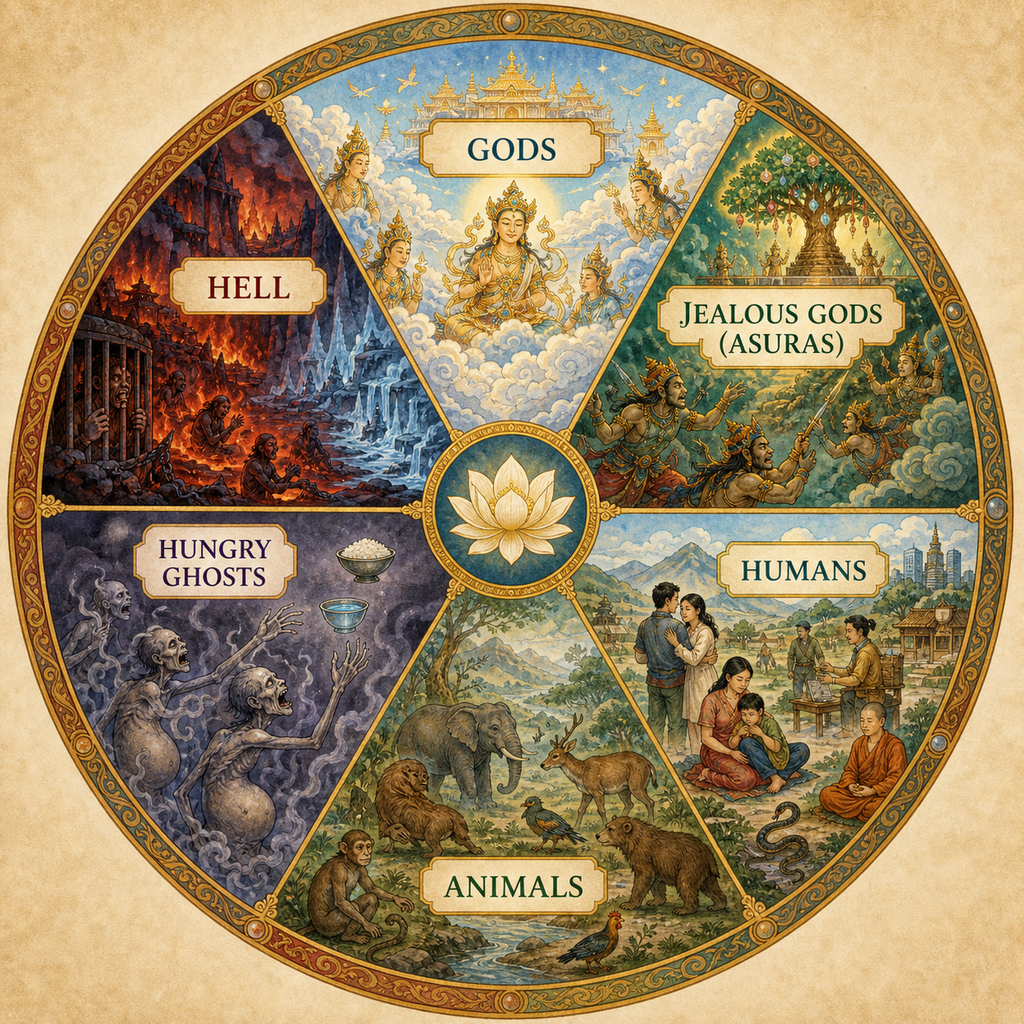
As Buddhism developed as a religion and theoretical system, it spread geographically and socially, absorbing earlier Hindu teachings and other traditions, including indigenous Himalayan understandings. These were eventually synthesized into the six realms. The six realms differ from our decidedly binary Western understanding of heaven and hell and express two important points in the Buddhist view: first, that all things are transitory and temporary; and second, that one thing always leads to another as its cause, condition, or outcome. Unlike the view that there is a solid hell to which people are consigned forever, the Buddhist view holds that nothing is permanent and that all things are interdependent. The six realms are therefore depicted as a cycle through which one’s mindstream might travel over the course of existence.

The Buddhist hell realms are as dramatic, expansive, and frightening as anything in Dante or Milton. Although Buddhist thought holds that nothing is permanent—in theory because nothing is permanent in life—an experience of a given realm is said to last for eons.

Over time, a more practical reading of these teachings began to emerge. Whether or not we accept, or even understand, their classical rendering, they are extraordinarily descriptive of human experience. For this reason, they became the structural underpinning of Buddhist psychology. By understanding the realms, we better understand contemporary experience and gain a means of becoming more aware of who we are and how we behave. This system is not intended as a fixed account of that experience, but simply as a finger pointing to the moon, helping us develop greater awareness—and hence greater mindfulness—of our daily actions.

As we mentioned last week, the optimum position is the human realm. It is said to be extraordinarily rare and precious to be born human. This points to the expansive cosmology of Buddhist thought and the possibility of sentient experience occurring in many realms and systems throughout the universe, the world, and even within our own being. Sentience is like a Russian doll: the very small exists within the large, which exists within the largest.

Much of this experience is considered dark, meaning that there is no awareness that would allow a being to develop along the Buddhist path toward greater understanding of itself and the world around it. Many of these experiences, realms, or life forms are, by our standards, quite horrific and difficult. In the classical sense, the idea is that being born human is exceedingly rare. In fact, it is said to be as rare as a one-eyed turtle surfacing through a ring randomly tossed into the ocean. Buddhist descriptions are nothing if not dramatic and fanciful.

Along with being precious, our human birth is said to be well favored if we live in circumstances in which we can practice the Dharma. That is, if we are not experiencing so much pain and fear that sitting in meditation would be pointless, or such intense hunger and suffering that we cannot focus our intention. Those of us who can sit upright on a cushion and watch our minds until we begin to understand ourselves—and hence the world around us—are considered free and well favored.

That status is said to be both rare and wonderful, and Buddhist practitioners are encouraged to remind themselves of it daily. There are four reminders: that all things are temporary; that our experience in this lifetime is free and well favored, and therefore something for which we can be grateful; that our actions have karmic consequences; and that samsaric existence inevitably involves suffering.

Karmic consequence means that what we do in our lives shapes what will come, just as our present experience has been shaped by what came before. As we discussed in relation to the realms, our current actions depend upon previous actions and will influence future ones. Life is, in part, a consequence of our actions. This bears little connection to the Western interpretation of karma as reward and punishment; it lies closer to the scientific principle that every action produces a proportionate reaction.

We will explore the four reminders and their importance to Buddhist practice more deeply at some point. For now, the point is that these Buddhist principles are intended to move the mind toward an understanding of human experience through an understanding of our personal experience.

The human realm is where we are fully present in our lives and able to accept success and failure, pleasure and pain, and the entirety of human experience without clamping down or becoming stuck in our reactions. The human realm is therefore said to be quite challenging, because we are presented with so many ways to lose our minds in the reality of the world around us. We are forever tempted by the world’s beauty to grab hold of it and keep it for ourselves, which causes great pain and suffering. And we are forever frightened of the pain and suffering that life presents.

Unlike hierarchical or binary systems, the circuitous system of the six realms—with humanity in its most favorable position—means that heaven and hell are not polar extremes but experiences we will encounter in our lives. Although it may be human nature to strive for higher experiences and turn away from lower ones, the fact is that all of these experiences will likely present themselves to us, sometimes within the course of a single day.

This post will complete our discussion next week.

The Bandits of Hope and Fear

Remembering 2 Remain Human in The 6 Realms

A Tibetan Buddhist saying warns that the bandits of hope and fear come to rob us of the present. The present being the precious moments that comprise our life. The true gift of opening this present is that it’s not only where we find our life, but it is the only place where spiritual awakening is possible.

In short, no matter how we apply ourselves, we will never awaken some day. We can only awaken now. Imagining what might occur if we keep working for it is fruitless unless we are present to experience it when it happens.

And we can only experience the present now.

Hope and fear are deeply ingrained in us. Hope can be exhilarating when it lifts our mood and makes new possibilities seem real. But hope will not get the job done. And if the desired result fails, our exhilaration can collapse into defeat. Fear constricts us from the other direction, narrowing our world and limiting our choices.

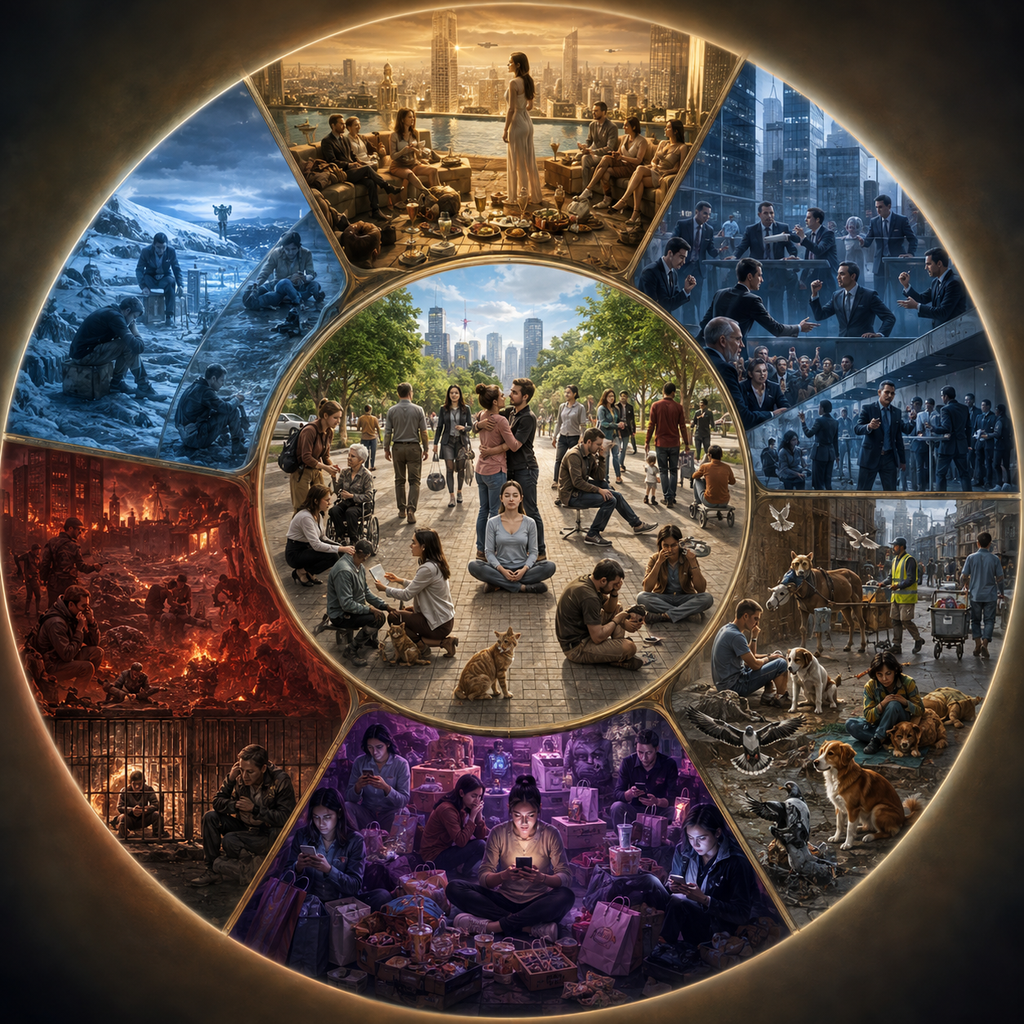
The six realms of Buddhist cosmology offer a useful map of human experience. Whether we understand them as literal worlds, social structures, or psychological states, each realm shows a different relationship to hope, fear, and the present moment.

The god realm is a state of sustained pleasure in which we feel comfortable and untouchable. Yet when the conditions supporting it disappear, the fall can be dramatic. Much like secret passages leading from the study to the kitchen in the game “Clue,” the god realm seems to have a trapdoor leading directly to hell. When a seemingly perfect life collapses, the shock can plunge us correspondingly into anger and despair.

Just below the realm of the gods—past the velvet ropes, inside the VIP world that most people on the ground level never see—is the jealous-god realm. Like the nouveaux riches standing impatiently at the velvet rope. They may get past the ropes, but they’ve got to work so hard to look and act right to get there. These poor jealous gods have so much to be grateful for, if they could only stop looking over their shoulders. Hope drives us forward while fear warns that someone else may be gaining on us.

At the center is the human realm. Interestingly, in the Buddhist system, gods are not in the ideal position because they lack the impetus for moral reflection. The human realm, with all its pain and uncertainty, is considered the ideal position for growth. Here we possess the courage to engage with others and participate fully in the world. The human experience becomes more stable as we learn to work with hope and fear. We can acknowledge fear, letting it wake us up, without allowing it to control us. We can recognize our hopes and ambitions without allowing them to fool us with insidious desert mirages. The more we long for water, the more water falsely appears.

As we get sucked in by the seduction of hope, or chained by the restriction of fear, we can notice and return. Just as we practice in meditation. Just like a fisherman employing “catch and release.” Notice our thinking just as it is. And then offer it back to the stream.

Even “higher” meditative states can be mere distraction if they keep us from encountering ourselves. Human experience involves the whole of reality: pain, sadness, and suffering, as well as joy, inspiration, and bliss. If we choose to “spiritually bypass” these, we become attached to the hope of a higher plane in fear of being tainted by an actual life. The Buddha said that life is suffering. When we bypass pain, we bypass life.

Thus, the human realm is said to be the most painful, as we are fully aware of our pain and the possibility of its cessation. And it is so easy to letour awareness slip and have hope steal us away with the promise of higher realms, or fear drag us down.

Below the human realm is the animal realm. Animals have tremendous wisdom and so much to teach us. But their existence is servile and contained in a shuttered awareness. Psychologically, it is a condition in which our options seem limited and our behavior becomes habitual. We repeat familiar patterns because they feel safer than the unknown. The animal realm can offer a kind of security, but it is the apparent safety of narrowed awareness rather than freedom. We enter it when we want nothing beyond what we already know, and when anything unfamiliar feels threatening.

Next is the hungry-ghost realm. Hungry ghosts are traditionally depicted with enormous mouths and bellies but impossibly narrow throats. They crave nourishment yet cannot receive it. We inhabit this realm whenever we cannot get enough. We may eat, smoke, shop, scroll, or surround ourselves with stimulation and still feel empty. Compulsive consumption is often an attempt to compensate for fear, loneliness, or trauma.

We are not enjoying what we consume; we are trying to fill something that consumption cannot reach.

This hunger can also take a visual form. I once walked down the street with a friend I was dating on the first warm day of the year. Everyone seemed beautiful, and my eyes kept wandering. Finally, she turned to me and said, “You look ridiculous when you do that.”

“Do what?” I asked.

“Continually give yourself away,” she replied. “It’s weak.”

She was right. I was giving my attention away repeatedly while receiving nothing but more hunger in return. Looking had become another form of hungry grasping.

Then comes the infamous hell realm, a state of such intense pain and/or depression that we cannot imagine escaping it. Hope and fear have collapsed into the black hole of anger and self-hatred. We encounter this when we are so enraged or despairing that neither light nor reason can reach us. Buddhist texts tell us the experience lasts until its karma is exhausted. Psychologically, it persists until we surrender hope and fear and accept what is.

If we do this, in time, the affliction will open just enough to afford us the space to remember our basic goodness. Once we recognize precious we are, and how precious this life is, we might see how much we are hurting ourselves. Then can begin to let go.

It’s important to note that we are talking about acceptance and release, not grasping for a hopeful mirage that, after a brief respite, will only lead back into the dark. Acceptance and release. Staying in the pain, and knowing – knowing, not hoping – that is will pass.

In this way we are remembering to stay human.

The human realm offers a middle way: remaining as open-hearted and present as we can be, remaining present between hope and fear. It is natural to imagine what we hope for, and worry about, what frightens us. But we need not let these bandits steal the present—and with it our agency and our lives.

Hope and fear usually exist outside of the present. Our practice is to not be taken away by fantasy, but to remain present and human as best we can.