
Pressure and Procrastination as (Poor) Coping Strategies:
The title “Critical Mass” refers to Hexagram 28 of the I Ching, often translated as “Great Exceeding” or “Preponderance of the Great.” Its image is a ridgepole sagging beneath too much weight: strong in the middle but weak at either end. It describes a moment when the structure of things can no longer support the pressure placed upon it.
For me, the image also suggests a breakdown in communication between heaven and earth. In traditional Chinese thought, heaven can represent vision and guiding principle, while earth represents available conditions and resources. Between them stands the human being—the element capable of responding to both.
The heart connects these poles. Through feeling, empathy, and compassion, we negotiate between what we believe we should do and what we can actually do.
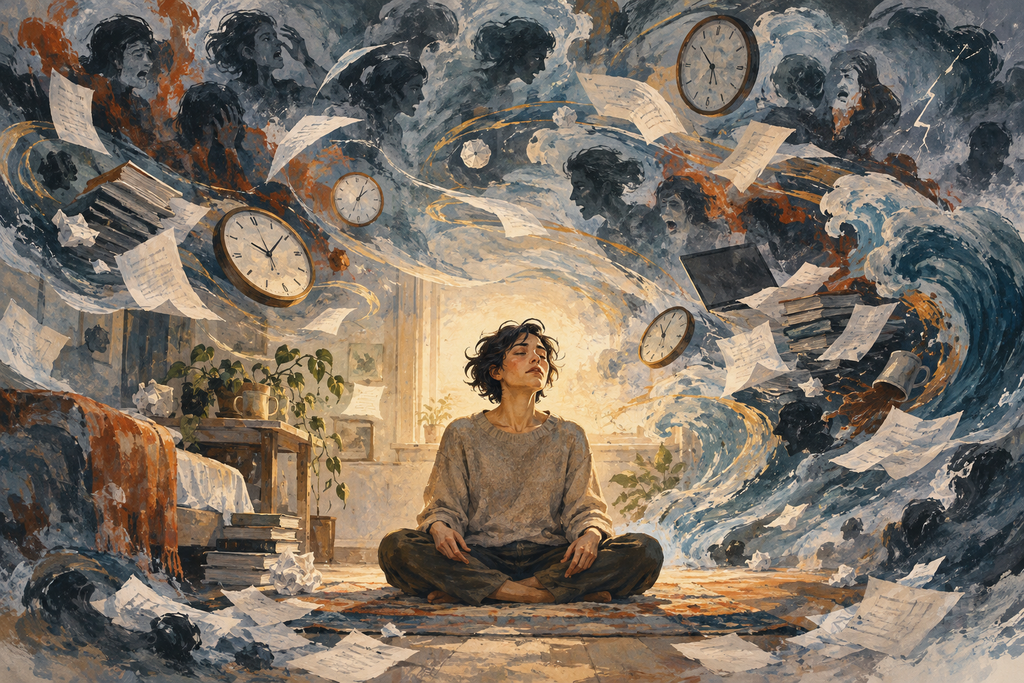
Stress and traumatic fear can interrupt that connection. The body contracts, our perspective narrows, and clear thought becomes harder to translate into action. We may know what needs to be done without knowing how to begin. For some of us, this leads to procrastination and avoidance until everything undone seems ready to collapse around us.
As pressure builds, survival instincts take over. We want to flee, freeze, or fight our way out. Yet when we reach the breaking point, some of us rise to the occasion and begin the heroic work of digging ourselves out. Urgency organizes us. What matters becomes obvious. The next step becomes unavoidable. We spend less time negotiating with ourselves and more time responding to what is needed.
It’s a shame that we sometimes need panic to reach clarity. But when the pattern repeats, instead of approaching it with acceptance and curiosity, we berate ourselves. We decide that we’re lazy, dysfunctional, delusional, or damaged. We spend time and money on remedies and programs that don’t work, reinforcing the belief that we alone—despite the millions of people who struggle this way—are broken.
Then life quiets down, and the last thing we want to do is get to work. Space provides the opposite of pressure: room to postpone, to wait until we feel ready. But when will we feel ready? When we’ve lost the weight? Found the right eye cream? Made yet another “2 Do” list?
I’ve come to realize that “2 Do” lists are where my intentions go to die—at least until they’re resurrected by the panic of a deadline.
These patterns have deep roots, but we don’t need to identify every cause before we begin working with them. The more useful question may be: Can we learn to show up before life forces us to?
That’s where meditation comes in. We sit down and discover what is actually here. We stop chasing theories and bullet points on a notepad. We stop and see what is happening now.
Maybe we discover that we don’t want to be there. We’re restless and uncomfortable. We have a million other things to do. We keep jumping off the cushion because pausing amid so much urgency feels absurd.
But perhaps that is exactly what we need: to look at the panic with love and remain present with ourselves.
This is how we begin to reconnect with the ground beneath us and recover our capacity for clear action—not by obeying the panic, but by staying with it until it settles and our view becomes clearer.
Pema Chödrön calls this “learning to stay.” It takes practice. We practice staying with whatever arises, holding it in the open arms of love rather than squeezing it in panic.
We discover the mountain-like stillness within us. The mountain remains still even when storms rage across it, even when expectations collapse. But the mountain did not acquire its strength overnight. It grew into it over time.
We can bring that practice into everyday life. Notice the reluctance and the desire to escape into something easier. Give those feelings room, and then choose one small action: open the document, write the first sentence, or make the call.
A clear starting time, a manageable commitment, or someone who knows what you intend to do may help. These things create a reason to begin before the emergency arrives.
We can also learn to distinguish between resting and avoiding, between being kind to ourselves and abandoning ourselves. Learning to stay means not abandoning our lives simply because they feel difficult. In fact, that may be when we most need to remain present for ourselves.
We don’t have to wait until everything becomes overwhelming before caring for what matters. We can begin now, with the next right thing, one step at a time.