
Mapping Human Experience
It is said that the Buddha, speaking to a community of priests, adepts, and teachers, was asked why he didn’t speak about the gods. His answer was purportedly a rather dismissive, “That’s not important.” This was taken to mean that speculation about the afterlife—and any preexistence we may have had—has only a slight bearing on the present moment we actually inhabit. And it was that present moment that was all-important to the Buddha’s first cycle of teaching.
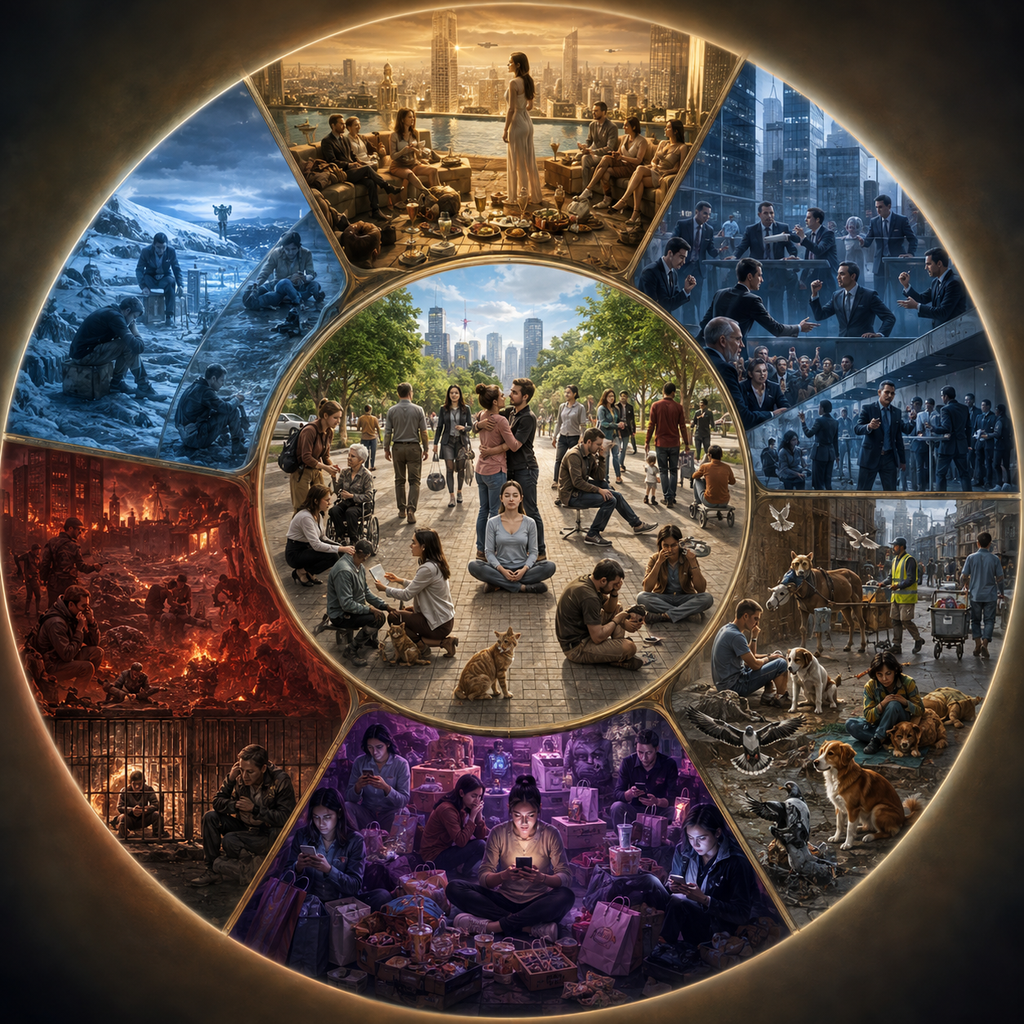
As Buddhism developed as a religion and theoretical system, it spread geographically and socially, absorbing earlier Hindu teachings and other traditions, including indigenous Himalayan understandings. These were eventually synthesized into the six realms. The six realms differ from our decidedly binary Western understanding of heaven and hell and express two important points in the Buddhist view: first, that all things are transitory and temporary; and second, that one thing always leads to another as its cause, condition, or outcome. Unlike the view that there is a solid hell to which people are consigned forever, the Buddhist view holds that nothing is permanent and that all things are interdependent. The six realms are therefore depicted as a cycle through which one’s mindstream might travel over the course of existence.
The Buddhist hell realms are as dramatic, expansive, and frightening as anything in Dante or Milton. Although Buddhist thought holds that nothing is permanent—in theory because nothing is permanent in life—an experience of a given realm is said to last for eons.
Over time, a more practical reading of these teachings began to emerge. Whether or not we accept, or even understand, their classical rendering, they are extraordinarily descriptive of human experience. For this reason, they became the structural underpinning of Buddhist psychology. By understanding the realms, we better understand contemporary experience and gain a means of becoming more aware of who we are and how we behave. This system is not intended as a fixed account of that experience, but simply as a finger pointing to the moon, helping us develop greater awareness—and hence greater mindfulness—of our daily actions.
As we mentioned last week, the optimum position is the human realm. It is said to be extraordinarily rare and precious to be born human. This points to the expansive cosmology of Buddhist thought and the possibility of sentient experience occurring in many realms and systems throughout the universe, the world, and even within our own being. Sentience is like a Russian doll: the very small exists within the large, which exists within the largest.
Much of this experience is considered dark, meaning that there is no awareness that would allow a being to develop along the Buddhist path toward greater understanding of itself and the world around it. Many of these experiences, realms, or life forms are, by our standards, quite horrific and difficult. In the classical sense, the idea is that being born human is exceedingly rare. In fact, it is said to be as rare as a one-eyed turtle surfacing through a ring randomly tossed into the ocean. Buddhist descriptions are nothing if not dramatic and fanciful.
Along with being precious, our human birth is said to be well favored if we live in circumstances in which we can practice the Dharma. That is, if we are not experiencing so much pain and fear that sitting in meditation would be pointless, or such intense hunger and suffering that we cannot focus our intention. Those of us who can sit upright on a cushion and watch our minds until we begin to understand ourselves—and hence the world around us—are considered free and well favored.
That status is said to be both rare and wonderful, and Buddhist practitioners are encouraged to remind themselves of it daily. There are four reminders: that all things are temporary; that our experience in this lifetime is free and well favored, and therefore something for which we can be grateful; that our actions have karmic consequences; and that samsaric existence inevitably involves suffering.
Karmic consequence means that what we do in our lives shapes what will come, just as our present experience has been shaped by what came before. As we discussed in relation to the realms, our current actions depend upon previous actions and will influence future ones. Life is, in part, a consequence of our actions. This bears little connection to the Western interpretation of karma as reward and punishment; it lies closer to the scientific principle that every action produces a proportionate reaction.
We will explore the four reminders and their importance to Buddhist practice more deeply at some point. For now, the point is that these Buddhist principles are intended to move the mind toward an understanding of human experience through an understanding of our personal experience.
The human realm is where we are fully present in our lives and able to accept success and failure, pleasure and pain, and the entirety of human experience without clamping down or becoming stuck in our reactions. The human realm is therefore said to be quite challenging, because we are presented with so many ways to lose our minds in the reality of the world around us. We are forever tempted by the world’s beauty to grab hold of it and keep it for ourselves, which causes great pain and suffering. And we are forever frightened of the pain and suffering that life presents.
Unlike hierarchical or binary systems, the circuitous system of the six realms—with humanity in its most favorable position—means that heaven and hell are not polar extremes but experiences we will encounter in our lives. Although it may be human nature to strive for higher experiences and turn away from lower ones, the fact is that all of these experiences will likely present themselves to us, sometimes within the course of a single day.
This post will complete our discussion next week.