DON’T START BELIEVING

Just Connect to the Feeling

The title is a play on the Journey song. Though it was a massive hit, I’m not a fan of the band, nor the sentiment of the song. Don’t stop believing? What would we do if we didn’t have to believe anything?

Beliefs are things we have to squint our eyes to see. We have to force them. Beliefs are ideas. And, tho ideas can greatly affect reality, ideas are not reality. And isn’t attaching ourselves to a belief, or a belief to ourselves, clinging? Clinging often comes at the expense of alternatives. But not always. Sometimes a belief is temporary and leads us to a next stage of development.

But sometimes they become solid and last throughout our lives. We lug them around, even when they’ve become obsolete. They have such gravity they tend to warp what we see, bending reality to their particular point of view. For instance, many people hold strong spiritual beliefs that place our nuanced reality in black and white terms. This offers a great deal of certainty. I sometimes envy that. When I feel overwhelmed, it would be comforting to find such surety. Surety in what? People fill the tabernacle with song and praise, but are any two people of those people believing the same thing?

It seems to me that each of us has an inner life informed by our particular experiences. Beyond that, there is so much we do not understand. Yet we always seem to need to know something. If we can force ourselves into believing something that many other people believe along with us, we feel comforted and strong. And if we believe our belief is right, we are often inclined to define that by believing someone else is wrong.

We may even come to believe they are a threat to our belief. In this way, we turn the whole world with its colors and dynamics into a binary contention.

When we meet the world with inquisitiveness, we open ourselves to discovery. But all too often anxiety causes us to clamp down on belief with white-knuckled tenacity. We find it reassuring to be certain about something. In doing so, we cease discovering. We believe something is true and therefore imagine we have found something. That something becomes a fixed reference point.

A path of discovery is an open system. Once we decide something is absolutely real and true, we begin to close the system.

Buddhism speaks of “non-dual” experience. This is to say that subjective experience is inseparable from, and concurrent with, external phenomena. Seeing a waterfall is an experience that happens in the mind as it happens in the space before us.

If we believe the waterfall is self-existing and imbued with magical properties, we might conclude that the sound of falling water is speaking directly to us. We might align ourselves with others who hear these magical utterances and accept them as real. As we fixate on the experience, we may fail to notice how loneliness, longing, or need is shaping our faith.

There is nothing wrong with hearing the poetry of a waterfall or experiencing it as healing. But turning that into a universal truth may be an attempt to make ourselves feel important. When Buddhists speak of emptiness, they are not denying the existence of the waterfall. They are questioning the solidity of the mental interpretations and elaborations that arise between the waterfall and our direct experience of it.

The mind is very busy. Meditation trains it to rest on one thing while allowing everything else to unfold around it. We hear the waterfall and feel healed. But when we immediately reach for our phones, searching for likes and validation, we may be turning the experience into a commodity.

It seems we often lack the confidence to let life be what it is without turning it into something larger than necessary. Chögyam Trungpa Rinpoche often said, “NBD” — no big deal. Perhaps we make events feel significant so that we can feel significant. When others feel the same thing, the experience can become euphoric. And that can feel wonderful and life-affirming.

But euphoria is not reality. It is a temporary hijacking of the senses, including our higher mental faculties. Falling in love is so powerful that it has inspired centuries of poetry and music. It can be spiritually transformative. Yet transformation, by definition, is temporary.

Relationships that endure allow the feeling of falling in love to become something else. If the bond is strong, it may evolve through many creative forms. The Beatles eventually stopped writing love songs. As disappointing as that may have been for some listeners, it gave them the freedom to explore a much broader creative landscape.

And at some point, of course, the dream was over.

What do we do then?

Shorn of belief, we’re left with ourselves. With our experience. And our life does need not be explained, apologized for, fixed, aggrandized or diminished. Perhaps that has been the point all along. Not to believe, but to simply feel. To experience life directly before rushing to explain it, own it, or turn it into certainty. It will never be certain. Yet, the waterfall still falls. The heart still breaks. Love still comes and goes. Joy still visits. Grief still teaches.

Life continues to unfold whether we understand it or not.

Maybe our task is not to arrive at certainty, but to remain open to the mystery.

OPENING TO LIFE . . .


And Living the Life We’ve Been Gifted

In some readings of Buddhist thought, there is the interpretation that desire is problematic—that people on a path to awareness shouldn’t be desirous. We shouldn’t want anything, and we most certainly shouldn’t hold onto it if we did.

I can’t think of a better way to forestall someone’s development on the Buddhist path than to turn them away from their basic human instinct.

The purpose of meditation is to wake up, or you might say, learn to pay attention to our life. If we are awake in our meditation, then we may wake up in our life. If we are awake in the world, then our senses would likewise be awake. In Buddhist practice, these senses are sometimes referred to as gates as these sense gates are our connection to the world.

I suppose, for the sake of developing calmness we could keep these gates locked. We could shutter our ears, wrap out mind in a cocoon, look to the ground, and live out life dutifully waiting for it to pass. We might move to a cave and lock ourselves away from everything. But even then there may be interesting stalagmites, stalactites, rock formations, and dark secrets that exist in this subterranean world.

As long as we have a mind, we will have no shortage of things that grab our attention. But shutting down the mind would be to shut out life. I think it’s a much braver to be willing to open our senses to the world. But how can we do this and keep our equilibrium?  With consistent meditation practice we can train our mind not to grasp at everything it sees, thus getting thrown out of balance.

Perception and desire are not the cause of suffering. Suffering happens when we grasp at things, often with a gripping panic as if holding on for dear life. This becomes problematic with our unbridled appetite to devour all the things we see, feel, taste, touch and think. Likewise when we lash out attacking all the things we disdain. And likewise ignore everything we deem beneath our attention.

Passion, aggression, and ignorance are the three seeds that are the cause and condition of the clinging and grasping that throws us off balance and causes suffering when we land on the ground.

Suffering comes from the friction between our solidification of things we desire, disdain, or deem unworthy, against a reality that is always moving and changing in continual dynamic flux.

The world is moving. It’s singing. It’s dancing. And we’re invited to join the party.

But if we see something we want, our attention will narrow and focus on the desired object. That’s problematic. When we objectify anything we turn it into something solid and fail to see it clearly. This is not reality. Believing in things that are not reality causes harm.

As much as anyone loves to be desired, it’s a rare circumstance when people want to be owned and objectified. Life wants to be seen. Life wants to be understood. Life wants us to dance, not growl at the wedding table because our partner is dancing with someone else.

By the same token, there are certain attachments that are entirely natural—for instance, parent and child, any of us and the pet that loves us, our favorite music, poetry, or favorite places on the beach or in the woods.  This is natural.

It becomes unnatural when we are grasping and clinging at objects  driven by a need to control. Our need to control comes from insecurity, from a disbelief within ourselves.

And hence we hold on to things that we deem valuable, things that we believe will increase our status if we cling to them, or manipulate them into clinging to us in some codependent dance. This is the dance of insecurity, not the open and flowing dance of life. Neurotic clinging and control is a stumbling, drunken reeling across the floor, bumping into tables and chairs, knocking things over. It is out of step with the natural flow of life. And it is precisely this dissonance—being out of step with the flow of life—that causes suffering, pain, and anxiety within us.

The more anxiety we feel, the tighter we cling. The tighter we cling, the less in the flow of life we are, and the more pain we are likely causing.

If we grip hard enough, we might believe for limited periods of time that we have gotten what we want, that we have wrestled that which we desire into our grasp and placed it in an immovable straitjacket. But it will never really please us, and it certainly won’t please the objects that we cling to and refuse to truly see.

We fall in love, and then we go into this state of blind gripping that keeps us from actually knowing and understanding the very thing we covet. We would rather keep a bird caged than experience birds in their natural beauty and majesty.

So how do we allow ourselves to feel natural attachment without falling into clinging and grasping?

Like everything, it takes training.  We sit in daily meditation practice and finbd the stability to see and release all that we perceive.  If we are willing to open our mind in meditation, and release ourselves from the grip of compounded thinking  then we are learning to open our eyes in life.

We start the process of releasing our grip when we see something that attracts us. Rather than grabbing and narrowing down on it, we could open up to it.  That opening can lead us to further perceptions.

We could see one thing we love and rather than narrowing down on it like a predator we can open top it in appreciation.  The same is true of things we hate, disdain, or fear. When we grab onto hatred, or really want something feared to leave us, we are still clinging. And we are imbuing it with much more power. By struggling with them, we are making ourselves smaller than the things we struggle against.  When we are smaller than an adversary, we are prone to lash out and grapple. But in the martial arts, for instance, students are trained to remain relaxed, open and balanced.

So the work here is to open up to that which we fear. Opening up simply means allowing ourselves to see the object clearly. We are not increasing the fear so much as opening to it and seeing what is actually there. And opening our eyes is the best defense.

Releasing our grip, lifting our gaze, and opening our senses to the world is not only brave, it’s an effective way to live.

It doesn’t mean we have to agree with anything. It doesn’t mean we have to like what we see. It simply means we are joining the party and becoming part of life.

So to me the two steps are simple:

open my eyes and remain open to what I see.

And when I inevitable collapse into grasping panic, I forgive that as basically human and seeing it as a departure from reality return to something present, such as out breath or our body.

There is nothing wrong with perceiving our world. There is nothing wrong with appreciating our world. There is nothing wrong with healthy attachments.

But there is nothing wrong with going wrong and clinging for dear life, as long as we realize it’s not reality and are willing to let go of the fantasy, and return to reality.  It’s okay to make mistakes. Notice them. Release your grip and come back to the flow of life in the present.

The art of being human is based on the practice of making mistakes and having the bravery to return to openness.

SPRING AWAKENING!

Good morning.

Chögyam Trungpa often began his talks with that salutation. Regardless of the hour, he would hold his golden fan open and proclaim “Good Morning.” Even though he sometimes began his talks very late at night, there was no irony intended. He was inviting everyone to wake up.

Good morning.

Any moment can be a fresh start when we’re awake to greet it. This very moment, right in this moment, can be an invitation to open to life.

So much of our lives are lived sleepwalking. We move through our days inside protective cocoons of habit, belief, and repetition, until we stub a toe against reality. In recovery parlance we talk about “islands of clarity” – moments of awake when we see beyond ourselves with more perspective. Unfortunately, for most pre-enlightened beings, we fall back into our brown out almost instantly. The pull of our sleep is so very strong.


People say “wake up and smell the coffee”.  But I can smell the coffee just fine from bed.

Dilgo Khyentse, Rinpoche said that the difference between the dreams we have at night and the dreams we walk through in life is duration. Dreams at night last mere seconds, despite the fact that they feel much longer. In the same way, our lives feel long and solid. In truth, our lives are startlingly brief. In fact, we are dying the moment we are born. Each moment of life ends and gives birth to the next. Yet, though we know life is short, we live as though we are permanent. We believe our pain is permanent. Our fear is permanent. Our identities are permanent.

We believe in the bubble.

We often live inside bubbles made of belief—sealed worlds of fixed assumptions about who we are, what is possible, and how long our suffering will last. Once we expand as far as we can within that enclosure, we begin to dull and atrophy.

Then something merciful happens. The bubble bursts. Fresh air rushes in. And for a moment, life feels miraculous. And what is a miracle if not the sudden rebirth from what seemed lifeless?

Yet so often we try to preserve that miracle, clutching it this is like someone opening a window for fresh air and then quickly shutting it so the freshness cannot escape. But rebirth is not a possession. It is a cycle.

Nature teaches this relentlessly: winter gives way to spring, death to life, ending to beginning. They are not opposites so much as two expressions of the same movement. I once heard a Tibetan teacher ask a room full of students, “How many of you have accepted the reality of death?” It being a Buddhist gathering a few hands went up.

Then he asked, “How many of you understand that you are dying right now?”

That question remains with me.

The death of winter is already the birth of spring. The end is already the beginning. And just as surely as every beginning comes from death, every life leads to this same destination.

In birth we leave behind of the dark and protected enclosure that first held us. In our life, living to our fullest is leaving the soft enclosure of our cocoon and learning not to squint so much at the sun. But looking ahead, we always miss what’s behind. It pulls us. What we’ve experienced feels so much more real than what we’ve yet to experience. Beginning is always a barter with something we lose.

I think of my niece on her wedding day, radiant in the doorway beside her father, suspended in that extraordinary moment before stepping forward. The future seemed so luminous that I had to go and offer my blessing.

As I drew closer, she was l cursing in that abrupt jersey way that the damned dress was cutting into her ribs.

There it was all at once: the transcendent and the corporeal, the sacred and the profane, the perfect image and the very human discomfort beneath it.

Every human birth is beautiful and painful and horrible. Because awakening is not abstract. It happens precisely here, in the tender recognition that life is moving, changing, dissolving, and renewing in every moment.

Many years ago, I found myself in a mountain community of practitioners who had been deeply shaken by the death of their teacher. There was grief everywhere, yet also an extraordinary honesty and warmth.

In that open mountain space, my own heart began to soften. Something in me that had been encased began to thaw. What I discovered was that there are two kinds of containers. One is the bubble of self-protection, which suffocates possibility. The other is the cradle of love and kindness, which allows something truer to be born.

The first imprisons. The second incubates.

Perhaps this is the real invitation of spring: not merely to admire rebirth in nature, but to allow it in ourselves. To understand that every awakening asks for a small death.

Every fresh morning is also the ending of the night. So whether the weather is good or gloomy, if we’re sad or glad, any movement of mind is precious and everything we encounter is an invitation to wake up.

Good morning.


IN THIS TOGETHER

The Power of a Self-Healing Community


A basic premise of recovery and healing is that isolation incubates pain, expanding it into suffering. On the other hand, communication, community, and connection allow space for healing.

It is true that when we are triggered, wounded, or overwhelmed, crawling into our protective space is often needed in the initial stages of healing. There is a wisdom to retreat. Sometimes the first act of sanity is to step back, become quiet, and allow the nervous system to settle.

But more quickly than we might find comfortable, isolation begins to have diminishing returns. At some point, if healing is to continue, we need to open up and connect with others, or the wound begins to fester.

Part of the reason is that the isolated mind reflects only itself. In that closed loop, it begins to feel different, separate, unique. We suffer in a way that seems as though no one else could ever understand. When we try to communicate we may feel as though no one gets us. And while this is true to some extent—no one knows the exact particulars of our experience—we are, as Maya Angelou reminds us, “more alike than we are different, my friend.”

By sharing our private pain with a trusted community, we allow ourselves to see it from a different perspective. We also give others the opportunity to empathize, often because they have lived their own version of something remarkably similar. We may begin in isolation until we are strong enough to reach out. And this makes us stronger. The stronger we become the wider our community is likely to become. At some point, our community may include those with differing opinions and points of reference. But, as the Buddha instructed the soldier, take the arrow out first. This is akin to the “putting your gas mask on first” trope.


HEALING.

When we are wounded—frightened, defeated, antagonized, or simply exhausted—it feels personal, as though we are being attacked by the world itself. It is reasonable that our immediate reaction is to strike back, assign blame, or clench our fists against the forces that seem to be victimizing us. But our reactions are not really the point. Blame blocks healing. Healing comes from feeling. Or, as is said, “feeling is healing.” Blame is something that happens in the head while feeling happens in the heart.

And it is our heart that has been wounded. The heart doesn’t have the same logic or language as does the mighty brain. The heart paints in abstract colors. We can only listen in and hold space for ourselves with loving patience until the infection abates.

The point is that we have been hurt and we need to acknowledge this. It’s not about who did what. It’s about what is. And what is, is pain.

The first step in working with hurt is to acknowledge it. Not what caused it. Not what it says about our personality or our place in the world. Not the story. Simply the hurt itself.

Can we face it directly?

Once we face the hurt, acceptance becomes the next important step. In time, we can train the mind to experience pain without immediate elaboration—psychological, social, or philosophical. We begin to see what is there without rushing to explain it.

Then acceptance opens into inquisitiveness. We become interested. Where is this pain happening? How do I feel it in the body? Is this pain being amplified into suffering or finding the space to heal?


COMMUNITY.

At some point, we may be to turn outward and speak it aloud to others. This is a brave step in the healing process. To let go our healing and begin to feel with others. This creates more space for the wound to continue to heal. There are many ways to do this: therapy, spiritual friendship, meditation communities, recovery groups, or simply trusted friends.

Sometimes just allowing someone to speak their pain exactly as it is—without fixing, changing, or judging—gives them the opportunity to hear themselves more clearly. In that simple act of being heard, something often softens. And when others respond not by solving but by speaking their own truth in a way that resonates, the person may feel less lonely, less cut off, less singled out by life.

Of course, each modality has both strengths and shadows.

Therapy can be profound, though there is always the risk of dependency on the relationship itself. Community spaces that discourage crosstalk can offer a neutral and nonjudgmental container, though at times they may feel emotionally distant. Informal conversations with loving friends can provide warmth and support, though sometimes those closest to us may only echo what we already want to hear.

To me, an ideal healing community contains something of all of these elements. Warmth. Heart connection. Support. Space. Camaraderie. A sense of being understood and a willingness to understand. One of my mentors, Michelle Killoran, introduced this to me as “the self-healing community.” We are seeking a community, built on empathy and understanding, that allows the next stage of our healing journey.

We are more alike, my friends, than we are different.

How can we help one another without adding further confusion—either through subtle judgment or through over-support of each other’s neuroses? How can we help one another see our own minds and our own path toward healing? And just as importantly, how can each of us become clear enough within ourselves to communicate what we truly need from the group, ourselves, and each other?

Sometimes we need simply to be held, physically or metaphorically. Sometimes we need clear advice and instruction. Sometimes we need silence. Sometimes we need witness. My hope is that this community can become a place where all of that is possible.

We are more alike, my friend, than we are unalike.

THE JOY OF SADNESS

HELP


______

THE FIRE HORSE

Hello everyone, and happy Lunar New Year.

I’m inviting everyone to join me this evening for a simple ceremony and conversation reflecting on the coming year. If the ancient traditions are to be believed, this year may be volatile. For many of us, life already feels that way. This may be a good time to speak with one another, to support one another, and to orient our minds toward compassion, empathy, and psychological and emotional health.

This invitation is very last minute, and I’m not assuming there will be a large attendance. But I’ve found—especially within the Dharmajunkies community—that when gatherings arise this way, the people who come are the people who need to be there. Recently, one of our members, Sherri Rosen, suggested that during this time of difficulty, change, and winter—communicating and being present for one another is especially important. I think it would be wonderful to follow that suggestion and gather tonight at 7:00 PM simply to be together: to celebrate, to find joy, and also to talk honestly about the joys and challenges we are experiencing.


THE FIRE HORSE

The Lunar New Year differs from the standard Western solar calendar in that it is organized around the moon’s cycles as they appear to us from Earth, rather than the Earth’s revolution around the sun. The solar calendar takes precedence in the West because it structures our daily lives and institutions, yet—as we see with leap years and uneven month lengths—it is not a perfect system. The lunar year, by contrast, is deeply organic. It aligns with the cycles of the moon, the tides, and many of our internal rhythms—the basic biological and ecological rhythms of life on this planet. Importantly, the lunar cycle corresponds across hemispheres, offering a shared global rhythm.

In many Asian cultures, each lunar year is associated with an animal that represents the energetic quality of that year. These animals combine with elemental forces—such as fire or water—to create a repeating cycle. Beyond being culturally symbolic (and, yes, the source of the placemats in Chinese restaurants), this system offers a way of reflecting on how energy moves through time.

Because lunar calendars differ slightly between cultures, some people celebrated yesterday and some celebrate today. This variability reflects the organic nature of human systems themselves. This year, many who observe the lunar cycle recognize it as the Year of the Fire Horse.

Traditionally, the Year of the Fire Horse is associated with intense energy, independence, volatility, and radical change. Fire combined with Horse amplifies passion, speed, and momentum. It is often seen as a year of disruption, upheaval, and breaking from tradition. It is linked to strong-willed individuals—especially women—who resist control. Historically, it has even been feared in some cultures as a time of social instability or misfortune. At the same time, it symbolizes fearless momentum, revolution, and catalytic transformation.

In short, the Year of the Fire Horse is fast, fierce, uncontrollable—and transformative.

Considering the upheavals we are already experiencing in culture, politics, and climate, this year feels like a kind of clarion call. That call may point to external circumstances, to our inner lives, or—most often—to both. While there may not be a direct causal relationship between how we feel and what is happening around us, the two are frequently in conversation.

Most people who observe the Lunar New Year live within Asian societies—some of the world’s oldest continuous cultures. These traditions often emphasize understanding natural rhythms as a way of relating wisely to present circumstances. While surface-level cultural expressions differ widely, beneath them we find shared human rhythms and basic truths.

The Buddhist traditions I study and practice center on the idea of Buddha nature—sometimes called basic or fundamental goodness. This view holds that all life, in its essence, has its own purpose and truth. While this fundamental goodness is often obscured by the conditions of social and psychological life, the teaching suggests that, at our core, we are not broken. We are already whole.

Whether or not one can prove this philosophically, living as though it were true can change how we relate to ourselves and others. Rather than assuming we are flawed and need fixing, we might experiment with the idea that we are fundamentally good and that our task is to uncover what is already there. The audacious implication of this view is that believing in our own goodness—and in the goodness of others—reduces the impulse toward violence, defensiveness, and overcompensation.

Losar, the Tibetan New Year, is traditionally a time of renewal and reconnection with this wakeful, good heart. From this perspective, working with the energy of the coming year begins with the assumption that the energy itself is not wrong or bad, even if it is challenging. If we believe in ourselves and in the basic goodness of humanity, then even volatile conditions can become workable.

Like learning to ride a horse, engaging this year’s energy calls for flexibility, clarity, and determination. We don’t dominate the horse, nor do we abandon ourselves to it. We synchronize. We adjust. We ride.

This year invites us to honor ourselves, to honor the spirit within us, and to learn how to ride that spirit toward the manifestation of goodness. It is a year to honor women. A year to honor change. A year to honor fear without being ruled by it.

By honoring fear, I mean respecting the warning signals that arise—ignoring them would be foolish. But red flags do not erase green ones. Pausing to regrip, to recoup, and to resynchronize does not mean we cannot move forward. Once we find our balance with this volatile but powerful energy, we may be able to let ourselves move with it—clearly, compassionately, and with discernment.

BETWEEN THE BOXES

PART 1 – The Comforts of Limitation

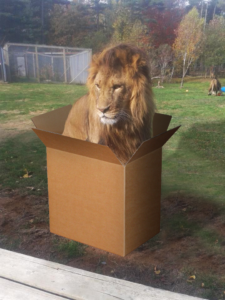
I’ll admit a small secret: I watch cat videos. I particularly love cats in boxes, especially big cats. My favorite is a tiger fighting its way into a box far too small for its body. It squeezes, contorts, until it bursts the cardboard apart—and then lies there, content, half inside a ruined container that clearly offers no real protection. The perfect caption read: “He is a cat, after all.”

That image sent me down a cat rabbit hole. Large, ferocious animals squeezing boxes that could not possibly hold them, yet they somehow get inside and find peace. What became obvious is that support and safety was never structural. It was pure feeling. Even when the box fails, the animal still experiences safety in the feeling of enclosure.


Anyone who has lived with cats knows that cats find the smallest, darkest hidey-holes everywhere in the house. We shake the food bag, jingle the cat bell, call their name—only to discover them calmly folded into a space we didn’t know existed. Sometimes just glowing eyes in the darkness. This is ancient mammalian behavior: nesting, concealment, protection.

Humans are mammals too, but with a difference. We’ve developed cognitive reasoning that sometimes overrides instinct—and sometimes merely disguises it. Our protective urge is still alive, but instead of crawling into physical boxes, we build psychological ones. This is the humamamalian quandary. The predator and the prey both live inside us, and they both want shelter.

Serial killers are often described as animals or monsters, yet to their perspective many describe killing as euphoric, making them feel godlike. My ethical framework refuses to accept this as anything other than a catastrophic illusion—but the illusion itself is revealing. The experience of being “beyond the box” can feel like absolute freedom. The difference is crucial. The serial killer’s god-experience is ego at its apex: “I am at the center.” Awakening, by contrast, is the collapse of the center altogether.

The serial killer has a solid center and is a only a god only from the point of view of the mouse they feel themselves to be. Sometimes the box bears no resemblance to our reality.

Recovery programs talk about “rational lies”: the mind constructing stories to justify acting out. When we believe these lies, we fail to see the box that enslaves us. We hide inside frames that feel like full states of being but are actually partial. That limitation is the price we pay for comfort.

Humammalian boxes have evolved to be efficient in a modern society with its multifarious information streams. We don’t carry crates, we switch identities. The phone rings and it’s our mother—suddenly we are someone smaller, older patterns activated. We arrive at work and assume another form entirely, a professional self designed to manage stress, competition, evaluation. Each box offers a perspective and a presentation. We become the person of the box we’re in.

Like cats, we often enter these boxes even when no immediate threat exists. The mere sight of the box is enough. From inside, we forget the box and simply experience the world as “safe enough.” Sometimes we scan the environment. Sometimes we fall asleep.

The problem is not that boxes exist. They are adaptive. They can even be brilliant. The problem is that they are fragile and temporary, and we forget that. No matter how ferocious we feel inside a box, it will eventually fail. Like my cat Roger hiding in an empty suitcase to avoid the vet, all the box does is delay the inevitable. Roger still got his shot. At the end of his life, he hid under the bed, refusing comfort, choosing his own final enclosure. His last moments were on his terms, in his own way, in his own box.

We do this too. Especially when we’re afraid.


PART 2 – The Space Between Boxes

I’ve served as a hospice caregiver, and I’ve watched people approach death by crawling into familiar patterns. An old man who wanted a drink before he went. A woman who smoked until the very end. We retreat into behaviors that once soothed us, even when they no longer protect us. Sometimes especially then.

Alternately, I’ve seen those accomplished in meditation who met their deaths as a new beginning, or a next stage.  They have experienced their own ego deaths any times – each time they stepped from their box. From outside the box, they could see impermanence, they understood the box game and knowing there was nothing to hold on to, when the time came they were in acceptance.
But, for most of us, clinging to the frail and changing boxes we think are “me”, we are afraid of death as it will tear us from everything we are attached to. For this reason, we construct boxes everywhere throughout our life. Over time, these boxes harden. What once was adaptive becomes restrictive. Sadly, we begin to live beneath the bed long before we die.

In relationships, we say things like “don’t play games with me,” yet games are simply boxes interacting with other boxes. To see yourself manipulating another person for love—causing pain in order to secure pleasure—is fascinating – when we see it from beyond the box.  But if someone points out our manipulation, we might jump back in and defend the box. Threatened boxes become rigid. Our available responses narrow.

At any given moment, we are the box we’re in. And yet each box has an edge. Between boxes there is space. That space may feel an uncomfortable contrast to the supposed safety of a box. So we hop from identity to identity like the floor is lava: worker, rebel, lover, child, controller, pleaser. The space between feels like annalization.

Meditation is learning to tolerate that fall.

Contrary to fantasy, meditation is not about finding a better box called “a clear mind.” That, too, is a trap. Although a clear mind exists and is considered a mark of meditation training clarity appears, and will disappear. Cloudy mind replaces it. without warning.  Thinking mind. Dozy mind. The movement of mind is natural unless we freeze it. Turning any of these into an identity is a fool’s game. Literally, we are fooling ourselves into believing nothing just because we’ve frozen an idea in place.

The only box we need in meditation is the body. Sitting. Breathing. Not because the breath is sacred, but because it is present. Each time the past arises, we notice it, feel it, and return. Each time the future tugs at us with anxiety, we notice and return. Not to suppress—but to release the grip of limitation.

One of the sneakiest boxes is the one that says, “I am meditating.” It rejects experience in the name of progress. But awakening is not refinement; it is spaciousness. The difference between a god-experience and awakening is simple: one puts me at the center, the other removes the center entirely.

Animals reset. Humans accumulate. We carry neurological echoes of fear long after the threat has passed. Over time, the boxes we retreat into become fewer and more solid. Eventually, there is a final box waiting. But moment to moment, we are reborn into boxes constantly. Each unnoticed transition is another quiet imprisonment.

Buddhist teaching suggests that death removes the box entirely, and rebirth is shaped by the boxes we inhabited. Whether or not one accepts that cosmology, it is undeniably true psychologically. We are continuously rehearsing our confinement.

Liberation does not require destroying boxes. It requires seeing them. Feeling the discomfort of the space between them. Trusting that openness will not kill us—though it may unseat us.

The tiger rests because it feels safe enough to see the world clearly. Not because the box is strong, but because the animal is at ease. Practice is learning that same ease without needing the boxes.

That is real strength. Resting in the space between the boxes we can see the boxes as an ever morphing game. Like kids playing fort, we believe the game, yet know its not real life.

Can we rest in the space outside our boxes without being locked into them?

A POLITICS OF SOUL

Believing, Really Believing, In Basic Goodness

Juneteenth is no longer a national holiday, just as the celebration of Doctor Martin Luther King is no longer a national holiday. The shameful history of slavery, the Reconstruction era, and Jim Crow are all being removed from textbook history. A powerful white right-wing coalition has risen, seemingly under our noses, to a prominence that allows them to affect great change in our nation.

How did this happen? Through the basic sleight of hand of the shell game, one of the oldest betting games we know. Three cups: you place the pea or seed or pebble under one, then move the cups quickly, giving the impression that you are revealing the right one. People bet, and then they pick a cup. All physical illusion — or the ledger domain, as it’s called — is based on this bait-and-switch idea. The mind goes in one direction while reality is hidden, perhaps to be revealed later.

Like a virus that lies dormant until circumstances allow it to ripen and infect, our country has changed into something many of us fail to recognize. One political bait-and-switch is to demonize someone or something, diverting attention while corruption allows wealth to accumulate behind the scenes. Recently, this has worked in two directions, which while pernicious is working brilliantly.

You blame immigrants, left-wing politics, protesters, and critics as the problem, amassing popular power by portraying deviance. But “draining the swamp” begs the question: who’s swamped, and what swamp? Yet people get excited to support cleansing — ethnically, socially, politically. Great change is coming, and if you follow us, you’ll be on the right side. Life becomes binary: you are either marching along or in the way.

The reverse bait-and-switch is when the resistance is allowed a misleading point to direct their ire. We might call the leader demented or crazy. We might denigrate the leader and their followers with virulent accusations. But this is a false pebble under the cup. We are still looking the wrong way. Who benefits while we demonize the leader? Who benefits while we demonize the scapegoat?

To find the right cup, ask: who benefits? Admit the takeover of society has happened. Kudos to the bad guys. Get over it. But who is gathering power that moves the country away from history, popular considerations, and compassion. Who is  turning us toward the mercenary transactions for a few?

I long for reporting that moves from denigration or blind support to actual facts. What is happening? Who benefits?

Let’s break it down. When a government loses touch with the people it purports to serve, it becomes more powerful than the people’s will and spirit. It benefits a narrow spectrum of supporters. Power is amassed to perpetuate their agenda. However, rather than dwell on horror, aggression and hyperbole we could hold to the spirit of humanity that is our birthright. We could recognize and empower our own basic goodness, continue to show up, and create a politics of soul — a doctrine of goodness and a spirit of nonviolent resistance.

In honor of Doctor King, who encouraged followers to act without violence because violence played into the scenario the power structure wants. They demonize resistance to see it as harmful and worthy of extraction. But those who’ve bartered their souls to gain power over the world are well versed in aggression and violence. So, a resistant alternative would have to find the power of goodness. But failure to act in times of change is supporting the problem. Yet, acting out of aggression only plays into the game. How can we move toward our heart, spirit, and higher mind in strength and fortitude.

Buddhists teach that each of us has Buddha nature, an enlightened spirit in our hearts and minds. Many harken back to the Buddha’s fundamental teachings: there is no independent solid self or spirit. Yet his later teachings introduced people to their indomitable essential nature —Buddha Nature, a fundamental goodness that is realized when we step beyond protecting, and renounce cherishing the self. Instead of adding to cruelty by advancing egoic ideals, can we find a soulful rendering of feelings and emotions that ignite the spirit? While we cannot absolve the world of hatred and evil, we can reinforce our own goodness and strength and allow that to inspire the world around us.

We could choose a politics of soul: doctrine of caring and kindness, a proclamation of the indomitable spirit of love and compassion. This does not mean hugging mask-clad aggressors or hoping for the best while everything collapses. It means building strength around our belief in goodness and keeping it intact at all cost.

At all cost. Whether or not this effects current turmoil, our spirit will eventually guide the greater humanity away from vicious self-interest. This may not happen as quickly as our attention-deficit culture desires, but compassion and the manifestation of goodness are developed in the long game.

The evening before his assassination Doctor King looked out into a darkened crowd and said: “I’ve been to the mountaintop. I’ve seen the Promised Land. I may not get there with you, but I want you to know tonight, that we, as a people, will get to the Promised Land.” He was killed the next day. Yet his spirit lives on. As does the spirit of those who endeavored to bring peace, kindness, equality, and liberation, despite attempts to kill it.

Dr King’s words are remembered long after we’ve forgotten J. Edgar Hoover. John Lennon will be remembered longer than Richard Nixon because, despite his faults, his dream of love and equality speaks to our Human Spirit. Gandhi presented the possibility of liberation that inspires us to this day.  We remember a love that lasts forever, because love is forever.  Love is quiet within the shouting but is ultimately stronger than aggression that momentarily seems powerful.

Please, do not fall for the sleight of hand of momentary power. Take a seat in your good heart and follow your true nature. Your awake nature. I stand for a politics of soul. I stand for a government of kindness. I stand for a world where compassion has a chance.


CONNECTING TO ORDINARY MAGIC

The Ordinary Magic of Synaptic Receptivity and Connection.

As I walk down the street, or through a garden path, as I drive to the store or wander through the park, I become lost in my head, waging battles no one can see. This self obsession creates a moat between me and the life all around me. As I work out the details of my goals, the small and ordinary things of my life are passed by unseen. As though the birds and flowers and trees are less important than I am.

Children have a natural inquisitiveness. They are one in the joy of learning to learn, when everything is a discovery; the unbridled joy of discovering their own feet. When did we forget to be amazed by our own feet? When did we get so mentally complex that we forgot to be amazed at all?  When did we become so self-important that the very ordinary things of life became inconsequential? With meditation practice, we can reclaim this synaptic receptivity—the openness and willingness to connect deeply with the world around us. This is the ordinary magic of connection, allowing us to notice the moments that connect us to life, as it happens, in real time, all around us.

We usually cloud our connections with an overlay of bias, judgement, misapprehension. This misapprehension stems from the mind referring to itself in a limited loop, rather than connecting out to the life that is there. The mind wants what it wants, and so it limits information gathering to only that which supports its thesis. Instead of an open and childlike wisdom gathering, many adult minds are limited and dull. With regard to healthy brains, this dullness is a choice.


Isolation, Habit, and Self-Limiting Patterns keep us locked in cycles of ignorance.

Albert Einstein’s brain was ordinary in size and structure, but it had a profound synaptic receptivity—an openness to learn, notice, and connect. During his lifetime, Einstein’s ordinary mind had developed an extraordinary amount of neural connections. Is genius was making connections others missed. His mind had developed a willingness to learn.  We often lose this willingness. We replace connection with isolation and curiosity with self-limiting beliefs, compulsions, and habits. We look for answers we believe we already know, filtering reality through prejudice and bias. But the remedy is right in front of us. Literally. Here in the unspecial ordinary moments of life. By training the mind to notice even the inconsequential things, we are connecting to life itself, as it is. The mind loves connection. It learns and accumulates knowledge, but it is the ability to connect to new things, new ideas, new moments that physically develops its structure. This keeps it young, regardless of chronology.

A fundamental tenet of recovery from substance addiction is connection versus isolation. Isolation breeds addictive behavior, which further isolates us. This applies to all of us, regardless of substance use.  Attachment to habitual thinking and compulsive behaviors closes the mind’s receptivity. When we over-stimulate certain neural pathways through repetitive behavior, the options around those pathways begin to atrophy. Our world becomes narrow, centered on hunger, fear, and the constant search for comfort. The trajectory of this mind’s development is toward dullness and depression. Chogyam Trungpa referred to this trajectory as heading toward the “setting sun” as opposed to the rising sun of awakening.

This is neurosis: isolation that absorbs our attention and keeps us from noticing reality; birds building nests, clouds moving across the sky, or squirrels in frantic mating dances. We are drawn into fantasies, believing self-limiting stories: that enlightenment is beyond us and that the beauty of the world is unavailable until we sort the papers on our desk. A setting sun mind remains frightened, hungry, and disconnected.


Training Synaptic Receptivity Through Humble Openness 

Recovery from isolation is possible. It has been proven that an act of surrender, originating in desperation and defeat, can grow into ongoing acts of opening. This can be to actively thwart ego’s acquisitiveness and developing its inquisitiveness.  Instead of grabbing onto fantasies, we turn our mind to what’s here. Magic happens in the small ordinary places we are often too self-important to notice. As meditators, we employ the repetitive, simple behaviors to frustrate ego and retrain the mind to be here with what is; the breath, the body, the moment.  We are turning the mind to be inquisitive about life beyond the cushion. By directing our minds to see life as it is, we are positioned to see what we are becoming. We are facing the rising sun of possibility.  We train ourselves to be open, perceiving without bias, as if we were a pure lens, opening to the sacredness of ordinary moments.

In Meditation, each time we see ourselves caught in fantasy, we are strengthening our capacity to recognize what the mind is doing. Without judgment, we simply notice and return to the present. This choice to return builds neural pathways for connection and wakefulness. Recognition and returning render intentionality and agency. Realizations come and go, but our life is all around us, offering countless moments to build connectivity. Coming back to the present—even to the simple presence of the breath, our body, or our feet on the ground—builds the openness needed to experience the grand possibilities of mind.

To develop synaptic receptivity, we need connection. Connection to the breath, to the moment, to the ordinary magic of life around us. We learn to see the world, like Einstein did, as something to be part of, not to grab or conquer. When we have the humility to open to each moment, as it is, we discover that the beauty of the world in every step.

The ordinary becomes the gateway to discovery. This is Magic.